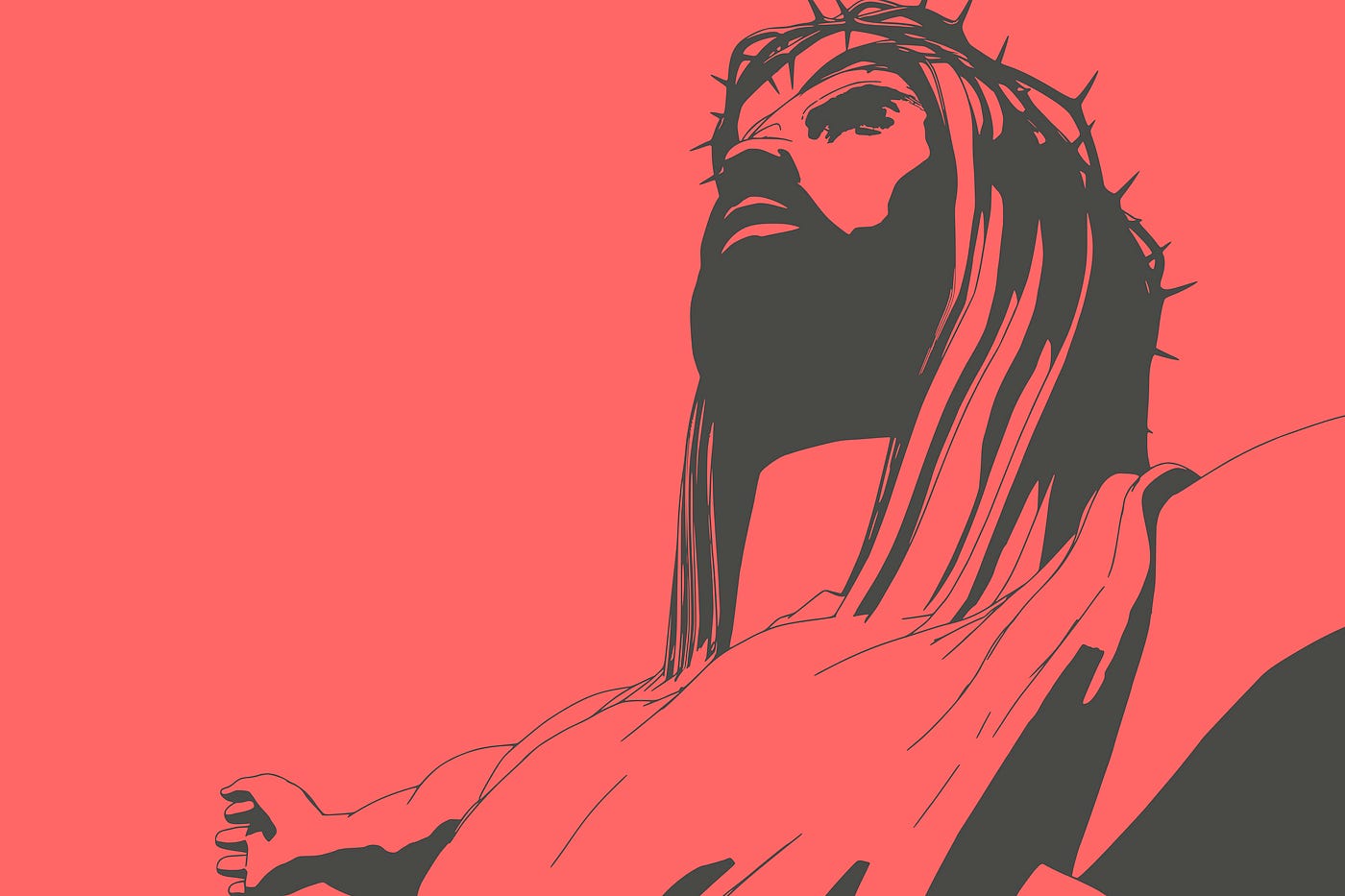
The Moment My Eyes Were Opened to the Wonders of Religious Art
How a brief delay in London introduced me to the quiet majesty of the Wilton Diptych.
The Moment My Eyes Were Opened to the Wonders of Religious Art
How a brief delay in London introduced me to the quiet majesty of the Wilton Diptych.
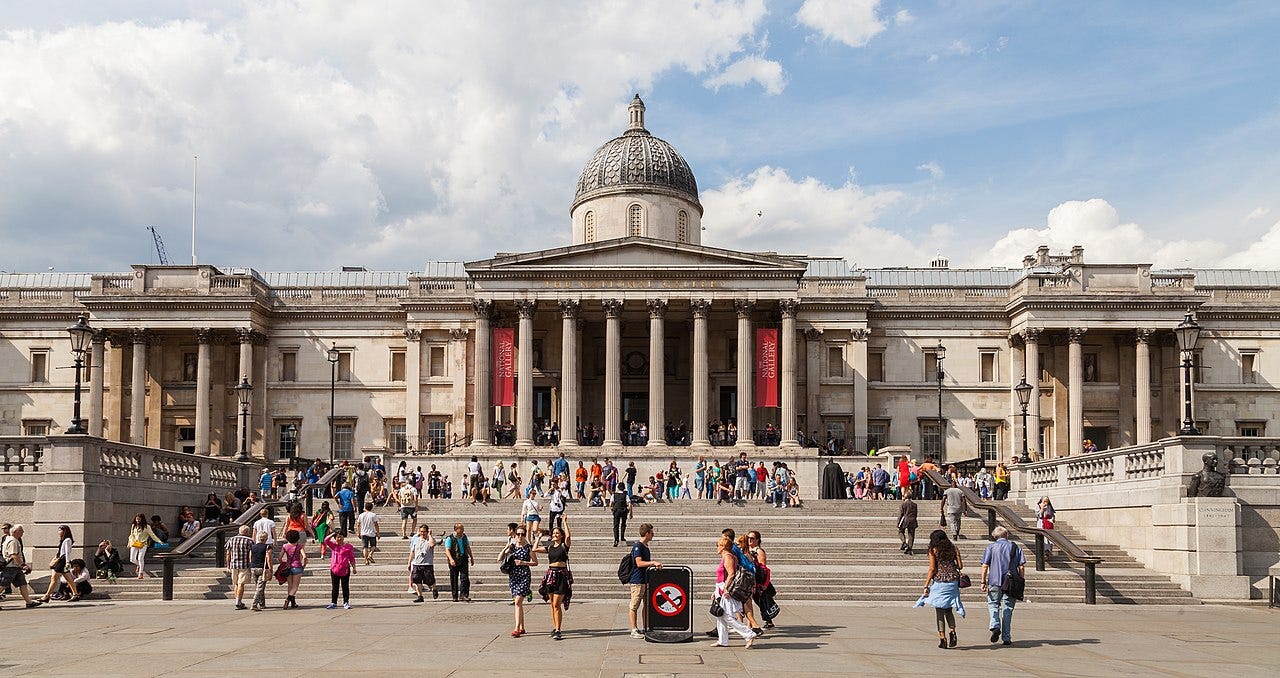
The National Gallery, Londin: CC BY-SA 4.0
I didn’t set out to have a life-changing encounter in 1995. I was simply trying to kill two hours in London after being forcibly ejected from my hotel following a church conference.
I worked as a Youth Adviser in my Diocese at the time, a role combined with a small parish on the outskirts of the city, which was deemed too small to support a full-time priest.
Periodically, I’d be required to attend conferences or seminars to “represent the diocese”, and on this particular occasion, I was invited to a meeting at no less a place than Lambeth Palace, the official home of the Archbishop of Canterbury in London.
Lest anyone think I was important enough to justify a personal invitation, I should add that there were a couple of hundred people there!
I went to the gathering in the afternoon, chatted with the Archbishop for about five seconds, enjoyed some hospitality at the Church of England’s expense, and, because there were overnight works on the train network, had to stay overnight in a hotel (at the Church of England’s expense, of course!)
Perhaps because I was slightly embarrassed at blowing the Church’s shrinking funds, I was keen to book onto the cheapest train back “up North” on the following day, which meant leaving London’s Kings Cross in the early afternoon.
This left me with a couple of hours to fill before my early afternoon departure.
What to do in London for a couple of hours that didn’t involve a huge expense and, as a bonus, would have a cloakroom where I could leave my overnight bag?
And so this is how I found myself making my first visit to the National Gallery in Trafalgar Square…
Exploring a National treasure
The National Gallery building on Trafalgar Square opened in 1838, designed by William Wilkins on the site of the former King’s Mews.
As the collection grew, the cramped interior underwent massive expansions, including grand 1870s domed rooms. In 1991, following a fierce architectural debate sparked by royal criticism (the now King Charles labelled it “a monstrous carbuncle”) of a modernist proposal, the Postmodern Sainsbury Wing opened, seamlessly blending contemporary design with Wilkins’s original classical style.
The National Gallery houses more than 2,400 paintings. While that might sound like a relatively small number compared to massive museums like the Louvre or the Hermitage (which hold hundreds of thousands of objects), the National Gallery’s collection is unique because it focuses exclusively on European paintings from the mid-13th century to 1900.
Because of this specific focus, almost the entire collection consists of world-class masterpieces — nearly all of which are kept on permanent public display.
When the scales fell from my eyes
It’s fair to say that, until this point, I had very rarely, if ever, stepped inside an art gallery — and almost certainly not since I left school.
I wasn’t opposed to the idea; I just never considered it!
But within moments of stumbling in off the street (the National Gallery is famously free to enter), dropping off my bag in the cloakroom, and wandering randomly into the galleries, I was completely overwhelmed…
I think the first thing that struck me was the sheer scale of many of the paintings.
I think I had imagined that most artworks would be small and dainty. And some of them are, to be fair! The Mona Lisa is smaller than one imagines, for example…
But I was confronted with huge paintings, many of them featuring near life-sized figures rendered in astonishing detail.
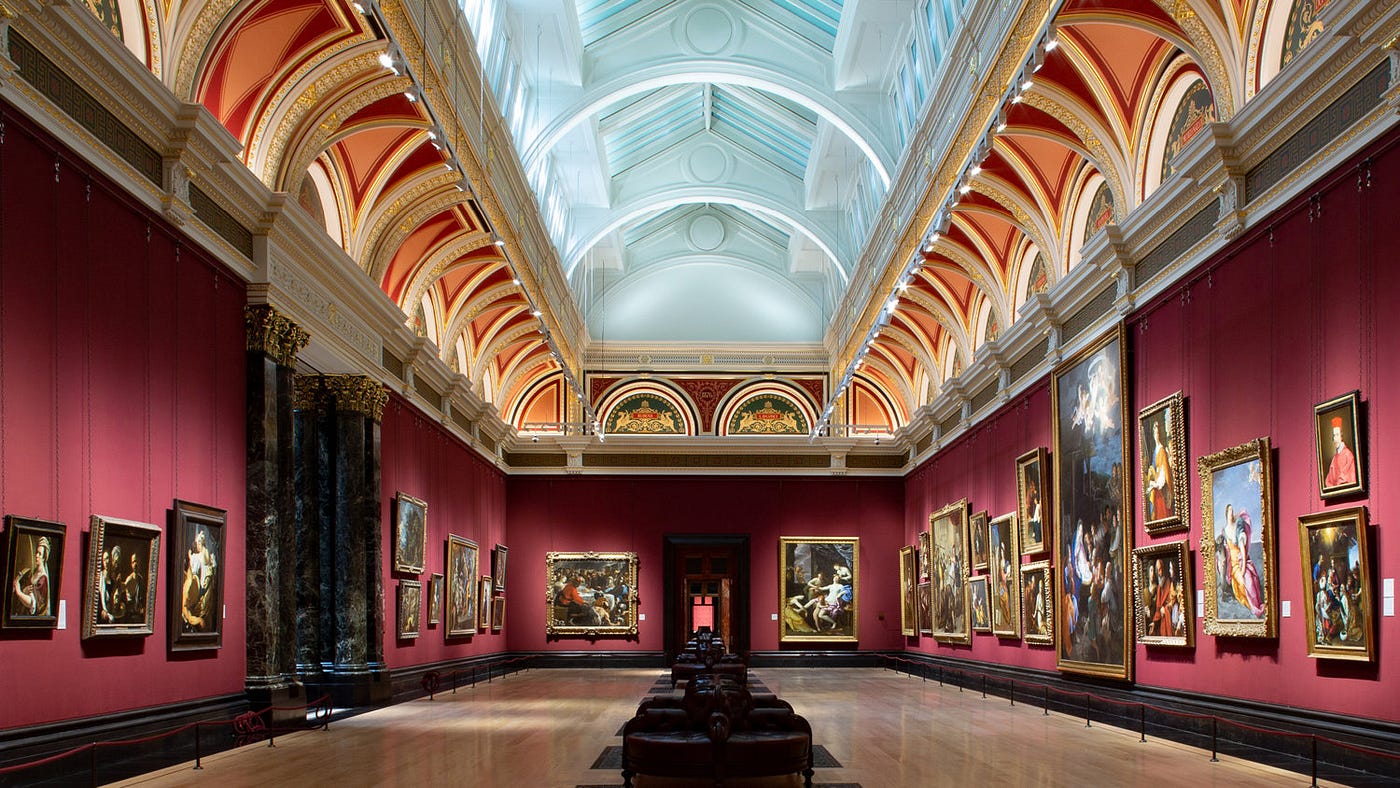
The National Gallery, Londin: CC BY-SA 4.0
I have since learned that feeling overwhelmed by the physical presence of the art is a very common reaction, especially because many of these works were never meant to be viewed in a standard room. They were commissioned for grand cathedrals or vast palace halls. When you are standing directly in front of them, their actual dimensions can be staggering.
The other thing that immediately struck me was the propensity of religious — specifically Christian — art. If you walk through the Sainsbury Wing or the main Italian and Northern European rooms, it can feel like almost every single canvas features a Madonna and Child, a crucifixion, or a saintly martyrdom.
There is a very direct historical reason for this: for the first few centuries of Western art history, the Church was the primary employer. Before the rise of a wealthy merchant class, artists depended almost entirely on religious institutions for commissions.
Because the vast majority of the population could not read, the Church used visual art to tell stories, teach theology, and inspire devotion.
I was bowled over, and even though the incident I recount is more than three decades ago, I can remember its effect upon me clearly.
A love of religious art
Since then, I’ve continued to develop my interest in religious art through visiting galleries, reading books and consuming relevant online content. I’ve also used this burgeoning knowledge in sermons, bible studies, Lent courses and so on.
I’ve written a smattering of posts on Medium that look at pieces of religious art, and I want to bring this insight and enthusiasm to a series of posts for my favourite Medium publication, Backyard Church.
Now, before I get started, I want to make one proviso: I am NOT an expert or an educated art critic. But I know what I like! I write as an enthusiastic amateur, blending theology and spirituality (which I AM an expert in 😊) with my understanding of religious art.
So, with that out of the way, let’s get started…
One of the oldest paintings in the National Gallery
If you want to view the pieces in the National Gallery in chronological order, you’ll want to head to the Sainsbury Wing, where you should start with Gallery 51.
Just off Gallery 51 is a small, dimly lit room that houses The Wilton Diptych.
It’s not quite the oldest painting in the entire gallery, but it’s one of the oldest surviving English medieval panel paintings, and the finest surviving portrait of King Richard II. Painted in 1395, it is still housed in its original frame and hinges, which is why it is kept in a glass case with carefully controlled lighting.
The diptych is also quite small in person (about 53 cm high), which often surprises visitors expecting a large altarpiece. There are plenty of those elsewhere, believe me.
Oh, I should also explain what a “diptych” is. A diptych is composed of two panels joined together with hinges so they can be opened and closed like a book. In the Middle Ages, diptychs were often used for private devotion. A noble, king, or wealthy patron could carry one while travelling, open it for prayer, and close it again to protect the painted surfaces.
So when you stand in Room 51A and look at the Wilton Diptych, you’re seeing a portable medieval devotional object that literally folds shut like a book — one reason it has survived so remarkably well for over 600 years.
By the way, for the sake of completion, it’s called The Wilton Diptych because it was kept for centuries at Wilton House, the country seat of the Earls of Pembroke in Wiltshire.
And here it is…
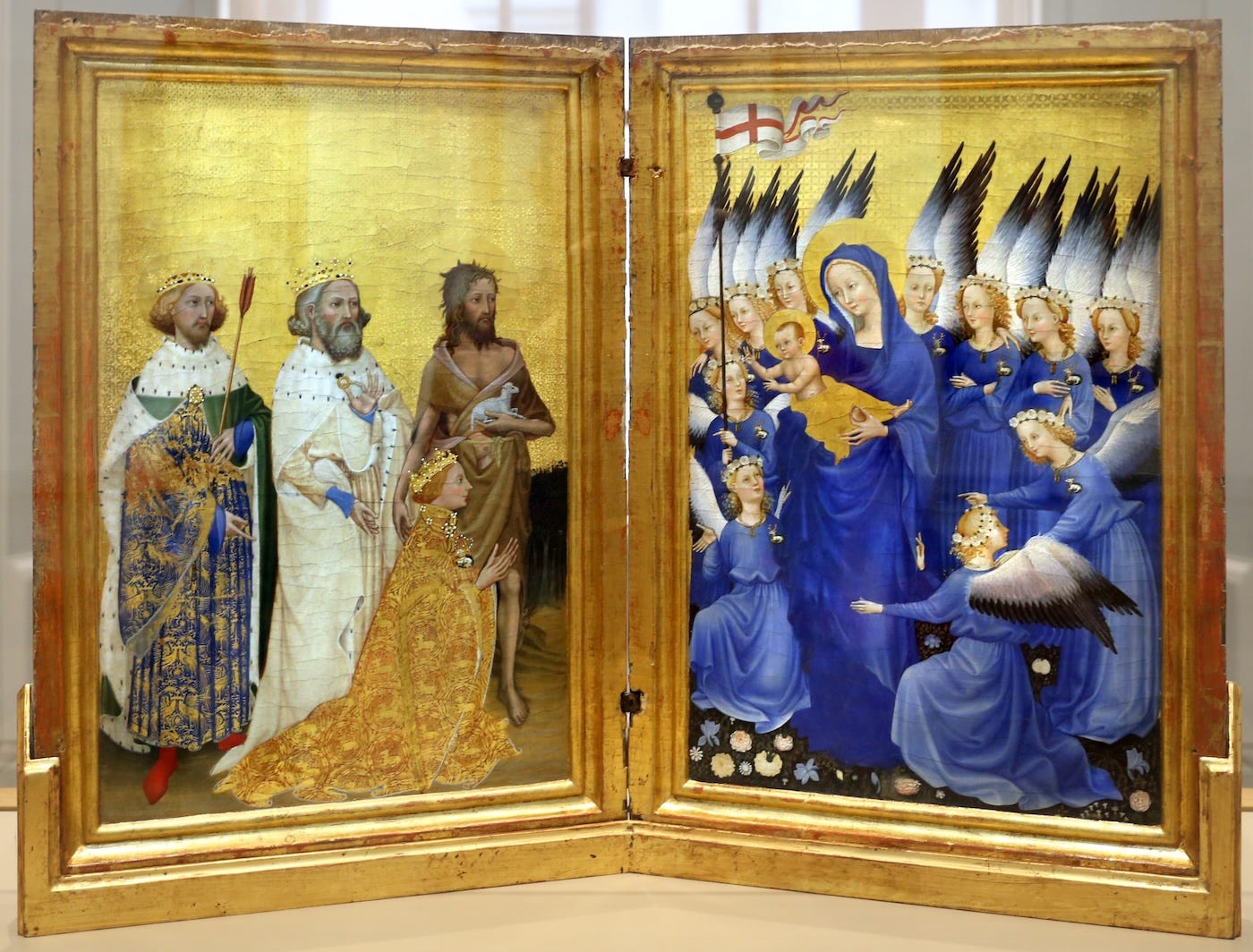
Wikimedia, CC BY 3.0,
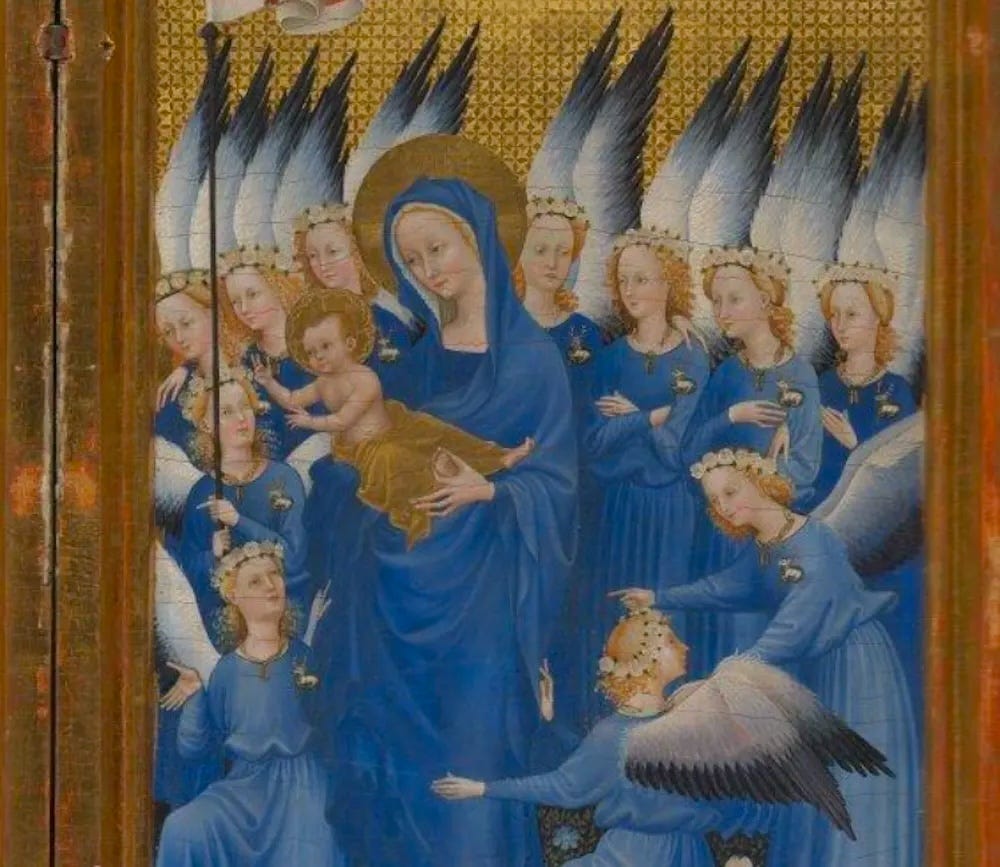
The painting is rendered in egg (yes, actual egg!) tempera, a technique that gives the colours a luminous purity. The ultramarine blue, derived from lapis lazuli — a pigment more precious than gold in medieval times — radiates divine energy. It’s no accident that this rare substance was often reserved for the robes of the Virgin Mary and the angels. Every detail here is intentional, symbolic, and steeped in meaning.
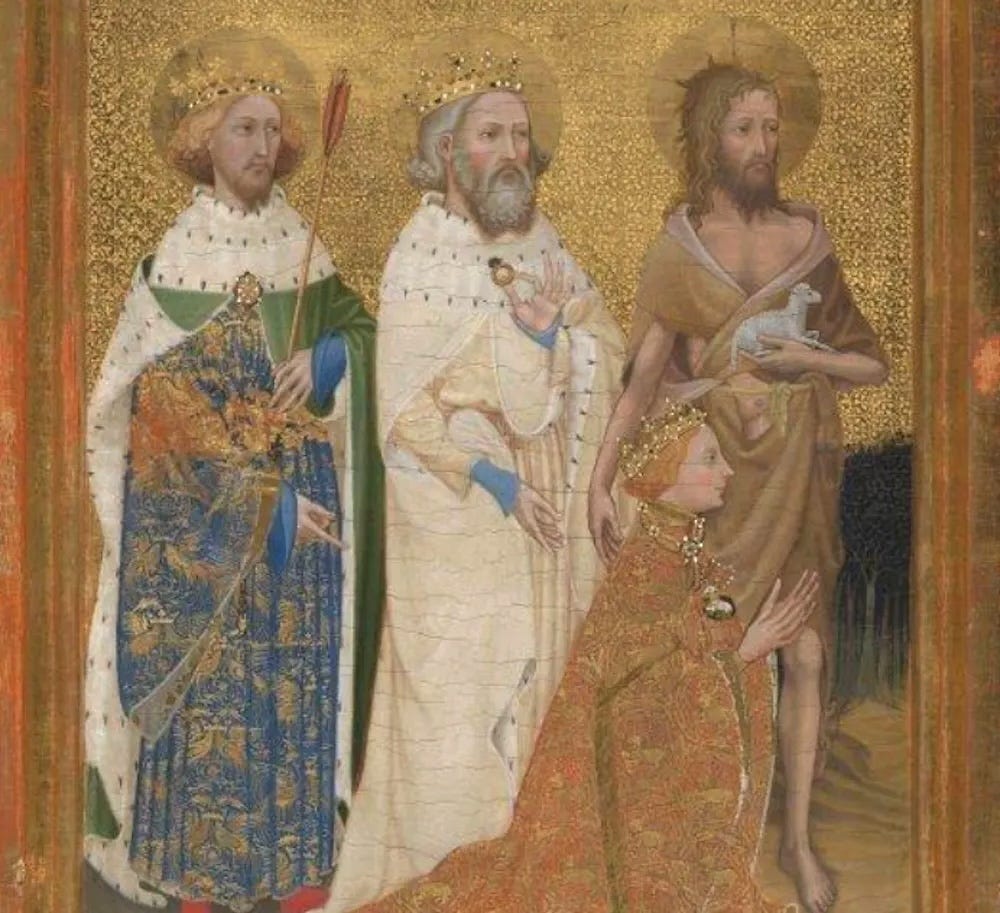
Let’s break it down. On the left panel, we see King Richard II, flanked by three saints:
- St John the Baptist, holding the lamb and touching Richard’s shoulder — his patron saint.
- St Edward the Confessor, carrying a ring tied to a legend of divine revelation.
- St Edmund, clutching the arrow of his martyrdom.
Wikimedia, CC BY 3.0,
They stand in a rocky landscape, beneath a gold-leaf sky, representing the earthly realm. There’s a subtle nod to the Epiphany here, too — Richard’s birthday was January 6th, the feast of the Magi, and each saint bears a symbolic gift.
On the right panel, the Virgin and Child are surrounded by eleven angels in a heavenly meadow. One angel carries the banner of St George, the patron saint of England.
Richard’s robe is adorned with white harts — his personal emblem, adopted from his mother and used as a visual pun on his name (“Richart” in French). The angels wear badges of the same white hart, reinforcing Richard’s divine connection.
Wikimedia, CC BY 3.0,
The infant Christ, wrapped in cloth of gold, bears a crown of thorns and three nails within his halo — symbols of the Passion. These details, though small, are rich with theological meaning.
Why eleven angels? Traditionally, eleven is a number which signifies incompleteness — perhaps a hint at Richard’s impending downfall. He died in 1400, just a few years after the painting was completed.
Despite its age — it’s now at least 600 years old — the inner panels are remarkably well-preserved. Some glazes have faded — the roses in the angels’ hair were once a deeper pink, and the green grass has darkened — but the overall effect remains breathtaking.
An Insight into the Present
The Wilton Diptych isn’t just a relic. It invites us to ponder: What does power look like when framed by faith? How do art and symbolism shape legacy?
This painting is more than pigment and wood — it’s a window into the medieval mind. It speaks of devotion, identity, and the longing for divine legitimacy. It’s a reminder that art has always been a mirror, reflecting not just beauty, but belief.
The Wilton Diptych is waiting. Go and see it if you ever have the opportunity whilst in London. Reflect on it. Let its quiet majesty stir your imagination. And share your thoughts — because art like this deserves more than admiration. It deserves conversation.
Have YOU ever stood before a painting and felt history whisper to you?
메타데이터
- post_id
- c9dc88b42103
- slug
- the-moment-my-eyes-were-opened-to-the-wonders-of-religious-art-c9dc88b42103
- url
- https://medium.com/backyard-theology/the-moment-my-eyes-were-opened-to-the-wonders-of-religious-art-c9dc88b42103
- canonical_url
- https://medium.com/backyard-theology/the-moment-my-eyes-were-opened-to-the-wonders-of-religious-art-c9dc88b42103
- author_url
- https://medium.com/@paulwalker71
- status
- ok
- fetched_at
- 2026-06-23 21:39:52