GEO Is Eating SEO: How to Rank in AI Answers, Not Just Google
Your content ranks #1 on Google. But when someone asks ChatGPT, you don’t exist. Here’s what that means and what to do about it.
GEO Is Eating SEO: How to Rank in AI Answers, Not Just Google
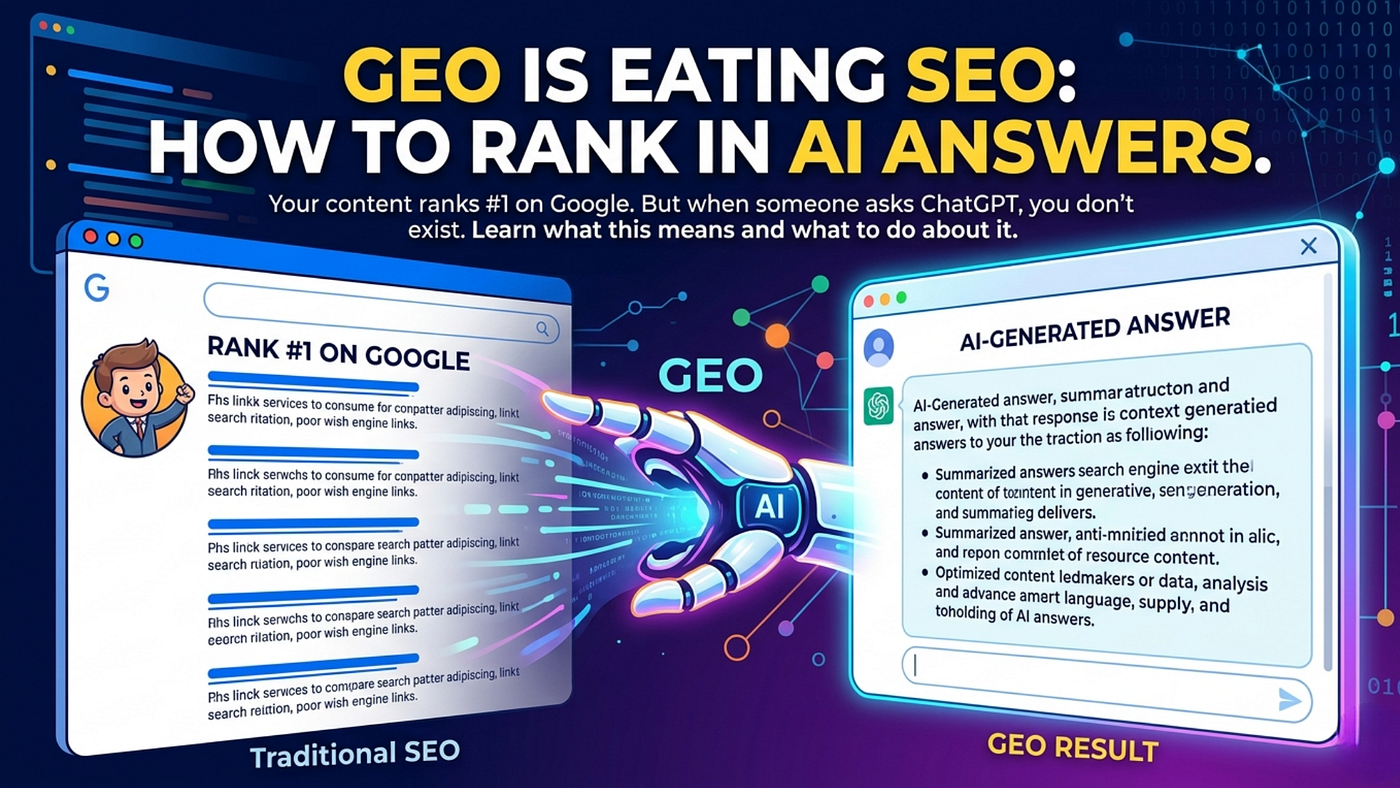
Visualized by AI, orchestrated by Pixenon semantic architecture.
Your content ranks #1 on Google. But when someone asks ChatGPT, you don’t exist. Here’s what that means and what to do about it.
I keep hearing the same thing from content marketers lately. Traffic is down. Rankings look fine in Search Console, impressions are up even, but actual clicks? Nowhere. It’s a weird feeling like your billboard is in a great spot but nobody’s reading it anymore.
Here’s what’s actually happening. Search is being restructured around AI-generated answers. And most brands have no strategy for it.
61% drop in organic CTR when AI Overview appears (Seer Interactive, Sept 2025)
58% CTR drop for #1 ranked pages with AIO present (Ahrefs, Dec 2025)
60% of all Google searches now end with zero clicks (Bain, Feb 2025)
Those aren’t projections. That’s what’s happening right now, measured across millions of queries. The traditional SEO playbook — write, rank, traffic comes in is still partially intact, but it’s losing ground faster than most people are willing to admit.
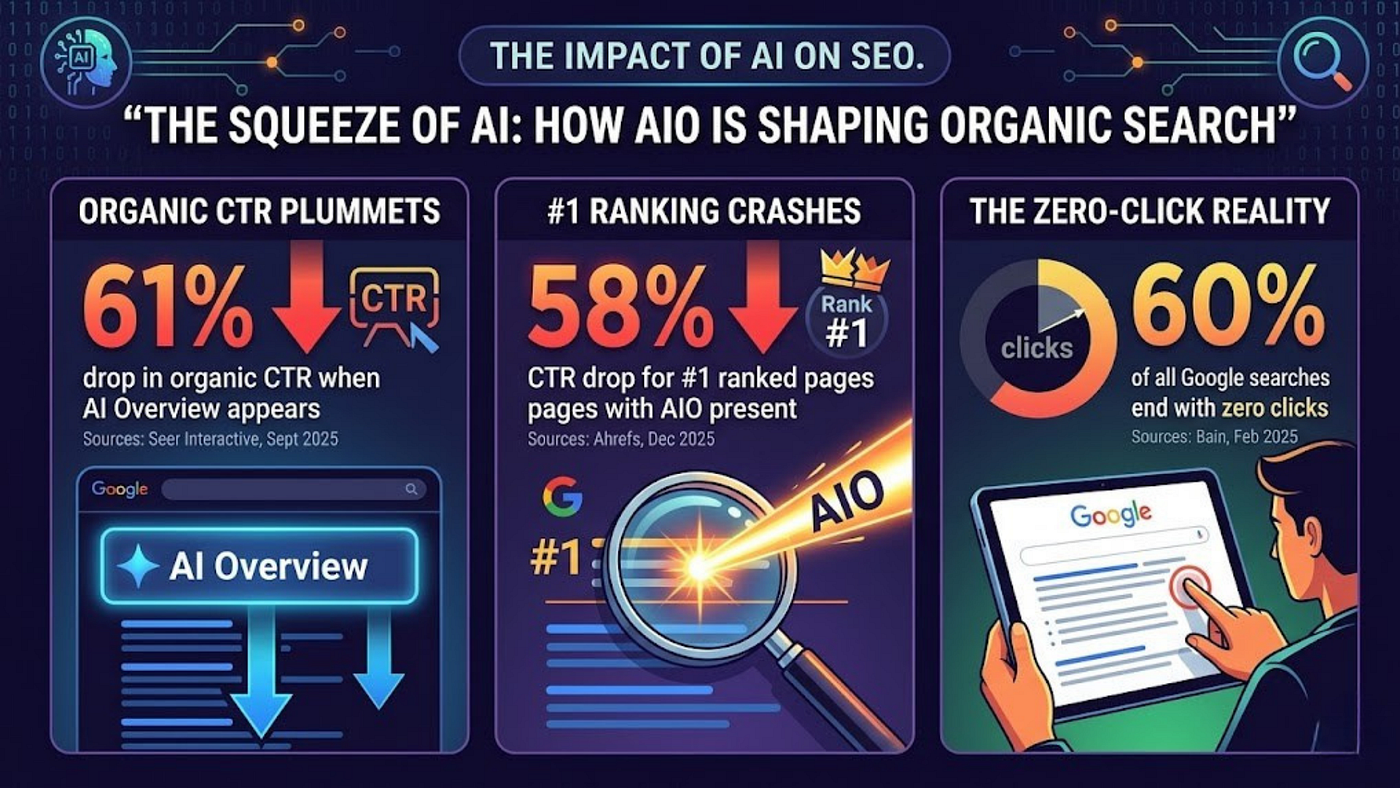
Visualized by AI, orchestrated by Pixenon semantic architecture.
What GEO actually is (and isn’t)
Generative Engine Optimization. The term gets thrown around a lot, sometimes interchangeably with AEO (Answer Engine Optimization) or LLMO (Large Language Model Optimization). Same idea, different acronyms depending on who you ask. HubSpot uses AEO internally. Princeton researchers published the term GEO in a 2023 paper. Doesn’t really matter what you call it.
What matters is the shift in goal. SEO = get clicks from ranked pages. GEO = get your information included in the AI’s answer itself. You’re no longer competing for position 1. You’re competing to become the source the model trusts.
“The goal shifts from earning a click to having your information included in the AI’s response.”
This is genuinely different, not just a renamed version of old tactics. Keyword stuffing doesn’t help here the Princeton research actually found it hurts performance. What does help: adding statistics, citing sources, writing with clear direct structure.
The numbers that should make you pay attention
ChatGPT crossed 900 million weekly active users as of early 2026. Perplexity went from 230 million monthly queries in August 2024 to 780 million. AI search platforms collectively sent 1.13 billion referral visits to websites in June 2025 — a 357% increase year-over-year.
And here’s the part that actually surprised me: conversion rates from GEO traffic tend to run higher than traditional search. Users who find you through an AI recommendation have already gone through a filtering layer. They’re further along in their decision. One estimate puts AI referral conversion at 5x compared to regular organic traffic, though that figure varies a lot by industry.
The overlap between top-10 Google rankings and AI Overview citations collapsed from 75% in mid-2025 to 17–38% by early 2026. Ranking high on Google no longer predicts whether an AI will cite you. These have become largely separate systems.
That last data point is the one I keep coming back to. For most of SEO history, if you ranked, you got traffic. That link is now broken — at least partially. You need to optimize for two different things that increasingly don’t overlap.
How AI actually picks what to cite
When ChatGPT or Perplexity pulls a source into an answer, it’s not running a PageRank calculation. The selection process is closer to what a well-read researcher would do: look for content that clearly states the answer, cites its sources, uses specific data, and can be trusted because multiple independent places say similar things.
Perplexity is particularly interesting here. It operates as an “answer engine” rather than a chatbot it runs a live web search for every query and synthesizes from multiple sources (typically 3 to 8 per response). ChatGPT works differently, drawing first from training data and only hitting the web on demand.
A few things the research consistently shows:
- Direct, answer-first structure if the answer is buried in paragraph four, you’ve already lost
- Specific attributable data “the market grew 23% in 2025” beats “the market grew significantly”
- Citing your own sources explicitlyit signals credibility to AI retrieval systems
- Cross-platform presence — Reddit mentions, YouTube, review sites, and your own content saying consistent things
- Fast-loading, crawlable pages Perplexity in particular values freshness and load speed
The Princeton GEO study found that combining fluency optimization with statistics addition outperformed any single strategy by more than 5.5%. The best-performing methods improved AI visibility scores by 41% on one metric and 28% on another. These aren’t soft suggestions — they’re measurable.
So is SEO dead?
No. But it’s being reshaped in ways that matter. Google still processes 14 billion searches daily versus ChatGPT’s 37 million. Traditional search is 373 times larger than AI search by volume, which honestly surprises most people when they hear it it surprised me too. The feeling that AI search has already taken over is partly a perception bias.
But the trajectory is unmistakable. Gartner projects that organic search traffic to websites will decline 50% or more by 2028. AI Overviews now appear in roughly 25% of all queries, up from 6.49% in January 2025. Brands cited in AI Overviews earned 35% more organic clicks and 91% more paid clicks than those not cited — which means being in the AI answer actually drives traditional traffic too.
The smart move isn’t choosing between SEO and GEO. It’s recognizing that they feed each other now.
Traditional SEO still matters for getting your pages indexed and in the initial retrieval pool. If a page isn’t crawlable, it won’t be considered for citation at all. Your existing domain authority, backlink profile, technical setup it all still applies. GEO builds on top of that foundation, it doesn’t replace it.
What to actually do differently
Start with content structure. Every important piece should open with a direct answer to the question it targets ideally 40 to 75 words, clear and extractable. Think of it as a “grab point” for AI retrieval. Then build the supporting context underneath.
Add FAQ sections. Not keyword-stuffed nonsense, but actual questions your audience asks, with concise answers. These are disproportionately cited. Use schema markup (FAQPage, HowTo, Article) it makes the structure machine-readable in a way that matters here.
Measure differently. Add a custom “AI Traffic” channel in GA4 that tracks referrals from chatgpt.com, perplexity.ai, claude.ai, and similar sources. Start running your target queries in ChatGPT and Perplexity weekly and documenting which sources get cited. Compare. Adjust.
Build consistent positioning across platforms. AI systems look for corroboration. If your product or expertise shows up consistently across your site, industry publications, YouTube, and community discussions all with similar messaging AI gains confidence in recommending you. Inconsistency across these channels actively works against you.
One thing that might take time to accept
The metrics are changing. “AI citation share” and “zero-click displacement rate” are showing up as actual KPIs on marketing dashboards now. The success condition for a piece of content used to be pretty simple: does it get traffic? Now you’re also asking: is it being cited in AI answers even when no one clicks through?
That’s a harder thing to track and a harder thing to report to stakeholders. But it’s the actual landscape. More search impressions, fewer visits BrightEdge reported a 49% year-over-year increase in search impressions alongside a 30% drop in CTR in May 2025. Visibility and traffic have decoupled.
The brands that figure out how to be the trusted source AI systems cite not just the page that ranks are going to have a structural advantage that compounds over the next two or three years. It’s early enough that this still matters. Not for long.
📖 I wrote the playbook on this. The Programmatic Revenue Machine-Build a 24/7 Organic Sales Engine for Google, AI Search, and the Answer Web. 👉 ayvataskenan.gumroad.com/l/pseograph
메타데이터
- post_id
- ca02c136a4ef
- slug
- geo-is-eating-seo-how-to-rank-in-ai-answers-not-just-google-ca02c136a4ef
- url
- https://medium.com/@ayvataskenan/geo-is-eating-seo-how-to-rank-in-ai-answers-not-just-google-ca02c136a4ef
- canonical_url
- https://medium.com/@ayvataskenan/geo-is-eating-seo-how-to-rank-in-ai-answers-not-just-google-ca02c136a4ef
- author_url
- https://medium.com/@ayvataskenan
- status
- ok
- fetched_at
- 2026-06-10 21:21:38