「I want to go play baseball.」 — — Why did Michael Jordan leave basketball back then?
Just days ago, LeBron James and Steve Nash invited Kevin Durant onto their co-hosted show, Mind The Game, for a wide-ranging discussion on…
「I want to go play baseball.」 — — Why did Michael Jordan leave basketball back then?
Just days ago, LeBron James and Steve Nash invited Kevin Durant onto their co-hosted show, Mind The Game, for a wide-ranging discussion on basketball. In the midst of the conversation, Durant made a bold remark:
“Some walked away to play baseball. Others have played basketball for 22 straight years.”
The contrast in this statement couldn’t be more obvious — Durant was clearly alluding to the most iconic figure in basketball history: Michael Jordan.
In 1993, at the absolute peak of his powers — having secured three straight championships and an MVP title — Jordan shocked the world by announcing his retirement from the NBA to pursue a career in baseball. This unconventional detour not only altered the course of NBA history but also redefined the relationship between athletes and their personal lives. His simple yet unforgettable return message, “I’m back”, would later become one of the most iconic moments in sports history.
So why did Jordan step away from the game? Was Durant’s comment fair? What did that baseball chapter mean for Jordan — and how did it shape the legend we now revere? Let’s revisit this extraordinary journey in full.

Jordan X (https://x.com/jumpman23)
A Painful Farewell from the Throne
On October 6, 1993, a crowd of reporters gathered at the Chicago Bulls’ training facility, eager to hear what was next for the biggest name in basketball. Clad in a dark, understated suit, Jordan stood before the cameras with a serious, resolute expression and formally announced his retirement.
“This is one of the hardest decisions I’ve ever had to make. In July, I lost my father — and that changed everything. After losing him, I couldn’t find the motivation to keep playing.”
When asked whether his decision was driven by physical fatigue or burnout, Jordan responded candidly:
“Physically, I’m okay. But emotionally, I’m struggling.”
As rumors swirled — particularly regarding gambling controversies — he addressed them head-on:
“Those rumors are misunderstandings. This has nothing to do with gambling. This is a personal choice.”
The press conference lasted about half an hour. Jordan frequently paused to take deep breaths, clearly trying to keep his emotions in check.
“I’ll always be grateful for everything basketball has given me,” he said in closing. “But now, it’s time to put down my shoes and look for a new direction.”
The news sent shockwaves through the sports world. Headlines everywhere declared “The Basketball God Steps Away.” It was, without question, the most seismic sports story of the year.
Jordan’s father, James Jordan, had been tragically murdered in July of that year. He was not just a parent to Michael, but also a guiding force and spiritual anchor. In The Last Dance documentary, Jordan spoke movingly about his grief during that time.
Beyond his on-court greatness, Jordan was also a global icon and corporate symbol, carrying unimaginable pressure and scrutiny. As journalist Sam Smith detailed in The Jordan Rules, it wasn’t that Jordan no longer loved basketball — he was simply exhausted by the relentless expectations and criticism. His emotional and psychological fatigue was something few could comprehend.
His departure also sparked numerous conspiracy theories, the most popular being that he was secretly suspended by the NBA for gambling. But then-Commissioner David Stern flatly denied such claims:
“Michael was never suspended. That’s a false narrative. If anything serious had happened, I would’ve taken the appropriate action.” Jordan himself reiterated in interviews that his decision stemmed purely from the loss of his father.
From Basketball Legend to Baseball Rookie: A Journey of Healing
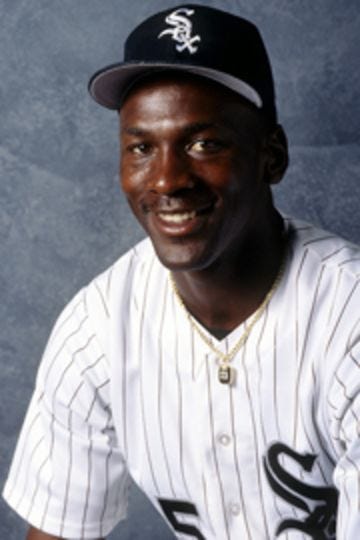
After leaving the NBA, Jordan turned his focus to baseball — another surprising move. On February 7, 1994, he signed a minor league contract with the Chicago White Sox and reported to spring training. He was assigned to the Double-A affiliate, the Birmingham Barons, a team based in Alabama that instantly became a media sensation. Jordan wore the number 45 — his high school baseball number and a symbol of new beginnings.
Many questioned why the king of the basketball court would pursue an entirely different sport. Jordan gave a heartfelt explanation:
“Playing baseball was a dream my father and I shared. He always said if I hadn’t chosen basketball, I could’ve made a great outfielder.”
This was not just about sports — it was about honoring his father’s memory. It was a form of spiritual continuation, a path toward emotional healing.
His manager at the time, Terry Francona (who would go on to become a respected MLB coach), remembered:
“He wasn’t there for a publicity stunt. He came early, stayed late, and was meticulous about details. He knew he wasn’t the most gifted baseball player, but he never asked for special treatment.”
Francona even believed that if Jordan had stuck with it for two to three more years, he could have made the major leagues.
https://www.milb.com/player/michael-jordan-470052
Statistically, Jordan’s performance was modest: over 127 games, he hit .202 with 3 home runs, 51 RBIs, and 30 stolen bases. These numbers didn’t wow critics, but for someone who had never received formal baseball training, his effort was commendable. Though Sports Illustrated ran the infamous headline “Michael, You’re Embarrassing Baseball,” many coaches and players stood by him as a symbol of courage and humility.
However, in August 1994, the MLB was hit by a major labor strike, which suspended the season and dashed Jordan’s hopes of making a spring training appearance in 1995. With baseball on hold, he quietly returned to Chicago, where he began closed-door workouts with Bulls players at The Berto Center.
“I’m Back”: The Return of the King
According to Bulls PR staff, Jordan initially joined the team just to help out during practice — but something had changed.
“You could see that old spark in his eyes,” they recalled.
His agent, David Falk, prepared several formal press releases for his return. Jordan looked at them and said:
“I don’t need all that. Just send out one sentence.”
And so, on March 18, 1995, a fax machine churned out a single line:
I’m back.
No punctuation. No flair. Just those two words. Yet they became one of the most unforgettable statements in NBA history.
The next day, Jordan returned to the court wearing number 45. The world watched in awe.
Back in the Arena: The Second Reign Begins
On March 19, 1995, Jordan stepped onto the court against the Indiana Pacers. Though the Bulls lost 96–103, Jordan put up 19 points, 6 assists, and 6 rebounds in his first game back. That night’s broadcast drew 35 million viewers — the highest single-game NBA viewership that season.
Back in Madison Square Garden, he dropped 55 points on the Knicks, silencing any doubts.
“People said I wouldn’t dominate again,” Jordan said. “So I let the game do the talking.”
Though the Bulls were eliminated by the Orlando Magic in the 1995 playoffs, Jordan’s return reignited the team and the league.
During the following offseason, Jordan trained with intense discipline. In the 1995–96 season, the Bulls went 72–10 — a record at the time. Jordan won his fourth MVP and led Chicago to a second three-peat. His final shot in the 1998 Finals sealed the Bulls’ sixth title, cementing their dynasty and his status as an irreplaceable icon.
Greatness in Two Forms: Endurance and Renewal
In the end, from an objective standpoint, Durant’s comment wasn’t entirely unfair. His emphasis on “longevity” and “sustained dominance” is indeed LeBron James’ greatest achievement.
But we must also recognize what Jordan endured — his psychological pain, emotional loss, and internal conflict. His first retirement wasn’t due to physical decline, but rather a profound spiritual exhaustion.
Both LeBron and Jordan are great in their own ways. LeBron’s greatness lies in his unmatched consistency and longevity. Jordan’s greatness comes from his ability to overcome grief, rediscover himself, and rise again.
Two paths. One shared legacy. Together, they define the brilliance and complexity of the NBA’s most legendary figures.
Author: Frank Yang
Submitted on July 14, 2025, to Medium
Lakers rumored to be trading for Wiggins — is this a good deal?
LeBron vs. Lakers Front Office: A Silent and Invisible Negotiation
The Last Dance of the Point God — A Career Retrospective of Chris Paul
NBA 2K26 Chooses Melo for the Cover! A Collective Nostalgia for Carmelo Anthony.
Based solely on his debut, what would be a projected player comparison for Cooper Flagg
If you have money, you should definitely buy a sports team: The asset miracle of North American professional sports over the past 20 years.
Chinese Blogger(中文部落格):https://frankyangsport.blogspot.com/ My author page on Sport Vision:https://www.sportsv.net/authors/frankyangsport
Facebook:https://www.facebook.com/profile.php?id=61572911911991
Fun Chinese translation:
- Michael Jordan 麥可·喬丹
- baseball 棒球
- Chicago Bulls 芝加哥公牛隊
메타데이터
- post_id
- ca0567d1bdbe
- slug
- i-want-to-go-play-baseball-why-did-michael-jordan-leave-basketball-back-then-ca0567d1bdbe
- url
- https://medium.com/@yangshare/i-want-to-go-play-baseball-why-did-michael-jordan-leave-basketball-back-then-ca0567d1bdbe
- canonical_url
- https://medium.com/@yangshare/i-want-to-go-play-baseball-why-did-michael-jordan-leave-basketball-back-then-ca0567d1bdbe
- author_url
- https://medium.com/@yangshare
- status
- ok
- fetched_at
- 2026-07-19 00:15:46