AI Society for 1.9.25 — Your Personal AI Supercomputer
Today: Nvidia Project Digits and Cosmos World Foundation Models, Seagate’s HAMR, Large Concept Models, DeepSeek-v3 dangers, AI and…
AI Society for 1.9.25 — Your Personal AI Supercomputer
Today: Nvidia Project Digits and Cosmos World Foundation Models, Seagate’s HAMR, Large Concept Models, DeepSeek-v3 dangers, AI and radiology, and Heinz 57.
First off, hardware, with announcements flowing from CES. One from Nvidia, ‘Project Digits,’ is impressive, and Enrique Dans offers details on an all-in-one supercomputer. A massive step up from the Jetson Nano that they announced just a few weeks back, this is something for your rec room, next to the flatscreen and PS5.
*Around 1,000 times more powerful than a standard laptop, it’s about the size of the Mac Mini, and runs through with a standard power outlet, offering 1 petaflop of AI performance for prototyping, tuning and running large AI models. It has 128GB of memory and up to 4TB of storage, with the additional possibility of being able to combine two machines so as to run models of up to 405,000 million parameters, the current size, for example, of the most advanced model of Llama 3.1.*

Source: Nvidia
Note that it only runs Linux, so you’ll not be running PowerPoint on it anytime soon. Which is probably a good thing.
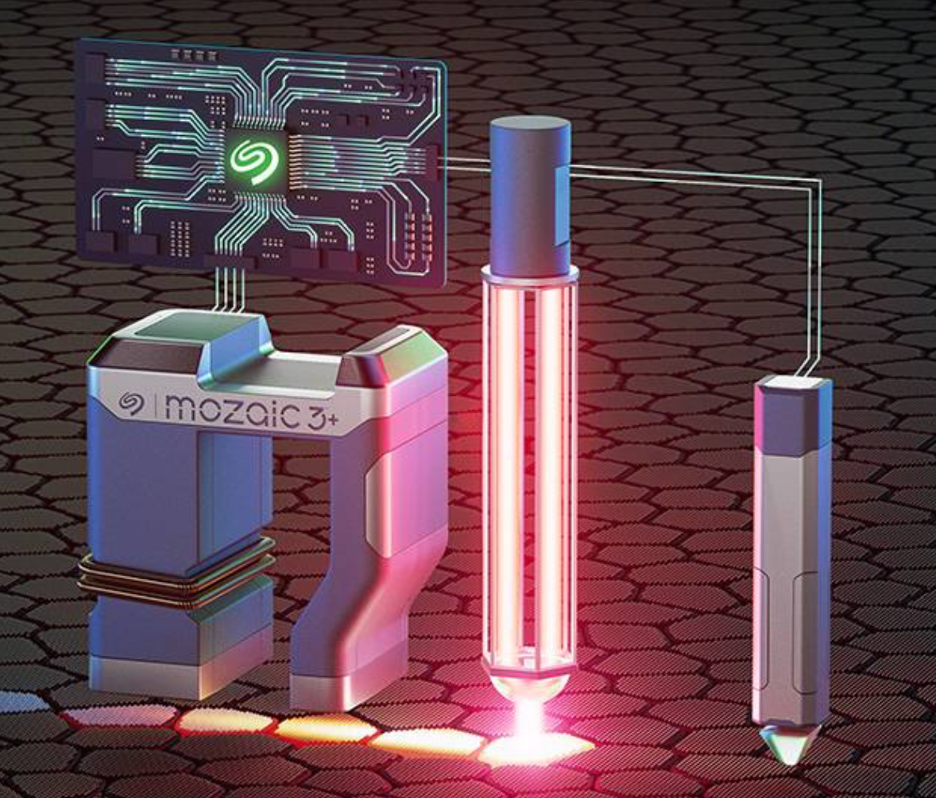
Continuing with hardware, and the continuing need for storage, if you remember the post on SSD demand from a few weeks back, this is a good follow-up. As posted by Gandhi KT in ‘Generative AI,’ Seagate is in the process of productizing a technology decades in the making — Heat Assisted Magnetic Recording — which is poised to deliver the next jump in recording density. And if you think technologies first developed over half a century ago are not ripe for innovation, read the post to learn about the ‘Plasmonic Writer & Super Lattice Platinum Alloy Medium’ and the ‘Gen-7 Spintronic Reader.’
Source: Seagate
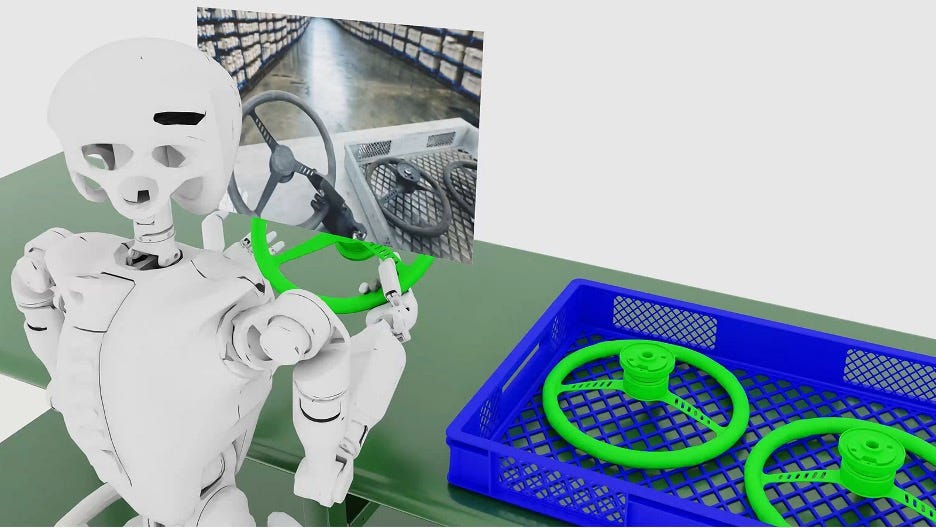
And back to Nvidia, this time LLMs (or LWMs), and their announcement of Cosmos World Foundation Models, which will be able to predict and generate videos that follow the rules of physics. From their PR:
· NVIDIA today announced NVIDIA Cosmos™, a platform comprising state-of-the-art generative world foundation models, advanced tokenizers, guardrails and an accelerated video processing pipeline built to advance the development of physical AI systems such as autonomous vehicles (AVs) and robots.
· Physical AI models are costly to develop, and require vast amounts of real-world data and testing. Cosmos world foundation models, or WFMs, offer developers an easy way to generate massive amounts of photoreal, physics-based synthetic data to train and evaluate their existing models. Developers can also build custom models by fine-tuning Cosmos WFMs.
· Applications:
§ Video search and understanding, enabling developers to easily find specific training scenarios, like snowy road conditions or warehouse congestion, from video data.
§ Physics-based photoreal synthetic data generation, using Cosmos models to generate photoreal videos from controlled 3D scenarios developed in the NVIDIA Omniverse™ platform.
§ Physical AI model development and evaluation, whether building a custom model on the foundation models, improving the models using Cosmos for reinforcement learning or testing how they perform given a specific simulated scenario.
§ Foresight and “multiverse” simulation, using Cosmos and Omniverse to generate every possible future outcome an AI model could take to help it select the best and most accurate path.
Source: Nvidia
A while back, I covered ‘Large Concept Models.’ Now, Dr. Ashish Bamania penning in ‘Level Up Coding’ takes a deeper, more technical dive into LCM architecture, benefits, and areas for improvement. His analysis is based on the Meta paper, which notes the following as the genesis for LCMs:
· Imagine a researcher giving a fifteen-minute talk. In such a situation, researchers do not usually prepare detailed speeches by writing out every single word they will pronounce. Instead, they outline a flow of higher-level ideas they want to communicate. Should they give the same talk multiple times, the actual words being spoken may differ, the talk could even be given in different languages, but the flow of higher-level abstract ideas will remain the same.
· Finally, when processing and analyzing information, humans rarely consider every single word in a large document. Instead, we use a hierarchical approach: we remember which part of a long document we should search to find a specific piece of information.
· To the best of our knowledge, this explicit hierarchical structure of information processing and generation, at an abstract level, independent of any instantiation in a particular language or modality, cannot be found in any of the current LLMs.
Turning to China, some observations by Boqiang Liang on what their researchers do and do not know about o3, focusing on the concept of ‘Test Time Compute.’ He outlines the four phases in detail:
· Policy initialization
· Reward design
· Search
· Learning
And the core value:
Test Time Compute revolutionizes AI performance by allowing models to use additional computational resources during inference, significantly enhancing their capabilities. It marks a shift from scaling only training data to scaling both training and inference computations.
Also on the China front, a word of warning. I covered DeepSeek-v3 performance a week or two back, and now Mehul Gupta in ‘Data Science in your pocket’ points out some disturbing details on their terms of use. Basically, any code or IP developed via the bot’s use remains the property of DeepSeek. My suggestion would be to read the terms in detail before going any further.
Next, the weekly post on healthcare, this time radiology and the state of play with AI as related by Mikhail Iljin. He does a great job of describing the role of the radiologist, the types of scans including CT, PET, and MRI, a view to the future, and areas where AI can assist:
- Matching known findings from old scans to locations in the new scan (“registration”).
- Automatic detection, segmentation and classification of everything worthy of attention in the new scan.
- AI-assisted manual interactive correction of inaccuracies/omissions in the automatic AI’s results.
- Assigning malignancy score to a patient, given all the findings, patient’s history and metadata.
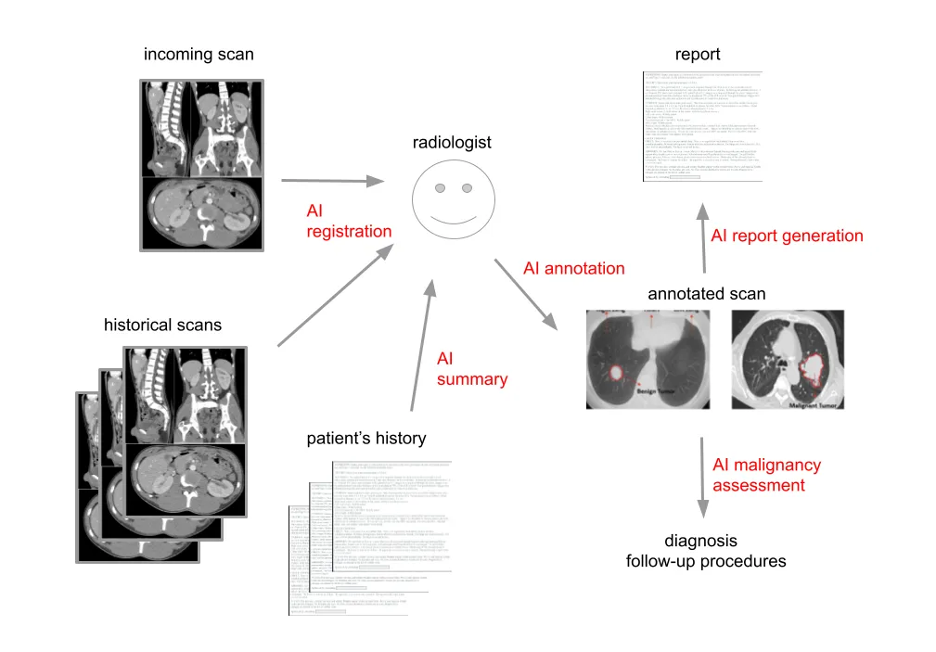
Source: Mikhail Iljin
And, at the intersection of health and advertising, new Meta policies. ‘The Information’ reports on the company’s new limits on how advertisers can target users. From the article:
· Telehealth companies including Hims & Hers, Sesame and Noom have flocked to Facebook and Instagram to promote their booming weight loss drugs.
· But pressure from regulators concerned about consumers’ health data privacy has prompted Meta Platforms to limit how advertisers target users with health-related ads, starting this month. That is upending weight loss campaigns in the middle of the New Year’s resolution marketing season.
· Some ad buyers likened the potential impact of Meta’s changes to Apple’s privacy changes in 2021, which roiled the broader digital ad market.
· The FTC and the Department of Health and Human Services have also warned hospitals and telehealth providers about privacy and security risks posed by ad-tracking technology like Meta’s.
Note that this move by Meta, a step in the right direction, is very different from their release two days back on content moderation. And, based on the announcement, the shares of both Hims & Hers Health and Weight Watchers dropped today, but they are expected to recover.
To close, and as a follow-up to last year’s AI-generated ads, including the love-it or hate-it Christmas ones from Coca Cola, Heinz has just raised the bar in a very creative way. Check out the company’s YouTube video for the reveal!
메타데이터
- post_id
- ca0f1f8e22e3
- slug
- ai-society-for-1-9-25-your-personal-ai-supercomputer-ca0f1f8e22e3
- url
- https://medium.com/a-i-society/ai-society-for-1-9-25-your-personal-ai-supercomputer-ca0f1f8e22e3
- canonical_url
- https://medium.com/a-i-society/ai-society-for-1-9-25-your-personal-ai-supercomputer-ca0f1f8e22e3
- author_url
- https://medium.com/@daveginsburg
- status
- ok
- fetched_at
- 2026-07-07 12:17:01