The KPMG headlines are hard to read.
If you’re one of them, or watching from the inside waiting for your turn, you’re probably measuring your value the wrong way. Most…
What KPMG’s Layoffs Actually Signal: Your Expertise Was Never the Problem. The Business Model Was
The end of the pyramid. The rise of the problem-architect.
Part 1 of “The Unbundled Consultant”
The KPMG headlines are hard to read. High-performers. Recently promoted managers. Veteran auditors. Gone — not because they failed, but because the business model around them stopped working.
If you’re one of them, or watching from the inside waiting for your turn, you’re probably measuring your value the wrong way. Most consultants do. They measure it by the Pyramid Model: managing a team of juniors, producing decks, delivering audits, billing hours. That model is being hollowed out.
This isn’t about doom. It’s about being honest with yourself about what was actually valuable in what you did — because it’s probably not what your firm’s marketing said it was.
What AI Actually Can’t Do
An LLM can draft a digital transformation roadmap in 30 seconds. A tax strategy. A market entry analysis. These used to take weeks. Now they’re a starting point, maybe a first draft, not a deliverable you bill six figures for.
So if you’ve been competing on solutions, you’re playing the wrong game.
What AI genuinely can’t do — at least not in any way that’s useful yet — is understand why the right answer still fails in practice. You know that the technically correct solution doesn’t survive contact with a hospital’s legacy billing system. You know which data sets are a mess before anyone opens them. You know which stakeholder will quietly kill a project before it launches and why. You’ve sat in enough rooms to know that the deck and the reality are usually two different things.
That’s not a soft skill. That’s the whole job. The part that was always bundled inside the expensive brand.
The strategy, then, is simple to say and hard to execute: Stop selling solutions. Start selling problem mastery. Don’t tell a client how to fix their business yet. Tell them exactly why their last three attempts failed — and say it before they do. That’s the one thing that doesn’t have a ChatGPT equivalent, and probably won’t for a while.
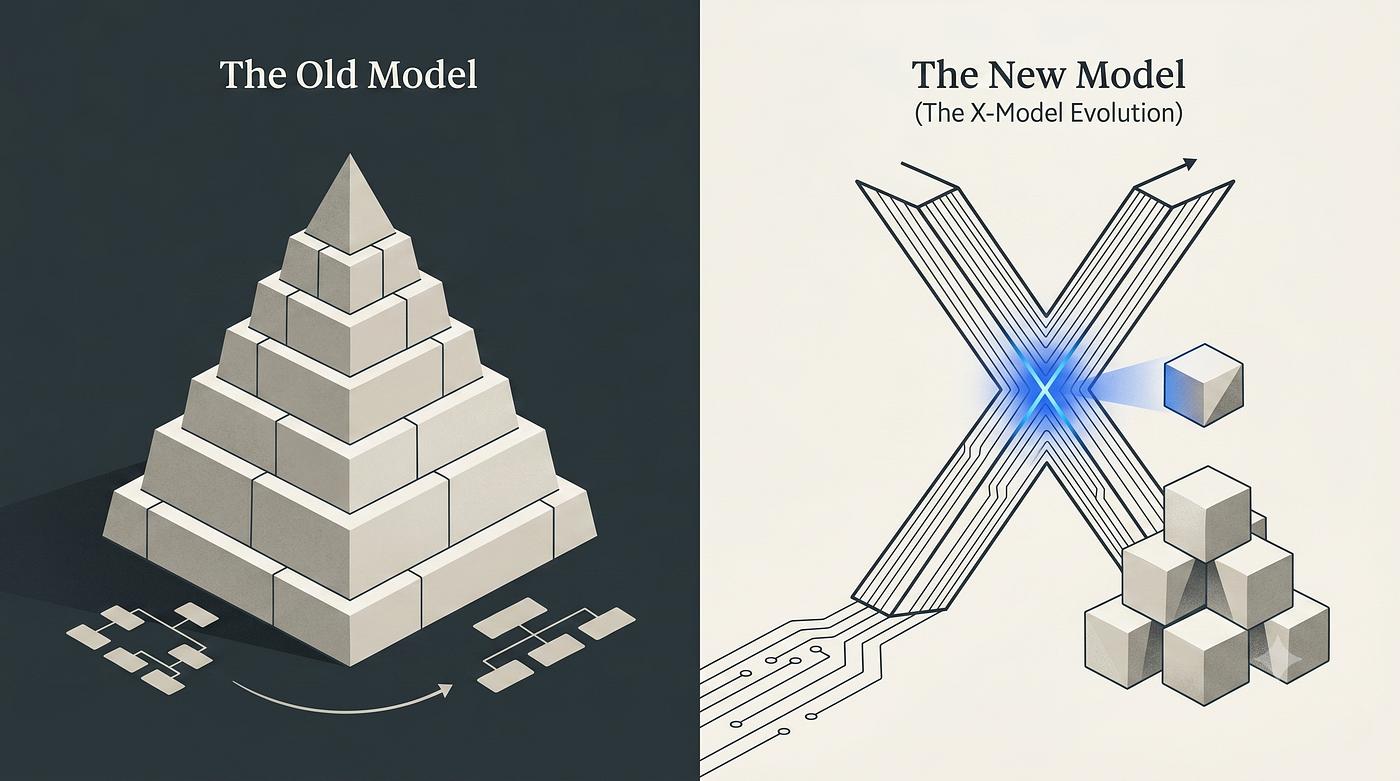
What Replaces the Pyramid: The X Model
The old model — lots of juniors feeding work up to fewer seniors — only worked because junior labor was cheaper than alternatives. Associates ran analyses, built models, formatted slides. Managers reviewed. Partners presented and billed.
That volume layer is getting automated. Not eventually. Now.
What’s replacing it is what some are calling the X Model. AI agents handling the volume work at the bottom — data gathering, analysis, drafting. A thin layer of humans making judgment calls in the middle — validating outputs, catching what the AI missed, applying nuance. Partners at the top owning client relationships and outcomes.
One experienced person + AI handling the data work + the human making the calls that actually matter. Same output. Different headcount.

New Consulting Model in AI Era
The thing that trips people up: you no longer need the Big 4 infrastructure to deliver what clients used to pay the Big 4 for. The infrastructure was the junior labor, the proprietary databases, the methodology decks. Most of that is now automatable or freely available. What clients actually bought — and will keep buying — is the judgment of someone who has seen this go wrong before. That part doesn’t live in the org chart.
Three Practical Pivots
First: Turn your friction knowledge into something you can sell directly. You’ve seen the same ten problems repeat across industries. Pick the messiest one — the kind a generic AI prompt would miss entirely — and build a diagnostic around it. Not a framework. A specific set of questions that surfaces what’s actually broken in a company before they’ve admitted it to themselves. Call this productized expertise — your judgment, packaged for reuse.
Second: Work fractionally. With AI handling the analytical volume, there’s no structural reason you can’t serve three companies at once. The limiting factor used to be hours. Now it’s judgment, and judgment doesn’t need to be exclusive. This is the fractional model — your expertise, delivered to multiple clients in parallel.
Third: Stop billing for time. It’s the hardest shift for anyone coming out of hourly billing environments. But if a client is paying for your judgment and a specific outcome, the number of hours you spent is your problem, not theirs. This is the human-in-the-loop premium — you’re not selling labor. You’re selling the assurance that the AI’s output is correct, that the risks have been caught, that the nuance has been applied. Pricing on outcomes also forces an uncomfortable clarity about what you’re actually promising — which turns out to be useful.
If You Were Just Laid Off
The reframe that actually helped people I’ve talked to: you weren’t fired from your profession. You were unbundled from a cost structure that was already failing.
The practical first step is unglamorous. Go back through your last three projects and write down the specific, messy problems that never made it into the final deck — things you knew but couldn’t say out loud, the data nobody wanted to touch, the workarounds everyone quietly agreed to. That list is your real inventory. It’s what you carry that the AI doesn’t.
Then look at what filled your actual days. Most of it was probably logistics, synthesis, formatting, coordination. All of that is automatable now. That’s not a threat — it’s margin you get back when you’re working for yourself.
The people I’ve seen land well after layoffs like this aren’t the ones who updated their resumes fastest. They’re the ones who stopped trying to replicate the Big 4 experience and started asking what they personally knew that was genuinely hard to find anywhere else.
That question is worth sitting with longer than feels comfortable.
This is Part 1 of a series on future-proofing your consulting career in the AI era. Part 2 will dive deeper into the “X Model” and how to structure a solo practice around judgment, not hours.
메타데이터
- post_id
- ca0fc45ee03f
- slug
- the-kpmg-headlines-are-hard-to-read-ca0fc45ee03f
- url
- https://medium.com/@unbundledconsultant/the-kpmg-headlines-are-hard-to-read-ca0fc45ee03f
- canonical_url
- https://medium.com/@unbundledconsultant/the-kpmg-headlines-are-hard-to-read-ca0fc45ee03f
- author_url
- https://medium.com/@unbundledconsultant
- status
- ok
- fetched_at
- 2026-07-13 12:04:51





