Ontology vs Semantic Model in Power BI: Understanding the Difference
Join My 30 Days Live PowerBI Classes — https://topmate.io/anurodh_kumar10/2159693?utm_source=public_profile&utm_campaign=anurodh_kumar10
Ontology vs Semantic Model in Power BI: Understanding the Difference
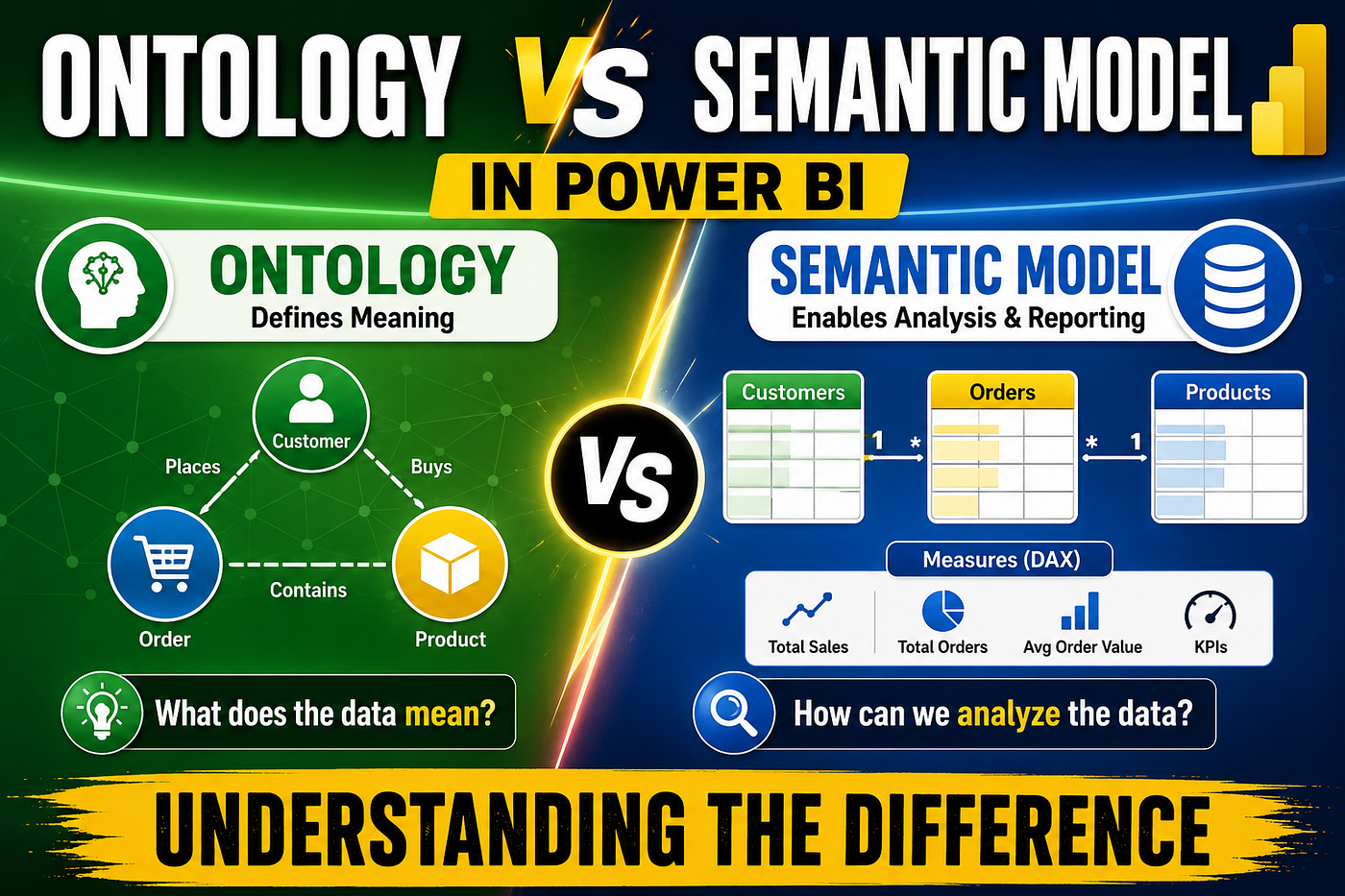
image by Anurodh kumar
Join My 30 Days Live PowerBI Classes — https://topmate.io/anurodh_kumar10/2159693?utm_source=public_profile&utm_campaign=anurodh_kumar10
In the world of Business Intelligence, terms like Ontology and Semantic Model are often used when discussing data architecture, analytics, and reporting. While they both help organizations make sense of data, they serve very different purposes.
For Power BI professionals, understanding this distinction can provide a deeper appreciation of how business knowledge is transformed into actionable insights.
Why This Matters
Organizations generate massive amounts of data every day. However, data alone has little value unless everyone agrees on what it represents and how it should be interpreted.
Consider a simple business question:
What is a customer?
The answer might seem obvious, but different departments often have different definitions.
- Sales may define a customer as anyone who has purchased a product.
- Marketing may include prospects who have not yet purchased.
- Finance may only consider customers with completed transactions.
Without a common definition, reports can become inconsistent and decisions can be based on conflicting information.
This is where Ontology comes into play.
What is an Ontology?
An Ontology is a formal representation of business knowledge.
It defines:
- Business concepts
- Entities
- Relationships
- Attributes
- Rules
- Terminology
Its primary goal is to create a shared understanding of how a business operates.
Think of an ontology as a business dictionary combined with a relationship map.
Example
A retail business might define the following concepts:
- Customer
- Order
- Product
- Supplier
Along with relationships such as:
- Customer places Order
- Order contains Product
- Supplier provides Product
These definitions help everyone across the organization speak the same language.
Key Question Answered by Ontology
What does the data mean?
What is a Semantic Model in Power BI?
A Semantic Model is Power BI’s reporting and analytics layer.
It takes business concepts and converts them into a structure that can be analyzed.
A semantic model typically includes:
- Tables
- Relationships
- Measures
- Calculated columns
- Hierarchies
- KPIs
This is the model that Power BI reports and dashboards connect to.
Example
A Power BI semantic model might contain:
Tables
- Customers
- Orders
- Products
Relationships
- Customers → Orders
- Orders → Products
Measures
Total Sales = SUM(Orders[Amount])Average Order Value =
DIVIDE(
[Total Sales],
[Total Orders]
)These measures allow analysts to answer business questions and generate insights.
Key Question Answered by Semantic Models
How can we analyze the data?
A useful way to think about it:
Ontology explains the business.
Semantic Model explains the data.
A Real-World Example
Imagine a hospital.
Ontology Layer
The organization defines concepts such as:
- Patient
- Doctor
- Appointment
- Prescription
Relationships include:
- Patient schedules Appointment
- Doctor writes Prescription
- Appointment generates Prescription
These concepts describe how the hospital operates.
Semantic Model Layer
The Power BI model contains:
Tables
- Patients
- Doctors
- Appointments
- Prescriptions
Measures
- Total Patients
- Appointments Per Doctor
- Average Waiting Time
Reports
- Operational dashboards
- Doctor performance reports
- Patient analytics
The semantic model turns business concepts into measurable insights.
How They Work Together
Ontology and Semantic Models are not competitors.
They complement each other.
The relationship typically looks like this:
Business Concepts
        ↓
     Ontology
        ↓
 Business Rules
        ↓
  Semantic Model
        ↓
 Power BI Reports
The ontology provides meaning and context.
The semantic model provides structure and analytics.
Together, they ensure that reports are both accurate and meaningful.
Why Semantic Models Are Critical in Power BI
Microsoft has increasingly emphasized semantic models as a core component of modern analytics.
In Power BI and Microsoft Fabric, semantic models provide:
Single Source of Truth
Multiple reports can use the same model, reducing duplication.
Consistent Metrics
Measures are defined once and reused everywhere.
Better Performance
Optimized models improve report responsiveness.
Enhanced Governance
Organizations can standardize business calculations and definitions.
The Growing Importance of Ontologies
As organizations adopt:
- AI
- Knowledge Graphs
- Microsoft Fabric
- Data Mesh architectures
- Enterprise Data Platforms
The need for clear business definitions becomes even more important.
AI systems can only provide reliable insights when business concepts are consistently defined.
This is why ontology-driven approaches are gaining attention across enterprise analytics initiatives.
Simple Analogy
If you’re new to the concept, remember this:
📖 Ontology is like a dictionary.
It explains what words mean and how they relate to one another.
📊 Semantic Model is like a reporting engine.
It uses those definitions to create dashboards, reports, and insights.
Ontology and Semantic Models solve different problems, but together they create a powerful foundation for analytics.
An ontology ensures everyone agrees on the meaning of business concepts.
A semantic model ensures those concepts can be analyzed consistently and efficiently.
As Power BI and Microsoft Fabric continue to evolve, professionals who understand both business meaning and data modeling will be better equipped to build scalable, trustworthy analytics solutions.
Key Takeaway
🧠 Ontology = Meaning
📊 Semantic Model = Reporting
Mastering both helps bridge the gap between business understanding and data-driven decision-making.
Join My 30 Days Live PowerBI Classes — https://topmate.io/anurodh_kumar10/2159693?utm_source=public_profile&utm_campaign=anurodh_kumar10

메타데이터
- post_id
- ca25dc635310
- slug
- ontology-vs-semantic-model-in-power-bi-understanding-the-difference-ca25dc635310
- url
- https://medium.com/powerbi-microsoft-fabric/ontology-vs-semantic-model-in-power-bi-understanding-the-difference-ca25dc635310
- canonical_url
- https://medium.com/powerbi-microsoft-fabric/ontology-vs-semantic-model-in-power-bi-understanding-the-difference-ca25dc635310
- author_url
- https://medium.com/@anu.ckp.1313
- status
- ok
- fetched_at
- 2026-06-27 18:20:27