The Core of the Hindi Epic 🙏🏻Ramayana🙏🏻How👉✨Why God Chose to Walk as Man
Mystic Varuna
The Core of the Hindi Epic 🙏🏻Ramayana🙏🏻How👉✨Why God Chose to Walk as Man
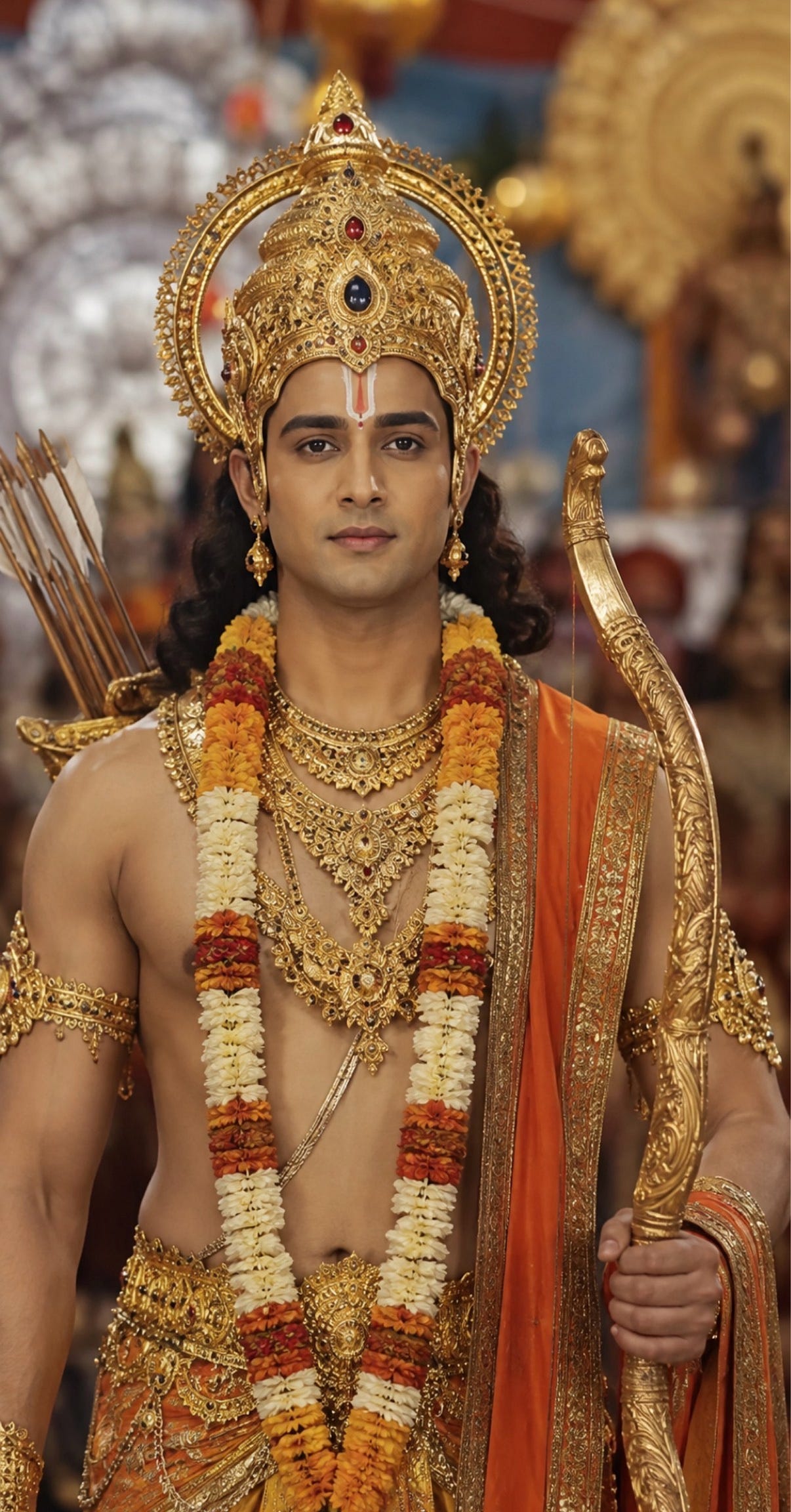
✍️ Write Up By Mystic Varuna
I. The Eternal Battle Written Into Existence

Long before it became a story told beside oil lamps in village courtyards, and long before it became verses chanted through the year in a Ramlila ground, the Ramayana was something else: a description of how the universe itself is structured. Every civilization, in some form, arrives at the same intuition, that there is a current pulling existence toward order, growth, and harmony, and another current pulling it toward decay, domination, and fear. The Sanatan tradition gave this intuition two names, dharma and adharma, and then, uniquely, refused to leave the conflict as an abstraction. It told a story. It gave dharma a face, a bow, and a name: Rama. And it gave adharma a face too, one with ten heads, immense learning, unmatched power, and a fatal blindness to its own arrogance: Ravana.
This is the real reason the Ramayana has survived for thousands of years across a landmass as vast as India and as far as Southeast Asia, retold in Sanskrit, Tamil, Awadhi, Thai, Khmer, Javanese, and dozens of other tongues. It is not merely a royal chronicle. It is a working model of how good and evil actually behave, how evil grows through boons, wealth, and unchecked desire, and how good, even when stripped of its throne, its army, and its comforts, remains anchored to something evil can never buy: dharma, the right way of being.
To understand the Ramayana, then, is not simply to memorize a sequence of events, the exile, the golden deer, the abduction, the bridge, the war. It is to understand why God, who could destroy Ravana with a single thought, chose instead to be born as a helpless infant, to grow up obeying his father, to lose his kingdom, to walk barefoot through forests for fourteen years, to lose his wife to a demon king, and to build an army out of monkeys and bears before he ever raised his bow against Lanka. That choice, the choice to descend, to limit himself, to suffer as a human suffers, is the actual heart of the epic. Everything else is detail.
II. What “Good” and “Evil” Truly Mean in Sanatan Thoughts 💭

It is worth pausing on something the Ramayana never quite says in the way modern retellings often assume, that good and evil are two equal, opposing forces locked in eternal battle, like two gods of equal rank fighting for control of the universe. That framing belongs to other traditions. In Sanatan Dharma, the relationship is different, and subtler.
Dharma is not one team competing against another team called adharma. Dharma is closer to the underlying order of existence itself, the way a river is meant to flow, the way a family is meant to hold together, the way a king is meant to protect rather than exploit his people, the way a son is meant to honor a father’s word even when it costs him everything. Adharma, in this view, is not an equal and opposite power. It is a distortion of that order, dharma turned inward on itself, twisted by ego, desire, and fear until it no longer serves life but only the self.
This is why Ravana is never described in the Ramayana as merely weak in virtue. He is, in fact, extraordinarily accomplished, a scholar of the Vedas, a devotee of Shiva, a gifted musician said to have played the veena with such skill that legend holds he once used his own nerves as strings, a ruler whose city of Lanka gleamed with gold. Evil, in this telling, is rarely presented as ignorance or incompetence. It is presented as brilliance without humility, power that has stopped answering to anything beyond its own appetite. That is a far more unsettling and far more useful definition of evil than simply a wicked person doing wicked things, because it means evil rarely announces itself as ugly. It often arrives dressed as strength, intellect, and self-belief, precisely as Ravana did.
Good, by contrast, is not defined in the epic as weakness, gentleness, or passivity. Rama is a formidable warrior, trained in every weapon of his age, capable of destroying armies. The difference between his strength and Ravana’s is not magnitude but direction, Rama’s power is always in service of a larger order he has chosen to submit to, while Ravana’s power answers to nothing beyond his own will. This single distinction, power submitted to dharma versus power submitted only to itself, is arguably the single clearest definition of good and evil the epic offers, and it is one that translates easily into any age, including our own.
III. Ravana: The Evil Architect of His Own Fall 🌒
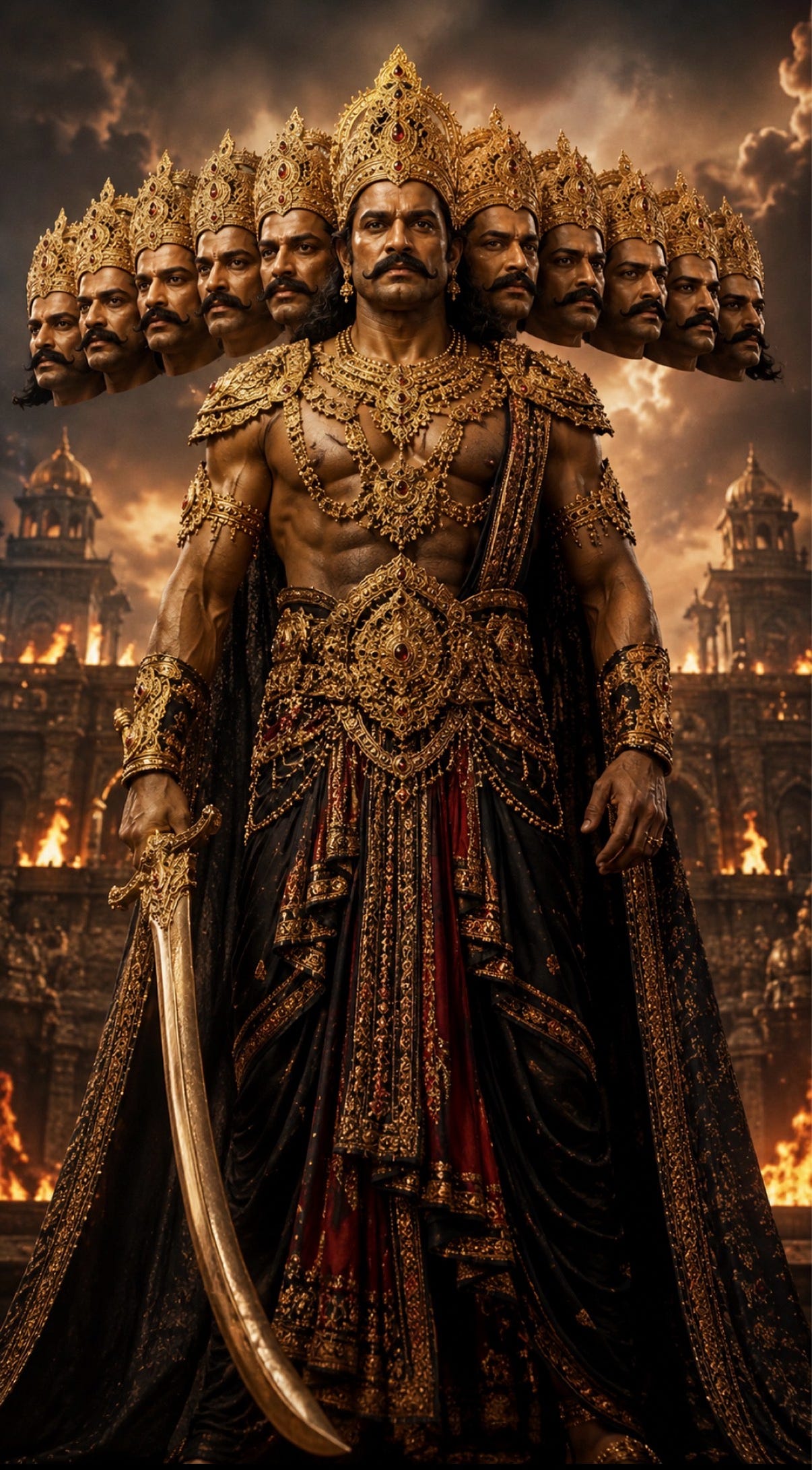
Every villain worth remembering is not born a villain, he becomes one, choice by choice, boon by boon. Ravana’s early life follows the pattern of extraordinary Sanatan tapasya. The Puranas describe him undertaking severe penance to Brahma, some accounts holding that he offered his own heads in sacrifice over great cycles of austerity, until he was granted near invincibility, protection from devas, danavas, gandharvas, yakshas, and other divine and semi divine beings.
But here lies the detail on which the entire epic turns. In his pride, Ravana never asked for protection from humans or from vanaras, forest dwelling monkeys. Why would he. To a being who had subdued gods and humbled the guardians of the directions, mortal men and monkeys seemed beneath consideration, not even worth naming in a boon. This single omission, born entirely of arrogance, becomes the crack through which his entire empire eventually collapses. It is one of the most quietly devastating pieces of storytelling in world literature, the very thing Ravana never feared is the exact form his destruction chooses to take.
This is not incidental to the epic’s moral architecture, it is the moral architecture. Evil, however powerful, tends to build its walls against the threats it respects, and leaves itself wide open to the ones it dismisses as beneath its notice, the very people or things it treats as small. Ravana’s ten heads are traditionally read as a symbol of this same excess, standing for his extraordinary command of the Vedas and Shastras, or for the many vices, desire, anger, greed, delusion, pride, envy, and more, that had come to rule him. A being who could recite scripture with such mastery, and who still could not master himself, is perhaps the most sobering figure the epic offers.
IV. Why the Divine Had to Descend: The Doctrine of Avatar 😱

If Ravana could not be undone by gods, danavas, or any being he had feared enough to guard against, then the solution had to come from outside the boon altogether, not by breaking the rules of the universe, but by finding the one door Ravana himself had left unlocked.
This is where the Sanatan concept of avatar becomes essential to the story, and it is worth sitting with what avatar actually means, because it is often flattened in casual retelling. An avatar is not God pretending to be something He is not. It is the Supreme, formless and infinite, choosing to take a bounded, finite form for a specific purpose, to restore a balance that has tipped too far, without erasing the free will and struggle of the world He enters. The classical teaching, echoed across the Bhagavad Gita, holds that whenever righteousness weakens and unrighteousness rises, the divine manifests, age after age, form after form, to protect the good, to end the wicked, and to re establish the natural order.
This is why the tradition does not see Krishna, Narasimha, Varaha, Vamana, and Rama as separate, unrelated stories, but as different chapters of the same intervention, each shaped by the specific problem it had to solve. Narasimha, half man and half lion, was necessary because Hiranyakashipu had secured a boon against being killed by man or beast, by day or night, indoors or outdoors, so the divine became something that was neither fully man nor fully beast, arriving at twilight, on a threshold. Each avatar, in other words, is a precise answer to a precisely engineered evil. The form is never arbitrary. It is the exact key cut for that particular lock, and Rama’s form was cut for Ravana’s lock alone.
V. Why Human Form, Precisely: The Genius of Rama’s Avatar (The Learnings)

Ravana’s boon left one door open, protection was never sought against humans or vanaras, because he considered them too weak, too insignificant to be worth fearing. And so the divine, in perfect precision, chose to become exactly that: a man. Not a god thundering down from the heavens with celestial weapons blazing from the first page, but a prince born into a human family, subject to human grief, human doubt, human fatigue, and human loss.
This is what makes Rama’s avatar so radical compared to some of the others. Rama does not simply defeat evil by overwhelming force. For most of the epic, he barely uses his divine nature at all, the Ramayana famously keeps Rama’s own awareness of his divinity understated through much of the narrative, allowing him to grieve for Sita as a husband grieves, to feel the sting of exile as a son feels wronged, to weep, to doubt, to strategize like a mortal general building alliances with vanara and bear tribes because he has no army of his own. He wins not by bending the rules of existence but by living entirely within them, more disciplined, more patient, and more devoted to dharma than any being, divine or mortal, around him.
There is a profound teaching folded into this. God did not need to become human to have the power to kill Ravana, a mere thought would have sufficed. God became human to demonstrate that dharma is achievable by human beings, that the path Rama walks is not reserved for gods but is available, in principle, to every person who chooses restraint over impulse, duty over comfort, and truth over convenience. Rama is not merely an avatar sent to kill a demon. He is a template. He shows a species drowning in its own appetites, its own Ravana like pride, exactly what a disciplined, dharma anchored human life looks like when it is lived all the way through, through betrayal, through loss, through exile, through war, and back again.
It also carries a quieter message about how evil should be answered. Ravana’s power was cosmic in scale, yet Rama does not meet it with an equal display of unrestrained divine force from the outset. He meets it with patience, alliance building, and strategy, gathering the very beings Ravana overlooked, the vanaras and the bears, into an army capable of doing what gods alone could not. The lesson embedded here is that overwhelming evil is rarely undone by a single miraculous stroke, it is undone by the patient, disciplined mobilization of exactly those forces the arrogant have taught themselves to ignore.
VI. The Story 👉From Ayodhya to Lanka and Back

The narrative itself carries this teaching forward, scene by scene. Rama is born in Ayodhya to King Dasharatha and Queen Kaushalya, one of four sons whose birth is itself framed as a divine answer to a kingdom’s suffering. As a young prince he is taken by the sage Vishwamitra to protect forest hermitages from the depredations of rakshasas, an early apprenticeship in defending dharma with disciplined force rather than unchecked rage. It is on this journey that he wins the hand of Sita, daughter of King Janaka of Mithila, by lifting and stringing the great bow of Shiva that no other suitor could even move, a moment less about physical strength than about a soul recognized by an equally extraordinary soul.
Then comes the pivot that defines the entire epic’s moral seriousness: on the eve of his coronation as heir to Ayodhya’s throne, Rama is instead exiled to the forest for fourteen years, the result of a promise his father Dasharatha had long ago made to his stepmother Kaikeyi. Rama’s response to this reversal, accepting it instantly, without protest, without political maneuvering, because a father’s word, once given, must be honored, is often treated as the single clearest illustration in the epic of what it costs to live by dharma rather than by self interest. He gives up a kingdom not because he is powerless to keep it, but because keeping it would mean breaking a promise that is not even his own.
In the forest, accompanied by Sita and his devoted brother Lakshmana, Rama lives a life of quiet asceticism at Chitrakoot and later Panchavati, encountering sages, protecting hermitages, and, fatefully, encountering Ravana’s sister Shurpanakha, whose humiliation after a failed advance toward Rama and Lakshmana sets in motion the chain that leads to Sita’s abduction. Ravana, drawn by reports of Sita’s extraordinary beauty and enraged by his sister’s disfigurement, lures Rama and Lakshmana away using the illusion of a golden deer, then abducts Sita and carries her to Lanka, imprisoning her in the Ashoka Vatika grove while relentlessly pressuring her to accept him instead of Rama.
What follows is not an instant war but a patient alliance building, Rama’s friendship with the exiled vanara prince Sugriva, the recovery of Sugriva’s kingdom from his brother Vali, and the emergence of Hanuman, whose leap across the ocean to locate Sita in Lanka remains one of the most beloved episodes in the entire tradition, a portrait of devotion so complete that Hanuman is worshipped across India to this day as the ideal of selfless service. The building of the Setu, the great bridge of stone across the sea to Lanka, engineered by the vanara architects Nala and Nila, allows Rama’s army, an army not of soldiers but of forest tribes, monkeys, and bears, to cross into Ravana’s kingdom.
The war that follows is long and costly. It includes the defection of Ravana’s own brother Vibhishana, who chooses dharma over blood loyalty and joins Rama’s side, a detail the epic treats with enormous respect, since it demonstrates that righteousness is a choice available even to those born into a house of adharma. It includes the deaths of great warriors on both sides, the near fatal wounding of Lakshmana and the urgent flight of Hanuman to fetch the Sanjeevani herb from the Himalayas, and finally the climactic duel between Rama and Ravana, in which the demon king’s ten heads are struck down one after another, only to be restored, until Rama finally looses the Brahmastra that ends the battle for good.
Even here, the epic refuses a simple triumphalist ending. After the war, Sita is asked to undergo Agni Pariksha, a trial by fire, to prove her purity to a watching world, a passage that later retellings and generations of scholars and devotees have wrestled with, some reading it as Rama bowing to social expectation rather than personal doubt, others reading it as one of the epic’s most painful and human moments, showing that even an ideal king is not free from the pressures of the society he must lead. The couple’s eventual return to Ayodhya, and Rama’s coronation, gives the tradition its enduring image of just, harmonious governance, Ram Rajya, a reign so associated with fairness and prosperity that it remains, even today, the standard against which good governance in India is measured.
VII. What Rama Teaches Us: Many Roles of One Life 🙏🏻
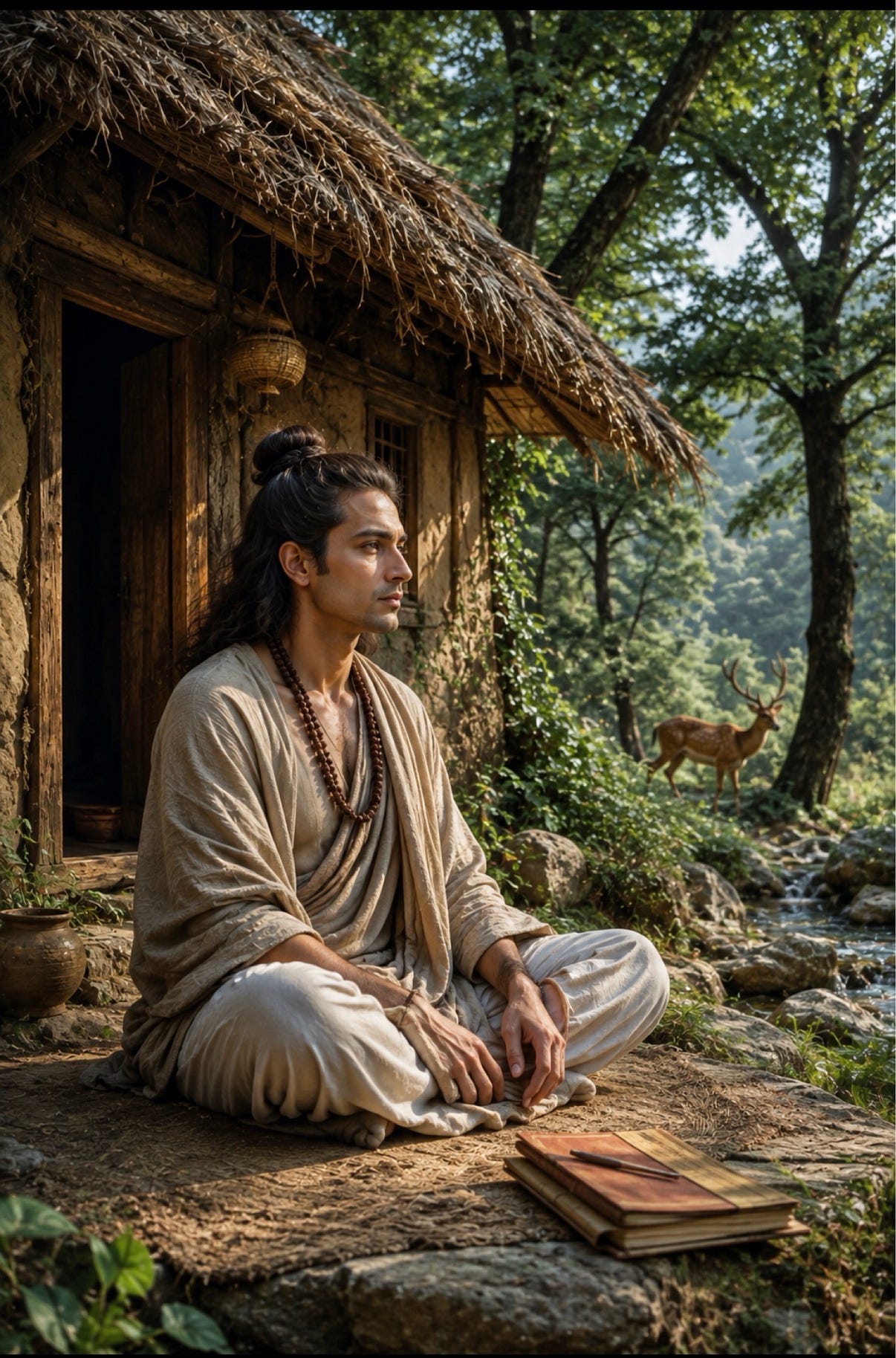
What makes Rama endure as Maryada Purushottam, the best among those who uphold maryada, the boundaries of right conduct, is not any single heroic act but the sheer consistency of his character across every relationship life demanded of him.
As a son, he accepts an unjust exile without bitterness, because a father’s word carries weight that personal ambition does not override. He does not ask why he must suffer for a promise he never made, he simply honors it, because for him the dharma of a son is not conditional on convenience.
As a brother, his bond with Lakshmana, who chooses to leave behind comfort and follow Rama into fourteen years of forest hardship out of pure devotion, becomes the tradition’s enduring model of sibling loyalty, just as Bharata’s refusal to enjoy the throne he did not seek, ruling instead as a caretaker in Rama’s name, placing his brother’s sandals upon the throne as a symbol of the rightful king, became a model of humility in power. Neither brother competes for the crown, and that restraint is treated by the epic as no smaller an achievement than any battlefield victory.
As a husband, his love for Sita drives the emotional center of the epic, his grief at her loss, and the extraordinary lengths, an ocean bridged, an army assembled from nothing, a demon empire confronted, to which he goes to recover her, is presented as devotion, even as later episodes complicate this picture and invite generations of readers to wrestle honestly with the burdens placed on Sita herself, a conversation the tradition itself has never closed and continues to hold with real seriousness.
As a friend, his treatment of Sugriva and Vibhishana shows a leader who builds alliances not through domination but through fairness and shared purpose, restoring Sugriva’s kingdom before ever asking for his help, and welcoming Vibhishana as an equal despite his lineage, judging him by his choice of dharma rather than the house he was born into.
As a warrior, Rama is repeatedly shown offering Ravana chances to relent, to release Sita, to choose a different path, even mid war, a portrait of a fighter who seeks the restoration of order, not the humiliation of an enemy for its own sake. Even in victory, the epic does not let Rama gloat, the war ends in solemn ritual, not celebration.
As a king, the Ram Rajya that follows his coronation becomes shorthand, across centuries of Indian political thought, for governance defined by justice available equally to every subject, prosperity shared rather than hoarded, and a ruler who considers himself accountable to the people rather than above them, a standard so demanding that it remains aspirational even now.
Taken together, these roles form the epic’s real curriculum: dharma is not one grand gesture performed once, but a thousand smaller decisions, made consistently, inside every relationship a person holds, with parents, siblings, spouse, friends, enemies, and subjects alike. It is precisely because Rama’s greatness is distributed across so many ordinary human relationships, rather than concentrated in one miraculous act, that his example remains usable by people who will never fight a war or rule a kingdom, but who will, every one of them, be a son or daughter, a sibling, a partner, a friend.
VIII. The Uncomfortable Wisdom of Ravana 👇
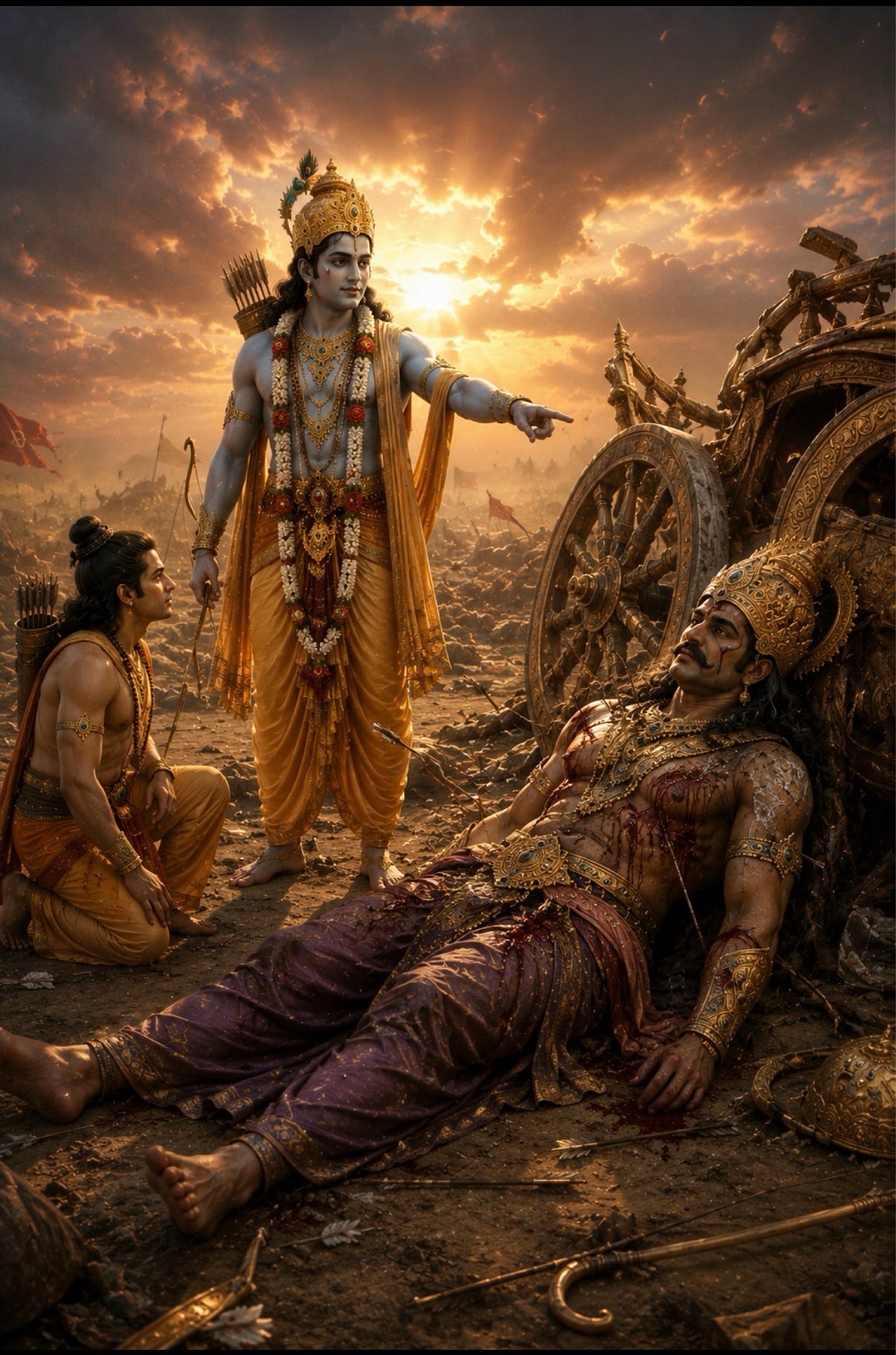
It would be a disservice to the epic’s depth to treat Ravana as a simple figure of pure malevolence, because the Ramayana itself does not. He is shown, even at the end, imparting genuine wisdom to Lakshmana as he lies dying, the well known episode in which the dying Ravana, at Rama’s own instruction, teaches Lakshmana lessons of statecraft and life, because even an enemy’s knowledge is worth honoring when it is true. Some retellings recall Ravana’s early life as a devoted, learned Brahmin before ambition and appetite consumed him.
This complexity is the point. The Ramayana does not teach that evil people are born stupid or without gifts, it teaches that gifts detached from humility become instruments of self destruction. Ravana’s tragedy is not a lack of capability, he had more capability than almost anyone in the epic, but a refusal to submit that capability to anything larger than his own desire. That is a warning meant less for the powerless than for the powerful, less for the ignorant than for the accomplished, because unchecked ego is a danger that grows precisely in proportion to one’s gifts, not in spite of them. A lesser scholar, a lesser devotee, a lesser king could not have built an empire as vast as Lanka, and could not have fallen as far.
IX. The Proof That Still Walks Among Us

For millions across the subcontinent and beyond, the Ramayana is not experienced only as scripture read in isolation but as a living geography, a story whose settings can still be walked, touched, and stood inside. Many believe this living continuity is itself a form of evidence, even where formal archaeological dating remains debated among scholars and historians.
The Essence of Great Epic is passed to generations since ages in India and surrounding nations like Indonesia and Manu more.
Ayodhya on the banks of the Sarayu river continues to be venerated as Rama’s birthplace, its temples and ghats drawing pilgrims across generations. Chitrakoot, where Rama, Sita, and Lakshmana are believed to have spent a significant portion of their exile, remains dotted with sites such as Ram Ghat and Kamadgiri, still circumambulated by devotees performing the same parikrama tradition holds was walked by the exiled prince himself. Panchavati, near present day Nashik, is honored as the forest home from which Sita was abducted, its name still carried by the neighborhood that surrounds it. Kishkindha, the vanara kingdom of Sugriva and Hanuman, is widely identified by tradition with the boulder strewn landscape around Hampi and Anegundi in Karnataka, a terrain whose caves and hills are still shown to visitors as the settings of specific episodes from the epic.
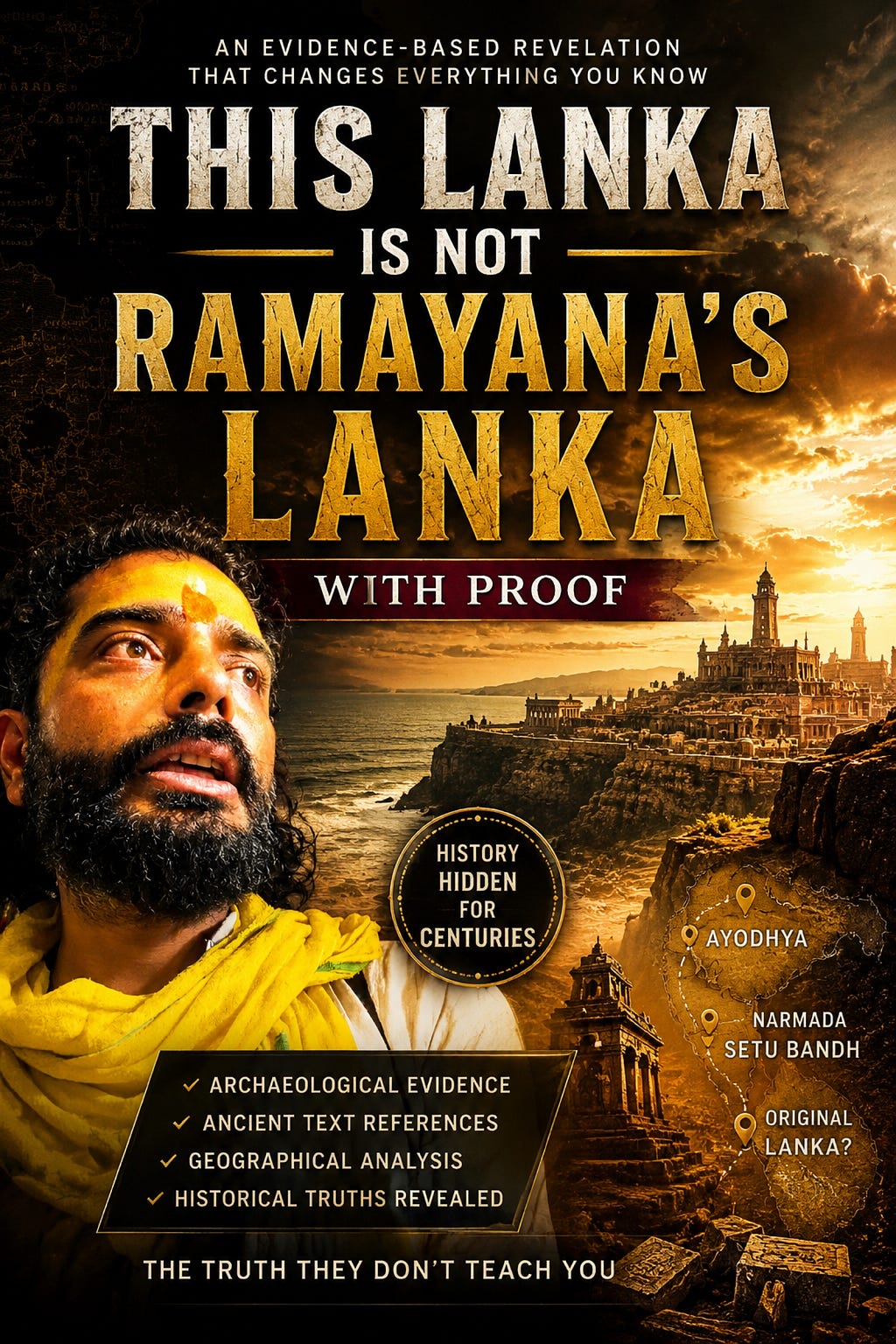
Perhaps the most striking is Rama Setu, known internationally as Adam’s Bridge, a roughly thirty kilometer chain of limestone shoals stretching between Dhanushkodi in Tamil Nadu and Mannar Island off Sri Lanka’s coast, visible even in satellite imagery as a strikingly linear formation across the shallow strait. Some researchers and pilgrims point to this formation as physical testimony to the great bridge described in the epic, engineered by Rama’s vanara army to cross into Lanka, others, including many geologists, describe it as a natural sandbar shaped by centuries of sedimentation. The debate itself has become part of the story’s modern life, occasionally reaching Indian courts and government bodies as questions of heritage, environment, and faith intersect.
Sri Lanka carries its own dense layer of Ramayana linked sites, passed down through local tradition, Sita Eliya near Nuwara Eliya, associated with the Ashoka Vatika grove where Sita was held captive, Ravana Ella Falls, said by local lore to be connected to caves once used to hide her, and Ussangoda, a barren coastal stretch some local traditions associate with the site of Ravana’s aerial battles, its unusual soil composition often cited by visitors as a curious, if scientifically debated, detail. Meanwhile, generations of researchers using planetarium software to reconstruct ancient planetary positions described in the Valmiki Ramayana’s own verses have proposed dating the events to several thousand years before the common era, a method some find compelling and others regard as inconclusive, but one that continues to fuel serious inquiry into just how old this living story truly is.
Beyond the subcontinent, the Ramayana’s reach becomes almost startling. Thailand’s national epic, the Ramakien, is a retelling of Rama’s story so central to Thai culture that its former capital was named Ayutthaya after Ayodhya itself, and its kings have long taken the royal title Rama. Cambodia’s Reamker, Indonesia’s Kakawin Ramayana performed nightly beside the Prambanan temple complex, Myanmar’s Yama Zatdaw, and Laos’s Phra Lak Phra Lam all carry the same core story, reshaped through centuries of local language, art, and performance. That a single narrative could travel across oceans and mountain ranges, taking root so deeply that entire nations built parts of their identity, and even their royal titles, around it, is treated by many devotees not as coincidence but as confirmation of the story’s enduring, almost gravitational truth.
Whether one approaches these sites as literal history, sacred memory, or symbolic geography, their sheer persistence, temples still standing, rituals still performed, place names still spoken exactly as the epic names them, thousands of years after the story is said to have unfolded, is, for many, its own kind of proof, not necessarily of forensic fact in the way a laboratory would define it, but of a truth deep enough that an entire civilization has refused to let it fade.
X. What We Can Learn: Carrying Rama Into an Ordinary Life 🙏🏻

The lessons drawn from Rama’s life are not designed for kings and warriors alone, they translate, almost uncomfortably precisely, into the pressures of an ordinary life lived far from any throne or battlefield.
Keep your word even when it costs you something real. Rama’s acceptance of exile is not a lesson in blind obedience but in the idea that integrity has no value if it only holds when it is convenient. A promise tested only by easy circumstances was never really tested at all.
Do not mistake strength for the right to dominate. The epic’s heroes, from Rama to Hanuman to Vibhishana, wield extraordinary power but never for self aggrandizement, Ravana’s tragedy shows exactly what happens when power stops answering to restraint, and how quickly capability curdles into cruelty once it forgets what it is for.
Loyalty and humility are not weaknesses. Lakshmana’s devotion and Bharata’s refusal of a throne he did not earn both demonstrate a strength that has nothing to do with force, the willingness to set aside one’s own claim for the sake of what is right is, in the epic’s own terms, no lesser a victory than anything won with a bow.
Even an enemy’s virtue deserves respect. Rama’s willingness to learn from the dying Ravana, and his welcome of Vibhishana despite his birth, model a rare kind of moral clarity, judging people by their choices, not merely their origins or their side in a conflict.
Unchecked desire corrodes even genius. Ravana’s scholarship, devotion, and gifts could not save him from the consequences of an ego that had stopped listening to anything beyond itself, a caution as relevant to modern ambition, in a career, a business, a public life, as it was to an ancient demon king ruling an island of gold.
Build alliances with those the proud overlook. Rama’s victory was made possible by vanaras and bears, precisely the beings Ravana never thought to fear. There is a lasting lesson here about who gets underestimated, and about how often real strength gathers quietly among the very people or circumstances that arrogance has already dismissed as insignificant.
Patience is not passivity. Fourteen years of exile, months of searching for Sita, the slow work of building an army and a bridge, none of it was rushed, and none of it was idle. Rama’s patience was active the entire time, a discipline rather than a delay.
And perhaps most quietly, the epic teaches that dharma is rarely convenient. It costs Rama a kingdom, fourteen years of hardship, and profound personal grief. The Ramayana does not promise that living rightly will be easy or immediately rewarded, it promises only that it is worth doing regardless, because the alternative, power without restraint, brilliance without humility, is shown, through Ravana, to end in ruin no matter how invincible it first appears.
XI. Closing: The Story That Refuses to End

The Ramayana does not really end at Rama’s coronation, and perhaps that is the final, quiet teaching hidden inside it. It is retold every year in Ramlila grounds across India, chanted in the verses of Tulsidas’s Ramcharitmanas in homes that have recited it for generations, performed in shadow puppetry across Southeast Asia, and carried, temple by temple, ghat by ghat, hill by hill, across a landscape that still bears its footprints.
It endures not because it is an old story well told, but because the questions at its center, how does good stand firm against evil that seems, for a time, unstoppable, what does a life anchored to truth actually cost, why does the divine choose to walk beside us rather than rule from a distance, have never stopped being the questions every generation must answer for itself. Ravana had to be answered, and the answer could not come from another god thundering down in glory, it had to come from within the very form Ravana had dismissed as too small to matter. Rama took a human form to show, once and for all, that the path he walked was never reserved for gods alone. It was always, quietly, an invitation, and it remains one still, to every person willing to choose dharma over convenience, restraint over appetite, and truth over comfort, one ordinary decision at a time.
Show your support to motivate me in exploring the unexplored hidden mysteries of Hinduism 🕉️ Subscribe on Medium
메타데이터
- post_id
- ca38e4d679e7
- slug
- the-core-of-the-hindi-epic-ramayana-how-why-god-chose-to-walk-as-man-ca38e4d679e7
- url
- https://medium.com/@mystic_varruna/the-core-of-the-hindi-epic-ramayana-how-why-god-chose-to-walk-as-man-ca38e4d679e7
- canonical_url
- https://medium.com/@mystic_varruna/the-core-of-the-hindi-epic-ramayana-how-why-god-chose-to-walk-as-man-ca38e4d679e7
- author_url
- https://medium.com/@mystic_varruna
- status
- ok
- fetched_at
- 2026-08-17 00:33:41