Inside the Supply Chain (Part 2): Shaking Down “Factory Direct” Scams and Their Toxic Back Alleys
The high cost of low prices: Uncovering the environmental disaster and quality gaps behind the “Source Factory” illusion.
Inside the Supply Chain (Part 2): Shaking Down “Factory Direct” Scams and Their Toxic Back Alleys
Also, full disclosure: my English is terrible, and I heavily rely on translation tools to write and reply here. I honestly don’t know if doing that feels disrespectful to you guys as readers, but I can promise you this — every single insight and industry secret I share is 100% real, earned through 10 years of sweat and grinding in manufacturing chains.
Since the first post covered the fake storefronts on the frontend, today I’m taking you backstage to talk about the holy grail of modern online shoppers: “Factory Direct” and “Source Factories.”
The truth is, legitimately compliant and law-abiding factories rarely bother with “factory direct” sales. Meanwhile, that “direct-from-source” bargain you just bought is highly likely born in an unlicensed, black-market workshop pumping heavy metals into nearby rivers.
Today, I want to pull back the curtain on a reality that platforms desperately try to hide.
1. The Manufacturing Paradox: Why Compliant Factories Stick to OEM
E-commerce networks love to push the utopian fairy tale of cutting out the middleman to lower prices. But fundamentally, the success rate of a legitimately compliant factory pivoting straight to retail consumers is devastatingly low. That is exactly why reputable, law-abiding factories still primarily focus on being OEMs (Original Equipment Manufacturers) for established brands.
When a factory goes direct-to-consumer (to-C), they have to sell a finished product. They can no longer just focus on the one specific manufacturing step they excel at, like they do when serving a brand. If a factory wants to run its own business long-term, it inevitably needs a brand identity to anchor it. At that point, innovation becomes a hurdle you simply cannot bypass.
Whether it’s building an internal R&D team from scratch or seeking risky external partnerships, it’s a long, high-risk capital investment. One wrong move, and you might even damage the interests of your existing OEM clients — ending up with nothing on both ends. Furthermore, building distribution channels and a solid reputation doesn’t happen just by crazily throwing money at ads. A brand’s cultural philosophy, core values, quality control system, and visual identity — these are absolutely crucial, and I think we can all agree on that.
2. The Traffic Rig: Digital Malls Need Famous Anchor Tenants
First, we need to understand one basic truth: an e-commerce platform is just like a physical shopping mall. If no merchants move in, it’s just a worthless concrete building, and the owners can’t make a dime. Therefore, maximizing transactions (GMV) is its core mission.
It’s just like in real life — when a large mall looks for tenants, they always give the best prime spots, sometimes even rent-free, to famous luxury brands. The building is essentially using the credibility of those legacy brands to endorse itself. E-commerce platforms operate on the exact same logic. That’s why you’ll notice big brands rarely spend heavily on platform ads themselves; the algorithm feeds organic traffic to them for free.
Since these brands already offer innovation, quality, excellent service, and solid warranties, as a consumer, it doesn’t matter where you buy them. But because consumers see these reliable brands on the platform, they naturally develop a sense of trust in the platform itself. Once that trust is established, the platform starts recruiting third-party merchants like crazy. And that’s when these so-called “factory direct” sellers finally appear.
3. Slicing Open the Phrase: “Factory Direct” is Mostly a Sham
In reality, most of them aren’t factories at all. Even the smallest real factories don’t want to deal with this. Processing factories chase volume. Retail consumers are too scattered; serving B2B clients is always their best option.
It’s a simple logic: if I’m a factory boss, do I want to earn a stable processing fee by manufacturing for a brand that has spent decades building its market? Or do I want to “cut out the middleman,” sell at a retail price (which honestly doesn’t leave much more profit margin than the processing fee once you factor in overhead), build a whole new team from scratch, and go head-to-head against those deeply established brands? I think if anyone calms down and thinks about it, the answer is obvious.
So why are there so many sellers in the market waving the “factory direct” banner, claiming they’ve cut out the middleman to give consumers a bargain? There’s only one conclusion: these are highly likely to be scams.
Let me tell you the story behind this. If you rent a physical shop in a mall, the rent could never be just a few dozen bucks a month. But e-commerce platforms are different. For just $1,000 a month, you can open dozens, even hundreds of storefronts simultaneously. You can just pick random names — names that aren’t even registered with the trademark office, taking cost-cutting to a psychotic extreme. Will consumers really take the time to look them up? This is the “Store Cluster” model I mentioned in my first post. It requires zero delicate operations or management; the platform’s algorithm will inevitably drag bargain hunters in.
4. Enter the Real Factories: The Bottom-Feeding Weeds
I’ve talked a lot of theory, but now the real factories in this story finally make their entrance.
The ones serving these massive store clusters are bottom-feeder operations that sit at the absolute floor of the industry. Their quality is so abhorrent that they are completely blacklisted from legacy brand OEMs — in fact, they can’t even land a contract with cash-strapped garage startups or indie design studios that have even a baseline requirement for quality. Originally, these bottom-feeders were supposed to be starved out by market selection. But the loopholes in e-commerce gave them the perfect soil to thrive.
All they need to do is copy and paste. They don’t need to care about quality; they just need to know how to operate the machinery. Many are completely unlicensed, black-market entities. For example, an e-commerce boss with 100 stores will say, “Copy product A for me.” The factory buys an original, uses a laser scanner (which takes anywhere from a few minutes to a few hours), and instantly dumps a 3D model. Since it’s a direct clone, they don’t spend a single second understanding why a screw or a clip is placed in a certain spot.
Next comes opening a mold. They don’t need precision molds. They use the absolute worst mold steel — sometimes, for speed, it’s not even steel, bringing their tooling costs close to zero. Then they load the raw materials and start production. The entire cloning process is incredibly fast. You can never catch all these black-market factories; they are like weeds. At the slightest hint of a regulatory crackdown, they just pack up and vanish overnight. The space is rented, the equipment is second-hand, so they just abandon it without a second thought. Since there are no quality requirements, as long as the machine turns on, it works — it’s all scrapped hardware patched together.
But do not underestimate this cheap, salvaged machinery. The production capacity is massive. A single $5,000 second-hand machine can churn out thousands of counterfeit phone cases in a single day. Let me break down the math for you: Suppose they run a basic 1-cavity mold (meaning the mold spits out one product per cycle). Even with a 30-second cycle time — which is laughably slow, practically a snail’s pace in legitimate manufacturing — running the machine for just 10 hours a day yields 1,200 units. Now, if the boss spends a mere $700 on a second-hand robotic arm for automatic pick-and-place, and modifies the tool into a 2-cavity mold, they can run a fully automated, 24/7 continuous operation. Just like that, their daily output sky-rockets to 5,760 units!
5. The Irreversible Cost: An Eco-Disaster Funded by Bargain Hunters
They don’t work alone; they exist as a highly coordinated shadow industrial chain. The “high-end” ones copy circuits and cracked software to mass-produce cheap motherboards. The “low-end” ones handle the messy surface treatments — spraying, electroplating, anodizing, and chemical polishing. I absolutely despise the ones doing surface treatments. They produce massive amounts of toxic, heavy-metal-laden wastewater.
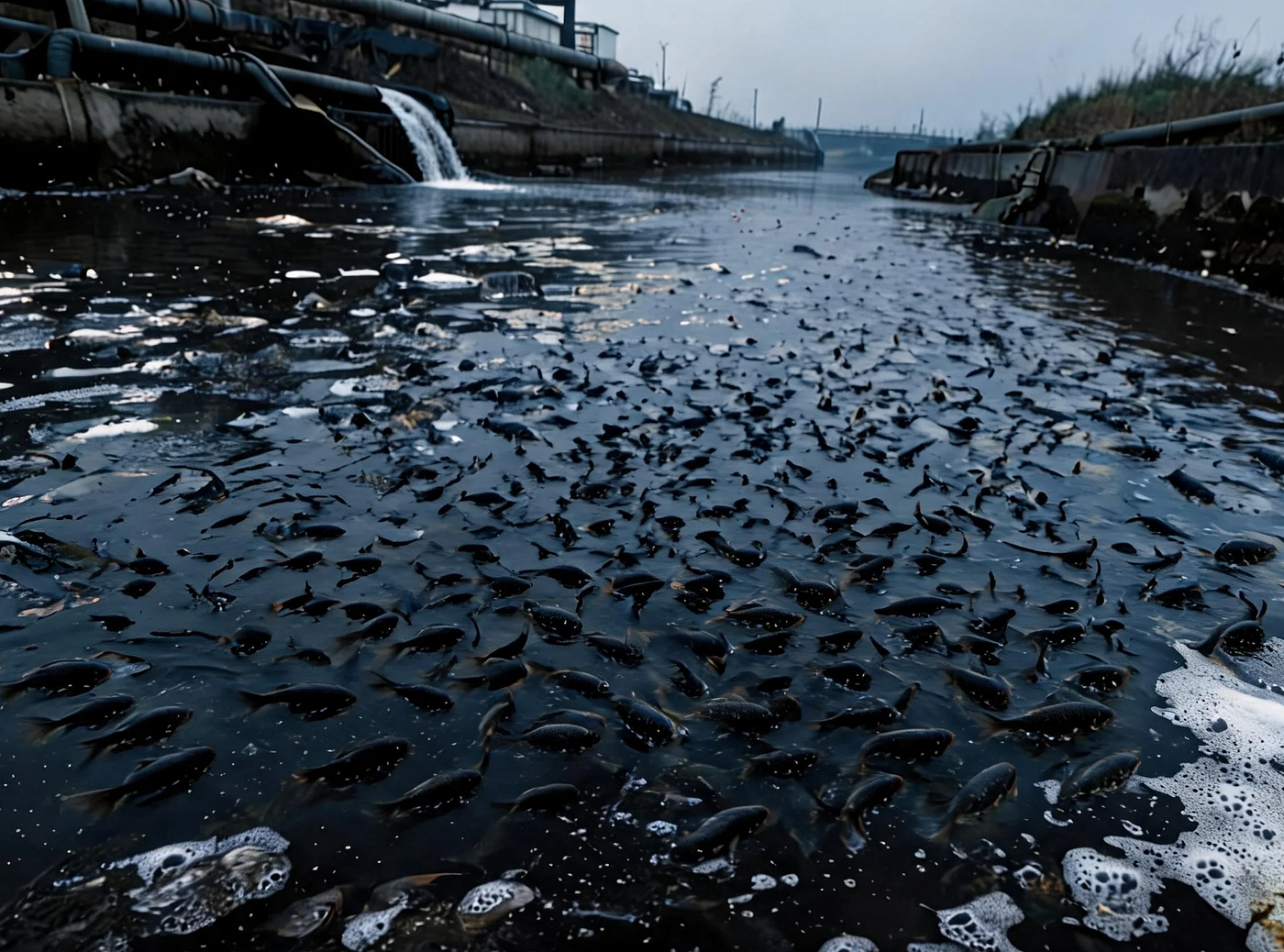
To evade environmental enforcement, they secretly lay underground pipes to discharge it directly into local rivers, mix it into municipal sewage, or sometimes just dump it right onto the open ground. The environmental destruction caused by this massive army of “guerrillas” is scattered but widespread. It is immense, irreversible ecological damage.
I once witnessed a wastewater treatment scene firsthand. Government workers were pouring massive containers of live fish into a black river that reeked of pure rot. The fish were densely packed, writhing, suffocating, and squeezing against each other in the thick sludge. I stood on the bridge looking down, and it literally felt like the black water itself was alive and crawling like a monster. I will never forget that image for the rest of my life.
Yet, powered by the massive profit margins of e-commerce, both the boss with 100 storefronts and these guerrilla fighters are making an absolute fortune. All they have to do is take a tiny fraction of those profits to completely control the narrative online. That’s why there are so few voices exposing them, and an overwhelming number of voices praising them as “affordable, high-quality alternatives.”
6. The Irony of “Accidental Safety” in a Broken Market
Let me close this by sharing a little story. Once, I accompanied a trusted supplier boss to buy an industrial electric motor. Curious, I asked him, “Why not just buy one online? It saves so much time.”
He scoffed and told me we had to go to a specialized salvage warehouse that dealt strictly in second-hand motors. When we arrived, I found a massive warehouse of about 3,000 square meters, with industrial motors piled up like mountains. We picked out a motor and started negotiating the price. The exterior of this motor was absolutely battered, rusted, and worn out. When I heard the final price, I was shocked — this piece of scrap metal was actually more expensive than a brand-new motor of the same specifications online.
Catching the look of pure confusion on my face, the warehouse owner lit a cigarette and chuckled. “Kid, don’t look at how beat-up it is. Once I run a load test and open it up for you, you’ll see why.” He pointed to the faded factory nameplate. “Look at the date. This thing is 30 years old. Now look at the condition inside — the thickness of the copper wire, the number of turns. This is solid, honest craftsmanship.”
He gleefully told me he bought this warehouse 7 years ago for $6 million, relying entirely on repeat B2B customers buying second-hand hardware. He laughed, noting that the land alone had now appreciated to $10 million, making him more money than the actual motors. Then, he took a drag from his cigarette and sighed with a deep emotion that I will never forget.
“This world is truly bizarre now,” he said. “Years ago, the market was flooded with fake electrical wires. If you lacked judgment, you’d buy fakes, and one careless moment later, your house would catch fire. Now? It’s great. We have a bunch of fake motors with falsely labeled power ratings. When you pair them together, the power drops across the board, and it’s actually safe!”
메타데이터
- post_id
- ca4f88b3bb47
- slug
- inside-the-supply-chain-part-2-shaking-down-factory-direct-scams-and-their-toxic-back-alleys-ca4f88b3bb47
- url
- https://medium.com/@tommy922guoji/inside-the-supply-chain-part-2-shaking-down-factory-direct-scams-and-their-toxic-back-alleys-ca4f88b3bb47
- canonical_url
- https://medium.com/@tommy922guoji/inside-the-supply-chain-part-2-shaking-down-factory-direct-scams-and-their-toxic-back-alleys-ca4f88b3bb47
- author_url
- https://medium.com/@tommy922guoji
- status
- ok
- fetched_at
- 2026-06-09 15:37:30