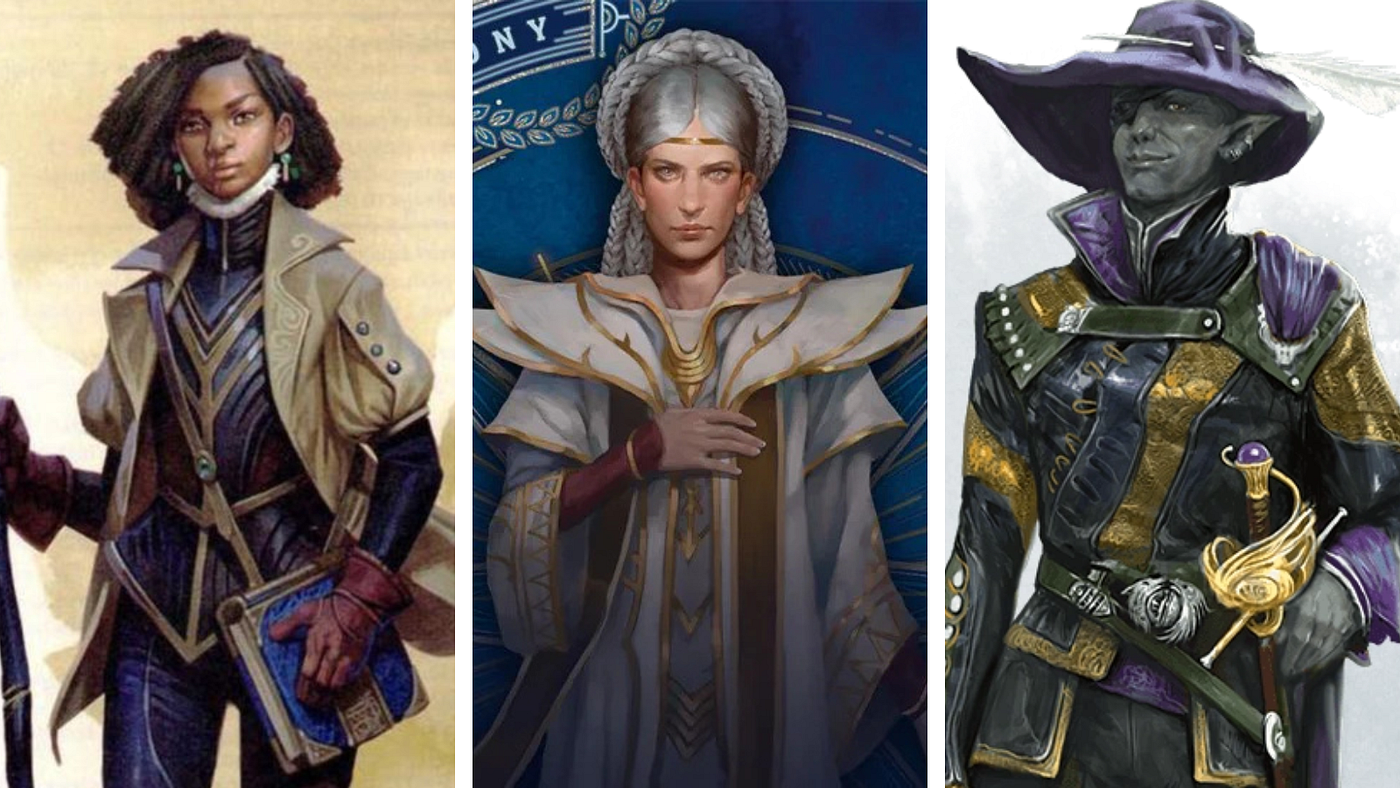
Dissecting the Tiers of Play Part 2 (Heroes of the Realm)
In my last article on this subject, I discussed Tier 1, the ‘Local Heroes’ adventuring tier of Dungeons & Dragons games. This post will be…
Dissecting the Tiers of Play Part 2 (Heroes of the Realm)

We know the origin story. It’s time for the sequel.
In my last article on this subject, I discussed Tier 1, the ‘Local Heroes’ adventuring tier of Dungeons & Dragons games. This post will be dedicated to Tier 2, the ‘Heroes of the Realm’ tier, also known as levels 5–10.
The 2014 Dungeon Master’s Guide states that adventurers at level 5 ‘have found their place in the world and have begun to involve themselves in the dangers that surround them’. This is a pretty good starting point for thinking about Tier 2 because it reframes Tier 1 as an origin story, an arc about manifesting powers, overcoming some kind of initial threat and taking on the role of someone who gets involved in future conflicts.
I used DC and Marvel comics characters as a point of reference in my last article, and I’ll do the same here. Tier 1 is about Bruce Wayne donning the cape and cowl or Tony Stark building the suit. Tier 2 is about the mob hiring the Joker or Whiplash building himself a suit. The stakes, the powers, the tension, the danger — all have increased.
Speaking of powers increasing, what advantages do Tier 2 characters have over Tier 1? For starters, damage output increases. Martial-focused classes — fighters, monks, paladins, etc. — gain an extra attack. Spellcasters gain an extra damage die to their cantrips. This immediately improves their ability to deal with most mundane threats.
Massive area of effect spells, like Fireball, Lightning Bolt and Flamestrike, become a lot more common. Arcane casters gain more useful utility spells like Slow, Haste, Dimension Door, Greater Invisibility and Rary’s Telepathic Bond. Summoning also becomes much more common, which allows characters to soak up and dish out even more damage.
Healers can upcast for greater healing, but more importantly, this is the tier where they can bring people back from the dead, assuming they’re sufficiently wealthy. Revivify can restore anyone who died within the last minute, and Raise Dead gives you a full 10 days for a resurrection. All classes will get at least one ability score improvement, and two subclass features, which are usually pretty big upgrades.
In terms of numbers, proficiency bonus increases to +4 by the end of Tier 2, which gives martial classes a +9 maximum to hit without magic weapons, and spellcasters a similar bonus to spell attack rolls. This would give them at least a 50% chance of hitting most enemies. Remember that in core D&D, before we start getting into supplements, the highest AC of a creature is the Tarrasque with 25, which is a world-ending behemoth your campaign is unlikely to contain (especially at Tier 2).
Spell save DC would be around 17 for a mage or healer with max in their spellcasting stat, but again, this is without magic items. These are going to become a lot more common during this tier as players roam more, encounter greater threats and start to have the money and time to invest in purchasing better gear.
So, in Tier 2, the average party can dish out roughly twice as much damage, handle big crowds of enemies, travel increasingly long distances in the blink of an eye, control terrain and bring people back from the dead. They are now the go-to people for any problem happening in the region rather than just their local community, and it’s probably their Tier 1 adventure that brought them to everyone’s attention.
Going back to my Batman/Iron Man examples, these are actually great examples of Tier 2 adventures. Why? Because they are based on the world reacting to the player characters. This isn’t another threat arising in the distance to drag the characters into the thick of things; this is a clear and present danger that is not only directed at the characters specifically but a result of what the characters did previously.
Imagine if the thieves’ guild the characters smashed in Tier 1 was run by a consortium of merchants who summon a powerful fiend to deal with the characters in Tier 2. It makes the world feel vital when it reacts to the player characters in this way, and gives the players consequences to their actions that create fun drama at the table.
In fact, this might be why there are very few official adventure modules that start at Tier 2. Adventures like Curse of Strahd, Out of the Abyss, Princes of the Apocalypse, Hoard of the Dragon Queen and Rime of the Frostmaiden, to name but a few, span both Tier 1 and Tier 2, with the latter part of the adventure building on themes from the first part, such as attracting the attention of an evil vampire lord, chasing a doomsday cult the length of the continent or returning into the darkness beneath the earth to investigate a growing threat before it gets too big.
Interestingly, the only official adventure that omits Tier 1 is Dungeon of the Mad Mage, which spans all three remaining tiers of play, is expected to be a bolt-on to Dragon Heist, but doesn’t actually build on the events of that adventure. Make of that what you will.
A lot of things get bigger in Tier 2.
Rewards will be greater because the party will be tangling with tougher enemies with greater resources. The wealth of cities, even nations, will be on the line rather than just towns and villages. During this tier, player characters are looking at getting their hands on a Rare major magic item, such as a Dragon Slayer or Ring of Spell Storing, and a few Rare minor magic items, such as Elixirs of Health, Superior Healing Potions or Scrolls of Protection.
These items are best tailored to the adventure and to the party obtaining them. A Dragon Slayer bow would be much more useful to an assassin rogue with a personal vendetta against the adult black dragon pulling the strings behind the scenes. It will have a lot more weight if the bow has a name, if it has a quest attached to it, and if wielding it feels like a major advantage to the party overall.
Timescale is also important. A Tier 1 adventure might take a week of actual adventuring. A Tier 2 adventure might take a few months as the players need to do more research, travel around more and bring long-term projects to fruition. They still don’t have access to magic that allows long-distance travel in the blink of an eye, though they will get Teleportation Circle at Level 9.
Travel will be important in these campaigns, however. Due to the complexity of the issues in adventures at Tier 2, characters should probably expect to cross the borders of kingdoms, travel to far-flung locations and maybe even to different planes of existence (the Feywild is probably the least objectionable of these at lower level).
The issue is scale. Tier 2 adventures should just feel bigger than Tier 1 adventures.
And, naturally, the enemies will grow in power. Using the XP budgets from the 2024 DMG, an average four-character party can handle a CR 14 creature as a high-difficulty encounter by the time they reach Level 10. This means Vampires, Beholders, Ice Devils and full-grown Black Dragons are all on the table as possible final bosses at this tier.
And they make great final bosses. Each of these can have their own personalities, their own lairs, their own hosts of minions, full names and a set of roleplay traits. They can make early appearances in the adventure to terrorise the characters, throw obstacles in their way regularly and sit at the centre of intricate webs of plots that the players can begin to unravel. They are the nemeses that the whole of Tier 2 builds up to.
Strahd is a fantastic example of this kind of nemesis. The entire adventure is about the player characters gaining power and recruiting allies to take the fight to Strahd directly, laying siege to his lair and ending his reign of terror over Barovia. Learning his weaknesses, neutralising his allies and underlings, and dodging his attempts on their lives are what the characters will spend most of their time doing.
What is the legacy of Tier 2 characters? Usually peace at a cost, a temporary safety with a looming, greater threat on the horizon. They might receive a knighthood, a mansion, maybe even become a local leader in their area, but with those rewards comes the responsibility of caring for the people in those territories in their hour of need.
And that hour of need will come, but we can talk about that more when we discuss Tier 3.
메타데이터
- post_id
- ca5bc57bb582
- slug
- dissecting-the-tiers-of-play-part-2-heroes-of-the-realm-ca5bc57bb582
- url
- https://medium.com/@FateAndFlannel/dissecting-the-tiers-of-play-part-2-heroes-of-the-realm-ca5bc57bb582
- canonical_url
- https://medium.com/@FateAndFlannel/dissecting-the-tiers-of-play-part-2-heroes-of-the-realm-ca5bc57bb582
- author_url
- https://medium.com/@FateAndFlannel
- status
- ok
- fetched_at
- 2026-07-15 02:45:04