Modeling Burst vs Sustained Release in Localized Chemotherapy Delivery
Introduction
Modeling Burst vs Sustained Release in Localized Chemotherapy Delivery
Introduction
Approximately 97% of cancer patients experience at least one episode of bone marrow suppression during treatment, leading to fatigue, infections, and treatment delays. These side effects result from systemic delivery, which injects chemotherapy drugs straight into the bloodstream. Only a small fraction of the drug reaches tumor tissue, while the majority affects healthy, rapidly dividing cells throughout the body.
As medical technology advances, researchers have begun exploring 4D-printed smart scaffolds as a way to deliver chemotherapy locally. These scaffolds respond to the pH imbalance of tumor regions, recognizing the higher acidity of the site and triggering a release of the drug directly into the tumor with minimal leakage.
After observing reduced systemic exposure using an initial delivery model, I theorized that sustained release of localized chemotherapy will decrease toxicity and increase exposure the most as compared to burst and systemic methods.
Systemic vs Localized Delivery Model
Primarily, a pharmocokinetic model was created to represent cyclophosphamide over a time period of 72 hours. The leakage fraction and half-life of smart scaffolds were estimated based on ranges found in related literature. These results present a broad but insightful comparison between systemic delivery and localized delivery.
This model suggested that localized delivery significantly increases the tumor concentration and decreases the blood concentration of chemotherapy, like expected. Localized delivery reduced systemic exposure by 96.06%, suggesting that direct tumor deposition may substantially decrease off-target chemotherapy circulation.
During this model, localized delivery was generalized in order to fit the 72-hour time span. However, smart scaffolds have the potential of a longer timeline, which led me to question whether or not release profiles made a significant difference in toxicity and tumor concentration following localized deliveries.
Method
To understand the significance of different release methods, a compartment-based pharmocokinetic simulation was developed in Google Sheets to compare burst, sustained, and systemic chemotherapy release profiles. The framework used recursive updates to compare the plasma concentration and tumor concentration of burst release, sustained release, and systemic release.
The following equation was used for plasma concentration:

This equation is part of a recursive model that is updated at each time step by accounting for drug release and first-order elimination from circulation. Ct refers to the plasma concentration at time t. ke serves as the elimination constant, and Δt is the simulation time step, which was regulated at 0.1 units. This structure allowed the model to simulate how different release kinetics affect systemic accumulation and clearance over time.
The following equation was used for tumor exposure:

The tumor concentration was a part of the recursive model that combined systemic uptake of plasma and direct localized delivery from the scaffold. In scaffold-based systems, an additional term was included to reflect direct deposition into the tumor area rather than distribution in the bloodstream first.
This model compares burst and sustained release profiles of localized delivery. Burst release scaffolds deliver the majority of the drug rapidly during the initial time step, with the drug concentration decreasing over time. Sustained release follow a different release profile approximated in this model using a Higuchi-style release function. Instead of rapid release and decay, sustained release prolonges drug exposure over time.
Unlike systemic delivery, scaffold-based delivery systems were assumed to release the drug directly into the tumor region, so only a small leakage fraction is left to circulate the bloodstream.
To compare the efficiency of systemic exposure to localized drug delivery, the peak concentration (Cmax) and area under the curve (AUC) were calculated for plasma and tumor concentrations.
Results
Plasma Concentration
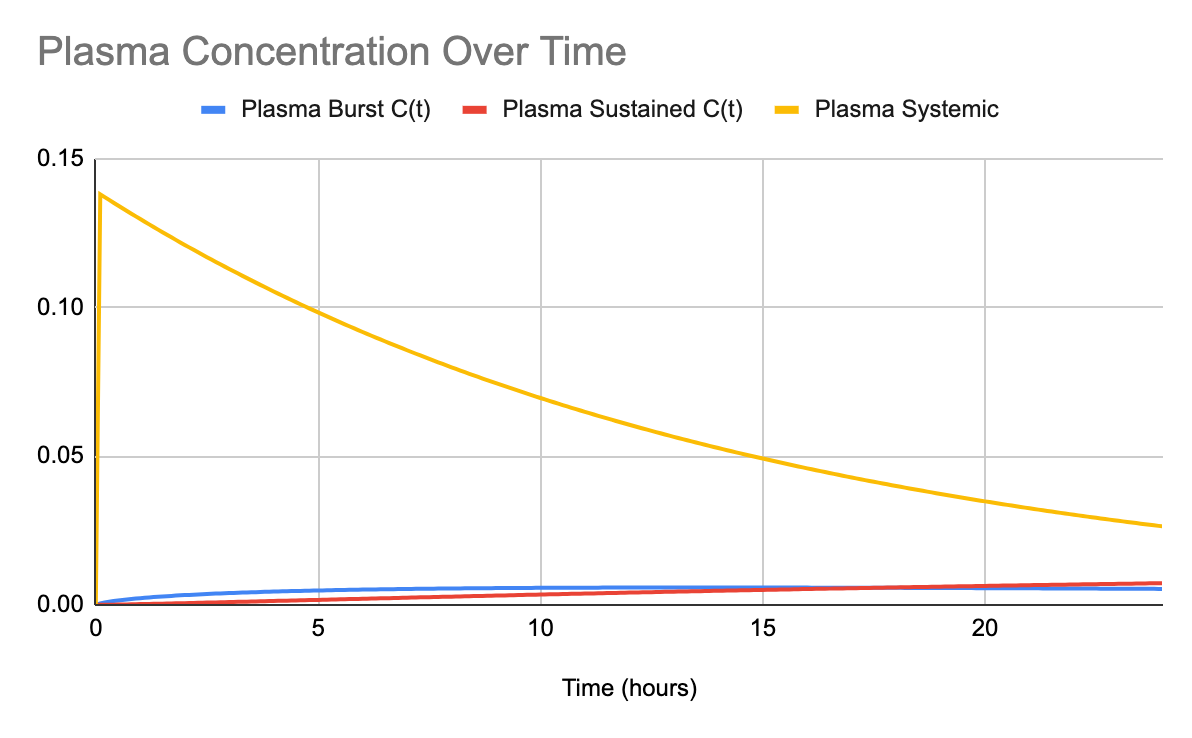
This graph was made to visualize the results of the plasma exposure compartment, highlighting that systemic delivery has higher toxicity than localized methods. The high spike in systemic delivery is due to direct exposure to the bloodstream, whereas scaffolds only release a small leakage fraction into circulation. Burst and sustained delivery show close results, with slight differences in peak concentration and overall exposure.
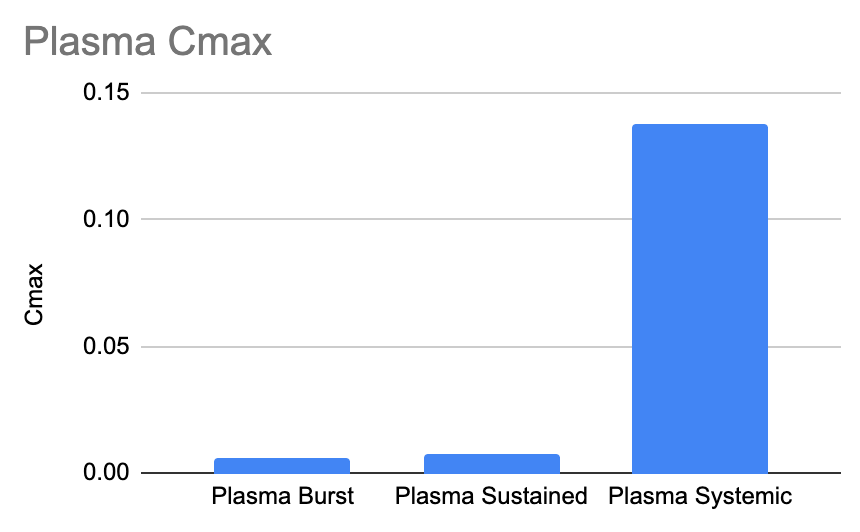
Examining the Cmax of all three delivery systems, systemic delivery again shows a clear spike as compared to localized deliveries. Sustained delivery is slightly higher than burst delivery, showing a higher peak concentration in the bloodstream. Despite its rapid release profile, burst delivery produced the lowest plasma Cmax among other delivery systems, suggesting that immediate local delivery may limit prolonged systemic circulation more than a slow delivery.
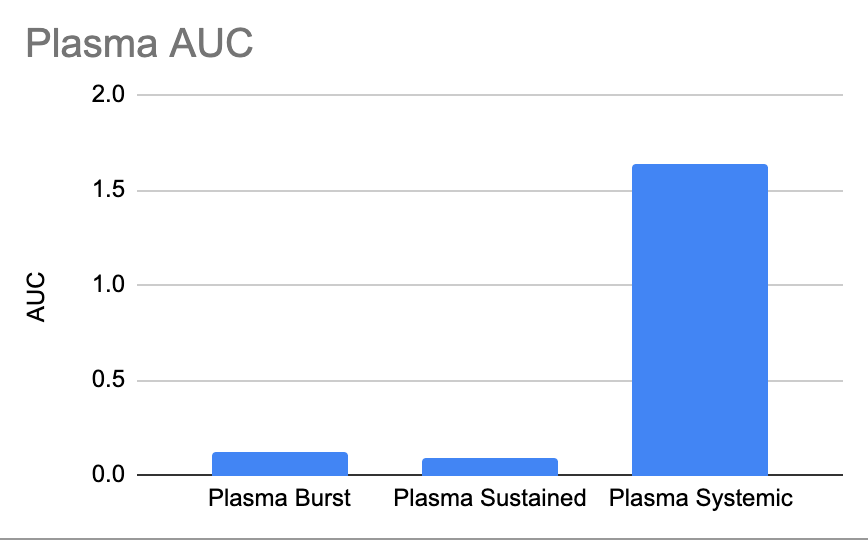
The plasma AUC shows the consistent result of systemic delivery having the highest blood toxicity. Burst release has a slightly higher plasma exposure even though it spends less time in circulation. While sustained release produced a slightly higher peak concentration than burst release, its lower plasma AUC suggests less cumulative exposure over time.
Tumor Concentration
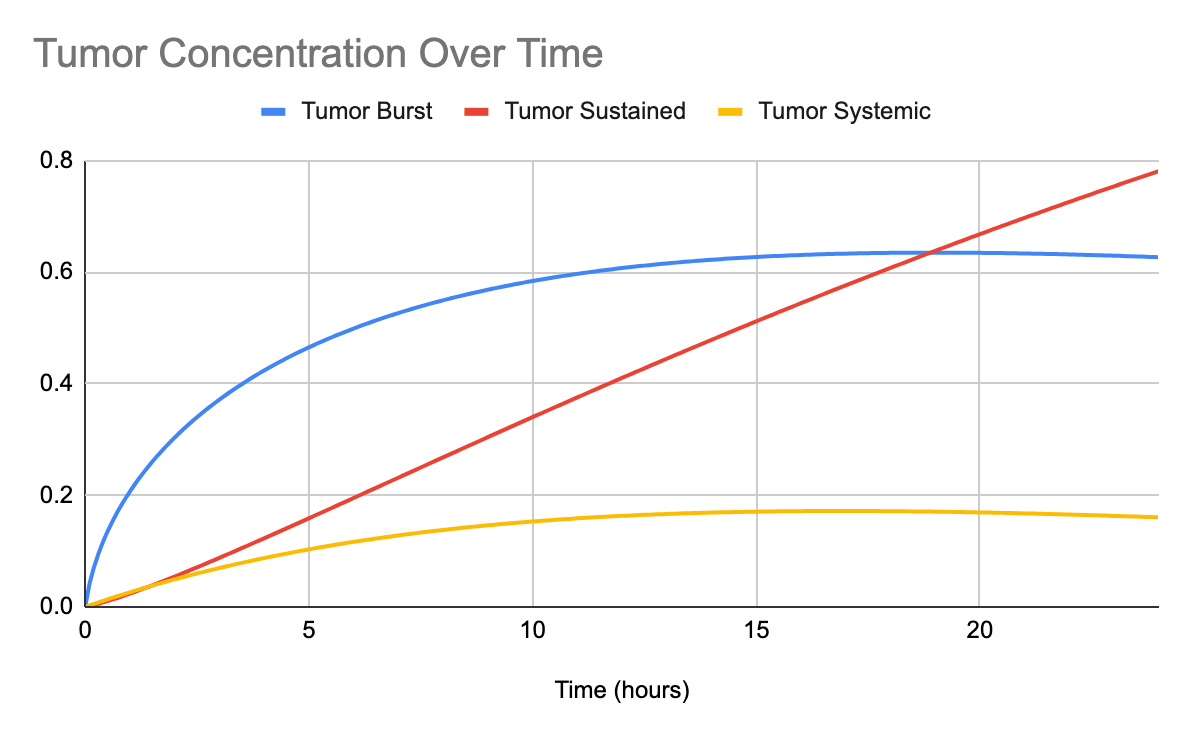
This graph visualizes the tumor concentration of each delivery method through each time step. According to the graph, systemic delivery has the lowest tumor exposure compared to scaffold methods. Unlike 4D-printed scaffolds, systemic delivery carries a small amount of the drug from the bloodstream and into the tumor region. Localized delivery systems had higher tumor exposure than systemic delivery due to direct deposition into tumor tissue rather than reliance on bloodstream transport.
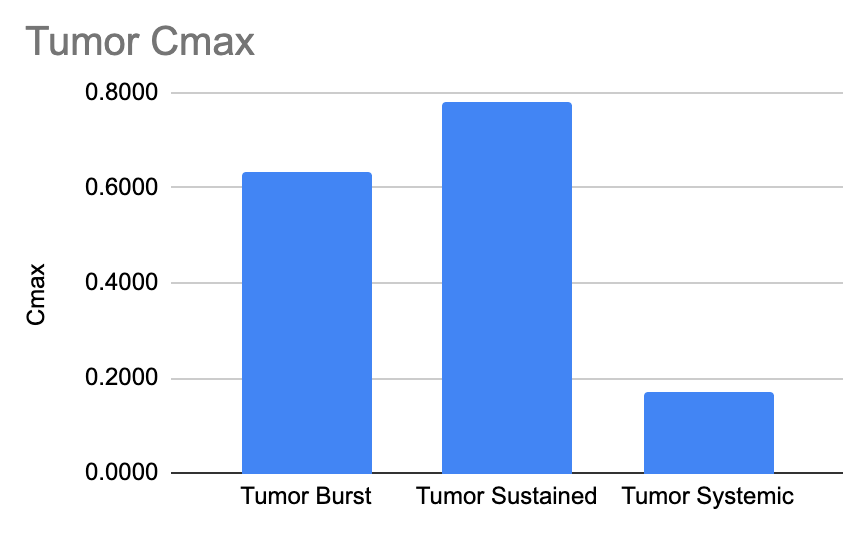
The Cmax indiciated that systemic release has the smallest peak in the tumor region. Burst release had a lower peak concentration than sustained relese, which could be attributed to the fact that the burst drug decays over time. Sustained release is indicated to have the highest peak concentration in the bloodstream, suggesting that prolonged delivery may spike more than a rapid release.
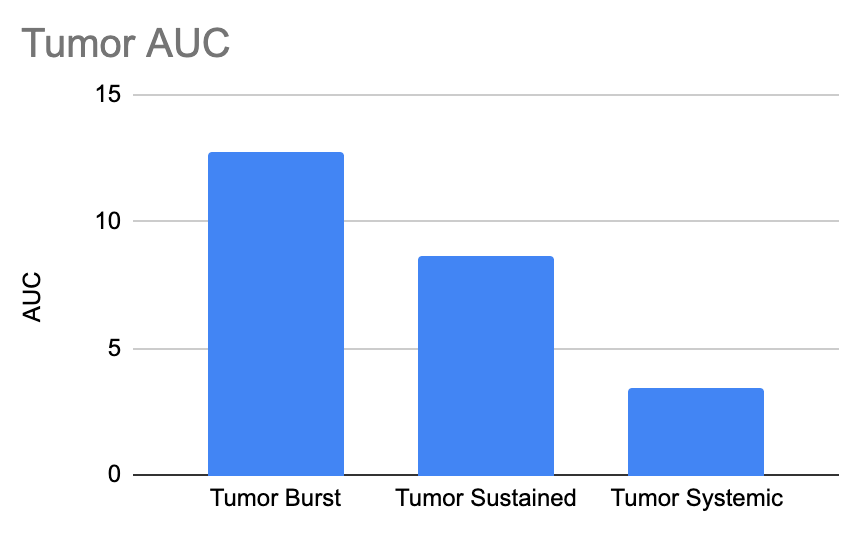
The AUC of the tumor compartment shows that systemic delivery has the lowest overall time spent in the tumor. Sustained release has a lower tumor exposure compared to burst release despite having the highest peak concentration. Burst release produced the highest culumative exposure, suggesting that both localized methods may optimize different therapuetic objectives.
Unexpected Tradeoff
While sustained release improved peak tumor localization, burst release produced greater cumulative tumor exposure. Rather than identifying a universally superior scaffold design, the simulation suggests that burst and sustained release profiles may optimize different pharmocokinetic priorities, including peak concentration versus cumulative tumor exposure.
Limitations
While this model does show significant results, the measures for the scaffolds were averaged based on related literature. The leakage fraction was estimated due to scaffolds starting in the tumor area, and the chemotherapy dosage was normalized for better comparison. This model has not been experimentally validated, and the assumptions of the pharmocokinetic model were simplified. The simulation also assumes homogeneous tumor uptake and does not take into account patient-specific metabolism or tumor heterogeneity.
Conclusion
Localized delivery through 4D-printed scaffolds consistently provide lower plasma concentration and higher tumor exposure as compared to regular, systemic delivery systems that inject the drug directly into the bloodstream. Given this finding, localized delivery systems may reduce cancer side effects, including bone marrow suppression, due to reductions in systemic chemotherapy exposure and improvements in tumor localization relative to traditional systemic administration.
Although sustained localized release was originally hypothesized to be superior to other delivery systems due to prolonged release behavior, the simulation revealed a more complex structure. The results suggests that localized delivery may need a balance between cumulative exposure and peak concentration depending on therapuetical needs.
메타데이터
- post_id
- ca64dbdd55a6
- slug
- modeling-burst-vs-sustained-release-in-localized-chemotherapy-delivery-ca64dbdd55a6
- url
- https://medium.com/@sarah311.ali/modeling-burst-vs-sustained-release-in-localized-chemotherapy-delivery-ca64dbdd55a6
- canonical_url
- https://medium.com/@sarah311.ali/modeling-burst-vs-sustained-release-in-localized-chemotherapy-delivery-ca64dbdd55a6
- author_url
- https://medium.com/@sarah311.ali
- status
- ok
- fetched_at
- 2026-06-09 15:37:30