We Stopped Grilling Over Charcoal. Here’s What Changed.
A kitchen decision that had nothing to do with trend and everything to do with physics.
We Stopped Grilling Over Charcoal. Here’s What Changed.
A kitchen decision that had nothing to do with trend and everything to do with physics.
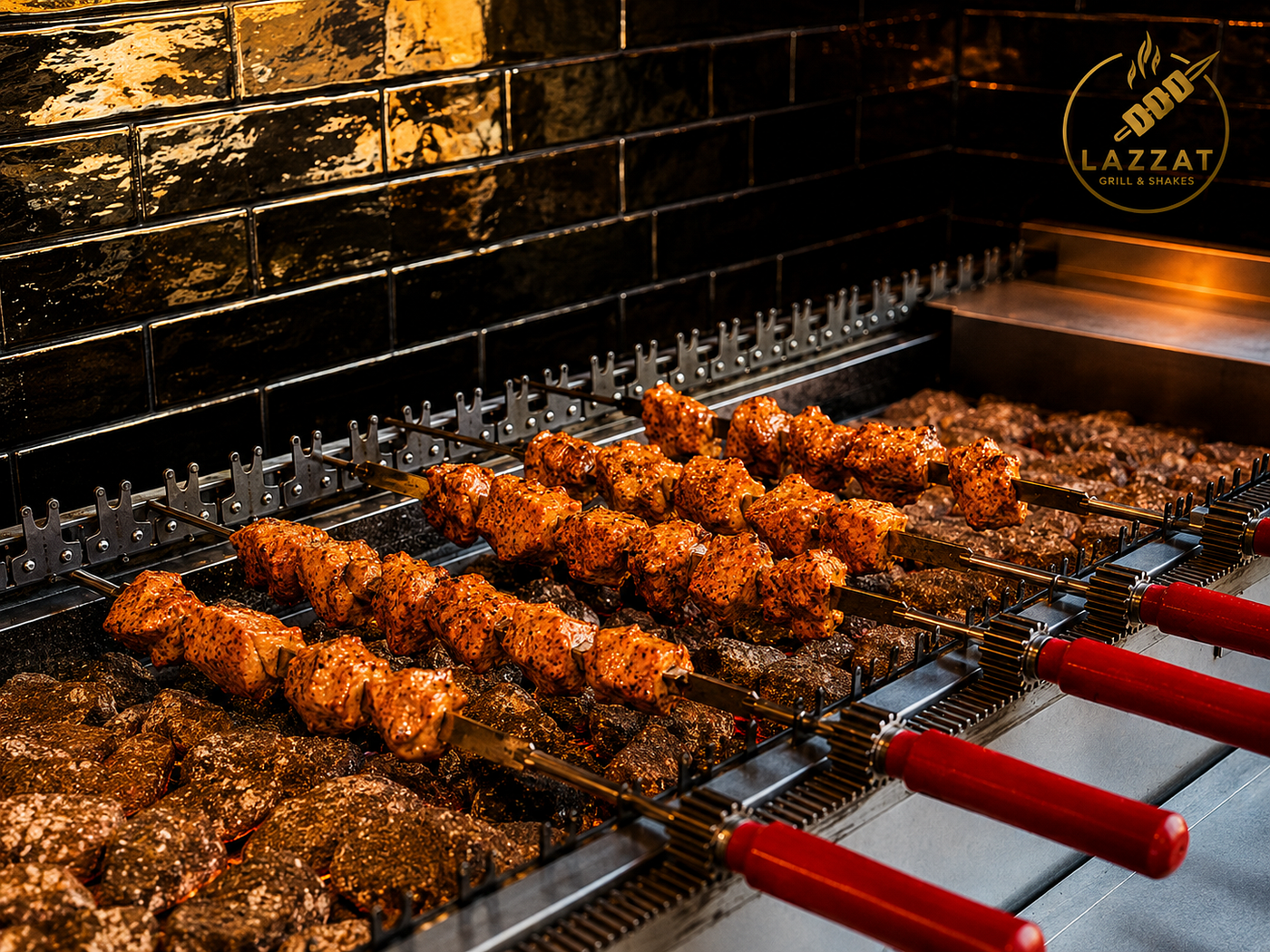
Lava Stone Grilling at Lazzat grill & Shakes
For a long time, every grilled restaurant looked the same from the outside. Flames. Smoke. A cook standing over a grate, moving skewers around to dodge a flare up before it turned dinner into charcoal. It looked dramatic. It photographed well. And it was, in a very specific way, working against the food.
At Lazzat, the grill isn’t gas and it isn’t charcoal. It’s lava stone. And once you understand why, you start noticing what every other grilled restaurant in your city is quietly fighting against every single service.
The Problem Nobody Talks About
Here’s what actually happens on a standard grill. Fat renders off the protein as it cooks. That fat hits an open flame. The flame spikes. For a few seconds, the heat under that piece of meat isn’t the steady temperature the cook set out to use, it’s whatever the flare up decided to make it. The exterior chars faster than the interior can catch up. The cook compensates by moving things around, timing things by feel, managing chaos in real time.
Most people who grill professionally have gotten so good at managing this that they don’t think of it as a problem anymore. It’s just the job. But it is a problem, and it shows up on the plate as inconsistency. The skewer at six in the evening doesn’t taste exactly like the skewer at eight, even though the recipe never changed and the cook never stopped paying attention.
Lava stone doesn’t have this problem. It absorbs heat and radiates it back evenly across its surface. When fat drips down, it hits stone, not flame. No flare up. No spike. Just steady, radiant heat doing the same job it did a minute ago and will keep doing a minute from now, regardless of how many orders have come through before it or how many are still waiting.
The Chemistry Behind a Good Char
There’s a chemical reaction happening on the surface of anything grilled well, called the Maillard reaction. It’s the browning, the crust, the flavor compounds that make grilled food taste like grilled food instead of just cooked food. That reaction happens best within a specific, narrow temperature range. Too hot, too fast, and the surface skips past that window into bitterness. Too cool, and the reaction never really gets going at all.
A flare up doesn’t just risk burning dinner. It risks skipping past the exact chemistry that makes grilling worth doing in the first place. This is the part that’s easy to miss if you’ve never thought about it closely: the difference between a genuinely good grilled meal and a forgettable one usually isn’t the marinade. Everyone marinates. It’s whether the protein got to sit in that narrow temperature window long enough for the surface to actually finish its job, or whether it got rushed through by inconsistent heat and pulled off the grill the second it looked done enough to pass.
The chicken doesn’t know the flame spiked. It just cooks differently because it did.

Why Even Heat Changes What You Actually Taste
Consistency is not a small detail in cooking. It’s arguably the whole point. A recipe is a promise that the result will taste the same way it did the last time, and the time before that. A grill that produces unpredictable heat breaks that promise in ways that are hard to notice individually but easy to notice in aggregate, over weeks of visits to the same restaurant.
With lava stone, the surface temperature stays within a tight, known range regardless of how much fat has dripped onto it that shift, or how many orders have gone across it that hour. The cook isn’t managing chaos. The stone is doing that work automatically, which frees the kitchen to focus on timing and technique rather than damage control.
Why We Didn’t Just Default to What Everyone Else Uses
There wasn’t a dramatic reason to skip gas and charcoal. No supplier fell through, no story about a broken grill at two in the morning. It came down to a simple question the founding team kept returning to while building the menu: if the marinade takes overnight to do its job properly, why would the final step, the part that actually finishes the dish, be rushed through by inconsistent heat.
Every protein at Lazzat goes into the marinade the night before it ever sees heat. That’s not a fast process, and it’s not meant to be one. By the time a skewer hits the lava stone, the muscle fibre has already started to change. What the grill needs to do at that point isn’t fix anything, it’s finish something that’s already mostly done. Even, steady, radiant heat is the only kind of heat that can complete that job without undoing the twelve hours of preparation that came before it.
How Lava Stone Compares to Charcoal and Gas in Practice
Charcoal grilling has a real, earned reputation for flavor, largely because of the smoke it produces. That smoke is genuinely part of the appeal for a lot of barbecue traditions, and there’s nothing wrong with that approach for the dishes it’s built for. But charcoal is also the least predictable heat source of the three, since the burn rate changes as the coals age through a service, and temperature control depends heavily on airflow that a busy kitchen cannot always manage precisely.
Gas is the most controllable of the three in terms of adjusting temperature on demand, which is why it dominates commercial kitchens. Its weakness is the same one lava stone solves directly: an open flame still spikes when fat hits it, regardless of how precisely the base temperature was set beforehand.
Lava stone sits in a different category entirely. It is not trying to replicate the smoke of charcoal or the adjustability of gas. It is solving a narrower, more specific problem: how to keep the actual cooking surface at a stable temperature throughout an entire service, regardless of what is dripping onto it minute to minute.
What This Actually Tastes Like
Order a two skewer bowl and pay attention to the second bite, not the first. The first bite of anything grilled tends to taste good, that’s what char does, it grabs attention immediately regardless of what’s underneath it. The second bite is where the marinade either shows up consistently or it doesn’t. Where the char either runs deeper than the surface or stops exactly where it started, leaving a bland center underneath a good looking crust.
That’s the difference lava stone is actually solving for. Not a better looking sear for a photograph. A more honest one, all the way through the piece, bite after bite, regardless of when during service it was ordered.
The Part That Doesn’t Fit on a Sign
We don’t lead with this on a sign outside the restaurant. It’s not the kind of detail that fits neatly on a banner or a menu description. But it’s the reason the chicken tastes the way it does, and it’s the reason we would make the same decision again if we were starting entirely from scratch tomorrow, with every option on the table.
What Changes in the Kitchen, Not Just on the Plate
There’s a version of this story that focuses entirely on flavor, and that version isn’t wrong, it’s just incomplete. Switching to lava stone changed something in the kitchen itself, not just in what comes out of it. A cook working a gas or charcoal line spends a meaningful percentage of their attention managing the fire, not the food. Watching for flare ups. Repositioning skewers away from hot spots. Making small, constant corrections to compensate for a heat source that won’t hold still.
Take that management task away, and the attention goes somewhere else. Timing gets more precise, because the cook isn’t splitting focus between the protein and the flame underneath it. Consistency across a long shift improves, because the tenth order of the night is being judged by the same stable heat as the first one, not a grill that’s been building unpredictable hot spots for three hours.
This is the part that rarely gets photographed, because it doesn’t look dramatic. Nobody films a grill that isn’t doing anything unexpected. But the absence of drama is exactly the point. A kitchen that isn’t fighting its own equipment is a kitchen that can put more attention into the parts that actually matter to the person eating the food.
The Marinade Was Never the Whole Story
Most restaurants that take flavor seriously talk extensively about their marinades, and for good reason, a marinade genuinely matters. But a marinade is only half of a two part process, and the second half gets far less attention in most conversations about grilled food. What happens on the grill either honors what the marinade started or undoes a meaningful part of it.

Salt and acid, the two workhorses of most marinades, spend hours breaking down muscle fiber and carrying flavor compounds into the protein, not just onto its surface. That’s slow, patient chemistry, the kind that can’t be rushed without losing most of its benefit. Then the protein goes onto a heat source that either respects that timeline or works against it. An inconsistent, spiking flame can scorch the outside of a well marinated piece of chicken before the inside has had a chance to reflect any of the work that went into it overnight.
Lava stone doesn’t add flavor on its own. It doesn’t season anything or contribute a taste of its own the way charcoal smoke does. What it does is get out of the way of the marinade’s work, providing heat steady enough that twelve hours of preparation actually shows up in the final bite instead of being cancelled out by three minutes of inconsistent grilling.
Why This Detail Rarely Makes It Onto a Menu
If you’ve eaten at more than a handful of grilled food restaurants, you’ve probably never once been told what kind of heat source cooked your meal. That’s not an oversight. It’s genuinely hard to describe cooking equipment in a way that sounds appetizing rather than technical. Nobody wants to read a paragraph about thermal radiation while deciding what to order for lunch.
But the fact that this detail doesn’t make it onto menus doesn’t mean it doesn’t matter to what ends up on the plate. It just means most of what actually determines food quality happens in places customers never see and rarely ask about. The marinade gets a mention because it’s an easy, appetizing detail to write about. The heat source that finishes it almost never does, even though it’s doing equally important work.
If you want to see the six proteins this actually applies to, the full lineup is on Lazzat’s menu. But the honest answer to what makes it different was never going to fit on a menu description. It’s this.
메타데이터
- post_id
- ca7dc5303822
- slug
- we-stopped-grilling-over-charcoal-heres-what-changed-ca7dc5303822
- url
- https://medium.com/@lazzat.ca/we-stopped-grilling-over-charcoal-heres-what-changed-ca7dc5303822
- canonical_url
- https://medium.com/@lazzat.ca/we-stopped-grilling-over-charcoal-heres-what-changed-ca7dc5303822
- author_url
- https://medium.com/@lazzat.ca
- status
- ok
- fetched_at
- 2026-08-18 14:54:50



