Why Your Rankings Are Stuck Even After Doing Everything Right
The content has been improved. The keywords have been refined. Links have been built. The technical checklist has been run through more…
Why Your Rankings Are Stuck Even After Doing Everything Right

The content has been improved. The keywords have been refined. Links have been built. The technical checklist has been run through more than once.
And the rankings have not moved.
This is one of the most discouraging points in SEO because every visible action item has been completed. What remains is usually one of three things that operate quietly in the background: authority that has not caught up yet, a technical issue with no obvious symptom, or a shift in the competitive landscape that had nothing to do with your site at all. Understanding E-E-A-T signals and how they influence rankings in 2026 is part of what separates sites that eventually break through from sites that stay stuck despite doing the visible work correctly.
Your Site Might Simply Not Have Enough Authority Yet
If every visible optimization has been done and rankings still will not move, the missing piece is often domain authority, and authority is not the same thing as backlink count.
A few random backlinks do not build trust. Google evaluates the overall strength of a site based on several signals working together:
- How relevant its links are to its actual subject matter
- How consistently it publishes over time
- How focused it stays on a clear topic rather than spreading thin
- How transparent its business or author information appears
One strong, relevant link from a respected source in your niche contributes more than dozens of weak, unrelated links ever could.
A new domain starts with no history at all, while an established competitor may have years of accumulated content, links, and engagement working in its favor. If a new site is not ranking yet, it may simply need time for those signals to accumulate. Authority also does not build evenly across a site. Some topics gain traction sooner than others, and that uneven progress is normal rather than a sign that something is failing. As topical authority develops around a focused subject area, visibility tends to improve step by step rather than all at once.
Technical Problems That Hide Without Throwing Errors
Some of the most damaging technical issues never produce a visible error message. The site loads. Pages render. Nothing in the dashboard looks broken. And rankings stay weak anyway.
Silent Crawl Inefficiencies
Important pages buried several clicks deep in the site structure, redirect chains that make Googlebot work harder than necessary to reach a final destination, old noindex tags left active after testing, and blocked resources that prevent proper rendering all consume crawl budget. Crawl budget is the amount of time Googlebot spends exploring a site. When that time is wasted on low-value pages, the pages that actually matter get less attention.
Mobile Experience Problems
Mobile experience matters more than many site owners realize because Google primarily evaluates the mobile version of a page. Slow loading, layout issues on small screens, oversized images, and popups covering main content can all weaken rankings even when the desktop version looks completely fine.
Site Migration Issues
Missing 301 redirects from old URLs, broken internal links left over from a redesign, and duplicate versions of the same page created during a URL change can all disconnect the link equity and authority signals a page had built up before the migration happened. This is one of the most common sources of sudden, unexplained ranking drops.
None of these issues come with a manual penalty notice. They simply make Google’s job harder, and a harder job for Google usually means less confidence in showing your page.
A Sudden Ranking Drop Is Usually Not a Penalty
When rankings fall suddenly, the first assumption is often the most alarming one: a penalty. In most cases, that assumption is wrong.
Google runs core updates regularly. These updates do not target individual sites. They reweight how Google measures quality, relevance, and trust across the entire web simultaneously. A drop can happen because Google now values certain quality signals more heavily, because user intent for a query has shifted, or because the type of content Google considers most helpful for that query has changed. Some sites gain visibility during these updates while others lose it, often without either group having changed anything themselves.
Competitors improving is the other major cause of unexplained drops. If competing pages publish more detailed or updated content, earn stronger relevant backlinks, improve page speed and mobile experience, or restructure their content more clearly, they may now deserve the position your page previously held. A real penalty almost always comes with a manual action notice inside Google Search Console. If that notice is not present, the more accurate explanation is algorithmic recalibration or competitive improvement, not punishment.
Making Your Content Visible to AI Overviews
In 2026, ranking well in traditional results is not the only visibility that matters. AI Overviews and other AI-driven search features select content based on how clearly it is structured and how directly it answers a question, not on keyword density.
AI systems scan pages differently than human readers. They look for clean H2 and H3 hierarchies where each section covers one topic, a logical progression from question to explanation, and no mixing of unrelated ideas within the same section. When a page follows this structure, AI systems can quickly identify what each section is about and what answer it provides.
Answer-first formatting is the structural pattern that aligns most closely with how AI systems summarize content:
- Give the clear answer in the first sentence of the section
- Follow it with a short explanation
- Add supporting detail afterward, not before
Long introductions before the actual answer reduce the chance that a section gets selected as a source, because the answer is buried rather than immediately visible. Consistency also matters more than it seems. Using the same core terminology throughout a page, avoiding vague language, and keeping paragraphs short all make a page easier for AI systems to summarize accurately. Entity SEO practices that keep terminology and topic associations consistent across a site reinforce this clarity at a broader level, not just within a single page.
A Layered Checklist for Fixing Stuck Rankings
Ranking problems should be diagnosed in order, because fixing a later-layer issue while an earlier layer is still broken rarely produces results, and it makes it harder to tell what actually worked.
Foundation Layers First
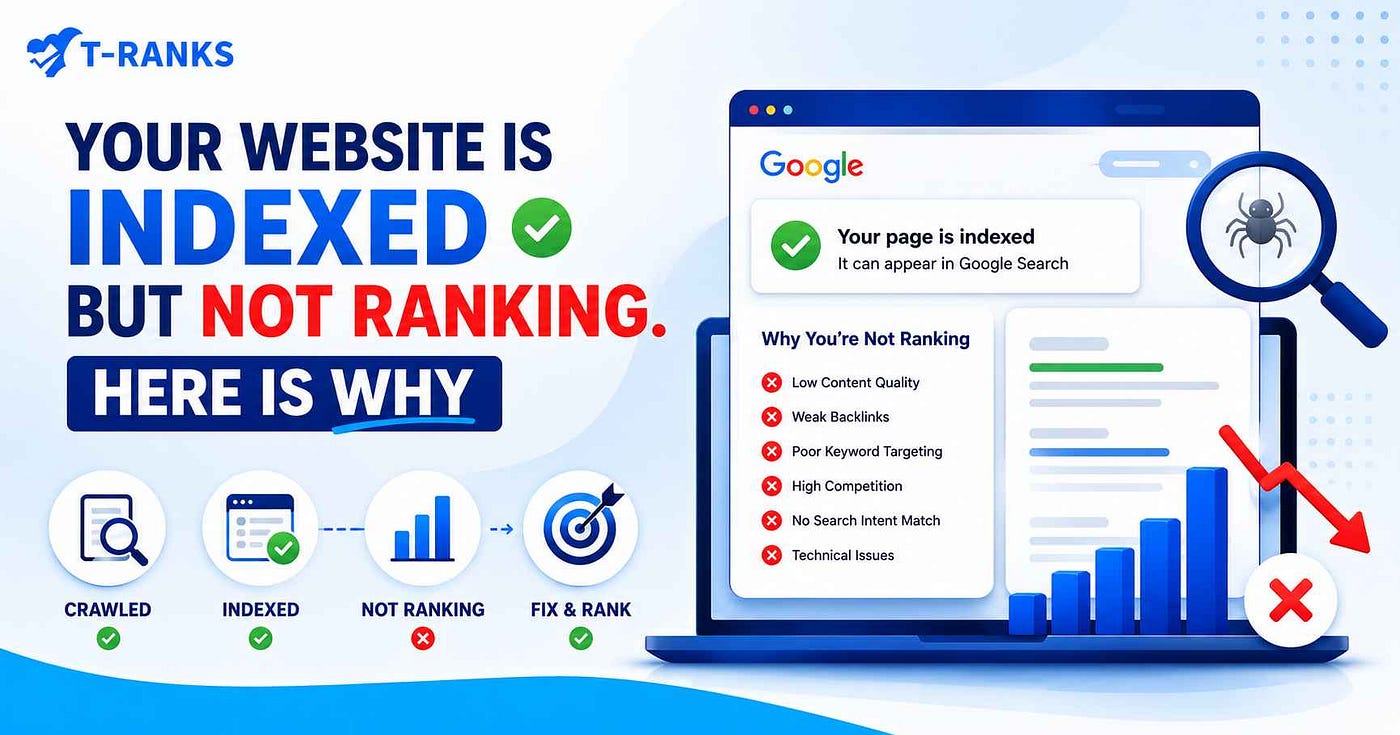
- Confirm indexing and crawl access — a page that is not indexed, or that Googlebot cannot reach due to noindex tags, robots.txt restrictions, or redirect chains, cannot rank regardless of anything else
- Review search intent — compare your page’s format and depth against what is currently ranking for the target keyword
Relevance and Structure Layers
- Reassess keyword difficulty relative to your site’s current authority. Competing against dominant brands on a high-difficulty term may require shifting toward more specific, lower-difficulty queries first
- Improve content usefulness by adding direct answers near the top, removing repetition, and including practical examples
- Strengthen internal linking by connecting related pages with descriptive anchor text and reducing orphan pages
Authority and Visibility Layers
- Address authority gaps through relevant, gradually earned backlinks and consistent publishing within a focused topic
- Review technical stability including page speed, mobile performance, and broken links
- Optimize for AI visibility using clear headings, answer-first formatting, and consistent terminology
Each layer depends on the one before it. Working through them in order is what turns scattered effort into steady, measurable progress instead of a pile of disconnected fixes that never quite add up.
메타데이터
- post_id
- ca7efb996253
- slug
- why-your-rankings-are-stuck-even-after-doing-everything-right-ca7efb996253
- url
- https://medium.com/@info_75606/why-your-rankings-are-stuck-even-after-doing-everything-right-ca7efb996253
- canonical_url
- https://medium.com/@info_75606/why-your-rankings-are-stuck-even-after-doing-everything-right-ca7efb996253
- author_url
- https://medium.com/@info_75606
- status
- ok
- fetched_at
- 2026-06-14 11:28:49