Alice through the looking glass
Or why photographers love reflections
Alice through the looking glass
Or why photographers love reflections
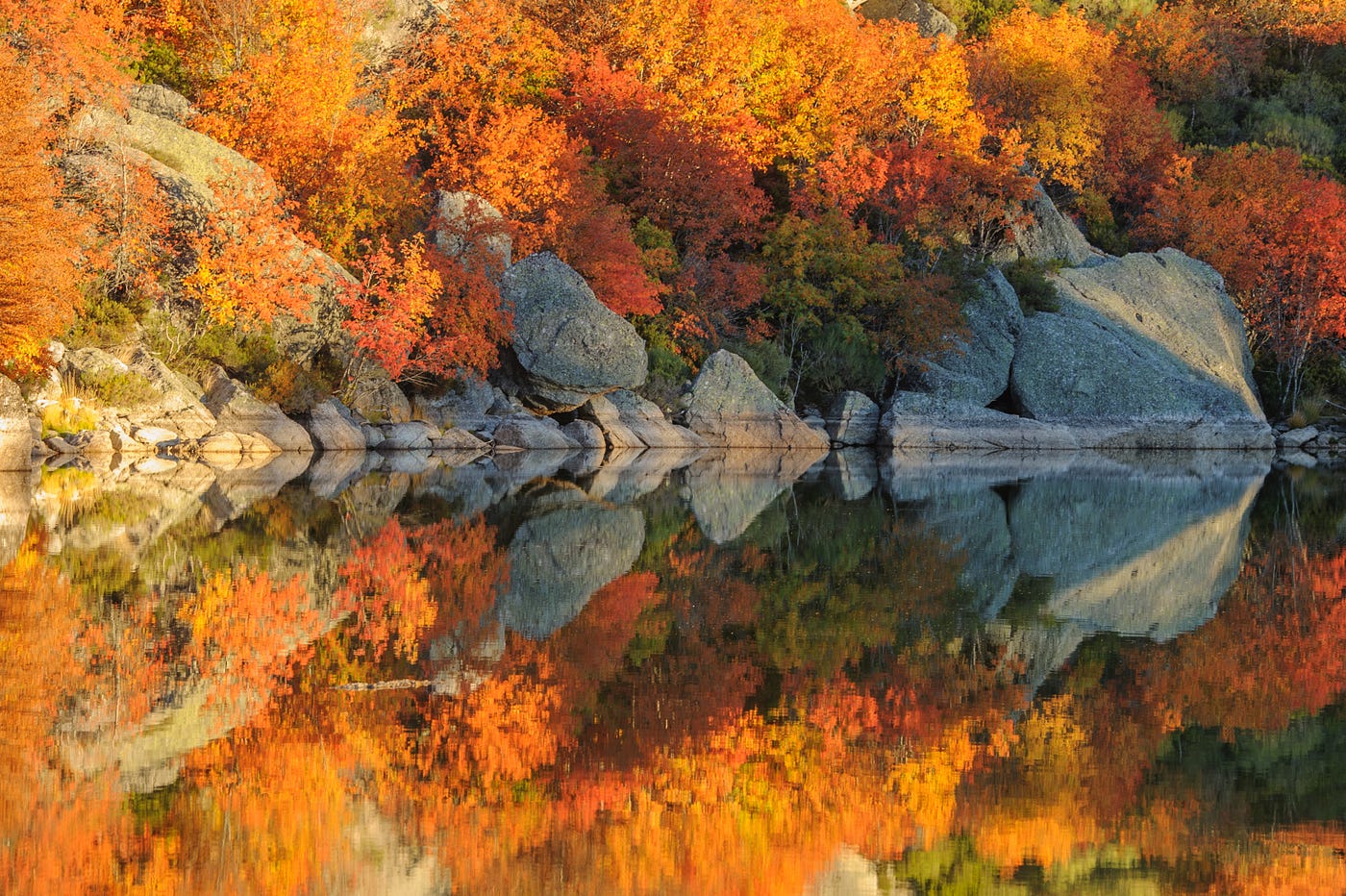
Symmetries - Laguna Negra. Photo by the author
The history of photography shows us a handful of masterpieces in which reflections on water, puddles, glass, or mirrors are a primary compositional element.
I am sure you can name a few famous photographs that play with reflections. For instance, in one of the most famous and analyzed photographs, “Place de l’Europe. Gare Saint-Lazare” by Cartier-Bresson, he plays with the decisive moment as well as the symmetry created by the reflection in the water.
Or Elliott Erwitt’s evocative “Kiss in the Rearview Mirror,” where reality appears blurry and out of focus while the reflection of the couple’s kiss inside the car is sharp. At this point, the reflection is more important than reality itself.
Robert Frank shows us skyscrapers in a puddle. And even the great landscape photographer Ansel Adams portrays the Half Dome in Yosemite by relying on the reflection of the frozen river.

Impressionism — Laguna Negra. Photo by the author
Reflections can show us a world almost identical to the real one when they are sharp, or a blurry, distorted reality bordering on Impressionism and it is in that fringe between the real and the deformed where their fascination lies.
The world we see in them only exists within the photographer’s creation and the viewer’s interpretation. Alice steps through the looking-glass and finds a world where the rules of reality have changed; as photographers, we frame reflections and achieve weightless, distorted landscapes and realities that we couldn’t capture any other way.
The person looking back at us in the mirror in the morning is not identical to us, and that subtle difference is analyzed by psychologists to understand why we prefer that specular image over the one we see when we are photographed. An effect that millions of teenagers (and others who are not so young) were quick to exploit to share on social media.
That selfie in front of the mirror is not the real self, but its specular twin, which we like better. As photographers, we lose our minds when our eyes stumble upon those games of symmetry that a perfect reflection displays.

Autum leaves, Laguna Negra. Photo by the author
My photographic work is almost exclusively landscape, completely realistic to the point of being nearly documentary, and I rarely manage to step out of that comfort zone to venture into the figurative or abstract.
Years ago, during a shoot at the Laguna Negra in Soria (Spain), I planned a session in the middle of autumn, with the beech forest at its peak color and the golden morning light creating a perfect scene. However, the total absence of wind during those early morning hours caused a perfect mirror image on the lagoon. This triggered a change of plans, and what was supposed to be just another landscape session turned into the interplay of symmetries and abstractions that illustrate this article.

Symmetries — Laguna Negra. Photo by the author
Technically, once the eye spots the possibilities of the lake’s opposite shore, everything was easy: you take off the wide-angle lens and switch to a telephoto lens to create a frame that completely decontextualizes the place. I was looking for a perfect and symmetrical reflection that could be anywhere, as opposed to the vast majority of my photographs where the viewer could pinpoint the location.
Over our years as photographers, we learn to look for those reflections in the landscape, small puddles, rivers, lagoons, the receding waves on the beach … and to compose by searching for those distinct angles, those subtly altered realities that transport us, like Alice, into a world that will never be real.
If you want to see more pictures of that photographic session: gallery of photos
Disclaimer: The gallery is on my personal website with no advertisements, sale of products or services.
Disclaimer2: English is not my native language, and I have used AI tools to assist with the translation. However, none of the original text, which can be read here in Spanish, was written using AI
메타데이터
- post_id
- ca985838e6f5
- slug
- alice-through-the-looking-glass-ca985838e6f5
- url
- https://medium.com/full-frame/alice-through-the-looking-glass-ca985838e6f5
- canonical_url
- https://medium.com/full-frame/alice-through-the-looking-glass-ca985838e6f5
- author_url
- https://medium.com/@antoniorodriguez
- status
- ok
- fetched_at
- 2026-07-08 19:15:55