Mizar and Alcor: Unveiling the Double Stars of the Big Dipper
Aaron McCoy / Getty Images
Mizar and Alcor: Unveiling the Double Stars of the Big Dipper

Aaron McCoy / Getty Images
“Somewhere, something incredible is waiting to be known.” Carl Sagan’s poignant reflection resonates profoundly when observing the starscape, particularly the Big Dipper — a familiar landmark of the northern sky. Among its characteristic stars lies a fascinating duo, Mizar and Alcor, whose appeal transcends centuries of human curiosity. Nestled within the Ursa Major constellation, these two stars represent more than an ordinary stellar pairing; they serve as a portal into understanding the intricacies of double-star systems and the deep connections between astronomy and human culture.
For ages, Mizar and Alcor have illuminated the night sky and ignited imaginations, from guiding ancient sailors across open seas to serving as a rudimentary vision test visible to the naked eye. In modern times, they continue to inspire astronomers as technological advancements unveil the complexity hidden within their apparent simplicity. Delve into the scientific depth, historical relevance, and enduring wonder of this cosmic duo, as they bridge the divide between ancient lore and cutting-edge discovery.

The Big Dipper asterism hovers over a northern forest and snow. Daniel Johnson
The Astronomical Significance of Mizar and Alcor
Unique Physical Properties and Stellar Hierarchy
Located in the handle of the Big Dipper, Mizar (ζ Ursae Majoris) and Alcor (80 Ursae Majoris) provide a captivating case study for astronomers. Mizar is a second-magnitude star, radiantly brilliant and easily spotted in the night sky, while Alcor appears dimmer yet readily identifiable. Despite their apparent proximity, early astronomers mistakenly classified them as a binary system. However, current studies reveal that Mizar and Alcor are an optical double star — a pairing that appears close from Earth’s perspective but generally lacks a strong gravitational bond. Nonetheless, emerging evidence suggests a weak gravitational link between the two, perhaps rooted in their shared origin billions of years ago.
Mizar holds a distinctive place in astronomy’s history as the first double star observed through a telescope in 1617. Close inspection reveals that Mizar itself is composed of two components, Mizar A and Mizar B, both A-type main-sequence stars. These are further revealed to be spectroscopic binaries, forming a surprisingly complex quadruple system interconnected through orbital mechanics. Such intricate arrangements play a vital role in furthering our understanding of stellar formation and hierarchical dynamics.
Alcor, once considered a simpler star, has likewise surprised astronomers. Infrared imaging has uncovered that Alcor hosts a faint binary companion — a low-mass M-dwarf star — which sheds new light on its own evolutionary processes. Together, Mizar and Alcor illustrate the diversity and complexity of multi-star systems, from their structure and mass interactions to their role in advancing spectroscopic astrophysics.
Technological Advancements in Observation
Mizar and Alcor stand as milestones in the journey of technological progress in astronomy. In the pre-telescope era, observers identified the pair with the naked eye, marking early human achievements in unaided stargazing. Galileo’s deployment of the telescope in the early 17th century led to the monumental discovery of Mizar’s double nature, setting the stage for further scientific breakthroughs. By 1889, Mizar made history as the first binary star to be photographed, using the powerful refractor at Yerkes Observatory.
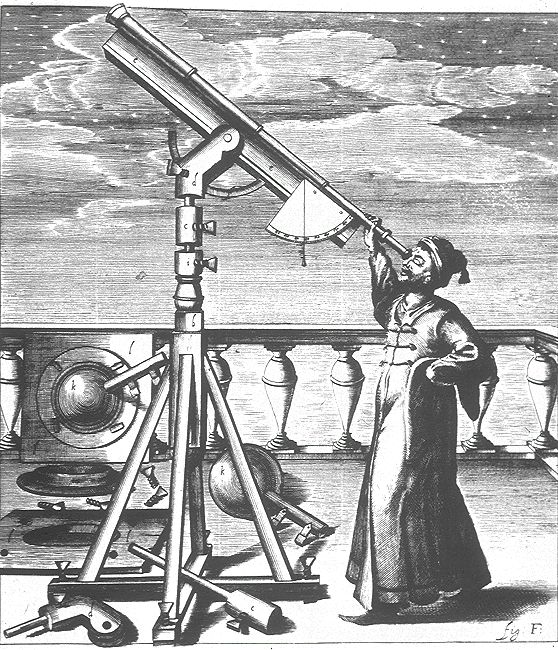
In contemporary studies, advances in spectroscopic analysis have revolutionized our understanding of the Mizar system’s orbital dynamics. Astronomers have precisely measured the radial velocities of its four stars, unveiling their intricate motions and gravitational interactions. Similarly, Alcor’s once-hidden companion emerged through cutting-edge infrared imaging and adaptive optics, tools that continue to redefine our view of seemingly simple stars.
This evolution, from rudimentary stargazing to high-resolution imaging, underscores the enduring allure of Mizar and Alcor. They exemplify astronomy’s capacity to merge human curiosity with ever-advancing technology, expanding the boundaries of what we can uncover about our universe.
Historical Significance of Mizar and Alcor
Navigation and Vision Testing in Human History
Long before telescopes, Mizar and Alcor were indispensable tools for ancient navigators and observers. Mariners in the northern hemisphere relied on the Big Dipper as an asterism that guided them toward Polaris, the North Star. Positioned near the middle of the dipper’s handle, Mizar and Alcor became prominent navigational markers during clear nights, helping sailors maintain their bearings.
Their practical relevance extended beyond navigation. The two stars also served as an informal optical test for visual acuity. Separated by only 11.8 arcminutes, distinguishing Mizar from Alcor required keen eyesight, a skill heralded in cultures such as ancient Rome, where resolving the pair was often perceived as evidence of sharp vision. Similarly, Arabian astronomers referred to the pair as “Suhail and his Rider,” symbolizing a knight (Mizar) accompanied by his steed (Alcor). This dual function as both a navigational and visual aid highlights humanity’s early ingenuity in leveraging celestial objects for practical purposes.
Myths and Cultural Symbolism
The story of Mizar and Alcor is deeply woven into human cultural traditions. In Hindu mythology, they represent the immortal bond of Arundhati and Vashishta, symbolizing marital fidelity. Newlywed couples are often directed to observe the stars together as a cultural and spiritual blessing for their union.
In Japanese lore, Mizar and Alcor contribute to the “Hokuto Shichisei,” or Seven Stars of the Big Dipper, embodying themes of interconnectedness and familial unity. Meanwhile, various Indigenous peoples of North America integrated the dual stars into their mythology, often portraying them as celestial guardians or guides.
Such narratives reflect a universal human tendency to attribute personal and symbolic meanings to the stars, grounding cosmic phenomena within familiar stories and cultural values. The enduring cultural presence of Mizar and Alcor demonstrates the timeless interplay between celestial wonders and human imagination.
Conclusion
Mizar and Alcor, positioned in the handle of the Big Dipper, represent a remarkable blend of scientific intricacy, historical significance, and cultural resonance. Mizar’s extraordinary quadruple star system and Alcor’s binary companion underscore the evolving power of astronomical research, while their historical role as navigational aids, vision tests, and cultural symbols bridges the gap between ancient heritage and modern science.
For stargazers, these stars offer both a gateway to exploring cosmic systems and a tangible connection to the shared human fascination with the night sky. As technology and curiosity continue to unfold the universe’s mysteries, Mizar and Alcor stand as timeless reminders of the intricate beauty existing just beyond our reach. By looking upward and marveling at this stellar duo, we reaffirm our enduring quest to understand the cosmos and our place within it.

Meta Description
Discover the allure of Mizar & Alcor in the Big Dipper! Explore their stellar evolution, historical roles, and cultural myths. Stargazing tips included!
메타데이터
- post_id
- caa159dc1c78
- slug
- mizar-and-alcor-unveiling-the-double-stars-of-the-big-dipper-caa159dc1c78
- url
- https://medium.com/@timplay89/mizar-and-alcor-unveiling-the-double-stars-of-the-big-dipper-caa159dc1c78
- canonical_url
- https://medium.com/@timplay89/mizar-and-alcor-unveiling-the-double-stars-of-the-big-dipper-caa159dc1c78
- author_url
- https://medium.com/@timplay89
- status
- ok
- fetched_at
- 2026-07-20 07:40:56