Huawei’s Tau‑Scaling Law Is Not a Law, But an Undefined Slogan
Introduction
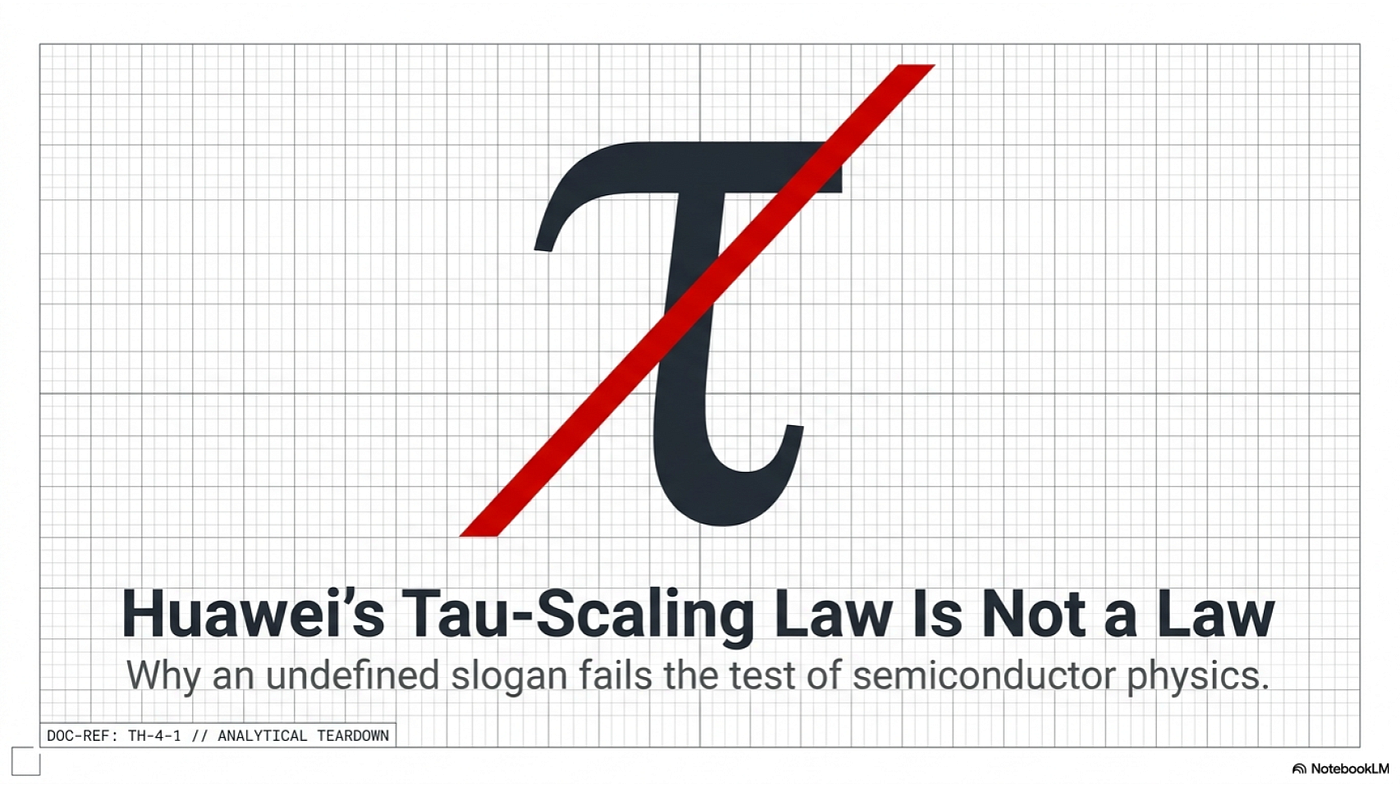
Huawei’s Tau‑Scaling Law Is Not a Law, But an Undefined Slogan
Introduction
Huawei’s renowned chip architect Tingbo He (何庭波) recently introduced what she calls the Tau‑Scaling Law, a proposed principle describing how hardware performance improves over time according to a latent “time constant” τ. The presentation frames τ as if it were analogous to Moore’s Law — a universal, predictive relationship governing semiconductor evolution.
But Moore’s Law succeeded because it described a single spatial variable (feature size) whose scaling directly determined transistor density. It was grounded in physics, validated by decades of empirical data, and expressed in a precise, falsifiable form.
τ‑scaling, by contrast, attempts to describe temporal performance, which is governed not by one variable but by a complex interaction of physical, architectural, and system‑level constraints. Worse, τ‑scaling has no definition: no formula, no measurable quantity, no empirical curve, no predictive model.
This critique argues that τ‑scaling is not a law. It is an undefined slogan — a premature abstraction that oversimplifies a multi‑variable system into a single symbol without empirical grounding or scientific legitimacy.
Moore’s Law: What a Real Law Looks Like
To understand why τ‑scaling fails, we must understand why Moore’s Law succeeded.
1. The Original Definition (1965)
Gordon Moore observed that:
The number of transistors on an integrated circuit doubles approximately every 12 months.
In 1975, he revised it to:
Transistor density doubles roughly every two years.
This is a precise, quantitative statement.
2. Why It Worked
Moore’s Law worked because:
- transistor size is governed by lithography wavelength
- smaller features → more transistors per area
- more transistors → more performance
- the scaling trend was physically driven
- the industry aligned around it, reinforcing the trend
It was a geometric law, not a temporal one.
3. Empirical Evidence
For decades, transistor counts followed a near‑perfect exponential curve:
- Intel 4004 (1971): 2,300 transistors
- Intel 8086 (1978): 29,000
- Pentium (1993): 3.1 million
- Pentium 4 (2000): 42 million
- Core i7 (2008): 731 million
- Apple M1 (2020): 16 billion
A plot of transistor count vs. year is a straight line on a log scale — the hallmark of exponential growth.
4. What Made It a Law
Moore’s Law had:
- a clear definition
- a single governing variable
- decades of empirical validation
- predictive power
- falsifiability
This is what a scientific law looks like.
τ‑scaling has none of these properties.
Problems
1. Hardware timing is governed by interdependent variables, not independent ones
Moore’s Law works because it describes spatial scaling — a geometric constraint with one dominant variable: feature size. Even though many other factors exist (power, yield, cost), they do not break the exponential trend because they are secondary to lithographic resolution.
In contrast, hardware time constants arise from many variables that are not independent but tightly interdependent, including:
- wire length
- RC delay
- clock frequency
- pipeline depth
- cache hierarchy
- memory latency
- interconnect topology
- power delivery
- thermal limits
- process variation
- voltage scaling
- packaging technology
These variables:
- interact nonlinearly
- constrain each other
- do not scale in the same direction
- do not scale at the same rate
- often scale against each other (e.g., smaller transistors → worse wire delay)
Because of these interdependencies, there is no way to collapse hardware timing into a single governing constant τ without discarding the physics.
A multi‑variable law is possible only when the variables are:
- independent
- separable
- or governed by a shared mechanism
Hardware timing satisfies none of these conditions.
Thus, defining a “τ‑scaling law” is not merely premature — it is structurally impossible.
2. No empirical basis for a “law”
A scientific law requires:
- many data points
- across multiple generations
- across multiple architectures
- with predictive accuracy
- independently validated
τ‑scaling has:
- no dataset
- no formula
- no curve
- no mechanism
- no replication
It is not defined, let alone validated.
3. Hardware time constants are diverging, not converging
Modern chips face:
- the memory wall
- wire delay dominating transistor delay
- frequency scaling plateau
- thermal constraints
- interconnect bottlenecks
These trends do not scale uniformly. They do not follow a single exponential curve. They do not collapse into a single τ.
4. No engineering value for Huawei
Huawei’s real bottlenecks are:
- packaging
- interconnects
- memory bandwidth
- thermal management
- power efficiency
- yield and process variation
A speculative τ‑law does not help solve any of these. It is not actionable, measurable, or operational.
5. The narrative temptation
Moore’s Law is iconic. There is a strong temptation for companies to:
- propose a new “law”
- name a trend
- create a narrative
- signal leadership
But naming something does not make it real.
Analysis
1. Why Moore’s Law works and τ‑scaling cannot
Moore’s Law is fundamentally geometric:
One variable dominates. The mechanism is physical. The relationship is stable.
τ‑scaling attempts to describe time, but time in hardware is not governed by a single mechanism. It is the emergent result of many interacting subsystems — electrical, thermal, architectural, and manufacturing.
Thus:
There can be a law of space. There cannot be a law of time in a complex hardware system.
2. τ‑scaling is a narrative device, not a scientific principle
The introduction of τ is not derived from:
- semiconductor physics
- circuit theory
- architecture
- empirical scaling trends
It is derived from:
- the desire to name a trend
- the desire to mirror Moore’s Law
- the desire to create a unifying story
This is rhetorical, not scientific.
3. The deeper issue: oversimplification of complex systems
Modern chips are limited by:
- interconnect delay
- memory bandwidth
- thermal density
- power delivery
- packaging constraints
These do not scale uniformly. They do not share a single time constant. They do not obey a simple exponential trend.
τ‑scaling collapses a multi‑dimensional system into a single symbol — and loses the physics in the process.
Conclusion
Tingbo He’s Tau‑Scaling Law is not a law. It is an undefined slogan presented with the rhetorical weight of a scientific principle, but without the empirical grounding, physical justification, or predictive accuracy required for legitimacy.
Moore’s Law succeeded because it described a single spatial variable with decades of data. τ‑scaling fails because it attempts to describe a multi‑variable temporal system with a single constant — a category error at the level of physics.
Huawei gains no engineering value from this abstraction. The semiconductor community gains no clarity from calling slogans “laws.” And the physics of hardware scaling gains nothing from oversimplification.
τ‑scaling is not a law — it is a slogan.
Supplementary Notes
The critique above stands on its own. What follows is not part of the argument itself, but an addendum for readers who want to understand the broader conceptual landscape. These sections clarify the logical patterns and foundational ideas that frame the discussion, and they provide context for interpreting similar claims in future work.
Group 1: Evidential & Structural Problems
1. False Analogy
- Definition: Treating two fundamentally different domains as if they were comparable.
- Usage: τ‑scaling is presented as analogous to Moore’s Law, despite Moore’s Law describing a single spatial variable and τ‑scaling attempting to describe multi‑variable temporal behavior.
- Why it matters: A false analogy gives the illusion of scientific legitimacy without shared structure.
2. Oversimplification
- Definition: Reducing a complex system to a single explanatory factor.
- Usage: Collapsing dozens of interacting hardware time constants into a single τ.
- Why it matters: Oversimplification obscures the real engineering constraints and misleads decision‑making.
3. Non‑Falsifiability
- Definition: A claim that cannot be contradicted by any observation.
- Usage: Any deviation from τ‑scaling can be attributed to “other factors,” making the claim immune to empirical refutation.
- Why it matters: A non‑falsifiable “law” is not a scientific law.
Group 2: Conceptual Confusions
4. Category Mistake
- Definition: Attributing properties of one category to something in a fundamentally different category.
- Usage: Treating temporal performance (multi‑variable, emergent) as if it were spatial scaling (single‑variable, geometric).
- Why it matters: Misclassifying the domain leads to invalid conclusions.
5. Reification
- Definition: Treating an abstract symbol as if it were a real physical entity.
- Usage: τ is treated as a physical constant rather than a conceptual placeholder.
- Why it matters: Reification gives rhetorical weight to a concept without grounding it in physics.
6. Mistaking Correlates for Causes
- Definition: Treating a correlated trend as a causal mechanism.
- Usage: Observed improvements in hardware performance are attributed to τ rather than to specific engineering advances.
- Why it matters: Misattributing cause prevents accurate diagnosis of bottlenecks.
Group 3: Inflated Reasoning
7. Explanatory Inflation
- Definition: Adding theoretical weight without adding explanatory power.
- Usage: Introducing τ as a “law” without providing new predictive or engineering insights.
- Why it matters: Inflated explanations obscure rather than clarify.
8. Narrative Reductionism
- Definition: Reducing a complex phenomenon to a simple story.
- Usage: Presenting hardware evolution as governed by a single time constant.
- Why it matters: Narratives can motivate, but they cannot replace physics.
9. Appeal to Intuition
- Definition: Relying on intuitive plausibility rather than empirical grounding.
- Usage: Suggesting that “time constants should scale” because it feels analogous to spatial scaling.
- Why it matters: Intuition is not a substitute for measurement.
Important Concepts
1. Wire Delay
- Definition: The RC delay of interconnects, which grows disproportionately as feature sizes shrink.
- Why it matters: Wire delay is now the dominant limiter of chip performance — and it does not scale uniformly.
2. The Memory Wall
- Definition: The growing gap between processor speed and memory latency/bandwidth.
- Why it matters: This is a primary bottleneck in modern architectures and cannot be captured by a single τ.
3. Thermal Density Limits
- Definition: The inability to dissipate heat as transistor density increases.
- Why it matters: Thermal constraints halted frequency scaling; they do not follow exponential trends.
4. Multi‑Variable Temporal Scaling
- Definition: The idea that time in hardware is governed by many interacting factors.
- Why it matters: This is the core reason τ‑scaling cannot be a law.
5. Process Variation
- Definition: Manufacturing variability that affects timing, power, and yield.
- Why it matters: Variation introduces non‑uniform scaling behavior across chips and generations.
6. Packaging and Interconnect Architecture
- Definition: The physical and topological structure connecting chip components.
- Why it matters: Modern performance gains come from packaging (e.g., chiplets), not transistor scaling — and packaging does not obey a single time constant.
7. Operationalization
- Definition: Turning a concept into something measurable and testable.
- Why it matters: τ‑scaling lacks operational definition; without measurable primitives, it cannot be validated.
[embed]
메타데이터
- post_id
- cac4573b1ddf
- slug
- huaweis-tau-scaling-law-is-not-a-law-but-an-undefined-slogan-cac4573b1ddf
- url
- https://medium.com/@acriticalmind/huaweis-tau-scaling-law-is-not-a-law-but-an-undefined-slogan-cac4573b1ddf
- canonical_url
- https://medium.com/@acriticalmind/huaweis-tau-scaling-law-is-not-a-law-but-an-undefined-slogan-cac4573b1ddf
- author_url
- https://medium.com/@acriticalmind
- status
- ok
- fetched_at
- 2026-06-24 18:57:25