Silicon Valley Is Taking All The Wrong Lessons From China’s Successes
Silicon Valley and an increasing number of Americans are taking the wrong lessons from China’s successes. What Americans should learn from…
Silicon Valley Is Taking All The Wrong Lessons From China’s Successes
Silicon Valley and an increasing number of Americans are taking the wrong lessons from China’s successes. What Americans should learn from China and other Asian countries is industrial policy, not 996 or authoritarian control.
Living in Taiwan and working across Asia, I’ve witnessed a stark disconnect between Silicon Valley’s China envy and the reality on the ground. It’s odd to watch Americans eat up China hype when China’s shining economic moment in Asia has passed.
As an example to start, I’ve seen a lot of China envy in the West, of social media videos showing LED buildings and the shock that another country could develop innovative AI products. I keep seeing endless memes of China/South Korea/Taiwan/Japan Living in the Future. I am openly cynical of this take.

It is true China is getting better at country branding. “The Chinese government is investing massive resources in information and propaganda efforts, while the US has abandoned some of its most vital tools in this space,” said Li Qiang, a New York-based activist and Chinese government critic who founded China Labor Watch, whose funding was frozen in February but later restored. “The long-term damage to America’s global influence may not become fully apparent until a year or more from now.”
- Who lost (the information war with) China? | Semafor
- How China wins in the new propaganda war
- US Propaganda Wars: China’s New Strategy Wins Over Influencers
It’s not just propaganda though. It’s true that China has lifted millions of people out of poverty, built massive infrastructure projects, and has the hallmarks of an advanced economy, but the economic fundamentals tell a different story.
Living in a wealthy Asian country myself and traveling frequently, I love the clean streets and modern cities. However, actual Chinese people I speak with are lamenting lost progress and dynamism in the same timeline of China envy in the US, showing mutual misunderstanding. The view of the Chinese economy is very bleak because the Chinese-speaking world is more aware of young people with master’s degrees delivering food and economic malaise.
Successful Taiwanese entrepreneurs who have exited the China market are putting their investment back home or in Japan, Indonesia, and Vietnam. A short 10–15 years ago, China was an endless goldmine for Taiwanese businesspeople, but since the disaster of zero-covid policies and increasing red tape around doing business in China, including the very real chances of detention and not being able to get your money out, Asian markets have soured on China.
In contrast, when I was in Singapore for work at a recent industry conference, all eyes were on Japan as a lucrative untapped market for digital services and looking at what beachheads were available in Indonesia.
The people I know who shut down their businesses and were able to get their capital back to Taiwan are part of the wave of capital flight. That money returning to Taiwan and speculation has driven up the Taipei real estate market and the TAIEX to insane heights:
- Rich Chinese, Taiwanese selling off China assets en masse | Taiwan News |
- Taiwan’s Real Estate Development from the Cross-Strait Perspective
- China may face sustained capital outflow pressure, top economists warn
- China’s Achilles’ heel — capital flight | Brookings
Outside of those examples, there are other signs of trouble for the Chinese economy and the satisfaction of ordinary people. Luxury goods sales are down in China and keep falling. Middle Class Chinese showing up at the US-Mexico border to cross for a better life doesn’t say good things about the China Dream. Singaporean universities get more Chinese applicants for Chinese-medium instruction programs, several times the magnitude for English-medium programs, than they can handle because Chinese applicants see it as a foothold to potential Singaporean residency.
There are also the desperate moods of young people I’ve personally worked with in China. Their 996 conditions are based on a lack of options.
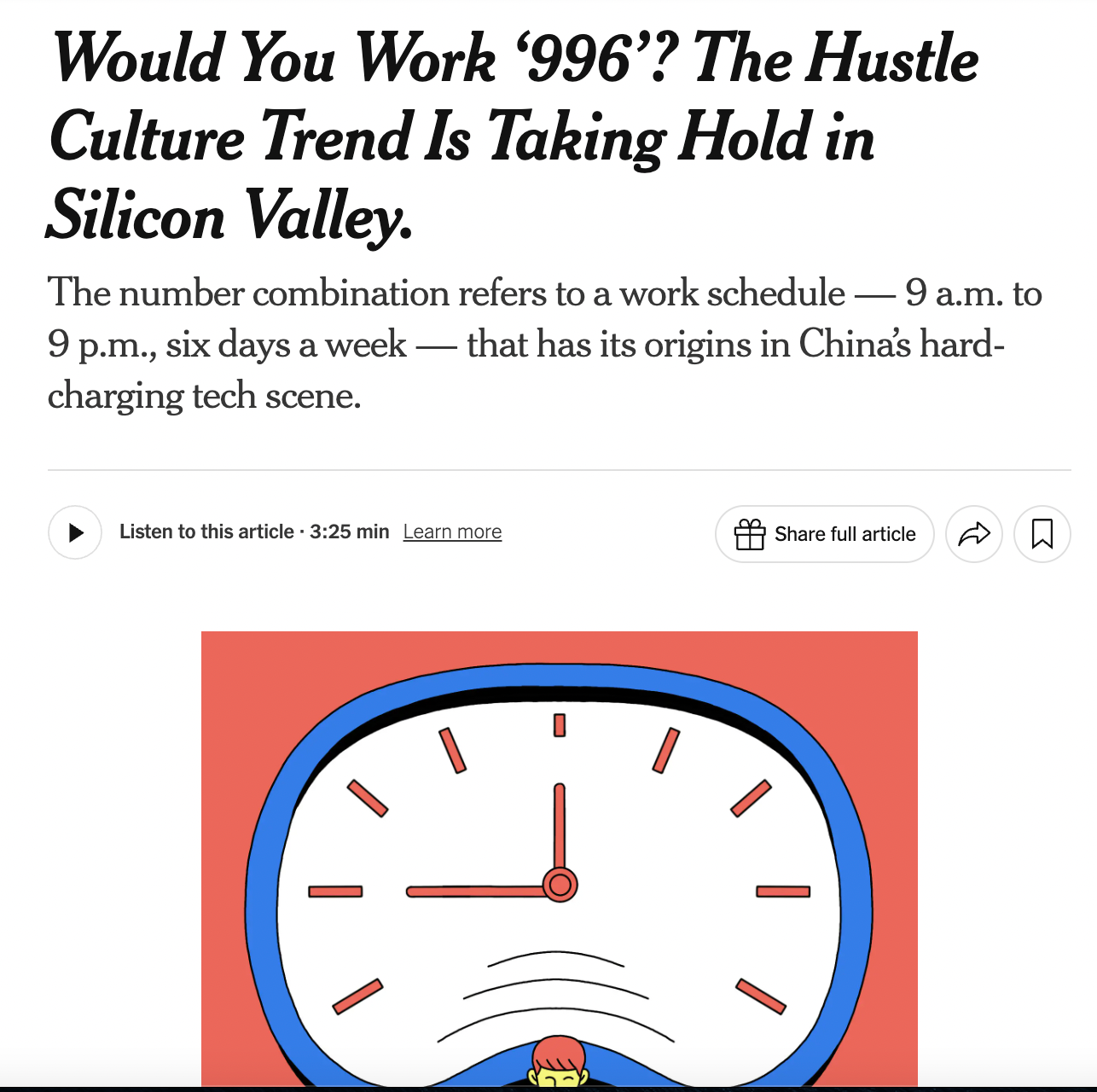
Along that note, the cynical part of me thinks this is a play to reduce labor rights in the US with Silicon Valley pushing things like 996 culture in the US, taking all the wrong lessons from China’s successes. In fact, the most dangerous misreading of China is Silicon Valley’s embrace of 996 culture.
- Silicon Valley AI Startups Are Embracing China’s Controversial ‘996’ Work Schedule | WIRED
- As China’s 996 culture spreads, South Korea’s tech sector grapples with 52-hour limit | TechCrunch
- Why China’s 996 Work Culture Won’t Win The Future Of Work
- Why the ‘996’ schedule is capturing the interest of Silicon Valley leadership : NPR
After all, it’s an open secret that tech companies like hiring H1Bs not only because the US doesn’t produce enough of the right talent pool, they also want a compliant workforce. Meanwhile, companies in East Asia are shockingly inefficient due to presentee-ism (aka 996) over results. Institutions in China are recognizing the problems of this and trying to take action. Toxic work cultures in Asian countries remain a reason why many in Asia still want to work in the US despite how wealthy many Asian countries have become and have better public services and infrastructure than the US. These issues contribute to the low birthrates in Asia that have sombering implications for superaged societies:
- Why are fertility rates so low in East Asia? It’s the society, stupid
- South Korea to China: Why is East Asia producing so few babies? | Demographics News | Al Jazeera
The giants of American industry have done their own research on what makes teams successful and seemingly turned their backs on them for their own political motives.
- Google’s Project Aristotle — Psych Safety
- Four Steps to Building the Psychological Safety That High-Performing Teams Need | Working Knowledge
American enterprise and innovation has been successful because of this culture of openness and respect for individual rights: our rebellious streak of willingness to make things happen versus playing it safe and fitting in combined with our unique access to vast amounts of venture capital. It’s vital especially in areas like national defense where we could be outclassed.
As such, instead, what Silicon Valley and Americans should learn from China and East Asia is the power and success of smart industrial policy. For example, China’s EV industry is world leading. We Americans should be building infrastructure while preserving our own innovation culture. This means investing in better transit, healthcare, and initiatives to encourage development in crucial industries:
- Mapping Two Decades of China’s Industrial Policies | FSI
- What Can Industrial Policy Do? Evidence from Singapore | The Review of Austrian Economics
- 5 Key Learnings on Asia’s Sustainable Infrastructure Development — The ASEAN Magazine
- How Asia Works author Joe Studwell on industrial policy lessons for the U.S., state capacity, and corporate culture — Economic Innovation Group
China is succeeding despite 996, not because of it.
That being said, Americans need to adjust to a more competitive multipolar world and actually build again versus being conned by politicians on both sides playing culture war issues. The politics of symbolic gestures on the left and right offering racial resentment but causing economic harm need to go and be replaced with real economic opportunity and building actual things — the example of Mexican President Claudia Sheinbaum’s effective communications on infrastructure projects offer a huge contrast.
American voters need to demand we build and make lives better for people versus falling for the talking points of enemies, both foreign and domestic.
The capture of Silicon Valley by technofeudalists is a truly sad development. I hope the real innovators of America retake narrative and capital to push for areas like real infrastructure development, investment in education, dive back into innovation culture, treating people right, and actually making things of value again.
메타데이터
- post_id
- cac4ac7df0eb
- slug
- silicon-valley-is-taking-all-the-wrong-lessons-from-chinas-successes-cac4ac7df0eb
- url
- https://medium.com/@bessiefromsgv/silicon-valley-is-taking-all-the-wrong-lessons-from-chinas-successes-cac4ac7df0eb
- canonical_url
- https://medium.com/@bessiefromsgv/silicon-valley-is-taking-all-the-wrong-lessons-from-chinas-successes-cac4ac7df0eb
- author_url
- https://medium.com/@bessiefromsgv
- status
- ok
- fetched_at
- 2026-08-18 06:32:24