Going East by Train (2/2)
a train journey from Ankara to Kars
Going East by Train (2/2)
a train journey from Ankara to Kars
It was still bright when we arrived in Kars. The minibus dropped us by the old cathedral and we took the first taxi in line to our airbnb. It was the only one in town, that type of business was just developing. Kars was off the visitors map, because of its remote location at the far end of Eastern Turkiye and lack of marketing. Western Türkiye has so many sites of cultural and historic interest that the East is easily forgotten. The airbnb building, a four-storey apartment block, was new and cheaply done, but it had the great advantage of being located close to the centre in an area that felt like a village with small houses and orchards. We just needed to cross a bridge over the Kars river and we were in the centre. Unlike Erzurum, everything was open the night we arrived. The restaurants and cabarets were busy all evening, people ate, drank alcohol and danced their traditional dances. We had arrived in the Caucasus, a different region, with a history of shifting borders

.Kars is a relatively small city of less than 100,000 people today, but it has a long history. It was part of the Ancient Kingdom of Armenia in the 4th and 5th centuries, and for a brief time in the 10th century, it was the capital of the Bagratid Kingdom of Armenia, a kingdom that broke off from Umayyad and Abbasid rule, the caliphates that had taken over Great Armenia. For centuries afterwards and because of its strategic location between the Ottoman Empire, Persia and Russia, it was conquered and changed rule several times. It became part of modern Türkiye in 1921 with the Treaty of Kars signed between Türkiye and the Soviet Union.


Russian houses in Kars ©Photo: Dominique Magada
For the 40 years before, between 1877 and 1917/18, Kars had been a Russian city, as Russia expanded its influence to south Caucasus. A new city was built at the foothill of the old citadel and the architecture flourished. Following the urbanism style in fashion then, a grid system of perpendicular and parallel streets was developed — a novelty there — and many one and two-storeys mansion houses were built along the streets. Luckily they have been preserved and give the city of Kars a unique charm. I enjoyed walking around the area, especially when the streets were covered in snow and empty of cars. A similarity in climate with temperatures hovering around -10 degrees celsius in early March, may have attracted the Russians at the time. Since then, the larger buildings have been repurposed into municipal offices, museums, hotels as well as religious buildings. It is the case in particular with the Russian cathedral, Alexandre Nevski, which was converted into a mosque. Part of the stones that formed a cross on the façade have been removed, and a couple of minarets added. The day I visited, it was reserved for women (I don’t know if it is the case all the time). For once, I could visit it and not my husband. Inside, there was a vast rectangular room typical of a church with a gallery running around the upper level and a balcony for dignitaries. The room was empty apart from a wooden Mihrab that had been added on the side pointing to Mecca. The women were sitting on the carpeted floor and studying the Coran, a book open in front of them. They welcomed me and suggested that I sit with them. I declined and not wanting to be too intrusive during their prayer time, I left.
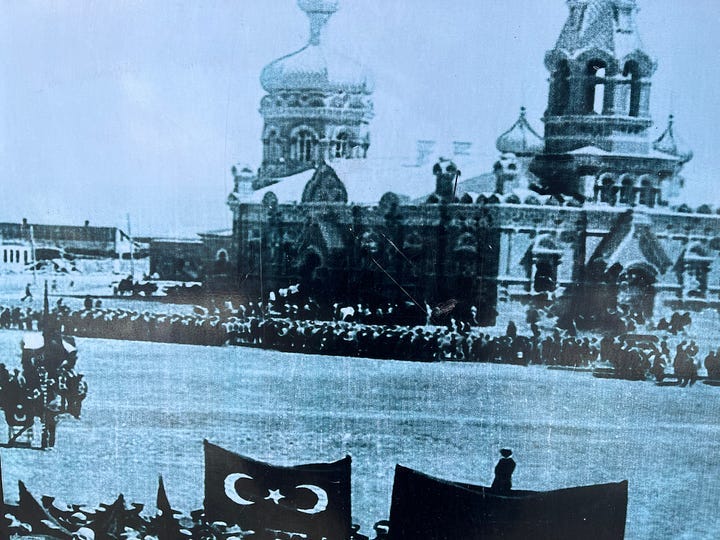
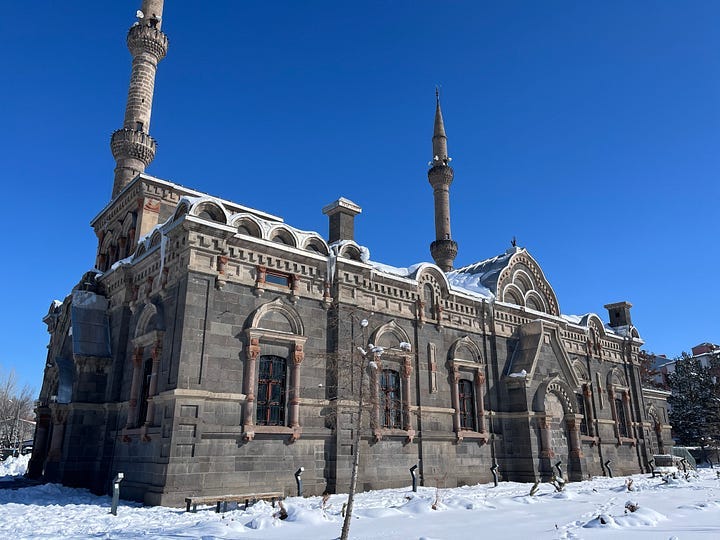
The old Russian cathedral before and after ©Photo: Dominique Magada
When I said to my Turkish friends in Ankara that I had plans to travel to Kars, they told me “it’s like Russia out there.” At first, I was surprised at their comment after 100 years of Kars being a Turkish city, but I understood better once there. The recent history of Kars reminded me of Alsace, my region of origin in France, located on the German border. At about the same time as Kars was Russian, Alsace was under German rule (1870–1918), and up to this day, people hold the same clichés about Alsace being more German than French. So I do have a special sympathy towards people from border regions. We understand divided allegiances and that makes us a more independent-minded people.
Watching a local folk show in the evening, I understood how strongly local people felt towards the Turkish Republic, the same way people from Alsace feel about France. In one of the dances which celebrated the life of Mustafa Kemal Atatürk, the grand finale was to kiss the Turkish flag. The dancers, dressed in a Georgian style coat with cartridges aligned over the chest, showed utter respect and emotional attachment when holding and folding the flag.
I enjoyed being in Kars and discovering a different culture and food away from the easy commercialisation of culture aimed at tourists, as we often see in Türkiye, but I wasn’t there for long enough to understand all its intricacies. There, we played the tourists, ate goose meat and Gravyer cheese, a corruption of the Swiss name Gruyère. Kars is also the Turkish capital of cheese. Production was introduced in the late 19th century by a religious community exiled from Russia, the Molokans, who were known for their dairy expertise. In about the same period, a Swiss cheesemaker named David Moser discovered while visiting the region, that the high altitude climate and quality pasture of Kars were ideal for the production of Swiss-style cheeses. The first large scale production of Gravyer started in 1926 and cheese production expanded from there, particularly in the nearby village of Bogatepe, the most famous in the area for its quality cheese. In Kars town, there was a multitude of cheese stores, including some run by producers themselves, so we had ample opportunities to taste the different cheeses: aged cheese, smoked cheese, herb-flavoured cheese, and more.

Breakfast in Kars Photo©Dominique Magada
Our trip culminated with a visit to the lost city of Ani, the ancient Armenian capital, located right on the Armenian border at about 40 kilometres from Kars (an easy taxi ride). A river in-between two cliffs acts as geographical and political border. Little is left of Ani, which in the 10th and 11th centuries was a thriving city and an important geo-political centre on the old Silk Road, but the setting, especially in winter, is spectacular. Scattered ruins of ancient churches half covered in snow in the frozen silence of history made an impression. We were practically alone there, with only a few other visitors who were curious enough to brave the cold. The site, managed by the Ministry of Culture, is well organised. I gather it is far busier in summer. And to crown it all, the icing on the cake in that trip was a sleigh ride on the frozen lake of Çildir outside Kars, which made me feel I was a character in a 19th century Russian novel.


The lost city of Ani ©Photo: Dominique Magada
메타데이터
- post_id
- cacb2f32bc02
- slug
- going-east-by-train-2-2-cacb2f32bc02
- url
- https://medium.com/voyages/going-east-by-train-2-2-cacb2f32bc02
- canonical_url
- https://medium.com/voyages/going-east-by-train-2-2-cacb2f32bc02
- author_url
- https://medium.com/@magadaRoma
- status
- ok
- fetched_at
- 2026-08-21 05:18:30