The Esoteric Enigma of The Elder Scrolls Oblivion: Unearthing Vivec’s “Chim” in the Shivering Isles
Introduction
The Esoteric Enigma of The Elder Scrolls Oblivion: Unearthing Vivec’s “Chim” in the Shivering Isles
Introduction
The Elder Scrolls IV: Oblivion has always been more than a game. It is a text, a living scripture, an experiment in how far digital mythmaking can be pushed before it slips into the surreal. The Shivering Isles expansion, released as a realm of madness grafted onto Cyrodiil, is the crown jewel of this experiment. Where the base game offers political intrigue and landscapes rooted in the familiar, the Isles are unapologetically alien. They pull the player into a dream logic where the twin poles of Mania and Dementia wrestle endlessly for dominance, each side both intoxicating and suffocating.
To wander here is to stumble into a philosophical trap set by Bethesda’s writers, one where Sheogorath, the Daedric Prince of Madness, is not just a mad god but potentially the player themself. Layered within this are whispers of CHIM, the esoteric principle introduced in The 36 Lessons of Vivec from Morrowind. The Shivering Isles do not simply exist as a playground of quests and colorful NPCs; they serve as a cryptic mirror of what Vivec described, a place where reality and unreality interlace, and where the act of playing becomes indistinguishable from the act of creating.
In this expanded exploration, we will not merely describe the Isles, but dissect them. We will look closely at the Argonians and why they matter more than most players suspect. We will examine the theory that Sheogorath is the Nerevarine reborn in lunacy. We will trace the connective tissue that binds Vivec’s CHIM to the land of madness. And finally, we will meditate on the ethereal beauty of its landscapes and soundtrack, both of which do more than entertain: they hypnotize.
The Argonians: More Than Just My Favorite Race
On the surface, calling the Argonians the most handsome race in Oblivion may sound like jest, but there is cunning truth buried in the claim. Argonians are outsiders by design, a reptilian people evolved from the alien swamps of Black Marsh. Their bodies are slick, their voices are strange, and their culture is largely hidden from Imperial understanding. Yet in the Isles, their amphibious adaptability becomes symbolic.
Argonians embody survival in the face of environments that devour lesser beings. In Mania’s psychedelic jungles, where mushrooms tower higher than trees and colors scream like static, an Argonian moves with effortless grace. In Dementia’s fetid swamps and gray-bog marshes, their biology makes them immune to despair where humans and elves stumble. Their presence becomes a living metaphor: the “handsome” nature of the Argonians is not skin-deep but tied to their role as survivors who thrive in worlds that reject order.
Cunning players see it. Argonians are not merely another playable race; they are emissaries of transformation. When you embody one, you already half-inhabit the liminal state that the Shivering Isles demands. Their culture, rooted in Hist trees that connect them to dreams and memories not their own, resonates uncannily with the Isles’ own dream-logic. To play as an Argonian here is to align with the idea of CHIM, the recognition of the self as both an actor and a dreamer within a fabricated universe.
Sheogorath as the Player: The Dangerous Theory
Sheogorath is madness personified, but in the Isles, his laughter has an edge. He mocks the player with jokes that cut a little too deep, as though he knows what you did in another life. This has led to one of the most fascinating theories in Elder Scrolls lore: Sheogorath is the Nerevarine.
The logic is unnerving in its clarity. At the end of Morrowind, the Nerevarine’s fate is ambiguous. Some say they vanish into Akavir. Others claim they live on in myth. Yet in the Isles, Sheogorath makes offhand references to Morrowind’s past with unnerving familiarity. His cadence mirrors Vivec’s, his obsession with fate and prophecy feels recycled, distorted, like a voice you half-remember from a dream.
This theory proposes that by achieving so much power in Morrowind, the Nerevarine fractured, sliding into madness under the unbearable weight of godhood. What remains is Sheogorath, a god who cannot help but toy with the pieces of the world. The Shivering Isles becomes, then, not simply an expansion but the logical continuation of the player’s journey. You are not just stepping into Sheogorath’s court. You are looking into a mirror.
The brilliance of this design lies in its ambiguity. Bethesda never confirms it, but every breadcrumb is laid deliberately. It dares the player to question whether they are ruling the Isles as a hero, or simply succumbing to the madness that comes with the knowledge of CHIM.
Vivec’s Shadow: CHIM in the Isles
The true heart of this enigma lies in Vivec. The Tribunal god-poet of Morrowind introduced CHIM, that gnostic state of realization where one understands the world as a dream yet continues to exist within it without dissolving into nothingness. To know you are fictional, to embrace it, and to laugh at the zero-sum trap — that is CHIM.
The Shivering Isles is soaked in this concept, though it never names it outright. Mania and Dementia mirror Vivec’s duality of warrior and poet. Sheogorath himself plays the part of the trickster-philosopher, teaching lessons through cruelty disguised as comedy. Every quest in the Isles forces the player to confront contradictions: mercy that looks like cruelty, sanity disguised as madness, freedom cloaked as imprisonment.
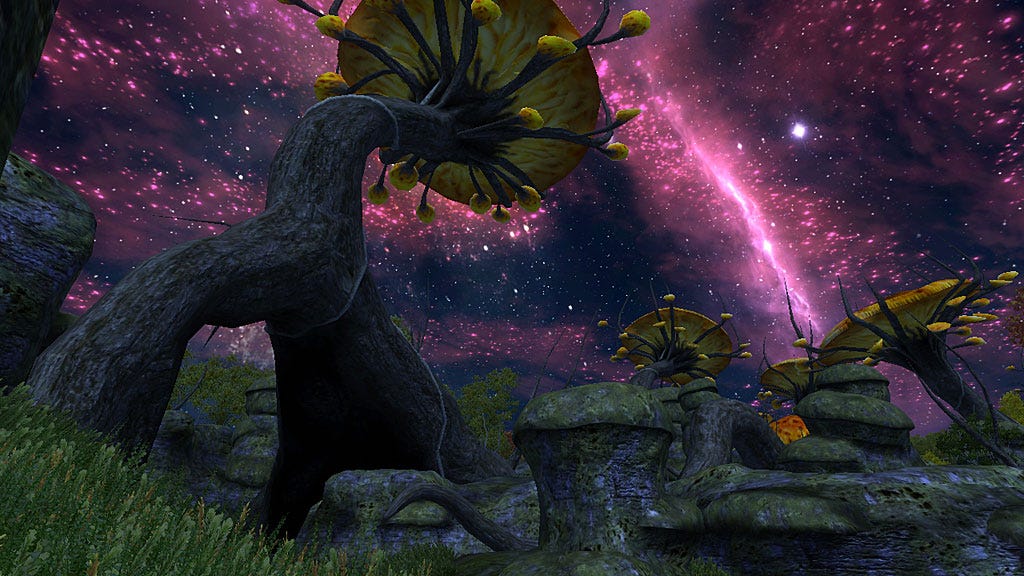
When you look at the landscape, you see CHIM at work. The Isles do not obey natural law. Colors are too vibrant. Shadows are too long. Architecture curls and twists into impossible angles. The very physics of the place bends under the weight of realization: you are walking through a dream that knows it is a dream. And by playing, by choosing, by engaging, you become complicit in sustaining that dream.
This is where Vivec’s shadow falls across the Isles. Oblivion never says his name here, but his ghost lingers in the concept of reality bending under the awareness of its own fiction. CHIM is not spoken, but it is enacted, every time you choose to rule as Sheogorath and smile knowingly at the absurdity of it all.
The Isles Themselves: Beauty That Devours
To speak of the Shivering Isles is to speak of beauty sharpened into a blade. Mania is a world painted in colors that hurt the eye. Its flowers glow with impossible phosphorescence, and its skies bleed neon like liquid over a canvas. To walk there is to feel elation tinged with unease, as though too much joy might tip into insanity.
Dementia is the inverse: a land of mold and rot, swamps that never end, twisted trees that seem to whisper curses. Yet even here, beauty festers. The water reflects a dull silver that feels holy in its decay. The ruins scattered throughout speak of forgotten empires that never truly died but sank into the bog, waiting for some fool to resurrect them.
The soundtrack binds it all together. Composed with haunting strings and soft, lingering woodwinds, it is not merely background noise. It manipulates the player, pushing emotion in directions the mind does not consciously register. The music of the Isles does what CHIM does: it tells you this is not real, yet you believe in it anyway, because it is too beautiful to ignore.
Legacy: The Isles as a Lasting Puzzle
The Shivering Isles has earned its place as one of the greatest expansions in gaming, but not because of content alone. It endures because it is a riddle that refuses to be solved. Players still debate Sheogorath’s true nature. Lore theorists still argue over whether CHIM is truly present or only a ghost of Morrowind. Artists still recreate the Isles’ landscapes because they feel like dreams too vivid to fade.
The Argonians remain a race whose presence here grows in significance the more you consider it. The theory of the player as Sheogorath continues to haunt Elder Scrolls forums like a recurring nightmare. And Vivec’s concept of CHIM, though buried in metaphors and madness, lingers as the intellectual key to unlocking the Isles’ deeper meaning.
The expansion is not simply about playing a new land. It is about playing with the nature of play itself. The Isles whisper the truth that all games are dreams, and that the player who knows this and keeps playing anyway has brushed the edge of godhood.
Conclusion
The Esoteric Enigma of Oblivion’s Shivering Isles is not solved by cataloging quests or admiring scenery. It is solved by surrendering to the madness and recognizing what lurks beneath: a mirror of Vivec’s CHIM, refracted through a god who may be you. The Argonians hint at it. Sheogorath toys with it. The Isles themselves enact it. And the soundtrack forces you to feel it whether you want to or not.
The Shivering Isles remain a masterpiece, not because they add more to Oblivion, but because they question the act of playing altogether. They suggest that when you step into madness, you step closer to truth.
And perhaps that is why the Isles endure. They are not just a place in a game. They are a test, a question, a whispered riddle: do you know you are dreaming, and will you laugh anyway?
메타데이터
- post_id
- cacce3f3d4bd
- slug
- the-esoteric-enigma-of-the-elder-scrolls-oblivion-unearthing-vivecs-chim-in-the-shivering-isles-cacce3f3d4bd
- url
- https://medium.com/@zelraeth/the-esoteric-enigma-of-the-elder-scrolls-oblivion-unearthing-vivecs-chim-in-the-shivering-isles-cacce3f3d4bd
- canonical_url
- https://medium.com/@zelraeth/the-esoteric-enigma-of-the-elder-scrolls-oblivion-unearthing-vivecs-chim-in-the-shivering-isles-cacce3f3d4bd
- author_url
- https://medium.com/@zelraeth
- status
- ok
- fetched_at
- 2026-07-24 20:46:40