Closing Hormuz: The Old Naval Mines Behind The New Global Crisis
The Third Gulf War, initiated on 28 February 2026 by a coordinated strike conducted by the United States and Israel against Iran, has…
The Third War of the Gulf
Closing Hormuz: The Old Naval Mines Behind The New Global Crisis
The Third Gulf War, initiated on 28 February 2026 by a coordinated strike conducted by the United States and Israel against Iran, has rapidly developed into one of the most consequential crises in recent maritime trade, with particularly acute implications for the transport of oil. Roughly 20% of global oil flows - amounting to approximately 20 million barrels per day (with one barrel corresponding to about 159 litres) - transit through the Strait of Hormuz, the narrow maritime corridor linking the Persian Gulf to the Indian Ocean. This critical artery now faces the concrete risk of prolonged closure, an event that had never occurred before in history, not least in light of Iran’s declared intention to deploy naval mines in the area.

A convoy during the Tanker War (1984–88). A scene we may yet witness again in the waters of the Strait of Hormuz? Photo courtesy of Norbert Schiller.
This article first examines what may be learned from the distant past regarding naval mine warfare; then turns to consider the lessons derived from the more recent history of the Persian Gulf; and finally analyses the present situation.

The strait of Hormuz. Source: Wikipedia
The first two months of war
The strait is of significant global importance due to its role as the world’s second-largest chokepoint in terms of oil traffic volume. Only the Strait of Malacca in South East Asia handles a greater volume of oil. For further information on the strategic and economic meaning of chokepoints, see here.

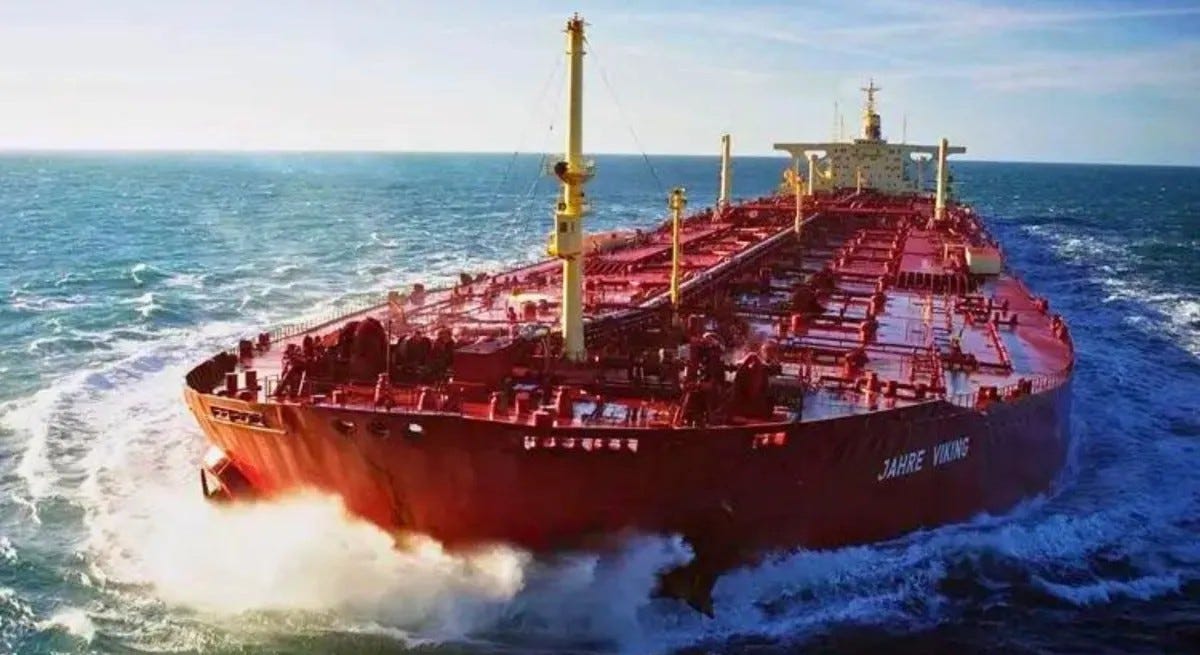
A tanker under her way in the Strait of Hormuz. Photograpf by the author.
In response to the United States and Israel’s military actions, Teheran closed the strategic Strait of Hormuz to all commercial vessels on 2 March 2026, with only a limited number of exceptions.The objective was achieved by laying an unknown number of mines at the narrowest point of the strait, as Iran itself acknowledged on 9 April 2026. This move precipitated a crisis that bears few parallels in contemporary history.

Nautical chart released by Iran’s Nour News and reproduced by the online publication Dawn. It shows the area closed to navigation due to the laying of naval mines, as well as the new traffic corridors, which run much closer to the Iranian coast than the pre-crisis routes.
As demonstrated in the official chart published by **United Kingdom Maritime Trade Operations (UKMTO) Centre**, the figure for ships entering and leaving has dramatically dropped from a historical average of around 138 per day, with a further slight increase in April. During March, the number of ships was almost zero.

Source: United Kingdom Maritime Trade Operations (UKMTO) Centre
[embed]Even more striking is this animation released by the website MarineTraffic on its Facebook page, which shows the almost vertical collapse of maritime traffic in the Strait following the Iranian blockade. Tankers are indicated in red. Circles represent vessels at anchor, while small triangles denote vessels underway. Note the concentration of ships in the Persian Gulf.
It is estimated that hundreds of ships, perhaps numbering around a thousand, have been stranded within the Persian Gulf awaiting a green light that currently seems unlikely to be forthcoming in the immediate future.

The image depicts a fleet of ships at anchor in the Persian Gulf. The picture is a frame from a FB video. No piece of information about the exact location is available. Photograph by Giorgio Bianchi on Facebook
The following chart details the situation as of 26 April 2026, as recorded by the MarineTraffic website:

On 26 April 2026, two months after the outbreak of hostilities, the situation has not changed, as this screenshot from MarineTraffic demonstrates.
The consequences of this situation can be seen in the sharp rises in oil tanker freight rates and insurance premiums. These, in turn, have led to a corresponding surge in the price of oil and gas on international markets.

Source: EIA
These markets are of particular significance in the context of the transportation of raw materials, as they represent the point at which oil and gas must be transferred to reach end consumers. The average increase in prices across these markets has reached an astonishing 30%. The price rise has been immediately passed on to consumers, predictably triggering a surge in inflation.

Source: EIA
A more significant concern is the imminent threat of a shortage of crude oil, a situation that has been exacerbated by a delay of merely a few weeks. This delay can be attributed to the fact that oil tankers that had already traversed the Strait prior to the closure required between four and six weeks to reach their intended destination. Indeed, cargo ships and tankers typically travel at a speed of approximately 12 knots (equivalent to approximately 22 kilometres per hour, or about 530 kilometres per day), as this represents the optimal compromise between fuel consumption and the time required to reach their destination. While it is possibile that a significant proportion of cargo ships and oil tankers could travel at higher speeds, this is not a common occurrence due to the associated costs.

Typical navigation times under normal conditions between the Persian Gulf and the main destination ports. Source: Wikipedia.”
In response to Tehran’s closure of the Strait President Trump, with the evident intention of preventing any advantage for ships that accepted Iran’s conditions, proclaimed a naval blockade on these vessels.
The conflict thus became a perfect example of ‘asymmetric warfare’, in which one of the contenders (in this case Iran) reacts to being outmatched by the opponent’s military might in open conflict by exploiting a whole range of insidious threats that prevent the enemy from exploiting the tactical advantage gained to their own ends.
In order to implement their threat, the Islamic Revolutionary Guard Corps (or Pasdaran) have a number of options at its disposal, including but not limited to: small fast boats, missiles, drones and mines.
It is important to acknowledge that the Pasdaran possess their own naval force, which is separate from the “official” navy. The latter consists of conventional units, many of which were attacked and destroyed in the early days of the war. In contrast, the Pasdaran navy is made up of hundreds of small assault craft, often little more than fast, lightly armed speedboats. The preferred tactic of the aforementioned actors is to operate in large formations, dispersing and then converging on the target from multiple directions. Despite their lack of armour, which renders them relatively vulnerable, their sheer numbers enable them to overwhelm enemy defences or, at the very least, to evade surveillance. A significant proportion of these vessels are also equipped for mine-laying operations.
The present article will focus exclusively on this final threat, as it is both the most insidious and effective.

Potential threats to a transport vessel. Gemini generated imagine, based on this original.
War at sea is very different from war on land: it is structurally ‘dynamic’ in that its objective is to secure and maintain the ability to move freely at sea (to transport troops and supplies or to attack enemy territory directly).
Mining a stretch of water is the only possible way to ‘occupy’ it in a sense vaguely similar to that in which an army is said to ‘occupy’ a certain territory.
The unique characteristic of these weapons lies in their ability to alter the availability of waterways, thereby affecting mobility at sea. When an area is mined, the risk of passing through it is so high that it becomes unfeasible.
In this way naval mines can have a profound impact on maritime shipping and commercial activities. In the event of a strait being mined, or indeed, as in the case of Hormuz, a genuine chokepoint, the effect is to impose a complete blockade on all traffic, with devastating consequences at a global strategic level.
Lessons from the past history
History provides numerous examples of the strategic effects of minefields, and here we shall mention just a few.
During the First World War, one of the most successful minefields was that which closed the Dardanelles in 1915, following the Ottoman Empire’s entry into the war on the side of Germany and Austria. The defensive strategy comprised 300 mines distributed over ten lines, with the addition of coastal batteries designed to neutralise minesweepers attempting to clear the area. The narrowest point of the Dardanelles is a mere 1,300 metres wide, underscoring the strategic significance of this choke point.

The defenses of Dardanelles, 1915. Source: Wikipedia
The Anglo-French fleet, which intended to force its way through to bombard Istanbul and compel Turkey to withdraw from the conflict, advanced with excessive overconfidence. In the operation carried out with a massive deployment of forces on 18 March 1915, three battleships (the French *Bouvet and the British [Irresistible ](https://en.wikipedia.org/wiki/HMS_Irresistible_(1898))*and Ocean) were sunk with heavy losses, and three others were severely damaged. The attack directed against Istanbul was replaced by the landing at Gallipoli, which led to a substantial defeat of the Allied expedition after ten months of futile attempts. Turkey persisted in its engagement until the conclusion of the hostilities.

The British battleship Irresistible hit by a Turkish mine on Aprile 18th, 1915. Source: Wikipedia
During the First World War, the Italian Royal Navy suffered significant losses in the Adriatic due to the deployment of mines, with the battleship *Regina Margherita* being sunk by two mines off the coast of Valona on 11 December 1916. During the Second World War, the Italian Navy was tasked with maintaining open communication routes with the African continent. This was achieved by repeatedly breaching the minefields that had been laid by the British in the Strait of Sicily. These episodes are of particular significance as they elucidate the considerable attention that the Italian Navy has historically allocated to mine warfare, developing highly sophisticated technologies which will be discussed in greater detail subsequently.
In the final months of the Second World War, the United States engaged in a systematic mining operation in Japan’s ports and coastal waters during the Pacific theatre. The operation was given the significant designation **Operation Starvation.** More than one hundred B-29 bombers from the 31st Bombardment Wing were deployed, dropping some 12,325 mines, the success rate of which was extraordinary. Indeed, 670 ships were sunk or damaged, totalling 1,250,000 tonnes of tonnage (9% of all losses inflicted on the Japanese merchant fleet in just three months), virtually blocking military and civilian supplies to the Japanese islands.
It is evident from these historical illustrations that naval mines, even in their most elementary forms, have the potential to be remarkably efficacious and hazardous. Even a weak navy (such as Turkey’s, for example, in the past, and as Iran’s today) can achieve significant strategic results by using these weapons, which are only seemingly ‘modest’.
Lessons from recent history: what has happened and what could happen again in the Persian Gulf
Conversely, the waters of the Persian Gulf have previously been the site of significant naval confrontations, thereby illustrating the fragility of maritime security in the region.
During the **Iran-Iraq War (1980–88), a series of events came to be known as the ‘[Tanker War](https://en.wikipedia.org/wiki/Tanker_war)**’. In an effort to gain a competitive advantage, both parties initiated a series of attacks on oil tankers transporting crude oil produced within their respective nations. This strategic move aimed to disrupt the most significant and profitable trade routes for their respective economies.
The severity of the situation escalated further from 1984 onwards, when Iran began targeting numerous neutral vessels as a response by Iran to a series of highly effective attacks by Iraq.
The message was unambiguous: no state in the region can afford to adopt a passive stance; any local crisis has the potential to escalate into a full-scale conflict; and a threat directed against Tehran could result in devastating economic consequences for all the economies of the Persian Gulf at any moment.
This is very important, because it is precisely the strategy Iran adopted in the 2026 war: to escalate the conflict as far as possible (this time with missile and drone strikes against the Gulf monarchies) to demonstrate that any threat against Tehran would immediately result in harm to everyone. The only difference between the situation in the 1980s and that of 2026 is that in 1984 the Pasdaran, or ‘Guardians of the Islamic Revolution’, unlike in 2026, refrained from completely closing the Strait of Hormuz, whilst continuing to strike oil tankers, including those of the Gulf states.
Lloyd’s records indicate that, during the Tanker War between 1984 and 1988, at least 37 oil tankers were ‘lost’ as a result of air and naval attacks, with a peak of 16 vessels recorded in 1986. However, it is noteworthy that only one tanker actually sank in the open sea as a result of a missile attack (not a mine). As reported in a question-and-answer session with Shri K. Vijaya Bhaskara Reddy, the Indian Minister of Shipping and Transportis on August 4th, 1984
The Indian ship APJ Ambika was hit by a missile on 1 August 1984 and subsequently sank in the Khormussa Channel near Bandar Khomeini, not in the Strait of Hormuz.
The remaining vessels sustained significant damage but remained afloat. They were subsequently towed to port and then scrapped.
This, too, is an important lesson for 2026. Supertankers are such giants that it is truly difficult to put them in trouble. It is only through the utilisation of authentic attacks, whether these are surface ships or aircraft, that a considerable degree of damage or sinking can be achieved, and only if their hydrocarbon cargo is set on fire. From a practical point of view, nevertheless, there is no need to sink them: it is enough to inflict such severe damage that repairing it is not economically viable. The insurance companies and shipowners will see to it that the vessel is scrapped by taking it to one of the many shipbreaking yards….
In the Tanker War one of the few vessel to sink after being hit was the Normal Atlantic, which was not a tanker but an ore/bulk/oil carrier with a tonnage of approximately 87,000. The cargo had recently been loaded with naphtha in Saudi Arabia and she sank on December 10th, 1987, four days after being attacked in the Strait of Hormuz by three Iranian speedboats, which struck it with RPGs in tanks 3 and 7. The incident occurred at the narrowest point of the strait, but the vessel was successfully towed out of the shipping channel before the hull broke apart.

The Normal Atlantic in flames. She was hit by RPGs (Rocked-Propelled Grenade) not by mines. In the background, the Omani coast is visible. Source: The Long and Winging Road
The mine war: a nightmare that could be repeated
In 1987, there was a significant escalation in hostilities, as the Iranians began to use mines as well, primarily to block the channel leading to the ports of Kuwait.
A thorough examination of the events that transpired is warranted, as there is a possibility of recurrence of a similar situation in the present day.
At first glance, the potential for mines to be a threat appears to be of lesser importance. As demonstrated in the documentation from Lloyd’s of London, a mere two vessels were lost due to the detonation of mines. The first of these was the Anita, a diminutive support ship with a displacement tonnage of only 186. This vessel was destroyed by an explosive device in the Gulf of Oman, in proximity to the anchorage of Fujarah. The second vessel to be lost was the Marissa I, a small craft with a displacement tonnage of 181.
However, the employment of mines has played (and continues to play ) a pivotal role in naval strategy, particularly in an “asymmetric warfare” such as the 2026 war in the Persian Gulf.
In such circumstances, the strategic objective of the weaker navy (in this case, that of Iran) is not to entirely obstruct the passage of enemy vessels, but rather to impose a significant cost on such an endeavour. This objective was partially achieved by Iran during the Tanker War with Iraq and appears to have been achieved more effectively in the conflict with the US in 2026, when traffic through the strait has fallen to virtually zero.
During the Tanker War, at least six tankers were hit by mines: the Soviet-built but Kuwaiti-chartered Marshal Chuikov, the Liberian-flagged Primrose, the Greek-flagged Ethnic, the Liberian-flagged Stena Explorer, the US-flagged Bridgeton, and the Texaco Caribbean, also US-flagged.
The majority of the mines (at least 10) were situated within a channel leading to Kuwait’s primary oil terminal, Al-Ahmadi. In response to the escalating tensions, Kuwait requested assistance from the United States, consequently leading to the direct involvement of the latter in the conflict.

Al-Ahmadi oil terminal in 2025. Many tankers are visible at their moorings. Source: Google Earth
In November 1986, Kuwait issued a call for foreign assistance to protect Kuwaiti-flagged tankers, which were increasingly being hit by Iranian attacks. The Soviet Union was the first to act, taking the initiative of chartering tankers under the Soviet flag and providing an escort through the Gulf to Kuwait. This is why the first tanker to be damaged was the USSR-flagged Chuikov.

In any enclosed sea, shipping traffic is strictly channelled into lanes. On this map, the routes taken by Iraqi oil tankers (and generally those of neutral countries) are shown in yellow; those of Iranian oil tankers are shown in red. The areas hatched in blue indicate the zones where the Iranians attacked their targets (Iraqi and neutral); those in ochre indicate the zones where Iranian oil tankers were hit. Source: Academic
Concerned that the Soviet Union was gaining an advantage, the United States wanted to respond to Kuwait’s request. Under U.S. law and policy, the Reagan administration considered it necessary to reflag the Kuwaiti tankers under the American flag before placing them under U.S. naval escort. The relevant statutory framework was the Vessel Documentation Act of 1980, then codified in 46 U.S.C. Chapter 121. Following extensive legal deliberation in March 1987, the solution devised was to ‘re-flag’ 11 Kuwaiti tankers (and LNG carriers) under the US flag and registry. The ships were to be renamed, to be manned by a US captain, and to be subject to inspection by the US Coast Guard, which waived a plethora of safety requirements. Furthermore, they were to fly the American flag, a measure which rendered it legal for US Navy ships to provide them with defence. However, should the US Navy proceed with this course of action, it would find itself in direct conflict with Iran. It was previously assumed that the Iranians would be unwilling to attack a US-flagged ship. This assumption was found to be valid for the Islamic Republic of Iran Navy, the “official” Iranian navy, but not for the Islamic Revolutionary Guard Corps Navy, which was (and is) one of the two maritime forces of Iran, parallel to the conventional Iranian Navy
Operation Earnest Will (July 1987–September 1988) was so initiated to provide escort services for oil tankers in the Gulf. The operation was widely publicised as the official and public response of the United States to the request for help from the neutral Arab countries of the Persian Gulf.
As the Italian historian Bernardini states
the events that transpired in the Persian Gulf in 1987 represented a deviation from the prevailing traditional US policy in the region, which was predicated on the principle of delegating responsibility to local actors as guarantors of Western interests (Bernardini, p. 89)
This is particularly interesting if one accepts Luttwak’s insight, which draws a parallel between the behaviour of the United States and that of the Roman Empire, at least in its early years, when it tended to delegate the task of border surveillance to its clients. Only when the situation deteriorated, Luttwak argues, did Rome send its legions directly. You can read more about this here.
However, in 1987 the mission to protect international shipping was ultimately endorsed by UN Resolution 598, which was adopted unanimously on 20th July. The mission itself commenced on 21st July and disaster was narrowly averted.
Indeed, as early as 1986, the Iranian Pasdaran Navy had already established a base on the island of Farsi, strategically positioned in the centre of the Persian Gulf. Farsi is a diminutive islet of negligible significance, a rudimentary outcrop of the seabed, exhibiting near-perfect circularity with a diameter of approximately 500 metres. In contrast, the Pasdaran constructed a harbour on the southern side, capable of accommodating small vessels for rapid attacks and the deployment of mines along the obligatory routes for oil tankers.

Farsi Islet, as it appears in a 2024 satellite image. The islet has a diameter of approximately 500 meters. Soruce: GoogleEarth.
The first convoy of Operation Earnest Willing, which departed from the Gulf of Oman on 21st July 1987 and was destined for Kuwait, comprised the Kuwaiti oil tanker al-Rekkah and the gas carrier Gas Prince. The al-Rekkah was the archetypal supertanker of its era, measuring 353 metres in length and 29 metres in width, possessed a deadweight tonnage of 413,842 DWT, while the Gas Prince measured 46,723 tonnes of deadweight. The two ships were Kuwaiti, but were part of a group of vessels that had been re-registered in the US Shipping Registry. This allowed them to fly the Stars and Stripes and, as a result, under US law, to enjoy the protection of the US Navy. Consequently, the al-Rekkah was renamed Bridgeton, which subsequently became the name by which the incident would be known in the West.

SS Bridgeton. Source Wikipedia
he close escort comprised the missile cruiser USS Fox, the destroyer USS Kidd and the frigate USS Crommelin. The distant escort comprised other cruisers and an aircraft carrier. By the time the convoy had safely passed through the Strait of Hormuz, Iran declared that the ships were carrying ‘illegal goods’, and the Pasdaran prepared to launch an attack with speedboats from Farsi Island. Ayatollah Khomeini, Iran’s spiritual leader and Supreme Leader at the time, personally intervened to halt the mission, proposing instead the deployment of a minefield. An Iranian speedboat, specifically trained for such missions, was then deployed from the island’s base and created a narrow barrier of just nine mines, spaced approximately 500 metres apart, across the corridor through which the convoy was to pass. American intelligence services had obtained and analysed communications relating to the initial attack, but had not yet accessed the messages pertaining to the deployment of the minefield. On 24 July 1987 at 07:00, the Bridgeton collided with a mine approximately 13 miles west of Farsi Island.
This fact also illustrates just how close the shipping lane ran to the Iranian base. On the other hand, as we mentioned above, in an enclosed sea, shipping must necessarily take place along clearly defined shipping lanes (which are therefore easy to block).
Frank Seitz, the captain of the Bridgeton, spoke with Naval Institute editor Paul Stillwell at the U. S. Merchant Marine Academy, Kings Point, New York.
Question: Did you have any warning at all before the explosion, and what was your reaction when the mine exploded? Seitz: There was no warning. Afterward, I had a pretty good idea it was a mine. It felt like a 500-ton hammer hit us up forward. First, you heard a metal-to-metal clank. And then you felt the same motion on the ship as you get in big ships in a heavy seaway. They undulate, as the shock wave moves back and up the ship into the bridge and superstructure. In fact, we parted all the stays on our radar mast. ‘We all had to hold on so that this shock undulation didn’t knock us off our feet. A lot of stuff went flying. So there wasn’t much question that we had hit a mine. (from an interview to Us Naval Institutes, may 1988)

“The mine’s 250-pound charge struck the Bridgeton like a 500-ton hammer, shaking the bridge and the superstructure, and ripping a ten-by-five meter hole in one and one-eighth inch steel plating.” Source: U.S. Naval Institute
Question: What type of mine was it ascertained to be? Seitz: It was an M-08, a 1908 Russian design, bottom-moored, floating contact mine with contact horns, chemical horns, and a 115-kilogram charge.
Question: How far below the surface was the mine moored? Seitz: Well, we were drawing seven meters, so it had to be somewhat less than that. I think the water there was about 30 meters deep.
Reflecting on the explosion, which created a hole about ten meters long by five meters wide, Seitz believed it would have caused significant damage to any of the US warships. As the Bridgeton proceeded with difficulty, the Navy ships permitted the tanker to assume the vanguard position for the remaining duration of the voyage. According to Seitz’s testimony, it was he who advised the escort unit to proceed astern of the tanker, given the force of the blast.
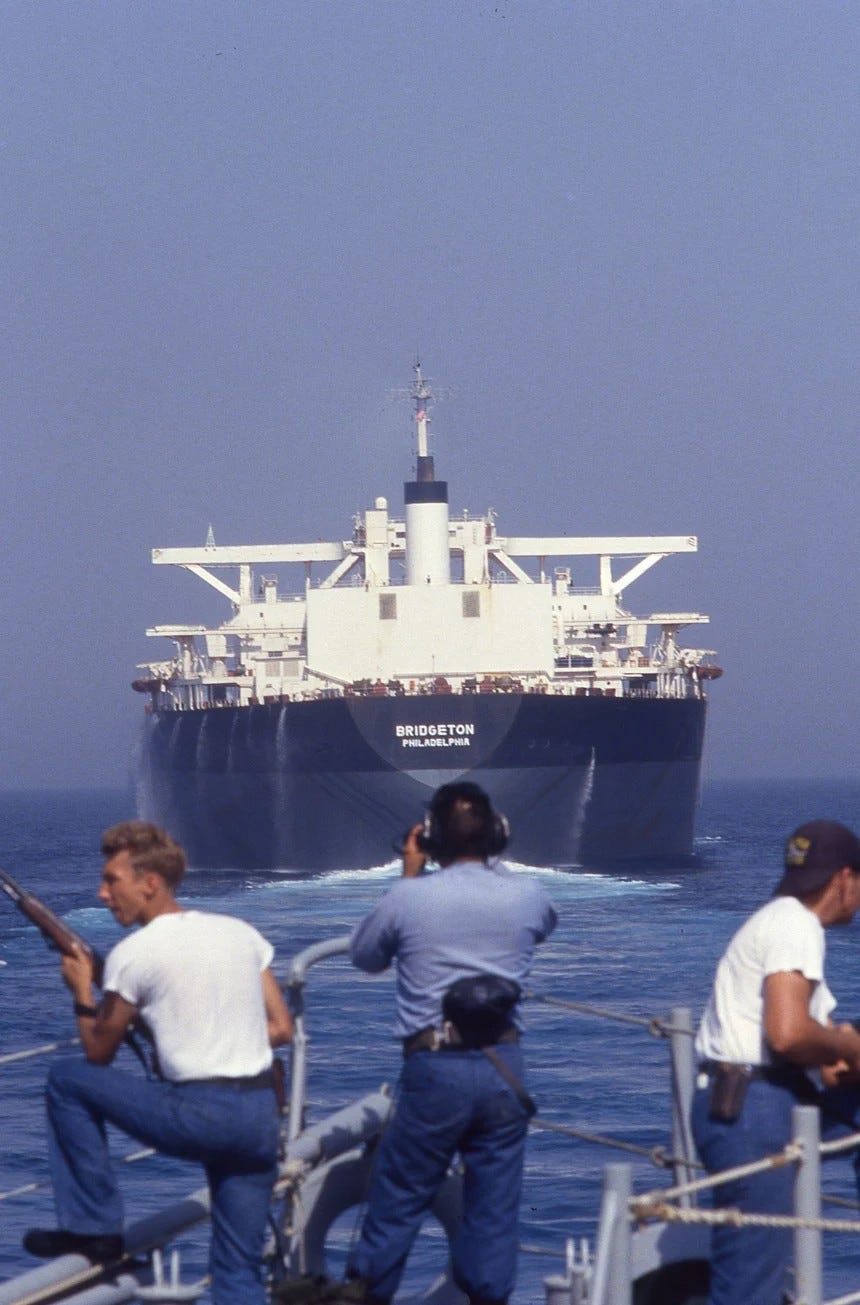
The SS Bridgeton acting as a minesweeper in July 1987.
The decision, which may have been justified from a strictly technical and military perspective, resulted in a significant blow to the public image of the US Navy, as statetd Samuel J. Cox, Director NHHC
The outcome, nevertheless, proved to be one of the most disgraceful photographs in the annals of US naval history, depicting the Bridgeton arriving in Kuwait with her former US escorts following in her wake, seemingly utilising the large tanker as a ‘minesweeper’ for their own protection. (Cox, No Higher Honour)
Moreover, the episode accentuated the structural deficiencies in the US Navy’s mine countermeasures capabilities. As was posed by the Washington Post on July 26th 1987:
The rationale behind the restriction of American-sponsored minesweeping operations to the deep-water channel leading to Kuwait’s ports, located 16 miles northwest of Farsi Island, is a subject of interest. According to Pentagon officials in Washington, the Navy’s inventory of mine sweeping vessels consists of only two dozen aged ships, of which none are currently operational in the Gulf region. Furthermore, they have noted the presence of 23 helicopters specifically designed for anti-mine operations. However, these helicopters are contingent upon the availability of a base or vessel from which to operate.
The American approach entailed the utilisation of anti-mine helicopters, while the mine-hunting sector was persistently under-resourced. This oversight ultimately led to a situation by 2026 where the nation found itself lacking any vessels dedicated to this specific domain.
A US Navy minesweeping helicopter from Helicopter Mine Countermeasure Squadron 14 (HM-14) launched from the USS Guadalcanal (LPH-7), leads the way for the 12th US reflagged Kuwaiti tanker convoy 22 October 1987. The convoy was made of Two tankers, Gass Prince and Ocean City, are being escorted by four US war ships (Haws, Ford, Raleigh and Standley). No minesweeper is in sight. Photo courtesy of Norbert Schiller.
Some months after, more severe damages were sustained by the frigate USS Samuel B. Roberts, which struck an Iranian mine on 14 April 1988 whilst en route to undertake an escort mission. This incident occurred in the central Persian Gulf, an area the ship had safely navigated just a few days earlier. The explosion resulted in a 15-foot (4.6 m) hole in the hull, the flooding of the engine room, and the dislodgement of the two gas turbines from their mounts. The detonation also resulted in the fracture of the keel of the vessel. Such substantial structural damage invariably proves fatal to a ship. For a period of five hours, the crew combated the elements of fire and flooding, ultimately succeeding in preserving the vessel.
All these cases clearly demonstrate that the threat posed by mines is real. Even if they do not necessarily lead to the sinking of the vessel struck, they compel adversaries to reduce or even halt maritime traffic and to adopt a range of costly countermeasures.
American forces counterattack: a lesson for the future?
Concurrently with the public escort operations for the oil tankers, the United States initiated a clandestine operation, Prime Chance, with the objective of preventing the Iranians from laying further mines at sea.
The helicopters, constituting the primary assets of the forces allocated to this operation, were to operate from mobile platforms consisting of barges that had been specially equipped with flight decks. Two mobile sea bases were deployed: the Hercules and the Wimbrown VII. They were civilian barges that had been leased from Brown & Root and converted into floating forward bases in the northern Persian Gulf. The Hercules was approximately 130 metres in length and 40 metres in width, whilst the Wimbrown was smaller, with a length of 80 metres and a width of 23 metres. Both had helipads suitable for the MH-6/AH-6 ‘Little Bird’ combat helicopters, and later the OH-58D Kiowa. They were also equipped with cranes for the purpose of launching small MK III-type patrol boats, which were used to pursue Iranian vessels.

Barge Hercules. An helicopter is clearly visible on deck, while a small patrol boat is partially hidden in the upper-right corner of the barge. Source: Facebook
The basic idea behind Operation Prime Chance was to have a stable base, situated away fromthe international waters of neutral countries, that was relatively inexpensive and could be used for rapid operations against Iranian installations and, above all, against vessels suspected of laying mines in the waters of the Gulf.

The bridge of the Wimbrown VII was crowded with small patrol boats that were launched using the barge’s cranes for patrol and attack missions. Source: Facebook
Indeed, these operations culminated in the apprehension of the Iranian vessel Iran Ajr, which was apprehended in flagrante delicto whilst laying mines. The vessel was initially attacked by helicopters launched from naval platforms, and was subsequently boarded and captured by naval vessels the following day (September 26th, 1987).

Mines on the deck of the Iran Ajr shortly after the capture. Photo by Henry Cleveland. Source: Capturing the Iran Ajr | Bradley Peniston (navybook.com)
Back to 2026
In 2026, the situation is more difficult than it was in the 1980s, because whilst during the Tanker War the Iranians only mined specific sections of the Persian Gulf, setting up proper ambushes for oil tankers, in 2026 they have declared that they have mined the Strait of Hormuz, effectively closing it to civilian traffic.
It does not matter how many mines have actually been laid: the mere awareness of the threat is enough to deter shipowners, given that no insurance company covers war-related risks. The seabed of the strait, as can be seen from the map below, is ideally suited for this purpose, as it never exceeds the maximum depth at which mines can be laid to be effective.

British Admiralty Nautical Chart n 3172, detail. Depths are in meters.
Let us now turn our attention back to the map released by the Pasdaran, which we referenced at the outset of this article.
The area designated for mining would coincide exactly with the former shipping lanes. Nevertheless, Iran’s strategy entails more than merely obstructing the Strait; it involves the manipulation of shipping patterns to serve its own interests. If it is no longer possible to follow the old routes, the Iranian authorities assert that vessels can navigate the Strait, albeit at a significantly closer proximity to the Iranian coastline. This would enable the authorities of Tehran to regulate traffic with greater efficacy and, most significantly, to impose a toll: a practice that has never before been observed and is not permitted by international law.
Iranian chart
Is this threat credible? The short answer is: yes, it is.
As reported by the website covershores.com, the Iranians possess an entire family of mines known as ‘Maham’ (a code name meaning roughly ‘as beautiful as the moon’).
Maham-1: The artefact under consideration is a traditional mooring mine. The system is based on a contact system, whereby the ‘horns’ that trigger the explosion when they touch a ship’s hull are utilised. This version is considered to be the least technologically advanced, yet it is still considered to be dangerous due to its considerable explosive potential. The charge of most models is 120 kilograms, but there are also versions with as little as 20 kilograms of explosive.

Maham 1. Source: covershore.com
Maham-2: This is a bottom-laying mine; it does not float in mid-water but lies on the seabed. Consequently, it is much harder to detect than moored mines. The device is triggered by magnetic or acoustic sensors and can be programmed with a ‘ship counter’ that activates it only after a specified number of days or after a specified number of ships have passed. Due to its position on the seabed, it is only truly dangerous in shallow waters; conversely, its explosive charge is a substantial 320 kilograms. Furthermore, the deployment of these systems can be facilitated from the air, through the utilisation of helicopters.

Maham 2. Source: covershores.com
It is hypothesised that Maham-3 is the most prevalent mine in Iranian arsenals. The mooring mine has been developed for deployment in waters with a maximum depth of 100 metres, thus making it suitable for use throughout the Strait of Hormuz. The device under consideration has a diameter of 80 centimetres and contains 120 kilograms of explosive material. This explosive material is capable of being detonated via acoustic sensors that are triggered directly beneath the ship’s hull. The triggering of the sensors can occur without the need for direct physical contact with the ship, which has the potential to cause devastating effects.

Maham 3. Source: covershores.com
Maham 6: The mine in question bears a strong resemblance to the classic Italian Manta bottom mine, which was utilised by Iraq during the Iran-Iraq War. The conical shape of the warhead presents a challenge in terms of detection on the seabed; however, the warhead’s relatively modest weight of 120 kilograms imposes limitations on the depth at which it can be deployed, while maintaining the capacity to inflict significant damage. Finally, it is evident that the Iranian armed forces are in possession of Chinese-manufactured mines capable of deploying a torpedo system that is able to home in on its target.
These mines can be deployed at sea in a variety of ways, including via surface vessels, helicopters, submarines and, most notably, the ‘small boats’ that constitute the foundation of the parallel fleet operated by the Pasdaran.
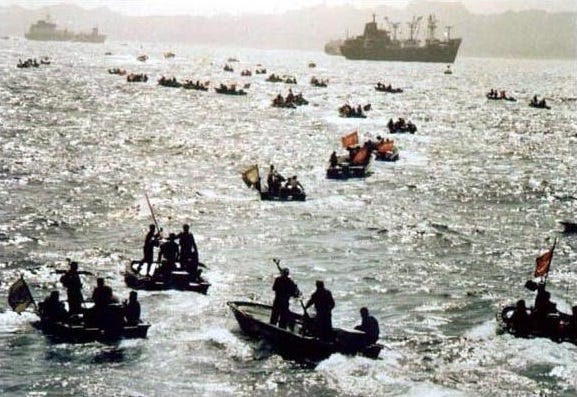
Speedboats of the Islamic Revolutionary Guard Corps swarming during Shahdat Manoeuvre (Exercise Martyrdom) in the Persian Gulf. Photograph by Ali Fereydooni via Wikipedia
Today, in addition to its conventional fleet of warships and larger patrol boats, the IRGC operates a vast fleet of small boats, estimated at more than 1000 boats in the 2004 Office of Naval Intelligence World Maritime Challenges report.[xxiv] Learning from past shortcomings of mass swarming tactics, Iran officially stated a new doctrine of “asymmetric” use of small boats. Instead of attacking all at once from the same direction, new Iranian strategy calls for dispersed swarming of 20-plus boats originating from a number of different directions. (Strauss Center for International Security and Law)

This photo is considered “outdated” but illustrates what is meant by the suggestion that Iranians might use very small vessels to lay mines in the Strait (in this case, it is an old Mahan1 mine). Source: covertshores
Furthermore, the Iranian Revolutionary Guard Corps Navy now also controls the small islands scattered throughout the strait, such as Abu Maze, which is equipped not only with small harbours but also with a landing strip. Although these small islands are vulnerable to American bombing, they serve as ideal bases for rapid raids to mine the shipping lanes used by cargo ships.

The island of Abu Musa. Source Google Earth
Finally, according to a video published by the British newspaper The Sun, the Iranians are also said to have extensive underground tunnels where they have stowed away numerous vessels, which are thus protected from air strikes and which would constitute (if the report were confirmed) a sort of extremely threatening ‘fleet-in-being’.
[embed]A year ago, Iran released footage of what it called “floating cities”: miles of reinforced concrete tunnels carved into granite mountains along its southern coast, housing speedboats armed with cruise missiles and hundreds of silent underwater drones. Scripps News Senior International Correspondent Jason Bellini. Source: Youtube
What can be done to counter the threat of Iranian mines?
Mine warfare tends to be overlooked in peacetime because it is unspectacular, slow, and technically thankless; but it becomes decisive as soon as an adversary threatens a strait, a port, or an amphibious zone. To respond to these situations, a distinction must be made between operations to completely clear an area and those aimed at opening a corridor through minefields. The former is a very long and costly operation, given the inherent characteristics of today’s minefields. Bottom mines, if deployed, can remain undetected for months or years, and if they do not malfunction for technical reasons, they can pose a real threat even after hostilities have ended.
The U.S. Navy, which tends to think in oceanic terms, considers it more realistic to create and maintain “Q-routes”, that is, controlled, monitored, and reasonably safe routes. Consequently the Americans prefer to focus on a “system of systems” package that combines surface vessels, helicopters, EOD divers, towed sonar, autonomous underwater vehicles, unmanned surface systems, and ships of opportunity. In other words, the focus is not on a specific type of specialized ship but on a suite of weapons and technologies that, depending on the situation, can be deployed and utilized by available platforms (naval and aerial): are there helicopters? Then helicopters are used. Are there destroyers? Then destroyers are used.
The doctrine of other NATO navies, and in particular that of the Italian Navy, is the opposite: while it is true that the Italians are also moving toward advanced sonar and remotely operated underwater vehicles to minimize personnel exposure in minefields, the Italian Navy concentrates all its technology on a single type of specialized ship — the latest-generation minesweepers with fiberglass hulls to avoid being subject to magnetic signatures
One must also take into account the fact that targets have also changed over time.
Modern oil tankers are much better protected than vessels from the 1980s. The IMO points out that the 1992 MARPOL amendments made double-hull construction mandatory for oil tankers of 5,000 dwt and above ordered after 6 July 1993. This means that double-hulled oil tankers are vessels in which the cargo tanks are protected by double sides and a double bottom extending across the cargo area. A contact mine strikes only the outer hull, and only if it is very powerful can it damage the inner hull as well. But beware: the damage caused by a mine is not limited to this. A large oil tanker is, from a physical point of view, a very long floating beam. If the explosion occurs beneath the keel, in addition to the initial pressure wave — which is extremely brief and violent, and responsible for any external breach — there follows the pulsation of a gas bubble, which is slower but capable of lifting the ship, causing a dangerous vertical flexing: first upwards, then downwards. This jolting movement can cause internal damage, ruptured pipes, permanent deformation of bulkheads, and misalignment of shafts, valves and safety doors. In short, the ship may remain afloat but can no longer sail safely.
This is an additional facet of the asymmetric warfare we are witnessing. It is not imperative to sink enemy ships; it is sufficient to impede their movement due to the risk of being struck, thereby achieving the strategic objective.
Conclusions
Today, Iran applies the doctrine of ‘mosaic defence’, in which the mine is no longer a static object, but part of a system that includes drones, coastal missiles and fast boats. As in 1915, mine clearance is not a purely technical problem, but a challenge involving the suppression of an entire defensive system. However, Tehran’s strategic objective in 2026 is the attainment of an economic breaking point through what we have termed an ‘insurance blockade’.
History teaches us that it is not necessary to mine every metre of sea to win; it is enough to sow uncertainty. Offensive mine warfare profoundly alters the geometry of war, redistributing traffic, causing insurance premiums to soar and forcing global powers into a slow, tedious and politically gruelling clearance mission.
In conclusion, the naval mine, despite being one of the oldest weapons, remains in 2026 the supreme instrument of hybrid warfare. It represents the ‘weak’ party’s’ ability to deny access to the ‘strong’ (Sea Denial) and the strategist’s ability to transform the depths into a battlefield where silence and waiting produce effects more devastating than a salvo of missiles.
Bibliography
Sailing Direction (enroute), Red Sea and the Persian Gulf, National Geospatial Intelligence Agency, Springfield, Virginia, 2020
Lawrence Sondhaus, The Great War at Sea: A Naval History of the First World War, Cambridge University Press, 2014, cap. 6.
Timothy Choi, “Ottoman Area-Denial Operations and Lessons for the Strait of Hormuz,” Journal of Military and Strategic Studies, 2014.
The United States Strategic Bombing Survey Summary Report can be found here: https://www.anesi.com/ussbs01.htm#dotjmf.
Lorenzo Bernardini, Golfo-1: il dibattito politico e la missione militare. Nuove prospettive di ricerca dalle carte del Fondo Valerio Zanone, Quaderni di Scienze politiche, Anno XII, n 25, 2024, p 79.
Nadimi, Farzin. The IRGC and the Persian Gulf Region in a Period of Contested Deterrence. [Washington, DC: ] Middle East Institute, November 2021.
William Komiss,• LaVar Huntzinger, The Economic Implications of Disruptions to Maritime Oil Chokepoints. CNA 2011
The Minister of Shipping and Transport, Shri K. Vijaya Bhaskara Reddy, delivered a speech on 4 August 1984 (https://rsdebate.nic.in/bitstream/123456789/347599/1/PQ_130_04051984_S174_p33_p34.pdf).
SS Bridgeton: The First Convoy https://www.usni.org/magazines/proceedings/1988/may/ss-bridgeton-first-convoy
Quentin Zimmer (United States Marine Corps), The Tanker War. It can be found at the following web address: https://www.naval-review.com/news-views/the-tanker-war/
Samuel J. Cox, Director NHHC, H-018–1: No Higher Honour — The Road to Operation Praying Mantis, 18 April 1988
Taker war, entry on Wikipedia (il contains the list of all damaged or sunk ships).
Hafez, Muhammad Husam حافظ, محمد حسام. مضيق هرمز بين سيادة الدولة ووظيفة القانون الدولي: قراءة في نظام المرور العابر وحدود توظيفه السياسي [The Strait of Hormuz: between state sovereignty and the role of international law: an examination of the transit passage regime and the limits of its political application. Doha/Qatar: المركز العربي للأبحاث ودراسة السياسات (Arab Center for Research & Policy Studies), 9 April 2026.
메타데이터
- post_id
- cae03f5fae65
- slug
- closing-hormuz-the-old-naval-mines-behind-the-new-global-crisis-cae03f5fae65
- url
- https://medium.com/teatime-history/closing-hormuz-the-old-naval-mines-behind-the-new-global-crisis-cae03f5fae65
- canonical_url
- https://medium.com/teatime-history/closing-hormuz-the-old-naval-mines-behind-the-new-global-crisis-cae03f5fae65
- author_url
- https://medium.com/@martinosacchi60
- status
- ok
- fetched_at
- 2026-06-13 07:35:29