From Coal Trading to a $300M Exit: Why Tech Founders Must Build “Moats” (Lessons from Ryan Gnessin)
In the fast-paced world of technology and startups, we often obsess over the “perfect” idea. We spend months planning grand strategies…
From Coal Trading to a $300M Exit: Why Tech Founders Must Build “Moats” (Lessons from Ryan Gnessin)
In the fast-paced world of technology and startups, we often obsess over the “perfect” idea. We spend months planning grand strategies, building complex roadmaps, and trying to predict the market. But what if the secret to a $300 million exit isn’t a flawless master plan, but the willingness to simply start, iterate, and relentlessly build defensible barriers?
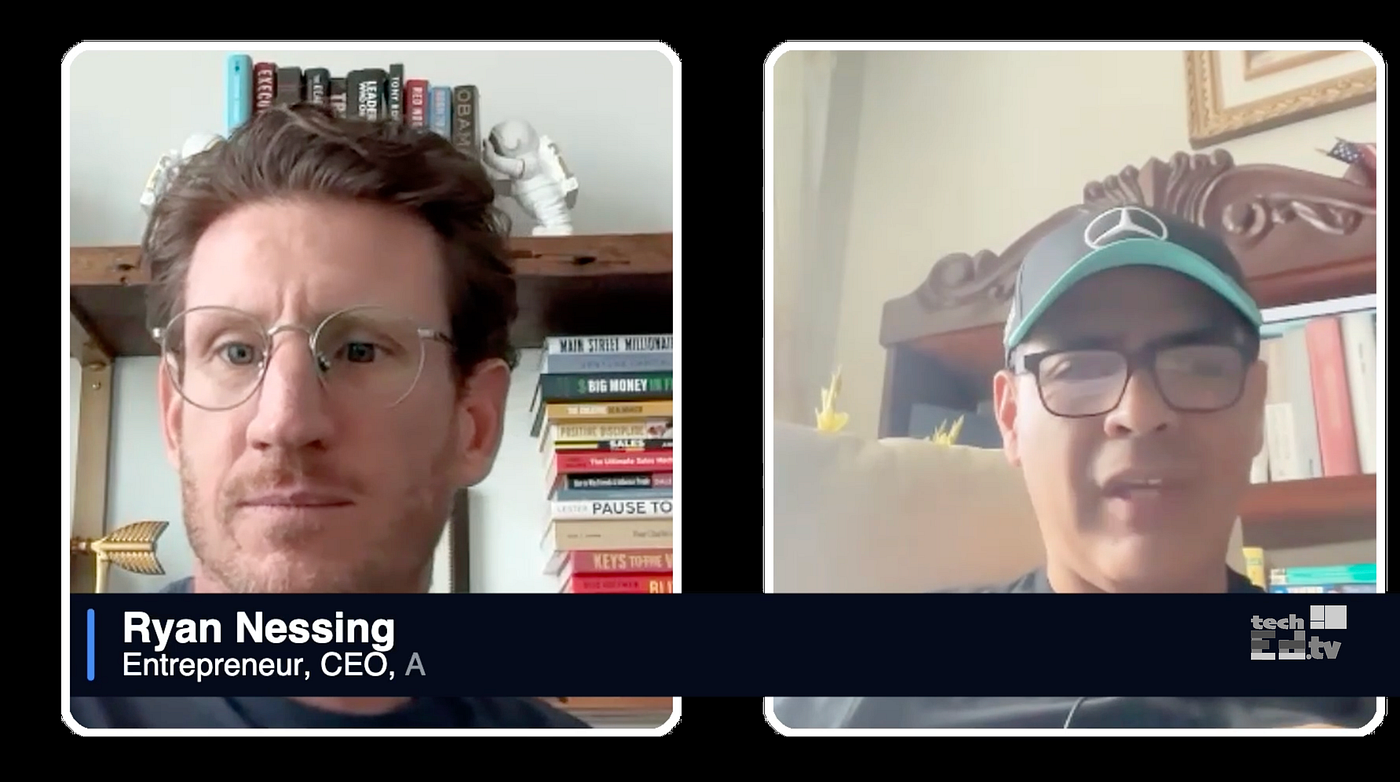
In the premier episode of TechEd TV, host Dr. Edwin Hernandez sat down with Ryan Nessing — an entrepreneur, CEO, and angel investor who went from trading coal in Indonesia to executing a massive roll-up in the e-commerce space, culminating in an exit of over $300 million.
While Ryan’s background is rooted in commodities and e-commerce, the lessons from his extraordinary journey are pure gold for tech entrepreneurs, SaaS founders, and innovators. Here are the core takeaways on pivoting, scaling, and surviving the hype cycles of the modern tech landscape.
1. The Power of the “Blank Canvas” and the MVP
Many tech founders are paralyzed by the need to have a world-changing vision from day one. Ryan’s entry into entrepreneurship was entirely different.
After a decade in the high-stakes, high-stress world of physical commodities trading with Glencore, he moved to New York in 2016 with a “blank canvas.” He had no job, no clear career path, and needed a visa to stay in the US. So, he started an e-commerce business selling branded footwear (like Nike and Adidas) on Amazon.
The Tech Lesson: This is the ultimate example of a Minimum Viable Product (MVP). Ryan didn’t build a complex platform right away; he used retail arbitrage to “dip his toe in the water” and understand the ecosystem. He generated cash flow, learned the platform, and identified a larger opportunity. Stop over-strategizing your software — ship it, see how the market reacts, and figure out the next step from there.
[embed]
2. If You Don’t Have a Moat, You Don’t Have a Business
Perhaps the most crucial advice Ryan shared for innovators is the absolute necessity of a “moat” — a competitive advantage that protects your business from being crushed by copycats.
Ryan points out that on platforms like Amazon, if you are selling a generic, undifferentiated product (like a basic pop-up beach tent), thousands of competitors will flood the market and erode your profit margins to zero. The same is true in the tech and SaaS worlds. If your software can be easily replicated by a developer over a weekend, you are vulnerable.
According to Ryan, a true business must have one of three things:
- Proprietary IP (Patents): Protect your core technology or utility.
- A Supply Chain/Logistics Advantage: Can you deliver your product or service in a way that is financially impossible for competitors to replicate?
- An Unshakable Brand: Ryan highlights Rhino USA (one of the 32 companies his team acquired). They sold motorsport accessories — items that could technically be copied. However, through aggressive grassroots marketing, event presence, and exceptional customer loyalty, they built a brand that people actively searched for by name.
The Tech Lesson: Don’t build a commodity SaaS. Build deep integrations, cultivate strong network effects, secure your IP, or build a community-driven brand that users refuse to abandon.
3. Start Where You Stand and Iterate
Ryan’s $300M exit didn’t happen because he planned to buy 32 companies from the start. It happened through iteration.
Once he understood the Amazon ecosystem through selling shoes, he realized there were thousands of small, profitable businesses generating $1M to $2M in revenue that could be bought for relatively low multiples. He started acquiring them. Once he proved the model with a few small acquisitions, he was able to raise hundreds of millions in equity and debt to scale the operation aggressively, growing his team to over 200 people.
The Tech Lesson: Ryan’s philosophy is: “Start where you stand… and iterate, iterate, iterate until it works.” Don’t try to raise a $50M Series B based on a whiteboard sketch. Prove your unit economics on a micro-scale. Once the machine works, then you pour the venture capital fuel on the fire.
4. Navigating the AI Bubble and Keeping Your “Powder Dry”
As an angel investor today, Ryan is taking a cautious approach. When asked by Dr. Hernandez about the current tech landscape, Ryan didn’t hold back: he believes we are in the midst of an AI bubble.
Comparing the current AI frenzy to the Dot-Com bubble of the early 2000s, Ryan points out that while companies providing the “picks and shovels” (like Nvidia) are generating massive, justified revenues, many of the AI startups trading at astronomical valuations lack the fundamental business models to survive long-term.
Instead of chasing the AI hype, Ryan is keeping his “powder dry” — holding cash and waiting for a market correction to acquire fundamentally sound assets at reasonable valuations. However, he did note one area of tech he is incredibly bullish on for the next 10 to 15 years: Humanoid Robotics.
The Tech Lesson: Be careful of “hype-driven” development. Just because you slap an “AI” wrapper onto your software doesn’t mean you’ve built a sustainable business. Investors like Ryan are looking past the buzzwords; they are looking for real utility, solid unit economics, and, of course, that ever-important moat.
Final Thoughts for Innovators Ryan Nessing’s journey proves that the fundamentals of business — whether you are trading coal in Jakarta, selling shoes on Amazon, or writing code in Silicon Valley — remain the same. Build something defensible, iterate constantly, and don’t let the pursuit of a “perfect strategy” get in the way of taking your first step.
메타데이터
- post_id
- cb538304a5ea
- slug
- from-coal-trading-to-a-300m-exit-why-tech-founders-must-build-moats-lessons-from-ryan-nessing-cb538304a5ea
- url
- https://medium.com/techedtv/from-coal-trading-to-a-300m-exit-why-tech-founders-must-build-moats-lessons-from-ryan-nessing-cb538304a5ea
- canonical_url
- https://medium.com/techedtv/from-coal-trading-to-a-300m-exit-why-tech-founders-must-build-moats-lessons-from-ryan-nessing-cb538304a5ea
- author_url
- https://medium.com/@edwinhm
- status
- ok
- fetched_at
- 2026-06-10 12:26:30