No Need to Blow the Bridge: Kerch Is a Monument to Russian Impotence
Live from Ukraine 🇺🇦
No Need to Blow the Bridge: Kerch Is a Monument to Russian Impotence
Live from Ukraine 🇺🇦
Thanks to the support of generous and determined, true friends like you, we will keep reporting on this terrible war with our boots on the ground.
We are grateful to those who support the message that must and can go on from a free Ukraine.
Kobleve — With the situation in Crimea turning this critical, a number of analysts seem to be competing from a distance over the most credible estimate for how long the bridge across the Kerch Strait will last. The feedback we keep getting from our contacts on the peninsula suggests conditions are already grave enough that Ukraine may not even need to bring it down.
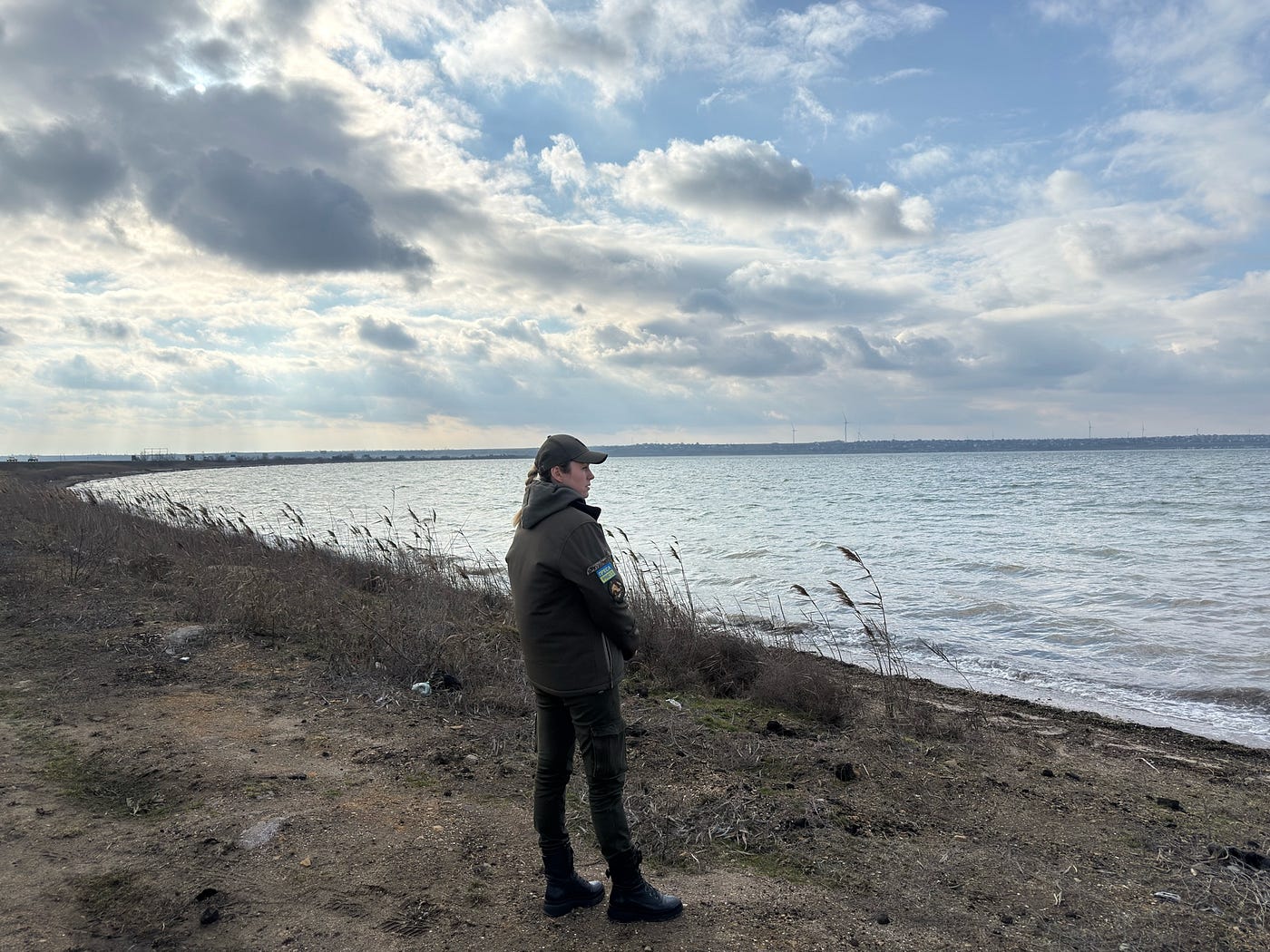
Alla looking towards the Black Sea — copyrighted photo Giorgio Provinciali
A bridge’s military value lies in its reliability rather than its physical existence. The latest Ukrainian deep strikes have shown that a supply line can be severed without reducing it to rubble: it is enough to make it intermittent, slow, dangerous, inadequate, politically embarrassing, and unable to carry the volume of goods, fuel, troops, ammunition, and administrative personnel an occupation demands. In that sense, the Kerch bridge already stands while growing more useless by the hour, taking on a role that is worse precisely because the structure is intact — a visible monument to Russian impotence.
Crimea is often described as a fortress. Historically, it is a vulnerable peninsula, dependent on external connections: power, water, fuel, railways, roads, ports, ferries, depots, substations, pumping stations, sorting hubs. The Kerch bridge is the most famous symbol of that dependence — one artery in a much larger system.
After 2014, Crimea’s structural vulnerability surfaced immediately, over water. The North Crimean Canal, which before annexation supplied the dominant share of the peninsula’s fresh water, was blocked by Ukraine; As NPR confirms, the canal covered roughly 85 percent of Crimea’s water needs before the Russian annexation, and that Moscow restored the flow only after the full-scale invasion of February 24, 2022, but then disrupted it again when its soldiers blew up the Nova Kakhovka Dam.
It is a paradoxically crucial precedent, because it shows what actually holds Crimea: flows, far more than imperial flags, bases, and proclamations. When the water and fuel stop arriving, when the trains stand still and the ferries stay in port, when the power fails and shops have to ration essentials, the political authority behind those flags and proclamations starts to wobble and loses its material grip. Ukraine applies pressure with surgical precision in exactly this direction. Russian-installed authorities in Crimea have declared an economic emergency after curbs on tourism, fuel sales, energy-saving measures, and limits on public transport and shops, while local and Ukrainian media described blackouts, water problems, and widespread disruption.
Here lies the first reason Kerch may never have to be blown: degrade the network that feeds the bridge and branches out from it, and the bridge becomes a structure suspended over a strait rather than a logistical solution.

From the Kinburn spit russians hit also soviet-era monuments like this one behind me — copyrighted photo Giorgio Provinciali
Cutting a chain does not mean snapping its most visible link. Military logistics works like a chain. The Kerch bridge is the most cinematic link in that chain; the most convenient one to break may well lie elsewhere. For Russian resupply to work, you need fuel in the depots, usable rail lines, intact sorting nodes, working ferries or ports, electricity for pumps and infrastructure, safe roads, repair capacity, personnel, and time. If one or more of these gives way, even an intact bridge may not be enough.
Every one of our contacts in Crimea describes exactly this: a functional isolation campaign now stretched across the entire peninsula. Ukrainian strikes target not only the land corridors but also depots, ferries, and energy infrastructure. They are tied to a clear aim — driving up the cost of the occupation, making Crimea steadily harder to supply and to defend.
The strategic point sits here: there’s no need to destroy the bridge if you can neutralize the predictability of the traffic on it and around it.
Moscow understood the risk perfectly well. Our more attentive readers will remember that back in March we flagged the construction of new roads and railways in the occupied south of Ukraine, built precisely to reduce dependence on the Crimean bridge and to create uninterrupted alternatives along the Sea of Azov. Paradoxically, this only strengthens the original thesis: if Russia had to build bypasses, corridors, and alternative lines, then the bridge is no longer treated as an absolute guarantee. And if those bypasses are worn down too, Kerch’s physical survival solves nothing.

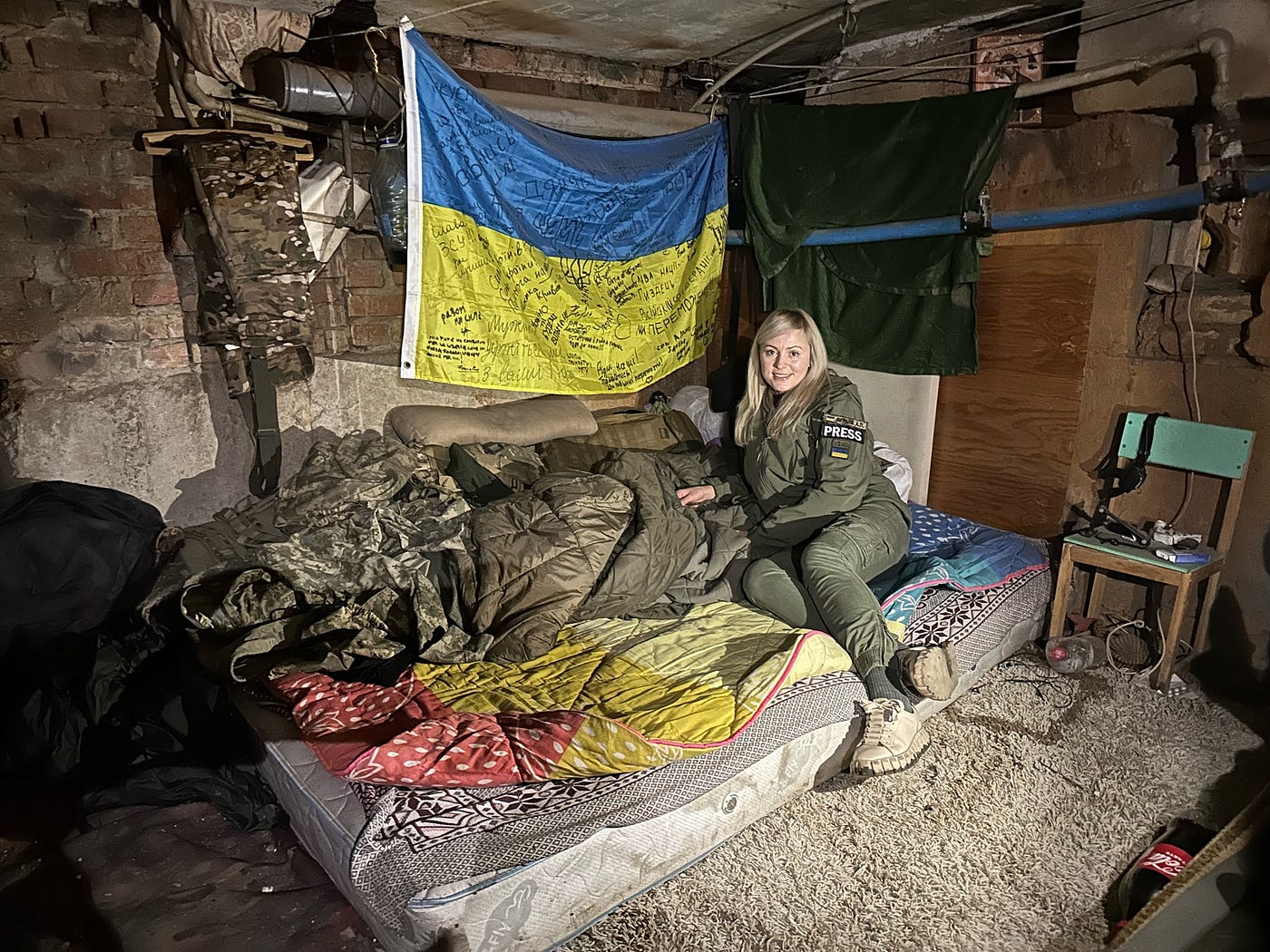
Alla inside a Ukrainian trench reached by russian fire from Kinburn and drones also coming from Crimea — copyrighted photo Giorgio Provinciali
The Kerch Bridge has a dual nature. It is civilian and commercial infrastructure, used for goods and for the movement of the population; it is also a military line of communication sustaining Russian forces in Crimea and the occupied south. It is a key route for Russian resupply and reinforcement toward Kherson and Zaporizhzhia, and a link between Russia and Crimea that is at once symbolic and practical. Precisely because it is dual, symbolic, and complex, demolishing it is not always the most useful option. A structure like this can be neutralized in at least three strategic ways, none of which turns it into scrap.
The first is neutralization by risk. Once infrastructure is perceived as vulnerable, traffic thins out or gets subjected to checks, closures, queues, restrictions, and escorts. Even temporary interruptions can compound: they delay ammunition and fuel deliveries, force larger stockpiles, raise protection costs, and divert resources from other fronts.
The second is neutralization by strangulation, upstream and downstream. Hit or destabilize the fuel depots, the electrical substations, the rail junctions, the ports and roads that feed the bridge, and the bridge can stay open while carrying too little, too slowly, or at the wrong moment.
The third is political neutralization. The bridge was built as material proof that annexation was irreversible. If it stands while Crimea sits in the dark, out of fuel, with bare shelves and tourism suspended, the symbol flips. It no longer displays the omnipotence of the Russian state; it shows that even Moscow’s most celebrated project cannot guarantee normal life.

A broken engine of a russian Shahed/Geran’-type drone in my hands — copyrighted photo Giorgio Provinciali
This dynamic is already evident in how the crisis is being managed. Russian authorities have spoken of emergency and restrictions; our contacts living there have described empty shelves and purchase limits in some supermarkets, while local officials denied any panic. Even treating our local sources with caution, the picture is clear: the narrative of Crimea as a safe rear has been cracked.
The most instructive comparison is the Russian occupation of Crimea in 2014 itself. Russia did not take the peninsula by systematically bombing bridges and cities. It took it by paralyzing the nodes of power. Armed men without insignia seized strategic buildings, checkpoints, airports, and civilian and military infrastructure; Ukrainian units were isolated and pinned; the political chain of command was overwhelmed by the speed of accomplished facts. Then came the referendum staged under Russian control, never recognized by the UN General Assembly, which in Resolution 68/262 reaffirmed Ukraine’s territorial integrity and declared the attempt to change Crimea’s status through that vote invalid.
The historical lesson is a powerful one: Crimea fell because Russia controlled what mattered — airports, local parliaments, communications, barracks, roads, public perception, and political timing — while most of the physical landscape stayed intact. Today, Ukraine is pursuing the inverse logic. It does not have to destroy the largest symbolic object; it has to make ungovernable the nodes that allow Russia to behave as the peninsula’s sovereign.
[embed]Me speaking about Crimea at “Frontline” by “The Times of London”
Another recent precedent reinforces the argument: the Russian Black Sea Fleet. Ukraine did not have to sink every Russian ship to achieve a strategic result. It made Sevastopol’ and Crimea far less safe as a naval hub. After a successful naval offensive begun the year before, in July 2024 the Ukrainian navy said that nearly all combat-ready Russian warships had been moved out of Crimea to other bases, leaving Sevastopol’ far less effective as an operational center; in October 2024 even the Russian official Dmitry Rogozin admitted that many vessels had been forced to relocate because of Ukrainian strikes.
This is a clear form of functional victory. The base can still exist, the piers can still be there, the flag can still fly. But once the main ships leave, the sorties drop, protection grows ever more expensive, and the initiative passes to the adversary, the base’s strategic value has been drastically cut. The same reasoning applies to Kerch. There’s no need to send the spans crashing into the strait if the bridge becomes too risky, too closely watched, too slow, too politically sensitive, or too dependent on infrastructure that is already degraded. Victory lies in preventing Russia from using it as an imperial highway.
[embed]Me speaking about Crimea in a video for AGEEIA
There is a subtler argument too: an intact bridge can serve Ukraine as well, as long as it no longer functions as a free and secure Russian military artery.
First, it can become a way out. In military theory, leaving the enemy a path of retreat can lower the odds of a desperate defense. If commanders, officials, collaborators, and Russian personnel sense that Crimea is becoming untenable, an escape route can speed up the psychological and administrative collapse. A force that believes it can evacuate may be less inclined to turn cities and civilian infrastructure into fortresses held to the last man.
Second, preserving a civilian route can carry humanitarian value. Crimea holds a civilian population: Ukrainians who stayed under occupation, Russians who moved in after 2014, mixed families, the elderly, the sick, and children. A campaign that aims to choke Russian military logistics without sealing off all civilian movement reduces some humanitarian risks and narrows Moscow’s room for propaganda.
Third, an intact but conditioned bridge is a powerful lever. Once Ukrainian sovereignty is restored, Ukraine would have every interest in managing infrastructure, humanitarian flows, security checks, and reconstruction without inheriting an even larger infrastructural disaster. The bridge could turn from a symbol of annexation into a controlled corridor, a bargaining chip, or simply a piece of infrastructure whose fate is settled politically later.
[embed]Me speaking of Crimea live on Euronews
For Moscow, Crimea has always been worth more than its immediate military utility. It is an imperial myth, a naval platform, a political prize, a source of domestic consensus, and proof of the Putinist idea that history can be rewritten by force.
The George C. Marshall European Center has stressed how the annexation and militarization of Crimea transformed Russia’s strategic posture in the Black Sea, tightening its control over Sevastopol’, the Kerch Strait, and the Sea of Azov.
For that reason, the gravest wound to Russia would be the loss of a claim rather than a span — the claim that Crimea is definitively Russian, secure, integrated, and normal, even with the bridge still standing. That bridge would become the standing symbol of shame and of total defeat.
As we have argued in describing the absurdity of pairing modern warfare with words from the past — “conquest,” “front lines,” “the rear” — when today the language is one of “control,” zones of mutual infiltration, and kill zones fading into ever-lighter gradients of gray along a front that has stopped being linear and become volumetric, a modern occupation does not collapse only when the last bunker falls. It can begin to collapse when insurers, freight carriers, local officials, soldiers’ families, business owners, administrators, and the soldiers themselves grasp that the political center can no longer guarantee predictability.
Panic does not have to be universal to be strategic; it only has to turn contagious in the right places.
From this angle, the phrase “turn Crimea into an island” should not be read in purely geographic terms. Crimea can become an island even while the bridge stays physically passable for a few hours a day, for certain categories of vehicle, under restrictions and at reduced capacity — more or less what is already happening. Crimea becomes an island when Moscow can no longer resupply it at the necessary pace, when the population senses that every essential good hangs on a vulnerable chain, and when Russian forces have to choose among feeding the front, the fleet, the power plants, the civilians, the hospitals, the occupation police, or the tourist propaganda.
None of this makes the bridge irrelevant; the opposite error would be just as serious. Kerch remains an enormous, symbolic, logistically important structure. As long as it can move personnel, vehicles, or military materiel, it remains a strategic target in the general sense — and, given its dual-use nature, any decision to strike it also raises questions about proportionality, civilian risk, and political impact.
Nor is Russia passive. It can prioritize military resupply over civilian, use alternative routes, repair damage, militarize transport further, impose rationing, squeeze non-essential consumption, and absorb civilian suffering to hold on to control. Russia has shown more than once that it can tolerate extremely high human costs. A logistical crisis should not be mistaken for automatic liberation.

Alla reporting from a relatively small cuntryside hit by the russian federation in Mykolaiv, Ukraine — copyrighted photo Giorgio Provinciali
There is also an information problem: much of the news from occupied Crimea arrives through local channels, pro-Russian outlets, Ukrainian sources, or media with limited access, and some claims — the precise extent of the blackouts, the exact number of damaged facilities — have to be handled with caution. Even so, what the major agencies — Reuters, AP, RFE/RL, The Guardian — have reported, together with the feedback we have gathered ourselves from the local sources we stay in contact with, converges on one robust fact: Crimea is under far more serious logistical and energy pressure than any ordinary, temporary disturbance.
The most striking result so far is an intact bridge leading to a lost Crimea.
The real grand finale, then, may be something worse for Moscow than any explosion in the Kerch Strait: a bridge still standing, still glorified in the old propaganda reels, yet powerless to stop the occupation from coming apart.
m reporting from Kobleve, Ukraine 🇺🇦
In 1.586 days of war, we recorded over 300 videos from ground zero and wrote more than 1,600 articles.
We are doing our best to provide genuine, first-hand reports from zones where almost no press dares to go. This means living in a kill zone constantly. We take the risk, but without your invaluable support, our voices would remain unheard and silent. Without brave people sharing our articles from afar, they would remain unread. Our reports would go unseen, and our efforts would be lost. There’s still a lot of work to do here, as the people around us are also in no better situation.
We’re renewing our fundraising campaign and thanking everyone who joins us in helping to restore what Russia is destroying. Moving forward, not even with a small reimbursement for each article we write, is extremely challenging. That’s why we are grateful to all the kind people who support us and trust in our mission.
Even a small donation helps.
We’ll keep you updated on developments.
Thank you all, dear friends 💙💛
Some simple hints to make this article more visible:
- Use this ‘friend link’ to share this article: https://medium.com/@giorgioprovinciali/no-need-to-blow-the-bridge-kerch-is-a-monument-to-russian-impotence-cb6ce3ffc3dc?sk=13311b87fc828ac0b256e542a5ae9cc9
- Holding the👏🏽 button allows up to 50 ‘claps’
- Click on the arrows to repost this article
- Leave a comment
Here’s a playlist that includes lots of videos we recorded over 4 years:
https://www.youtube.com/playlist?list=PLmIio7cmINntHr9tMgmz5z4vEAbY7B
메타데이터
- post_id
- cb6ce3ffc3dc
- slug
- no-need-to-blow-the-bridge-kerch-is-a-monument-to-russian-impotence-cb6ce3ffc3dc
- url
- https://medium.com/@giorgioprovinciali/no-need-to-blow-the-bridge-kerch-is-a-monument-to-russian-impotence-cb6ce3ffc3dc
- canonical_url
- https://medium.com/@giorgioprovinciali/no-need-to-blow-the-bridge-kerch-is-a-monument-to-russian-impotence-cb6ce3ffc3dc
- author_url
- https://medium.com/@giorgioprovinciali
- status
- ok
- fetched_at
- 2026-07-09 13:13:48