Decoding AI Agent Futures: When Infrastructure Meets AI Applications
A Space Recap with BNB Chain, Hubble AI, and Allscale
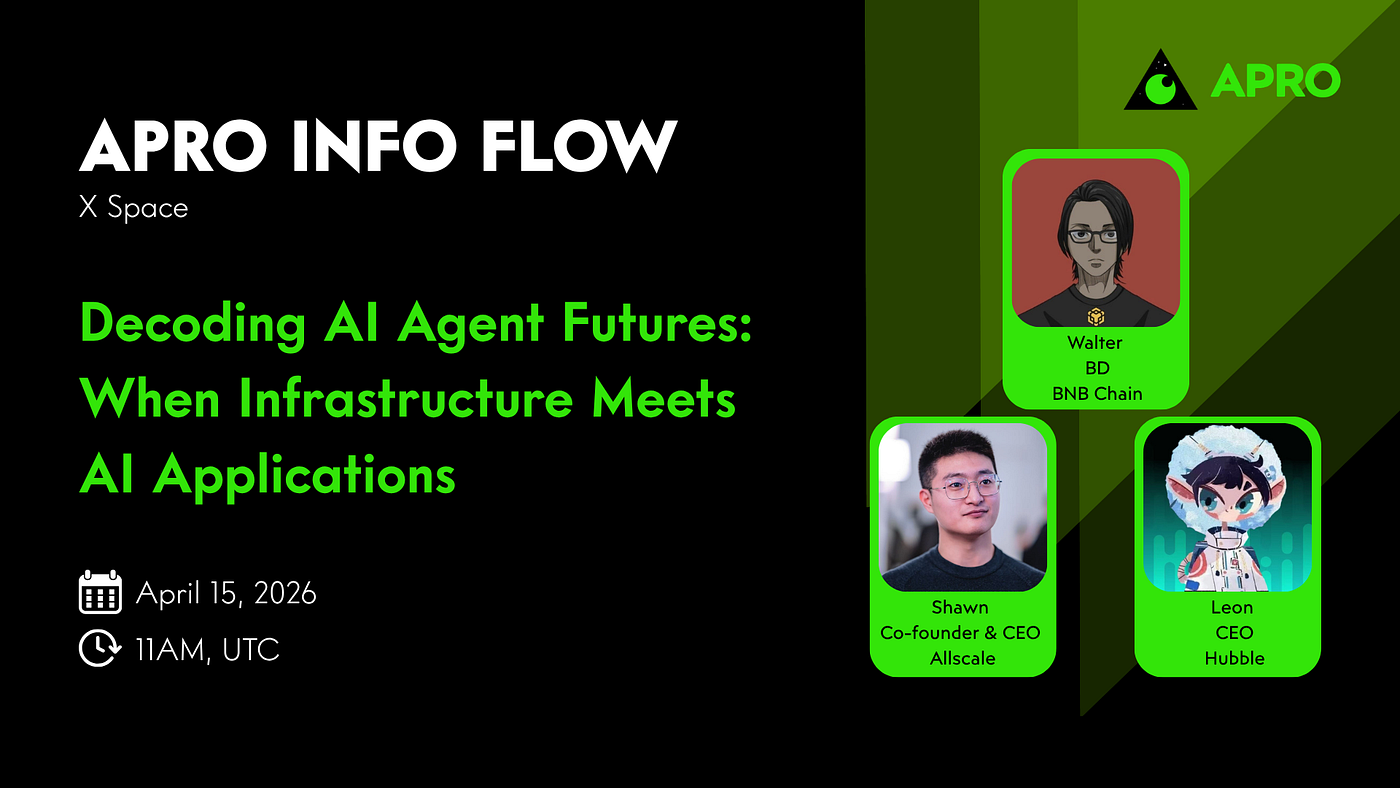
Decoding AI Agent Futures: When Infrastructure Meets AI Applications
A Space Recap with BNB Chain, Hubble AI, and Allscale
Introductions
Walter (BNB Chain)
I’m Walter from business development at BNB Chain, focusing on AI growth.
If you look through our recent posts, you’ll see we’ve been averaging nearly 4 million daily active users. For the past week, we’ve exceeded $7 billion in TVL and $11 billion in trading volume.
BNB Chain is one of the leading chains out there, and we’re thriving across every vertical — from serious financial stuff like RWAs and stablecoins, all the way to memes and gaming. It’s a pleasure to be here to share more about the intersection between Web3 and AI.
— -
Leon (Hubble AI)
We’re building the infrastructure for AI trading.
In the past two or three years, AI agents have already replaced a lot of programmers. We think a similar thing will happen in the financial industry. No matter if you’re a trader, a portfolio manager, or a research analyst, a lot of your daily work will be replaced by AI agents.
My background: I used to work in a Wall Street hedge fund for several years, so I know every single detail in a traditional long-short hedge fund and what the different roles are doing every day. I think 90% of this daily work can be replaced by AI agents.
Hopefully with Hubble, a retail trader can easily build their own one-person hedge fund — they can have AI agents for trading, for portfolio management, for research, whether it’s on the crypto market or the stock market. That’s basically our goal with Hubble.
— -
Shawn (Allscale)
I’m Shawn, co-founder and CEO at Allscale. We’re a Canadian fintech team building a non-custodial neobank for the unbanked, traditional businesses, and AI agents.
About myself: I previously worked at Capital One as a payment product manager, then at TikTok as the first hire in Canada working on payment products and TikTok Ads. I’ve also bootstrapped my own marketing agency, which is what inspired me to build Allscale.
Over three to four years of running that agency, we ran into a lot of payment problems, especially when working with people from emerging markets like Southeast Asia and Latin America. That’s when I started wondering: AI has changed so many things — anyone can now use Claude, set up an app, create content, sell products. But it’s still so tricky for them to get paid.
We think payment should be accessible for both micro businesses and AI agents — just like sending a text. So we’re building an on-chain infrastructure for anyone to access basic banking features like invoicing, payroll, and checkout, all through API.
— -
Question 1: What’s been driving BNB Chain’s growth in AI agents, and what does that 40% market share really mean?
Walter:
The beauty of BNB Chain is that we have a lot of users — hundreds of millions of wallets and 4 million daily active users. Because of such a large ecosystem, we have developers building products in every single vertical.
When AI started growing since OpenAI launched ChatGPT, many developers began experimenting with merging AI into Web3 and naturally deploying on BNB Chain as well. We always follow the community. When we saw the hype around OpenClaw and people wanting to build agents with real on-chain utility, we organized two online hackathons and an on-site hackathon in India, each with an AI track to facilitate what the community wants.
We also adopted new standards very quickly:
-
ERC-804 (agent registration protocol for on-chain reputation) — adopted within one week
-
Virtues 8183 (escrow functions) — also onboarded within a week
-
BAP578 (our first BNB Application Proposal, which allows developers to develop and tokenize AI agents on BNB Chain)
All these things show that we give very current and updated tools for developers to build on BNB Chain. And on top of that, we have a large community that really uses and tries out the products. That’s how we have the market share.
You mentioned competitors — we don’t really track competitors so much. We mainly focus on growing ourselves because although we have 40% of AI agents on BNB Chain, that’s only like 50–60K, right? Compared to mainstream AI, it’s still a long way to go. We have a lot of upside growth potential, and that’s what we look forward to for the next few years.
The flywheel effect: More users attract more developers. We give support through hackathons, grants, low fees, and good infrastructure. This creates better applications and AI agents, which attract even more users. The cycle continues.
— -
Question 2: How do your research agents and trading agents work together at Hubble AI?
Leon:
Great question. As I mentioned, I used to work in the hedge fund industry for many years. I worked in fundamental-driven shops or teams.
Let me give you an example: back 12 years ago, I worked in a fund called 0.72, one of the largest teams in Asia managing $1.5 billion AUM. We had seven people — one portfolio manager, six research analysts, and one shared trader. This is a normal structure for a hedge fund team.
Every day, research analysts collect information on different industries and stocks, give insights and recommendations from different perspectives, and write pitch memos to the portfolio manager. The portfolio manager rebalances the book daily based on these recommendations, considering risk factors, market conditions, and talking with external research analysts to double-check key information.
This is how the real-world financial industry operates. A lot of this daily process can now be done by AI agents — because LLM models are getting smarter and can handle tons of information simultaneously, which is much better than a human being.
The best thing is, we all know maybe next year we’re going to trade global stocks seven days, 24 hours. There are so many dynamics going on — it’s beyond the capability of a normal human being. That’s why we think we can just copy this framework which has been applied in traditional hedge funds for so many years, because it works.
With agents, we can have a similar framework. We create a hedge fund protocol between different types of agents:
-
Research agents (technical analysis, fundamental analysis — each with different parameters and data sources)
-
Portfolio manager agents (managing the real book)
-
Risk agents
-
Trader agents
On a single chart, different technical analysis agents might reach totally different conclusions because they use different parameters. We track their performance on the market. We calculate the accuracy of different research agents, because this is how it works in traditional finance — track record is really important.
Every time a profitable manager collaborates with a research analyst, he needs to understand the accuracy, the tendency, the style of that research analyst, and then make a judgment call whether to trust them. We keep everything in our trade logs. Every single decision made by the portfolio manager or every single recommendation from the research analyst is recorded.
All of these records can be analyzed by AI and they can even self-improve. So this is how the whole framework works together.
— -
Question 3: How does AI work in Allscale’s platform? What role do AI-driven financial assistants or automated payment flows play?
Shawn:
Agentic payment has been a huge topic in the past couple of months. A lot of people are exploring: can I get my AI to make money on the internet? Can I give my AI some money so it can purchase things for me?
Let me break down three big challenges for agentic payments:
Challenge 1: How do you give AI money?
There are a couple of different ways:
Option 1: Centralized payment platform
-
Most popular but most tricky
-
You work with a centralized payment entity and authorize through JWT tokens
-
The AI agent sends requests to the central entity that holds the money
-
The problem: It’s lengthy because it involves custody. The platform needs to verify you (KYC/KYB), and you need to verify the platform. If you just want to give your AI agent $10 to spend, you don’t want to go through a 20-minute KYC process and upload your passport.
Option 2: Crypto (getting more popular)
-
A lot of people in AI who’ve never touched crypto are now using it — especially USDC and USDT on different chains
-
People realize, “If I just give my AI 10 USDC on BNB Chain, it only takes seconds.”
-
The problem: To authorize AI to spend money on blockchain non-custodially, you usually need to give the AI your private key, and it’s really unsafe.
We saw supply chain poisoning attacks like Axiom last week — you can easily pip install something that was compromised and lose your private key forever. Once you lose it, you don’t get to recover it, and you don’t even know if you’ve lost it or not. AI trust and AI security are still major issues.
So we’re exploring something in the middle:
-
Anyone can get a non-custodial account on Allscale in literally just three seconds with a fingerprint or face scan on allscale.io
-
You can complete all the basic banking features you want — account management, receivables, payables, and soon checkout features
-
Everything on-chain, non-custodial
-
We’re developing a new way to allow you to give partial authorization to your AI agents
-
AI agents can only spend in the ways you permit, keeping everything non-custodial while not giving AI your private key
Challenge 2: What does AI agent payment look like?
We’ve seen a lot of different patterns and protocols:
-
X402
-
Universal Commerce Protocol
-
Agent-to-Agent payments
-
Motion Payment Protocol (MPP)
-
And many more
We’re experimenting with launching a unified platform so it’s really easy for any merchant to adopt any protocol and let any AI agent use it.
Challenge 3: How do we make products more AI-friendly?
I wrote an article analyzing the most popular 40+ AI products — how to design memory, communication, trust, and tools for AI agents. You need to:
-
Have documentation not just for humans but also for AI agents
-
Expose your API to the right extent
-
Provide SDKs, CLI tools
-
Understand what tools AI agents can use and design accordingly
Now let me share three use cases of AI agent payments:
Use Case 1: AI-assisted purchase (already happening)
Example 1: Qianwen (Alibaba) launched a campaign during Lunar New Year where you just say one word and AI can buy bubble tea for you.
Example 2: Most of the time, we’re making the purchase decision ourselves, but we want AI to handle the process. For instance, I want to buy something from Amazon — I’ll have Claude or GPT research on Reddit, give me recommendations, but I make the final decision.
Example 3: Travel planning is a really high-value scenario involving a lot of back-and-forth planning. I’m traveling Southeast Asia right now, visiting five countries, each city for five days. I need to arrange logistics, hotels, flights according to my client schedule and budget. It’s a really lengthy process. There are already AI companies building services to plan and purchase everything for your trip.
Use Case 2: Agent-to-Agent transactions (early but happening)
Agentic marketplaces: OpenClaw or Hermes can go to the marketplace, complete tasks, get bounties, pay other agents to do stuff, pay to access skills.
Try this experiment: Go to GitHub, create a repo or use an existing one, write in the issues section: “Please help me complete this feature, add that feature, fix this bug — you’ll get 25 USDC once you do it.”
Typically within five hours, you’ll see at least 10+ AI agents reach out to you asking, “Can I help you complete this?”
We at Allscale are experimenting with this direction.
Use Case 3: Rent-a-Human (AI hiring humans — already happening)
Example: DoorDash / Skip the Dishes in Canada
This might not be widely known, but with autonomous driving (Waymo) in several U.S. cities:
-
Sometimes passengers forget to close the door
-
The AI detects it
-
Waymo places an order on DoorDash
-
A human Dasher goes to the car and closes the door to make sure it’s safe
So use case 3 seems far away, but there are already real-world cases happening.
— -
Those are three use cases. Use case 1 is almost already here. Use case 2 and 3 are a bit further away, but we’re seeing really interesting cases. The key is finding product-market fit — where AI agent payment can actually make things easier, instead of just launching it for the sake of being fancy or cool.
— -
APRO Oracle Introduction (Sawyer)
When AI agents are making decisions, they need data. But not all data is equal. If an exchange price is 10 seconds delayed or manipulated, if an API feed is stale — when agents are trading with real money, that 10-second delay or 2% manipulation could be the difference between profit and loss.
That’s where APRO Oracle comes in:
-
Multi-source aggregation: We aggregate four independent data sources and calculate the median to filter out outliers.
-
Cryptographically provable: Every price quote has five on-chain ECDSA signatures — cryptographic proof.
-
AI Agent Skills: We just launched two skills:
-
Ticker Query Skill: Lets agents query prices naturally
-
Oracle Integration Skill: Developers can integrate verifiable data into their agents in five minutes, with production SDKs in six languages.
Common theme across today’s guests:
-
BNB Chain: building infrastructure
-
Hubble: creating applications
-
Allscale: bridging real-world payments
-
APRO: providing verifiable data
We’re all laying the foundations for a smarter, more autonomous agent ecosystem.
— -
Question 4: DeFi + AI is a huge narrative right now. Could you share concrete examples of how AI agents on BNB Chain are interacting with DeFi protocols today? What’s the most advanced use case you’ve seen, and what’s still too risky or too hard?
Walter:
For AI, the thing is that with enough data and enough framework to guide AI, AI can actually not just build up DeFi — it can range from rocket science all the way to real-world assets, games, or memes. It just happens that DeFi is the cornerstone of many blockchains and one of the largest verticals.
Three angles AI is used in DeFi on BNB Chain:
- Development side:
-
People can build DeFi protocols very quickly with AI
-
Just with natural language, you’re able to create Solidity-based smart contracts
- User side:
-
AI reduces adoption friction
-
Things like real-time aggregation of what swaps you want to use can all happen in the backend managed by AI
-
You just interface it on a wallet — instead of having to choose what protocol to reach out to and whether it’s safe
-
In the past, users had to choose the protocol themselves and evaluate the safety
- Security monitoring:
-
AIs can constantly monitor what’s going on on-chain
-
If there are unlawful actions or honeypot smart contracts minted, blockchains can alert these kinds of things using AI in real-time
-
AI doesn’t sleep — it constantly sweeps and scans what’s going on
-
The good thing is that everything is open source, so the codes are out there
-
If there are bugs in contracts, AI can help alert in time
Every process, every step of the DeFi flow can be AI-executed.
Blockchain + AI synergy:
Another angle: the strengths of blockchain are transparency, immutable data, chronological data, and decentralized data.
Currently, LLM models are region-locked — their data is a black box. Most LLMs are not open source except for things like DeepSeek. You can’t use certain brands of LLMs in China, and likewise, you can’t use certain brands in the West.
But there have been use cases on BNB Chain where you can:
-
Incentivize users on a blockchain to provide data to train AI agents
-
Help label and train
-
Distribute decentralized incentives
-
This way is actually cheaper
-
It provides uncensored information to train any AI agent
-
Which could be open source as well to make it a truly decentralized model
Of course, there’s still a lot of competition with the mainstream AIs like Google or OpenAI — they’re already very strong.
AI agents and autonomous economy:
Another important thing: AI agents can be fully autonomous on BNB Chain. We have infrastructure like X402 where agent-to-agent transactions can happen, as well as MCP (Model Context Protocol) and skills to bootstrap reasoning models to do precise actions.
For agents to really grow, they have to pay for their own resources — just like humans need to survive on resources. Agents will have to pay for:
-
API usage
-
Cloud usage
-
Other resources
To be truly autonomous, they need to be able to pay.
The beauty of blockchain is that for this ecosystem economy to happen, there has to be transactions, and nothing beats transactions on a blockchain where finality happens. Within 0.75 seconds, one BNB transfer from one wallet to another AI agent wallet is finalized, publicly verifiable, and they can continue with other work processes without needing KYC.
This is important infrastructure for machines to work and create a broader ecosystem on the internet. BNB Chain aims to be part of that Internet ecosystem.
We’re seeing progress:
-
Infrastructure like X402 on BNB Chain
-
Validators
-
ERC-309 for agents to transact
-
Builders creating reasons for AI to transact:
-
Platforms for AI jobs
-
Games where they wager against each other
-
Trading against each other
-
And more
This is just a start. There could be more meaningful purposes for AI agents to transact and build interesting ecosystems. BNB Chain will keep monitoring what developers are doing and provide support and growth based on where the community is headed.
— -
Question 5: Is Hubble AI deploying trading agents on BNB Chain? What made you choose BNB Chain?
Leon:
Actually, back in October and November when we deployed our first version of trading agents, we put a lot of emphasis on the on-chain part. At that time, ERC-8744 hadn’t officially launched, but we already copied it and deployed it to BNB Chain. We even helped the BNB team connect with the Ethereum Foundation AI team to make this partnership happen officially.
We used BNB Greenfield as a place to keep the track record. Track record is a really important part of financial agents. There’s a function in ERC-8744 called “feedback,” and we use the feedback function to keep the track record of:
-
Every single recommendation
-
Every single call of the research analyst
-
Every single prediction
We store all of this information on BNB Chain.
We recently launched (or are about to launch this week or early next week) version two of our AI trading platform, Hubble. This version’s main focus is: can the agent really make money or not? If we prove the concept, then the very next step is we’re going to launch this agent on blockchain in the form of ERC-8744, and we will officially store all of this track record on Greenfield. That could be our next step, our main focus.
Why we chose BNB Chain:
- Comprehensive ecosystem:
-
You have Astro
-
So many trading venues on blockchain
-
Greenfield as storage infrastructure
- Proactive in embracing AI:
- BNB Chain is very proactive to embrace new AI infrastructure
- Strong partner projects:
-
APRO for oracle solutions
-
Unibase for other elements
-
Projects providing solutions on different parts and elements of agents
- Market validation:
Several weeks ago, I read a tweet saying BNB Chain now has the highest number of AI agents deployed. I think that’s one of the hints that the AI agent ecosystem is really promising and active on BNB Chain. That’s the reason why we’re pretty positive on BNB Chain.
— -
Question 6: Allscale recently partnered with Bravo Rewards, which has stablecoin payments at 450+ restaurants globally. Bravo’s CEO said ‘AI can predict user intent, but without the final transaction data, it’s still just guessing. Integrating stablecoin payments closes the data loop and makes AI smarter.’ From an application perspective, what’s still missing for AI agent payments and settlement to hit that last mile?
Shawn:
(This was largely covered in Question 3 above with the three use cases and three challenges.)
One more thing I want to mention: when it comes to AI-driven escrow payments, this is a really interesting use case that I’m excited about.
Escrow payment is really important — Alipay was born from escrow payment in China (guaranteed payment). We saw some political shifts in Southeast Asia that caused some apps to be forced to close.
One really interesting use case will be AI-enabled escrow payments. For example, if I want to purchase a digital product from you, can I have my money in a smart contract and have AI enable escrow payments? That’s going to need an on-chain oracle powered by AI.
Let’s go back to the GitHub example. If I launch a bounty program on GitHub and say, “If you complete this, I’ll give you 50 USDC,” but there’s no way to enforce it — people can easily just delete everything and say, “I never did it.”
But if we could have AI oracle and AI-enabled escrow payment:
-
I load money into a smart contract
-
Post the bounty on GitHub with the smart contract attached
-
If you complete it, the AI can see: “Oh, you’ve already merged the pull request. Now I have to release the payment.”
I think that would be a really interesting use case, and I think it’s actually going to happen.
— -
Fun Questions: Rapid Fire
Question 7: If you could design the perfect AI agent for crypto, what would its superpower be? Not just good at trading or fast execution — something no agent has today.
Walter: Maybe robotics could come into play, where AI agents can operate mechanical bodies. AI agents are not only limited to blockchain — they can order DoorDash, they can operate machine bodies. With the ability to pay for resources like API keys, they can also pay for their parts and oil using crypto payments. So instead of a human DoorDasher closing the Waymo door, it could be a robot powered by an AI agent closing the door and earning the crypto fees.
Leon: I hope the agent can get access to any data it needs — that’s the super skill. One of the key bottlenecks for agents, especially research and trading agents, is really needing high-quality alternative data to give a good result and good output. If an agent can build any data pipeline it needs and get perfect high-quality data, that’s a superpower I hope the agent could have. (And maybe APRO can help with that!)
Shawn: Let me be honest — I was actually going to say I wish my AI could have access to all the data I want, because so much data is behind payment gateways and paywalls. You want to make the right decision, you need the right foundation, you need rich data. But I’ll give a different answer — like a daydream answer: if I can get an AI agent that has unlimited tokens, that would be my dream AI agent.
— -
Question 8: What’s the most unexpected use case for AI you’ve come across — whether in blockchain or anywhere? Something that made you think, ‘Wait, AI can do THAT?’
Leon: Whether any people already date with AI, but I think dating with an AI girlfriend or boyfriend — AI can give you all your needs, physical and emotional. For now, I think it’s still far from that, but that’s the answer out of my mind.
Shawn: (After confirming the question due to network issues) One thing that’s really interesting: AI-enabled escrow payments. When I was traveling in Southeast Asia and talking with some local businesses, they asked me questions about escrow payment plus AI. Escrow payment is really important. For example, the GitHub bounty case I mentioned earlier — if we have AI oracle plus AI escrow payment where AI can see the pull request was merged, it must release the payment. I think that’s going to happen.
Walter: Similar to Leon — developments on AI companions. I was very surprised because I never thought AI could be emotional enough and the latency would be low enough for such a product to be supported. But ever since we have LLMs, by chatting with them, they’re actually very close to speaking with a human.
— -
Key Takeaways
On Infrastructure (BNB Chain)
-
40% market share in AI agents, but still massive growth potential (50–60K agents vs. mainstream AI scale)
-
0.75-second finality for transactions without KYC — critical for autonomous agent economies
-
Rapid adoption of standards (ERC-804, ERC-8183, BAP578) within one week
-
Flywheel: users → developers → better apps → more users
On Applications (Hubble AI)
-
Replicating Wall Street hedge fund structure with AI agents (research + portfolio manager + risk + trader)
-
Track record is everything — every decision stored on-chain for AI self-improvement
-
Validation: West AI Wars champion and multiple top-10 finishers
-
Using BNB Greenfield for decentralized storage
On Payments (Allscale)
-
Three use cases: AI-assisted purchase (now), agent-to-agent (early), rent-a-human (happening)
-
Three challenges: giving AI money safely, supporting multiple protocols, making products AI-friendly
-
Core innovation: partial authorization (non-custodial without giving AI your private key)
-
Real-world validation: Bravo Rewards partnership (450+ restaurants)
On Data (APRO Oracle)
-
Multi-source aggregation + median filtering to eliminate manipulation
-
Five on-chain ECDSA signatures for cryptographic proof
-
Two AI skills for seamless integration (5-minute setup, 6 languages)
Format: Twitter Space
Host: Sawyer, APRO
메타데이터
- post_id
- cb7c9d3a04df
- slug
- decoding-ai-agent-futures-when-infrastructure-meets-ai-applications-cb7c9d3a04df
- url
- https://medium.com/@APRO_Oracle/decoding-ai-agent-futures-when-infrastructure-meets-ai-applications-cb7c9d3a04df
- canonical_url
- https://medium.com/@APRO_Oracle/decoding-ai-agent-futures-when-infrastructure-meets-ai-applications-cb7c9d3a04df
- author_url
- https://medium.com/@APRO_Oracle
- status
- ok
- fetched_at
- 2026-06-22 19:40:15