How to Track Delivery Payments Properly (Step-by-Step)
Introduction: Why Payment Tracking Matters More Than Most Businesses Think
How to Track Delivery Payments Properly (Step-by-Step)
Introduction: Why Payment Tracking Matters More Than Most Businesses Think
Running a delivery business is not only about managing orders and deliveries.
It is also about managing money correctly.
Whether you operate a milk delivery service, water supply business, LPG distribution network, or general delivery operation, one thing remains true:
If payments are not tracked properly, losses become unavoidable.
Many delivery businesses work hard every day:
- Riders complete deliveries
- Customers receive products
- Payments are collected
But at the end of the month, business owners still feel confused.
Questions start appearing:
- “Cash kam kyun lag raha hai?”
- “Pending itni zyada kaise ho gayi?”
- “Kis customer ne payment nahi ki?”
The problem is usually not low sales.
The problem is weak payment tracking.
The good news is that this can be fixed with a structured process.
This guide explains how to track delivery payments properly, step by step.
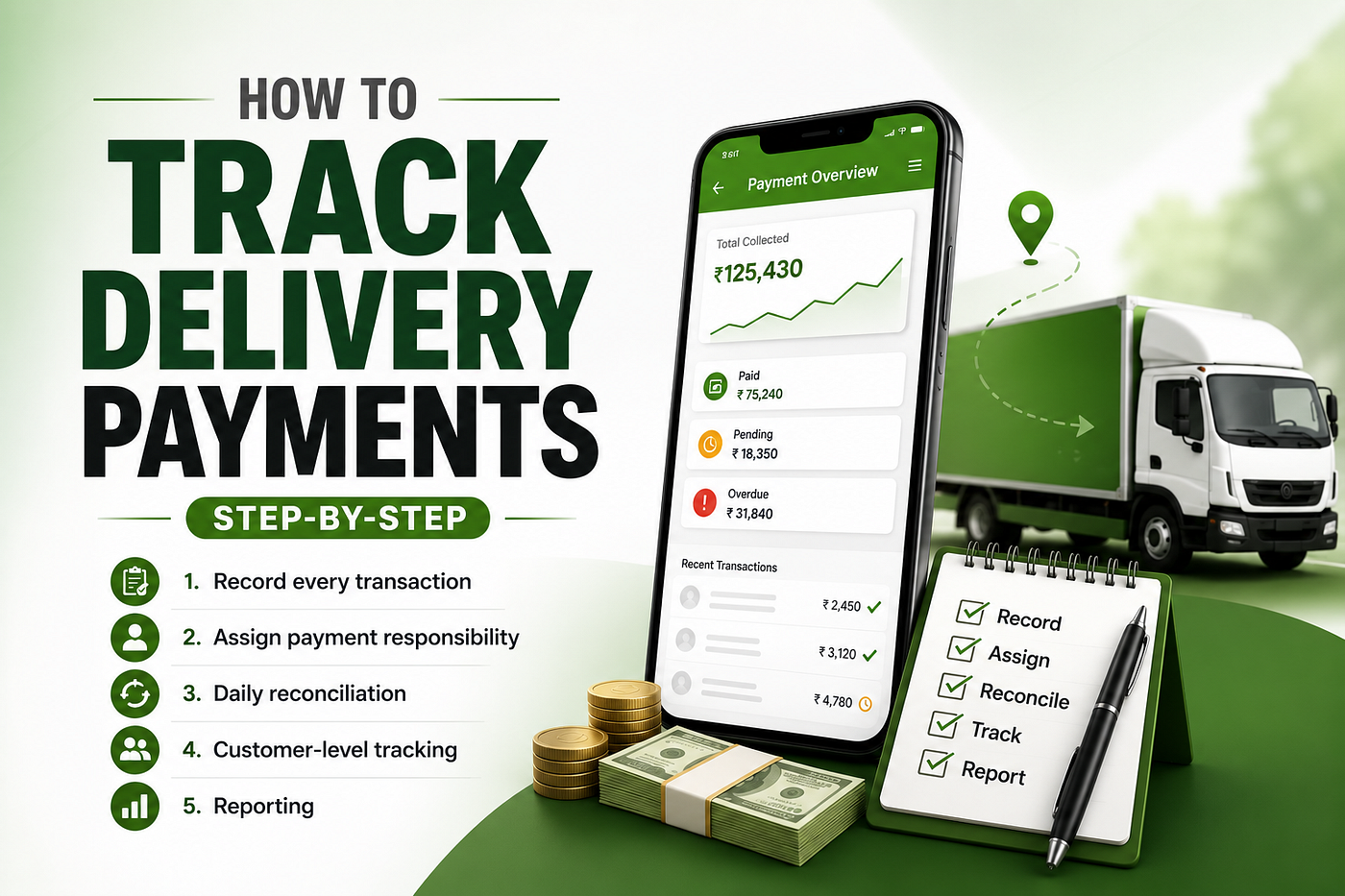
Step 1: Record Every Transaction Immediately
Never Rely on Memory
The first rule of payment tracking is simple:
Every transaction must be recorded immediately.
Not later. Not at the end of the day. Not “yaad se.”
The moment a payment happens, it should be entered into the system.
This includes:
- Cash payments
- Online transfers
- Partial payments
- Pending balances
Many businesses make the mistake of delaying entries.
For example:
- A rider collects cash during delivery
- The amount is remembered mentally
- The update happens hours later
This creates risk.
Because once details are forgotten or mixed up, errors begin to appear.
Why Immediate Recording Is Important
When payments are recorded instantly:
- Cash flow becomes clear
- Errors reduce significantly
- Pending balances stay accurate
- Daily reconciliation becomes easier
Most importantly:
Small financial leakages stop accumulating.
Step 2: Assign Payment Responsibility Clearly
Every Collection Must Have Ownership
One of the biggest mistakes in delivery businesses is unclear responsibility.
When multiple riders handle collections without proper tracking, confusion becomes normal.
Questions start appearing:
- “Kisne payment collect ki?”
- “Cash kis ke paas hai?”
- “Yeh amount submit hui thi ya nahi?”
Without accountability, tracking breaks down quickly.
Create Clear Payment Responsibility
Each payment should be connected to:
- A customer
- A rider
- A delivery
- A collection status
This creates transparency.
Now you know:
- Who collected the money
- Which payments are pending
- Which rider still holds cash
This single step improves operational control dramatically.
Why Responsibility Reduces Losses
When accountability is clear:
- Riders become more organized
- Collections become easier to monitor
- Missing payments are identified quickly
And most importantly:
Nobody relies on assumptions anymore.
Step 3: Perform Daily Reconciliation

This Is Where Most Businesses Fail
Many delivery businesses collect payments daily…
But they do not reconcile daily.
And that is a dangerous gap.
Daily reconciliation means comparing:
- Total deliveries completed
- Total payments collected
- Total cash submitted
- Pending balances remaining
Every number should match properly.
Why Daily Reconciliation Matters
Without reconciliation:
- Missing cash goes unnoticed
- Duplicate entries happen
- Pending balances become unclear
- Financial reports lose accuracy
Over time, small mismatches turn into serious operational problems.
Make Reconciliation a Daily Habit
At the end of every business day:
- Review completed deliveries
- Verify customer payments
- Match rider collections
- Confirm pending balances
This creates financial discipline.
And discipline creates control.
Step 4: Maintain Customer-Level Tracking
Every Customer Should Have a Clear Payment History
One of the biggest operational mistakes is tracking money in general rather than customer-wise.
Many businesses know:
- Total cash collected
But they do not know:
- Which customer paid
- Which customer is pending
- How much balance remains
This creates confusion very quickly.
Why Customer-Level Tracking Is Critical
Every customer should have:
- Payment history
- Outstanding balance
- Delivery history
- Collection records
This helps businesses:
- Follow up properly
- Avoid disputes
- Maintain accurate accounts
Now if a customer says: “Humne payment kar di thi.”
You can verify instantly instead of guessing.
Customer Tracking Improves Cash Flow
When pending balances are clearly visible:
- Follow-ups become faster
- Outstanding dues reduce
- Collection cycles improve
This creates healthier cash flow for the business.
Step 5: Use Reporting to Monitor Everything
Reporting Turns Data into Visibility
Tracking payments is not enough.
You also need to understand patterns.
This is where reporting becomes important.
A proper reporting system should show:
- Daily collections
- Pending balances
- Rider-wise collections
- Customer outstanding amounts
- Cash vs credit summaries
This gives business owners complete visibility.
Why Reporting Matters
Without reports:
- Problems stay hidden
- Leakages continue silently
- Decision-making becomes reactive
But with reports:
- Issues become visible early
- Trends become easier to understand
- Operations become more manageable
Now you are not just collecting money.
You are managing financial operations professionally.
Common Mistakes Delivery Businesses Make

Before closing, let’s quickly look at common payment tracking mistakes:
1. Delayed Entries
“Baad mein update kar denge.”
This creates missing records and confusion.
2. No Rider Accountability
Nobody knows who collected what.
This weakens operational control.
3. No Reconciliation
Businesses collect money daily but never verify totals properly.
4. Weak Customer Tracking
Pending balances become unclear and difficult to recover.
5. No Reporting
Without visibility, problems grow silently.
The Real Goal Is Not Just Tracking Money
Many business owners think payment tracking is only about accounting.
It is not.
Proper tracking creates:
- Operational clarity
- Better cash flow
- Stronger accountability
- Reduced stress
- Better decision-making
Most importantly:
It helps businesses scale without losing control.
Final Thoughts
Delivery businesses move fast.
Payments happen constantly:
- Cash collections
- Credit recoveries
- Rider submissions
- Customer balances
Without a proper process, confusion becomes inevitable.
But with structured payment tracking:
- Every transaction becomes visible
- Every balance becomes clear
- Every collection becomes accountable
And that changes the entire business.
Conclusion
Tracking delivery payments properly is not complicated.
But it requires consistency and structure.
The key steps are simple:
- Record every transaction immediately
- Assign payment responsibility clearly
- Reconcile daily
- Track customers individually
- Monitor reports regularly
Businesses that follow these steps do not just improve accounting.
They gain operational control.
And in delivery businesses, control is everything.
메타데이터
- post_id
- cb86aba9956e
- slug
- how-to-track-delivery-payments-properly-step-by-step-cb86aba9956e
- url
- https://medium.com/@tarsilofficial/how-to-track-delivery-payments-properly-step-by-step-cb86aba9956e
- canonical_url
- https://medium.com/@tarsilofficial/how-to-track-delivery-payments-properly-step-by-step-cb86aba9956e
- author_url
- https://medium.com/@tarsilofficial
- status
- ok
- fetched_at
- 2026-07-14 17:26:50