When Coral Collapse Happens in Real Time by Alex Brylske, Ph.D.
When Coral Collapse Happens in Real Time by Alex Brylske, Ph.D.
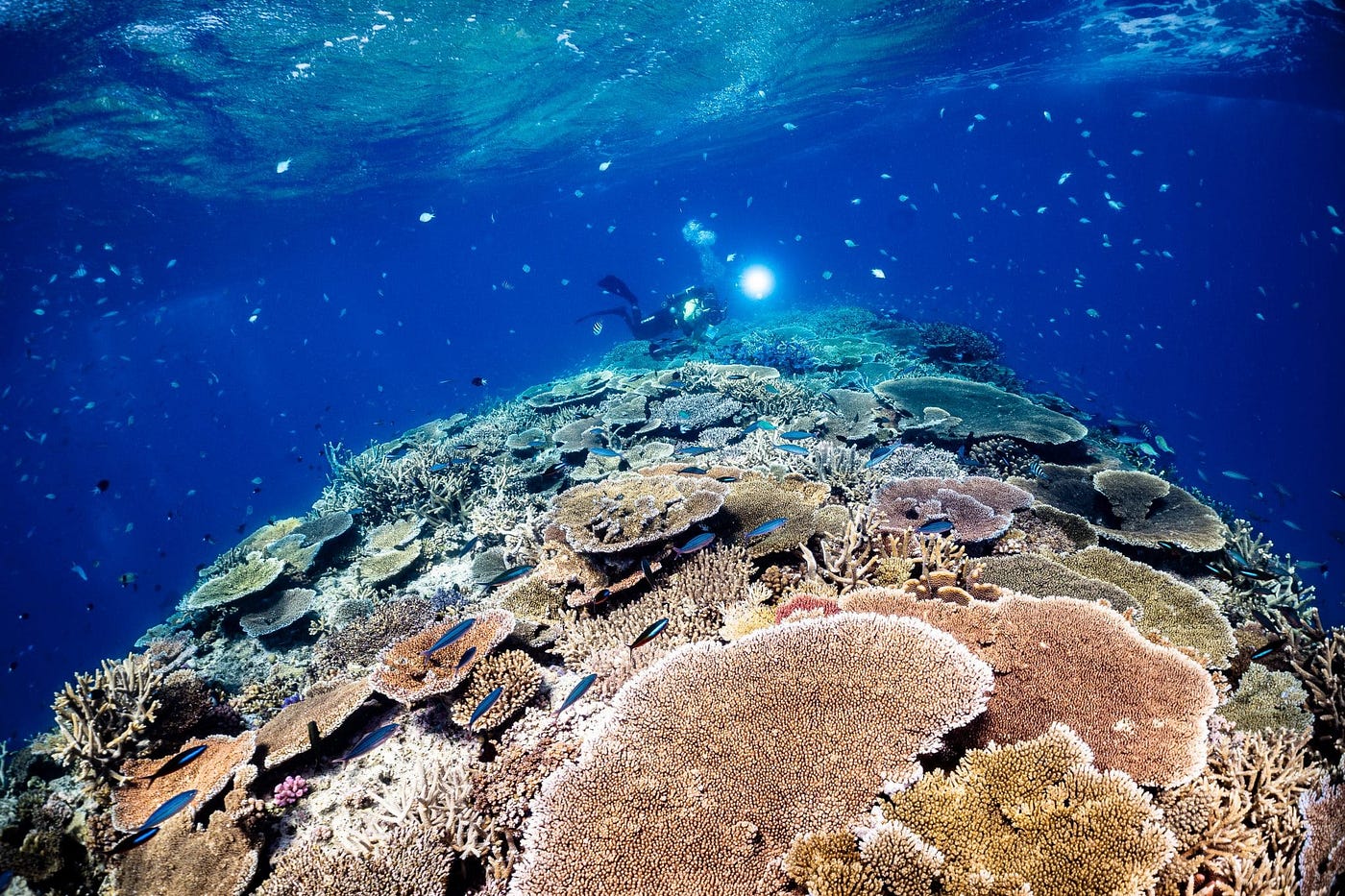
Massive coral changes: The kind of speed that means the reef you dove with your morning charter might not be the same reef you find when you return two weeks later.

by **Alex Brylske, Ph.D.**, President, Ocean Education International
**Click here to read this article on our Flippingbook platform.**
FOR DECADES, we’ve talked about coral reef decline as if it were a long-range forecast, using terms like “stressed ecosystems” and “gradual loss of resilience” to suggest we have all the time in the world to plan, pivot, and adjust. We treated reef collapse like a slow-motion film — so slow you could almost forget the frames were advancing. But recent experience in Florida has hit the fast-forward button, and it is a wake-up call for every dive professional on the planet.What we are seeing now is that while the causes of reef deterioration may accumulate over years, the actual collapse can happen with gut-wrenching speed. Not geological speed. Not “five-year management plan” speed. Operational speed. The kind of speed that means the reef you dove with your morning charter might not be the same reef you find when you return two weeks later.
This isn’t hyperbole; it’s the synthesis of three critical scientific findings based on the research studies listed at the end of the article. Viewed together, they reveal a system in which heat, bleaching, and disease have stopped behaving as isolated incidents and have begun acting as a coordinated assault. Take the 2023 marine heatwave. My friend and colleague Dr. Karen Neely and her team tracked more than 4,200 brain and boulder coral colonies across nine Florida Keys reefs. Although mortality wasn’t uniform, some sites were devastated. At Newfound Harbor, 43.1% of monitored colonies died during the event. At Cheeca Rocks, 30% died outright, and another 13% experienced partial mortality.
These aren’t just statistics; they mark the foundation of our industry disappearing in a single summer. And it happened fast. Neely reported that major losses at Newfound Harbor were already visible by early July. Most chillingly, the researchers suggest that some corals didn’t even go through the “polite” sequence of bleaching then starving; they simply hit their thermal limit and died directly from the heat. When the interval between “this reef looks a bit pale” and “this reef is dead” shrinks to weeks, the old rules of thumb for reef management go out the window.

Additionally, a team led by Miriam Ayad of the University of California, Santa Cruz, used spaceborne remote sensing to confirm that this wasn’t just a local blip. They described a “cascade of simultaneous negative impacts” triggered by surface temperatures exceeding 38°C (over 100°F). When satellites detect massive optical changes on reefs such as Horseshoe and Cheeca during the event, you know you’re dealing with a crisis of unprecedented proportions.
And then there’s the invisible threat. A study by Jan Landsberg of the Florida Fish and Wildlife Research Institute on Stony Coral Tissue Loss Disease (SCTLD) shows that by the time you see a lesion on a coral, the biological war may already be lost. They found physiological disruption deeply embedded in coral tissue before any macroscopic signs were visible to a diver’s eye.
As dive pros, we pride ourselves on “reading” the reef. But the science tells us the reef can be in terminal failure while still looking “okay” for the morning briefing.
Not Desperate, and Not Hopeless
Paid Advertisement
If this sounds like a eulogy, stop right there. I have spent most of my career fighting for these ecosystems, and if there’s one lesson the Florida story teaches us, it’s that we cannot afford fatalism. The science does not support the idea that the Keys are a lost cause. In fact, Dr. Neely’s data showed that at seven of the nine monitored sites, mortality among brain and boulder corals remained minimal despite 100% bleaching. Most of those “backbone” corals survived the heatwave. We aren’t just witnessing a collapse; we’re witnessing a massive, real-world experiment in reef resilience. And we are responding.
The Florida Keys are currently a test bed for Mission: Iconic Reefs, one of the most ambitious restoration projects on Earth. This isn’t just about attaching fragments to a reef and hoping for the best. It is a multi-phased, science-driven effort at seven key sites: Carysfort, Horseshoe, Cheeca Rocks, Newfound Harbor, Eastern Dry Rocks, Sombrero, and Looe Key.
Importantly, the Iconic Reefs Project is not just another opportunity to outplant more corals; it is rebuilding an ecosystem by removing invasive species and reintroducing “grazers” such as urchins and Caribbean king crabs to keep algae in check. The goal is to reach 25% coral cover by 2040. Whether they make it remains to be seen, but the point is this: the response to the crisis isn’t resignation. It’s a massive, coordinated counterattack.
When things move this fast, nuances like “site-to-site variability” aren’t just academic — they are central to our operational strategy. If one reef is crashing while the next is holding on, we need to know why and act accordingly.
The New Operational Reality
So, what does this mean for dive professionals in the trenches? It means our job description has just changed. We aren’t just tour guides anymore; we are the first line of observation and the primary agents of stress reduction.
Here is what we must do:
-
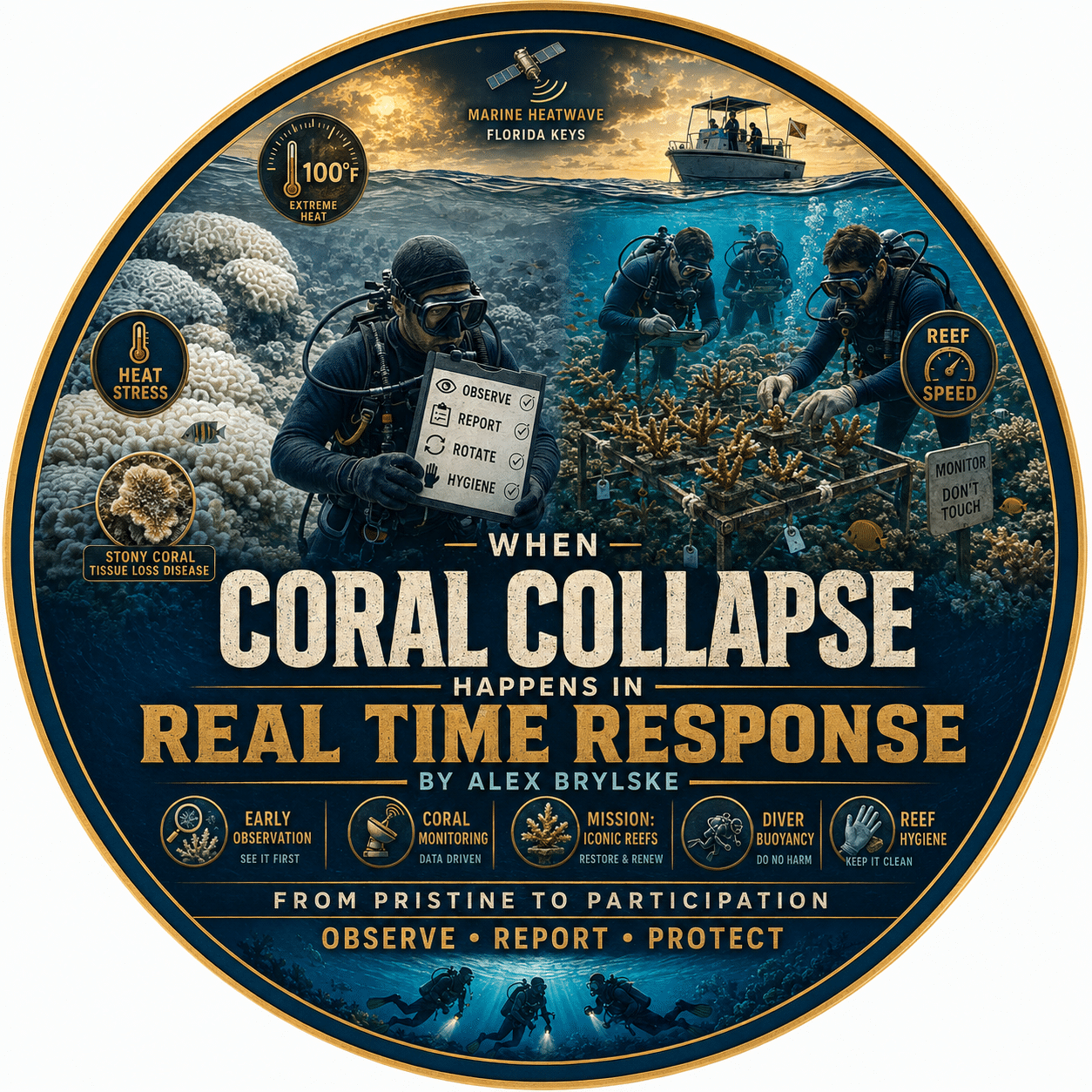
Treat Every Contact as Critical. On a reef at its physiological breaking point, a fin kick isn’t just a “mistake” — it’s a stressor in a system with no room for it. Buoyancy excellence is now a survival requirement for the reef.
-
Manage Sites Dynamically. If a site begins to pale or shows signs of disease, move. Habit is a terrible management tool. Rotate your sites, use rubble areas for training, and be prepared to suspend use of a signature reef if heat is a concern.
-
Become Operational Observers. Your staff spends more time in the water than any PhD. Train them to spot early signs of tissue loss or paling. Early reporting is the only way a regional response can keep pace with “reef speed” change.
-
Practice Extreme Hygiene. If there’s any chance your gear is spreading disease, treat decontamination as a non-negotiable professional standard, not a suggestion.
-
Change the Narrative. Stop selling “pristine” and start selling “participation.” Divers who understand the pressure these reefs face are your strongest allies. They will follow the rules, accept site changes, and support conservation efforts.
The old lesson was that reefs die slowly. Florida has shown us they can unravel in the time it takes to print a seasonal brochure. The threats are moving fast. Our response has to move even faster. We aren’t just bringing people to the reef; we are protecting what’s left while scientists and restoration teams fight for its future. It’s time to stop watching the film and start changing its ending.
Source List:
NOAA Fisheries. Restoring Seven Iconic Reefs: A Mission to Recover the Coral Reefs of the Florida Keys. Link
Neely, K. L., et al. (2024). Too hot to handle? The impact of the 2023 marine heatwave on Florida Keys coral.Frontiers in Marine Science. Link
Ayad, M., et al. (2025). Impacts of the 2023 Marine Heatwave in the Florida Keys: Detection and Analysis of a Mass Coral Bleaching Event Using Spaceborne Remote Sensing Imagery. Link
Landsberg, J. H., et al. (2020). Stony Coral Tissue Loss Disease in Florida Is Associated With Disruption of Host–Zooxanthellae Physiology. Frontiers in Marine Science. Link
Florida Keys National Marine Sanctuary. Coral Reef Restoration / Mission: Iconic Reefs. Link
Paid Advertisement

**Click here to read this article on our Flippingbook platform.**
THIS ISSUE’S ADVERTISING PARTNERS
Watch the Interview on Level Up for this issue:
[embed]
Watch the Level-Up: From Behind The Counter Interview:
[embed]
RECENT ISSUES
**2024 ISSUE ARCHIVE [2025 ISSUE ARCHIVE](https://scubadivingindustry.com/2025-issues-of-scuba-diving-industry-magazine/)**
MAGAZINE TOPICS
**BUSINESS EDU [ECO PRO](https://scubadivingindustry.com/category/eco-pro/) [NEWS & INNOVATION](https://scubadivingindustry.com/category/industry-news/) [PHOTO PRO](https://scubadivingindustry.com/category/photo-pro/) [RESEARCH](https://scubadivingindustry.com/category/diving-research/) [RETAILING](https://scubadivingindustry.com/category/retailing/) [SAFETY](https://scubadivingindustry.com/category/safety/) [TRAINING](https://scubadivingindustry.com/category/training/) [TRAVEL & TOURISM](https://scubadivingindustry.com/category/travel/) [FROM THE PUBLISHER](https://scubadivingindustry.com/category/from-the-publisher/) [Subscribe Here](https://scubadivingindustry.com/subscribe-for-free/) [Watch Our Podcasts Here](https://www.youtube.com/@Scubadivingindustry) [View This Issue on Flippingbook](https://online.flippingbook.com/view/421810635/)**
메타데이터
- post_id
- cb890156c2ae
- slug
- when-coral-collapse-happens-in-real-time-by-alex-brylske-ph-d-cb890156c2ae
- url
- https://medium.com/@scubadivingindustrymagazine/when-coral-collapse-happens-in-real-time-by-alex-brylske-ph-d-cb890156c2ae
- canonical_url
- https://medium.com/@scubadivingindustrymagazine/when-coral-collapse-happens-in-real-time-by-alex-brylske-ph-d-cb890156c2ae
- author_url
- https://medium.com/@scubadivingindustrymagazine
- status
- ok
- fetched_at
- 2026-07-16 15:04:30