The Next Battle in DeFi Will Be Fought Inside Liquidity Pools
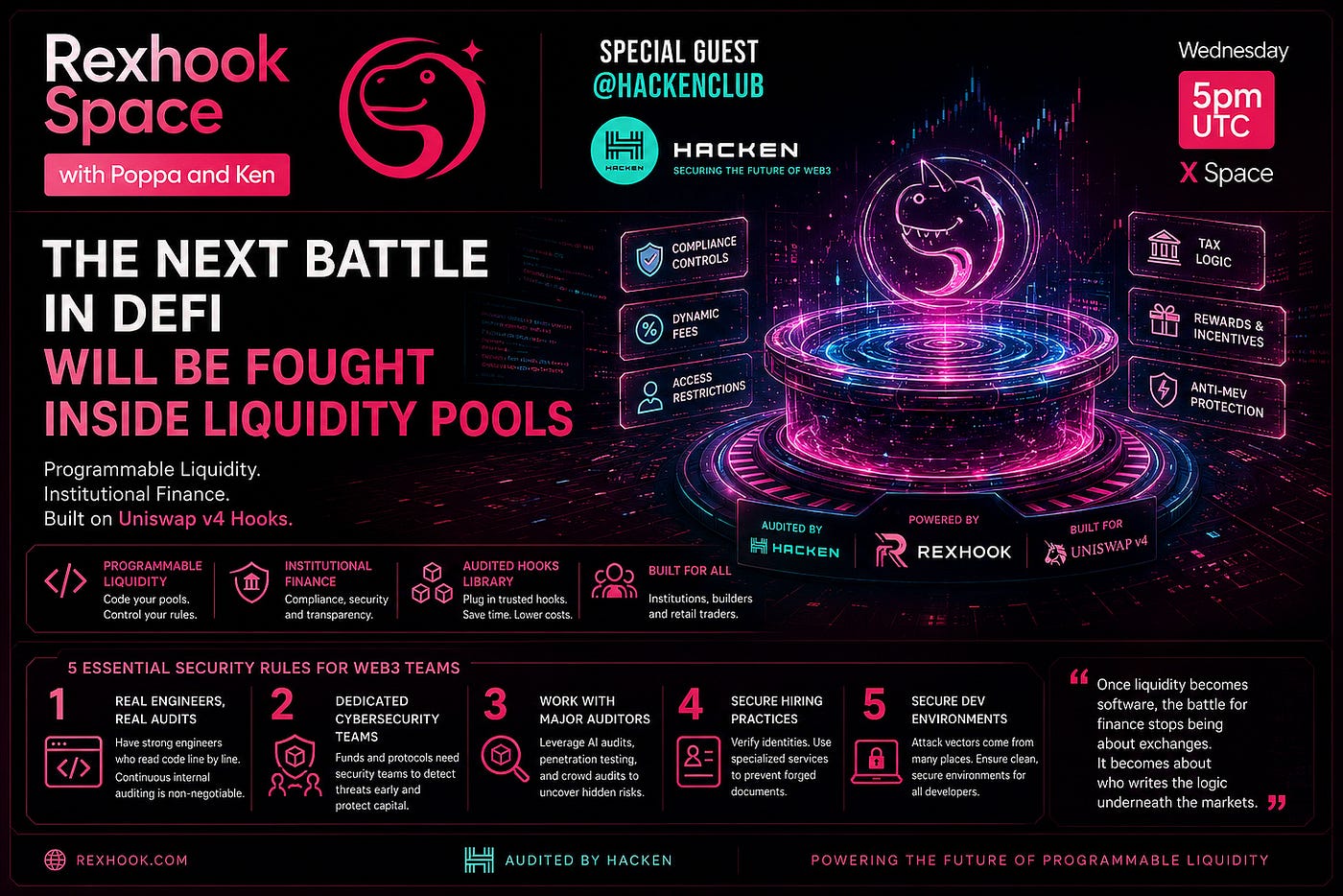
I recently joined an X Space hosted by RexHook alongside the team from Hacken, one of the most recognized cybersecurity firms in Web3.
The Next Battle in DeFi Will Be Fought Inside Liquidity Pools
RexHook and the rise of programmable financial infrastructure
I recently joined an X Space hosted by RexHook alongside the team from Hacken, one of the most recognized cybersecurity firms in Web3.
What started as a discussion about Uniswap v4 hooks quickly evolved into something much bigger.
By the end of the conversation, one conclusion became impossible to ignore:
The next generation of decentralized finance will not be built around tokens alone. It will be built around programmable liquidity itself.
And whoever controls the infrastructure layer around programmable liquidity may end up shaping the future architecture of financial markets.
Hooks Are One of the Most Important Innovations in DeFi
The word “hooks” sounds deceptively small.
In reality, Uniswap v4 hooks fundamentally change what liquidity pools can become.
Traditionally, liquidity pools were relatively static environments. They facilitated swaps, distributed fees, and followed predefined mechanics.
Hooks change that.
With Uniswap v4, developers can now program logic directly into liquidity pools themselves. That means pools are no longer just passive trading infrastructure. They become customizable financial systems.
This unlocks an entirely new design space for decentralized finance.
Liquidity pools can now:
- Enforce compliance requirements
- Restrict access to verified wallets
- Create dynamic fee structures
- Tax certain transactions
- Offer loyalty rewards
- Implement anti MEV protections
- Adjust behaviour based on volatility
- Route fees automatically
- Integrate KYC frameworks
- Support institution specific controls
In essence, liquidity itself becomes programmable.
That may sound technical, but the implications are enormous.
Imagine a tokenized real estate fund where only KYC verified wallets can access the liquidity pool. Fees dynamically adjust based on holding duration. Rewards are distributed only to compliant participants. Treasury logic is automated directly inside the pool architecture itself.
That entire framework can now exist natively within DeFi infrastructure.
This is why Uniswap v4 matters so much.
It transforms decentralized exchanges from simple swap mechanisms into programmable financial frameworks.
And once liquidity pools become programmable, they stop behaving like simple markets and start behaving like software.
DeFi Is No Longer Fighting Institutions
For years, crypto believed decentralized finance would replace institutional finance.
But programmable liquidity changes the equation entirely.
Institutions no longer need to fight DeFi.
Now they can shape it directly from inside the protocol layer itself.
Hooks allow compliance systems, permissions, treasury controls, identity frameworks, fee structures, and regulatory logic to exist natively inside liquidity infrastructure.
That is a profound shift.
For the first time, decentralized finance can begin operating with the programmable controls institutions actually require.
This may ultimately become one of the largest bridges between traditional finance and crypto infrastructure.
Because once regulation and programmable compliance can live directly inside liquidity pools, DeFi stops looking like an alternative financial system.
It starts looking like the next evolution of financial infrastructure itself.
Why RexHook Matters
This is where RexHook enters the picture.
RexHook is building infrastructure focused on audited and verified Uniswap v4 hooks. The project’s goal is to create a secure hook ecosystem where developers can deploy production ready components without rebuilding security architecture from scratch.
That is a much bigger opportunity than many people realize.
Because once liquidity becomes programmable, every pool effectively becomes custom financial code.
And custom financial code creates risk.
A lot of risk.
Every new hook introduces additional attack surfaces, additional complexity, and additional opportunities for catastrophic failure.
The beauty of a protocol like RexHook is that developers gain access to hooks already audited by Hacken and verified by the RexHook team. This lowers both security costs and compliance overhead for teams entering the Uniswap v4 ecosystem.
That matters because security is rapidly becoming one of the biggest bottlenecks in decentralized finance.
In traditional finance, institutions rely on standardized infrastructure layers. Banks do not rebuild core banking systems from scratch every time they launch a product.
DeFi is moving toward the same direction.
Protocols that provide trusted infrastructure primitives may eventually become foundational layers for the broader ecosystem.
And infrastructure businesses historically become some of the most defensible businesses in technology.
Infrastructure Is Where the Economic Value Accumulates
Most crypto cycles focus obsessively on applications.
But over time, value tends to concentrate at the infrastructure layer.
The reason is simple.
Infrastructure creates dependency.
If developers build on audited hook standards, if liquidity aggregates around trusted environments, and if institutions require compliant liquidity systems, then secure hook ecosystems begin functioning like toll roads for programmable finance.
That creates powerful network effects.
Developers prefer environments with trusted security standards.
Liquidity prefers environments with lower exploit risk.
Institutions prefer environments with predictable compliance architecture.
And users ultimately follow liquidity.
This is why audited hook ecosystems may become economically significant far beyond simple developer tooling.
They are not just products.
They are coordination layers for capital itself.
Web3 Still Underestimates Security Risk
One of the strongest themes throughout the Space was that Web3 continues to underestimate operational security.
According to Hacken’s Q1 2026 Security Report, the industry lost hundreds of millions of dollars in a single quarter across exploits, phishing attacks, compromised infrastructure, and operational failures.
What is particularly alarming is that many major incidents no longer originate purely from smart contract vulnerabilities.
Increasingly, attackers target the humans around the code.
That distinction matters.
Because the attack surface in crypto has expanded far beyond the blockchain itself.
And as programmable liquidity becomes more complex, the systemic risks become larger as well.
If hooks succeed, they could accelerate institutional adoption of decentralized finance dramatically.
But if poorly secured hooks proliferate across the ecosystem, they could also become one of the largest attack surfaces DeFi has ever introduced.
The stakes are enormous.
1. Serious Web3 Teams Need Real Engineers
Not “vibe coders.”
Not founders blindly shipping AI generated snippets.
Not managers who cannot review architecture decisions.
Serious protocols need deeply technical engineers capable of reviewing systems line by line and understanding how every component behaves under stress.
Continuous internal auditing must become part of protocol culture.
Security cannot be treated as a checkbox completed before launch.
It must become an ongoing operational process.
Interestingly, Hacken now offers embedded security models where members of their team work alongside protocols continuously rather than only performing isolated audits. Whether this becomes industry standard remains to be seen, but it reflects a broader shift toward persistent monitoring instead of one time reviews.
Modern protocols are simply becoming too dynamic for static security assumptions.
2. Crypto Funds Need Internal Cybersecurity Teams
Large capital allocators in crypto increasingly need dedicated cybersecurity operations.
Not eventually.
Now.
One point discussed during the Space involved early warning visibility around the KelpDAO situation before it escalated into a larger problem for liquidity providers. Institutional players with stronger security intelligence frameworks were able to react faster and reduce exposure.
This creates an entirely new competitive advantage inside digital asset markets.
The best crypto funds of the next decade will not only employ traders and analysts.
They will employ cybersecurity specialists.
Because in decentralized finance, operational security is directly tied to capital preservation.
3. Major Auditors Offer More Than Branding
Many younger projects try to minimize audit expenses.
That instinct is understandable, especially in difficult fundraising environments.
But mature security firms offer far more than a logo on a website.
Larger auditors now combine AI assisted code analysis, layered penetration testing, infrastructure review, crowdsourced vulnerability discovery, and ongoing monitoring systems.
This matters because modern attacks increasingly target ecosystems rather than isolated contracts.
A single weak point inside a protocol stack can create cascading failures across multiple integrations.
For smaller teams, crowd audit systems may become particularly important. Thousands of independent researchers attempting to break code can sometimes uncover risks that isolated internal teams miss.
Security through layered adversarial review is becoming increasingly necessary.
4. Hiring Developers Is Becoming a Security Vector
This part of the discussion surprised many listeners.
Fake identities in crypto are becoming increasingly sophisticated.
Government documents can now be forged convincingly enough that ordinary hiring processes often fail to detect them.
That creates enormous risk inside decentralized finance, where remote engineers may have direct access to treasury infrastructure, deployment systems, multisigs, or sensitive repositories.
The uncomfortable reality is that DeFi is effectively operating banking infrastructure while spending dramatically less on security than traditional financial institutions.
That imbalance creates ideal conditions for organized cybercriminal groups and potentially even nation state level actors.
Projects should increasingly consider using professional verification and security firms during hiring, especially for senior engineering roles.
The cost of prevention is significantly lower than the cost of compromise.
5. Developer Environments Are Now Part of Protocol Security
One of the most important insights discussed during the Space was how attacks increasingly originate through indirect operational vectors.
Scammers frequently impersonate recruiters, investors, or collaborators. Developers are tricked into joining fake interviews or downloading compromised software through malicious meeting links.
Once infected, malware can monitor clipboard activity, steal credentials, compromise wallets, or manipulate transactions silently in the background.
And if an infected machine is later used to deploy or modify protocol code, the consequences can become catastrophic.
This means projects cannot only audit smart contracts.
They must also evaluate the security standards of the environments where those contracts are written.
Remote operational security is no longer optional in crypto.
It is part of the protocol itself.
The Battle for Crypto Is Becoming a Battle for Infrastructure
For years, crypto operated like an experimental frontier.
That phase is ending.
Programmable liquidity, embedded compliance systems, AI assisted auditing, infrastructure level monitoring, and operational security layers are all signs that decentralized finance is maturing into a far more serious industry.
And protocols like RexHook may ultimately become part of the foundation enabling that transition.
Because if liquidity pools themselves become programmable financial infrastructure, then audited hook libraries become the secure building blocks powering the next generation of decentralized markets.
The most important companies in the next era of crypto may not be the ones issuing tokens.
They may be the ones building the programmable infrastructure that determines how capital itself behaves.
Because once liquidity becomes software, the battle for finance stops being about exchanges.
It becomes about whoever writes the logic underneath the markets.
And that battle is only beginning.
References
메타데이터
- post_id
- cb8b2d8ccc8f
- slug
- the-next-battle-in-defi-will-be-fought-inside-liquidity-pools-cb8b2d8ccc8f
- url
- https://medium.com/@hellokidgen/the-next-battle-in-defi-will-be-fought-inside-liquidity-pools-cb8b2d8ccc8f
- canonical_url
- https://medium.com/@hellokidgen/the-next-battle-in-defi-will-be-fought-inside-liquidity-pools-cb8b2d8ccc8f
- author_url
- https://medium.com/@hellokidgen
- status
- ok
- fetched_at
- 2026-07-10 15:46:15