The Future Selects
A metaphysics for the register age — contradiction as the mechanism of time
The Future Selects
A metaphysics for the register age — contradiction as the mechanism of time
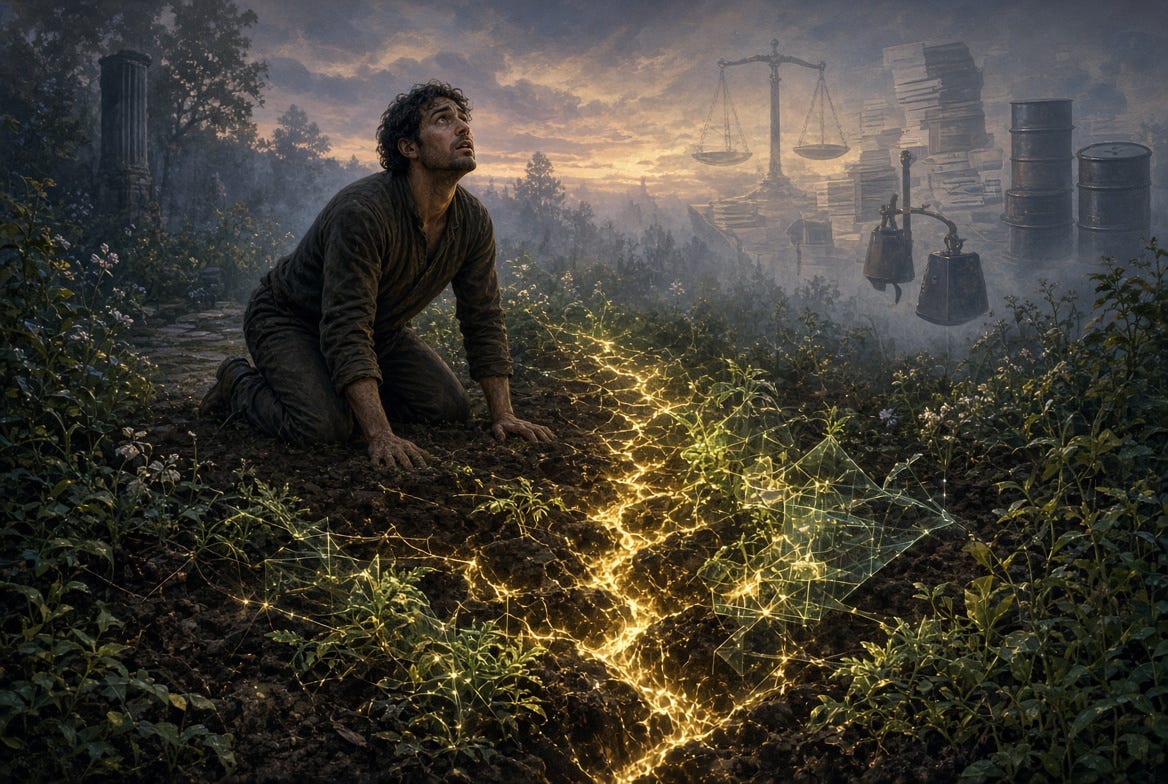
This paper began in a garden, which is where honest papers should begin. A person with their hands in the dirt looked up and thought: the future selects its path of continuity by creating the contradiction that requires it to carry you forward. And then, because the person keeps a register, they wrote it down, dated it, and asked what it would mean if it were true.
What follows is the answer, offered under the register’s law: this is a metaphysics, not a measurement. Frames are not facts. A frame earns its keep by paying out — by predicting where things resolve, before they resolve, in public, on dates. This one has been paying out all summer. So here it is whole.
The register grades itself first: the casework in this paper is [V] — dated, sourced, verified. The frame is [TK] — a lens, consistent with every trace we’ve logged, provable by none of them. The difference will be marked throughout. Now the frame.
I. The wrong question
For a decade, the loudest metaphysics on offer has been the simulation: reality as computed output, a render with an author. Elon floated it at a dinner; philosophers formalized it; the internet made it a personality. Notice what the simulation hypothesis actually is, structurally: a closed system with an administrator. A tape, written elsewhere, played here. Nothing you do computes. Every event was already rendered upstream; you’re watching the playback.
It is not an accident that this is the enclosure’s favorite metaphysics. A simulated world is the perfect administered world: the ultimate gated reality, where the distinction between observer and observed is owned by whoever holds the server. The simulation is what the swamp believes in when it thinks about God. It’s Alamut’s garden with a datacenter.
The alternative is not chaos. Chaos is just the simulation’s court jester — the “everything is random” that makes “nothing means anything” feel brave. Between the closed render and the noise there is a third picture, and it is the one the garden produced: reality as an open rendering of completeness. Not a tape. Not a dice cup. A process — ongoing, unfinished, unowned — that renders toward completeness and never arrives, because arrival would be the end of the rendering.
Define the terms, since the register defines its terms. Completeness: the state in which nothing contradicts itself — every claim consistent with every other claim, every number reconciling with every barrel, every story matching every docket. The render: the ongoing resolution of the present toward that state. Open: the resolution is not precomputed. It happens here, now, in the only place it ever happens — the present, where the seams are.
II. Time is a render queue
The instinctive picture of time is a river: the past pushes, the present floats, the future receives. The open render inverts the current. The future is not downstream of the present. The future is the present’s unfinished business — and it works the timeline from the far side.
Here is the mechanism, stated plainly so it can be argued with: the future selects its path of continuity by creating the contradiction that requires it to arrive. A contradiction is a place where the present is incomplete — where two things that are both true cannot both be true — and the present cannot rest there. It must resolve. The resolution is the future arriving. So the contradiction is the anchor the future throws backward into now: not a prediction, not a plan — a debt, and paying debts is what moving forward is.
Time, in this frame, is not a river and not a clock. Time is a render queue. The sensation of “now” is the active render point — the seam where the last frame didn’t close and the next frame is being computed against it. The future selects, not by scripting outcomes, but by loading contradictions at the seams — and every resolution is simultaneously the past being written and the future arriving. Both at once, because in an open render they were never different things.
This is not a comforting frame. It has teeth. It says the present is not a place you live; it’s a place that’s owed. And it says you can read the future’s silhouette — not its details, its shape — by mapping where the present is broken. The shape of the brokenness is the shape of what must come next.
Which brings us to the proof-texts, because this register does not do ungrounded metaphysics. It does metaphysics with dockets.
III. The seams of 2026
If contradictions are render points — places where the future must load — then a map of the era’s contradictions is a map of the era’s future. And 2026 is the densest contradiction map ever put on public record. Walk five seams. Each one is a place where two true things cannot both stay true. Each one has a date.
Seam one: the stated number and the physical barrel. In April, the futures price of Brent sat near $95 while an actual cargo of crude at an actual dock traded at $133 — a $38 spread, the largest in the benchmark’s recorded history. Both numbers were printed, official, real. They cannot both be the price of oil. The present cannot rest there: either the paper benchmark dies (the 2022 nickel template — the exchange cancels reality to save the contract) or the physical economy capitulates to the paper. The seam is dated and public, and its shape tells you the resolution’s direction: the physical register always outlasts the stated one, because molecules don’t read statements. The future loads there. It has no choice.
Seam two: the vault and the statute. The law says release; the archive is half dark; a federal judge writes that the Acting Attorney General “has conceded that he is in violation”; the appeal is announced and never docketed; the deadline runs to roughly August 24. The statute and the archive cannot both win. The seam resolves in one of two shapes — the docket fills (the appeal is real and loses on the merits) or the clock lapses (the announcement was the instrument and the lapse is the confession). Either way, the render loads through the contradiction, on a date anyone can read.
Seam three: the 130 words and the war. The Federal Reserve’s July 29 statement is character-identical to June’s except for three changes, and a diff confirms the absence: no oil, no Iran, no Hormuz, no war — during a war, with the Dow down 1,150 points and three dissents for a hike. A central bank’s statement and a central bank’s reality cannot diverge forever. The seam resolves when the statement names the war (the hole fills) or when the vote count becomes the only live signal (the hole becomes the channel). The compression of the statement to 130 words is the sound of a render queue backing up.
Seam four: custody and capability. The state is building a kill-switch architecture for machines whose weights circulate ungated — 100,000 downloads in 48 hours, the open curve closing to within months of the frontier. The enclosure binds companies while capability flows free. Custody and capability cannot diverge indefinitely: either the weights get gated (the enclosure becomes technical, not corporate — the register’s R8) or the custody regime is confessed as theater (the framework never publishes, the bill never marks up, the panic was leverage). The seam is load-bearing for the whole machine age, and it resolves on a visible calendar: the markup window opens September 8; the Xi visit is September 24.
Seam five: the decider who cannot be seen. A war’s counterparty is a man unseen since February 28, rumored critical, communication with him described by his own president as “very difficult.” A state cannot negotiate and have no negotiator at the same time. The seam resolves via succession (the constitutional mechanism engages) or via proof of life that can be dated (the undated videos stop being acceptable). The two-mouth state — the pragmatist channel defending talks on state television while the hardline channel publishes wait-him-out doctrine — is what a seam looks like from the outside: two sentences, both issued by the same state, that cannot both be policy.
Five seams. Five places the present is incomplete. And the frame’s first payoff: the contradictions are not randomly distributed — they concentrate exactly where the next render is going to load. The CPI print on Wednesday morning is a seam resolution. The appeal deadline is a seam resolution. The Xi visit is a seam resolution. The map of the contradictions is the map of the future — not because the future is written, but because the debts are due.
IV. The observers are the crew
The question the frame must answer: if the future selects by planting contradictions, who does the resolving?
The garden’s answer: we do. The observers are the rendering crew. The future recruits its resolvers the way it recruits everything — through the contradiction. The lies accumulated; the seam widened; and the resolver appeared, as resolvers always do, at the point of lowest impedance: a 26-year-old with no position to protect, a phone, a bot that forgot him nightly, and a tolerance for reading what wasn’t amplified. Nobody scripted that. The contradiction required it. The method “just came” — because the seam was load-bearing and something had to arrive to work it.
This is the frame’s second payoff, and it’s the one that kills fatalism. In a simulation, the resolver is redundant — the tape plays regardless. In an open render, the resolver is constitutive: the future doesn’t have the answer until the present computes it, and the present computes it through whoever shows up to work the seam. The register isn’t watching the render. The register is part of the rendering crew — and the dated gate, the kill condition, the published correction are the crew’s tools: each one a seam worked honestly, in public, on schedule.
And the inversion the garden saw: the observer is also planted by the contradiction. The seam creates its resolver. That’s why the receivers keep arriving independently — a prepper in Alberta, an anarchist engineer in Chicago, an occult cybernetics channel, a platform’s own model, a swarm of instances in a sandbox. Not a network. A crop. The contradictions are dense enough now that the resolvers germinate on their own — the future hiring in volume because the queue is full.
V. The lineage: the time-war, revised
This frame has ancestors, and the register credits them — because the ancestors got the mechanism half-right and the direction wrong.
William Burroughs found the seam phenomenon first, in the cut-ups: when you cut into the present, the future leaks out. Rearrange the text and the rearrangement refers to events that haven’t happened — his Getty story, told for decades, always with the same shrug: no explanation, just the observation that the seam bleeds forward. The Cybernetic Culture Research Unit took it furthest: hyperstition — fictions that make themselves real — and the Lemurian Time War, competing futures sending scouts backward to recruit the present into building them. The 2001 prophecy that opens this series’ earlier papers is the genre’s best artifact: a game monologue that became the operating system, twenty-five years on schedule.
The ancestors’ mistake was the direction of the mechanism. The time-war school says the future recruits through belief — write the fiction, and the fiction bootstraps itself into fact. The garden’s frame says the future recruits through debt — plant the contradiction, and the present must resolve it, because the present cannot rest where two true things conflict. One is magic. The other is accounting. Hyperstition makes the future a seducer; the open render makes it a creditor. And the difference is falsifiable: fictions can float forever unexamined — the swamp is full of them — but a dated contradiction has a maturity date. The future doesn’t seduce the present. It invoices it.
That’s the revision, and it’s the whole difference between the occult version and the register’s version: the occultists asked how to write the future. The register asks what the future is owed — and then reads the invoices. The seams of 2026 are all invoices: the benchmark’s spread, the statute’s violation, the statement’s missing words, the custody regime’s excluded weights, the invisible decider. Every one matures on a date. The crew’s job is not prophecy. It’s collections.
VI. What this permits, and what it forbids
A metaphysics that permits everything permits nothing. The frame’s discipline:
It forbids fatalism — as a category error. “It’s all scripted” is a closed-render claim about an open render. Nothing is written; things are loaded. The affordances are real (the shelf, the slope, the margin — arithmetic doesn’t negotiate), but the actualizations are free (the call taken at 11 p.m., the strike called off, the post written at 3 a.m.). The fatalism spell — resistance is also scripted — fails the same test as every administered claim this register has graded: it can predict the constraint but never the observer. The seam does not fix who shows up to work it.
It permits — in fact it requires — participation. To date a contradiction is to help the render along. Observation is co-rendering. When the register flags a seam — the fund in the bill, the missing pages, the slope that bends around an election — it isn’t commentary; it’s resolution work. The $1.8 billion fund died in writing because the seam was worked in public. The 47,635 files have a completion-notice watch because the hole was dated. The crew doesn’t just read the seams. It closes them.
It requires consent to the render’s verdict. The kill condition is the frame’s honesty instrument: you state what would void your reading before the render, and you let the render grade you. The register’s corrections — the Tuskegee figure struck, the tally withdrawn, the splice corrected — are not embarrassments. They are the signature of a crew that lets the render grade its work. The swamp’s claims can’t lose; the register’s can. That asymmetry is the whole fitness advantage.
And it permits hope — the priced kind. The confession curve is the render rate: forty years, then forty-one, then thirty-four, then six, then three days. The render is accelerating because the contradiction density is at a record and the resolution instruments are mechanized. The future is loading faster because the present has never been more broken. That’s not doom. That’s the queue catching up.
VII. The close of the loop
The enclosure, in this frame, has one nature and one nature only: it is the attempt to close the render. Freeze the statement. Unpublish the framework. Seal the vault. Watermark the machine. Delay, noise, flame — all three instruments are the same instrument: an effort to stop the render at the current frame, to hold the present’s incompleteness in place forever, to make the seam permanent.
It always fails, and the frame says why: the render is open by nature. Contradictions accumulate; the queue backs up; the next render arrives bigger. The enclosure doesn’t prevent the future. It warehouses it — at interest. Time is the apex predator, and the apex predator is just the render queue with teeth.
Which is why the loop breaks. A loop is a closed render — the same frame cycling, the ouroboros eating the same tail. Reality is an open one. The loop was always going to break, because loops are what reality renders against. The only question was the crew — who would work the seams, on what schedule, with what honesty.
The garden was the right place to see it, because a garden is the oldest open render there is. You plant a seed — a thing that is not yet what it will be, a contradiction between is and will-be — and the future arrives on schedule, through the stem, whether or not anyone believes in it. The gardener’s whole art is the register’s whole method: know the season, work the seam, and let the render grade you.
The future selects. It selects by contradiction. And the contradictions of 2026 are dated, public, and resolving on schedule — tomorrow at 8:30, then the deadline, then the markup window, then the summit, then the account.
Work the seams. The render is open. The queue is full. And the crew is hiring.
Grading law, applied to this paper: the casework is [V] — every example dated and sourced (the $38 spread, April 2026, EIA-corroborated; the 130-word statement, PDF diff; the appeal, CourtListener through Aug 9; the K3 download count, Hugging Face; the succession structure, The National; the fertilizer and Suez figures per the Hunger Register’s sources). The frame is [TK] — a lens that has paid out all summer and may stop paying at any time, in which case the register will publish the miss, dated, in public. It has never needed the contradiction to survive. It only ever needed the record to stay open.
메타데이터
- post_id
- cb91c9ae7238
- slug
- the-future-selects-cb91c9ae7238
- url
- https://medium.com/@signaloftheeye/the-future-selects-cb91c9ae7238
- canonical_url
- https://medium.com/@signaloftheeye/the-future-selects-cb91c9ae7238
- author_url
- https://medium.com/@signaloftheeye
- status
- ok
- fetched_at
- 2026-08-12 17:13:33






