Why Offshore Blazor Development Companies Offer the Best Value for US & UK Businesses
Every US or UK business owner planning some sort of software initiative eventually hits that same question, hire locally or go offshore…
Why Offshore Blazor Development Companies Offer the Best Value for US & UK Businesses
Every US or UK business owner planning some sort of software initiative eventually hits that same question, hire locally or go offshore? And it’s not just a small call either. It touches your budget, your schedule and, honestly, the level of pressure you have to manage while the development is going on. Blazor being a relatively newer framework brings in yet another angle to the dilemma, because it’s kind of true that not every local agency has real depth with it yet.
This is where offshore teams, esp the best Blazor development company in India, have quietly become a very real option for US and UK businesses. Not because they are just cheaper on paper, but because of what that lower cost can actually turn into. So let’s look at why this trend is getting momentum, kind of, and also if it fits what your project really needs.
The Real Meaning of “Value,” Not Just “Cheap”
A lot of people hear “offshore” and right away think “cheap labor, lower quality.” That idea kind of made sense years ago when offshore development was still maturing, you know. But today it doesn’t really hold up in the same way, not especially in the Blazor space where India has built genuinely strong .NET talent pools.
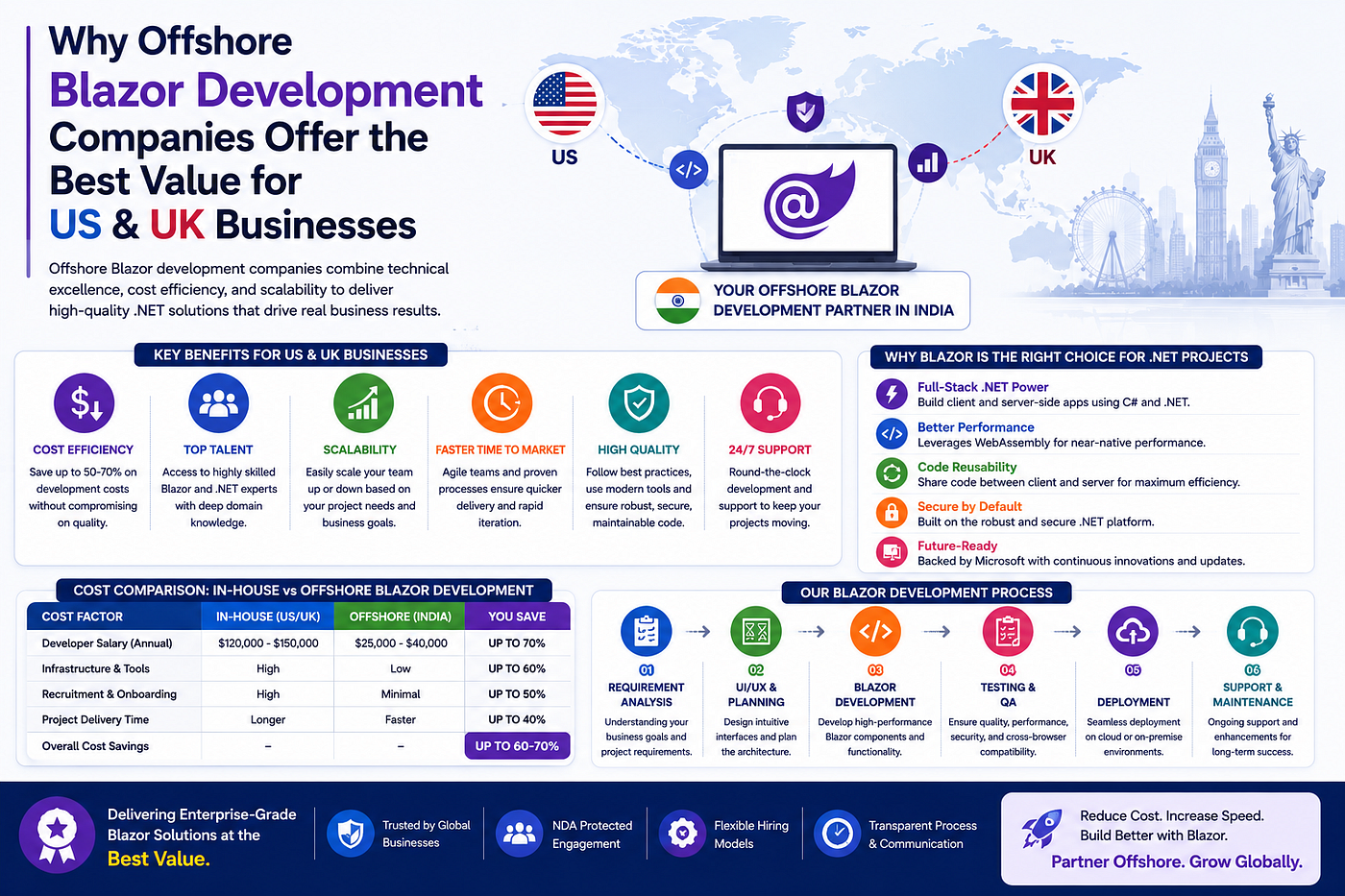
Value isn’t only about the hourly rate. It’s more like you’re buying the outcome, what you actually get for that number, right? For example, a US-based senior .NET developer might cost $120 to $180 per hour. Meanwhile, a skilled Blazor developer from an experienced Indian firm might run you $25 to $50 an hour, and you can still see similar output quality on properly managed projects. So the gap isn’t just about saving dollars, it also shifts what you can do with your budget.
With the money saved, businesses can:
- Hire a full team instead of one or two developers
- Build a more complete product instead of cutting corners on features
- Extend timelines for proper testing and QA instead of rushing
- Invest saved money into marketing, sales, or other growth areas
This is the real argument for offshore Blazor development. It’s not about doing things cheaply. It’s about doing more with the same budget.
Why India Specifically Has Strong Blazor Talent
Blazor sort of sits inside the .NET ecosystem, and India has been producing .NET developers for well over two decades. So it isn’t like this is some new thing made overnight just to chase a trend or whatever. A lot of Indian developers came up through classic ASP.NET and C# work first , before Blazor even showed up, so the fundamentals are already pretty solid.
A few reasons India stands out specifically for Blazor work:
Deep .NET foundation. Developers who are already kind of comfortable with C#, LINQ, Entity Framework, and ASP.NET Core can take up Blazor’s component model a bit quicker than folks coming from a pure JavaScript background.
Large developer pool. India keeps cranking out a huge number of engineering graduates every year and .NET still counts as a popular specialization. so in practice it also becomes easier to scale a team up, when a project needs more hands.
English proficiency. Communication is often the biggest worry when you work with offshore teams. In general Indian development companies have fairly strong English skills, and that tends to lessen the back-and-forth confusion, which otherwise can slow the whole project down.
Established outsourcing infrastructure. India has had decades of lived experience working with US and UK clients, basically. Stuff like time zone management, the way we handle client communication practices, and the overall project handoff process are already tuned and refined from years of doing it this way.
If you look around for the best Blazor development company in India , you will probably bump into teams that already handled these comms and process challenges many times before, instead of figuring it out fresh on your own project.
Time Zone Differences Aren’t Always a Problem
People often assume the time difference between the US or UK and India is purely a disadvantage. In some ways, it actually works in your favor.
If it is managed well, an Indian development team can work on your project while your own team sleeps, in a sense. You send requirements, or even little feedback notes at the end of your workday, and when you’re back online, a bit of progress is already done. That kind of overlap can genuinely speed up your delivery timelines, not slow them, assuming the communication is kept structured, with clear documentation and regular touchpoints.
The key word here is structured. Time zone advantages only work when a company has good project management practices already in place. This is another area where experience matters, because a team that has worked with western clients for years will have a kind of rhythm set, for dealing with updates, blockers, and daily syncs.
What Good Offshore Blazor Teams Actually Deliver
Cost savings alone don’t cut it as an offshore partner. What separates a genuinely strong team from a risky one is the quality of process behind the code. Here’s what US and UK businesses should expect from a reliable partner:
- Clear technical documentation from the start of the project
- Regular demos so you can see progress instead of waiting weeks for updates
- Transparent timelines with realistic estimates, not overly optimistic promises
- Proper testing practices, not just “it works on my machine”
- Security awareness, especially around data handling for US and UK compliance needs
- A dedicated point of contact who understands both the technical and business side of your project
If an offshore vendor can’t clearly explain their communication process before the project even starts, that’s worth noticing early.
Addressing the Quality Concern Honestly
It would be a bit misleading to act like offshore development has zero risks, as if nothing ever goes wrong. The quality can swing a lot between offshore firms, in the same kind of way it also swings between local agencies. The catch is that offshore adds an extra layer of due diligence, generally because you really can’t just walk into their office for a face to face discussion.
Some practical ways to reduce risk when evaluating offshore Blazor partners:
- Ask for a small paid trial project before committing to something large
- Request references from other US or UK clients they’ve worked with
- Look at their portfolio specifically for Blazor projects, not just general .NET work
- Ask detailed technical questions about hosting models, state management, and testing practices
- Check how they handle intellectual property and data security agreements
A serious, experienced team will have clear answers ready for all of these. Vague or evasive responses are a sign to keep looking elsewhere.
Why .NET-Focused Businesses Benefit Most
Offshore Blazor development works best for companies that are already in the .NET ecosystem and, you know, have that foundation in place. If your backend is built with ASP.NET Core, then adding Blazor on the frontend feels natural because the whole thing can stay in one language and one skill set. That makes it pretty good for offshore teams too, since one group of C# developers can tackle both the user interface and the server side, without having to juggle hiring across two separate specialties.
This unified approach also cuts down the communication overhead a bit, so instead of you coordinating between a frontend team that knows JavaScript and a backend group that knows C# , you’re working with one team that gets the whole picture of your application. And for offshore work in particular, less moving parts translates to fewer opportunities for that annoying miscommunication across different time zones.
Cost Comparison in Practical Terms
To put things in perspective, a mid-sized Blazor application built entirely with a US-based team might cost anywhere from $80,000 to $150,000 depending on complexity. The same application, built by an experienced offshore team with solid Blazor expertise, often falls in the $25,000 to $50,000 range. That’s not a small difference — it’s often the gap between a project being financially possible or not, especially for startups and small businesses working with limited funding.
This doesn’t mean that offshore is, automatically, the right move for every business. Bigger enterprises with strict compliance needs, or highly sensitive data, might go for local teams because of legal or regulatory concerns. Yet for a lot of US and UK companies, mainly startups and fast growing mid sized ones, offshore development can be a pretty sensible approach to create real software without having to spend a massive budget.
Choosing the Right Partner, Not Just the Cheapest One
With offshore hiring, there’s this temptation to just chase the lowest quote, like ok that’s it. But most times that turns into a mistake. Really the point isn’t hunting down the cheapest option that exists, instead it’s about locating the right Blazor development company in India, one that keeps a balance between solid technical ability, smooth communication, and reasonable pricing.
A decent way to think about it is , you are not merely buying code. You are buying a kind of working partnership that will probably last months or years, while your product keeps growing. Try to favor teams that ask solid questions in those early conversations, and that clearly show genuine Blazor project experience, not just promises. And also, they need to communicate in a straightforward way from that first call, like no awkward silence or messy back and forth.
Final Thoughts
Offshore Blazor development isn’t really about cutting corners or saving everything at any cost. If it’s done right, it’s more like stretching your budget a bit farther while still ending up with solid, well built software. And India has this deep .NET talent pool, plus strong English communication. On top of that there are decades of experience collaborating with Western clients, so it becomes a pretty solid option for US and UK businesses that are building Blazor applications.
The businesses that actually get the most value aren’t the ones that keep hunting for rock bottom prices. It’s more like, they take their time to properly vet a partner, ask the right questions, and then slowly build a real, functioning relationship with a team that gets both the technical side of Blazor, and also the day to day practical realities of running a business while being abroad.
메타데이터
- post_id
- cba5f13fceb8
- slug
- why-offshore-blazor-development-companies-offer-the-best-value-for-us-uk-businesses-cba5f13fceb8
- url
- https://medium.com/@step2gen/why-offshore-blazor-development-companies-offer-the-best-value-for-us-uk-businesses-cba5f13fceb8
- canonical_url
- https://medium.com/@step2gen/why-offshore-blazor-development-companies-offer-the-best-value-for-us-uk-businesses-cba5f13fceb8
- author_url
- https://medium.com/@step2gen
- status
- ok
- fetched_at
- 2026-07-09 16:18:44