🩸 MongoBleed: A Granular Breakdown of MongoDB’s Pre-Auth Memory Leak
Hola folks! Been busy building detections, reversing things, and living the security life, but it’s time to get back to blogs. Your…
🩸 MongoBleed: A Granular Breakdown of MongoDB’s Pre-Auth Memory Leak

Hola folks! Been busy building detections, reversing things, and living the security life, but it’s time to get back to blogs. Your friendly malware researcher and threat detection engineer is here to explain a fresh CVE, not just what it is, but how it really works under the hood, with examples and attacker-level clarity.
- CVE ID: CVE-2025–14847 nicknamed MongoBleed by security folks due to its similarity in impact to the infamous Heartbleed.
- Severity: CVSS Score: 8.7/10 (High)
- Affected Software: MongoDB Server versions, including all 3.6, 4.0, 4.2, and specific ranges within 4.4, 5.0, 6.0, 7.0, 8.0, and 8.2
- Introduced: The vulnerable code was merged way back around June 2017, meaning it had been sitting unnoticed for years and probably being exploited for 8+ years : )
- Disclosed: MongoDB publicly warned about it in late December 2025.
- PoC Released: Proof-of-concept exploit went public Dec 26, 2025.
- Who’s Affected: Any public-facing MongoDB instance with zlib compression enabled (18000+), whether or not it has authentication configured.
🌐 Why So Many Mongo Servers Are Exposed Online
Here’s a reality check: MongoDB is wildly popular as a NoSQL database in cloud environments and microservices. But security? Not always a priority for most startup-scale companies.
Many developers deploy MongoDB:
- For quick prototyping without tight firewall rules
- With default configurations and no authentication
- On cloud VMs where the database port (27017) is Internet-reachable
🔍 Scans show tens of thousands of MongoDB instances reachable from the public internet, a giant attack surface just waiting. So combine that with a pre-auth vulnerability and boom🔥 (luckily there’s no RCE)
☁️ Quick Memory 101 | Heap, C++, and Why This Matters
Before getting to how MongoBleed works under the hood, let’s keep memory basics simple:
- In languages like C++ (which MongoDB’s core is written in), memory is manually managed. There’s no garbage collector like Python or Java has, which means leftover memory can stick around and not freed.
- When a function allocates a buffer but doesn’t zero out its contents, there’s a chance previous data stays in that chunk of RAM.
- If you accidentally (or intentionally) read beyond what you should, you can see that random memory, which might contain secrets, APIs, tokens, and whatnot. 👀
🧠 How MongoDB Authenticates
-
Initial TCP handshake: Client connects to the MongoDB server on port 27017 : no authentication is required.
-
Compression negotiation: Client and server agree on using zlib compression for the wire protocol, and here lies the BUG / CVE. This happens before any login/authentication
-
Authentication: After receiving the command server decided whether that command required authentication or not
🧱 MongoDB Wire Protocol: OPCODES and BSON
MongoDB communicates using a binary wire protocol. Instead of plain JSON, it uses BSON (Binary JSON) compact and efficient for machines.
Some key terms:
- OP_MSG: The main opcode used to send commands like ping, find, etc.
- OP_COMPRESSED: When compression is enabled, messages get wrapped in this structure and then sent over to the server, and then the server decompresses the original message wrapped and then takes actions accordingly. LINK
Here’s the structure of an OP_COMPRESSED message:
struct {
 MsgHeader header; // standard message header
 int32 originalOpcode; // value of the wrapped opcode
 int32 uncompressedSize; // size after decompression, excluding header
 uint8 compressorId; // which compressor is used
 char *compressedMessage; // the compressed payload (excluding header)
 }
Explanation:
- originalOpcode tells the server what the real command is (ex: OP_MSG).
- uncompressedSize claims how big the decompressed data should be.
- compressorId is an ID for zlib, snappy, zstd, etc.
- compressedMessage is the actual payload to decompress. (The flaw lies in how uncompressedSize is blindly trusted by server)
🩸 The MongoBleed Explained:
Threat actors craft a simple message (OP_MSG), e.g. ping command, and use OP_COMPRESSED opcode to compress the original message/command
As you can see from the above structure of OP_COMPRESSED opcode, there’s one field “uncompressedSize” which tells the server the amount of memory required for this message to get decompressed
At the server side [message_compressor_zlib](https://github.com/mongodb/mongo/blob/master/src/mongo/transport/message_compressor_zlib.cpp).cpp contains code for decompression, which blindly trusts the claimed size and returns the entire allocated memory after decompression instead of returning the actual decompressed memory.
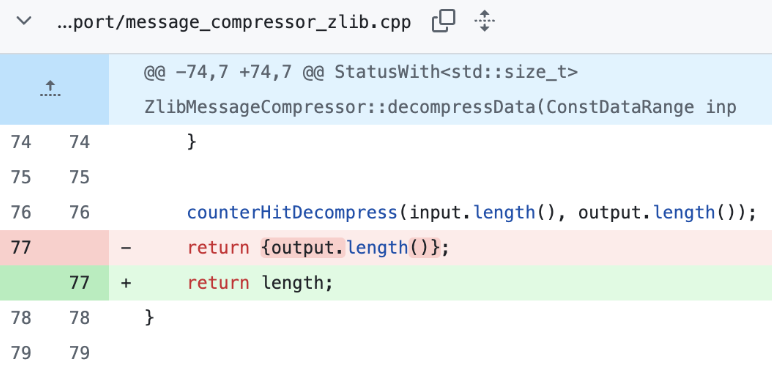
Implemented fix
Let’s take an example:
- TA sends a regular ping command, compressed it’s ~3KB and uncompressed ~5KB normally
- But in the crafted exploit, they set uncompressedSize to 500KB intentionally
- The server dutifully allocates 500KB of heap memory, decompresses the actual small message into that memory, and then sends back the entire 500KB buffer instead of 5KB in response.
- Result: That “extra” memory (455KB) likely contains sensitive bits like credentials, APIs , secrets, keys, session tokens got leaked. Not every byte is useful, but repeated probing can leak high-value secrets over time.
🛠 Recommendations & Mitigations
If you manage MongoDB systems, here’s your patch-and-protect checklist:
- Patch Immediately : Upgrade to patched versions e.g. 8.2.3+, 8.0.17+, 7.0.28+, 6.0.27+, 5.0.32+, 4.4.30+ as provided by MongoDB since Dec 19, 2025.
- Network Segmentation : Make sure your MongoDB servers aren’t directly exposed to the Internet. Only trusted networks should access database ports.
- Disable zlib Compression : If you can’t patch right now, turn off zlib in your network message compressors.
- Filter & Firewall : Block port 27017 from public access & Use VPN or private peering for environments
- Rotate credentials : your creds might have been leaked in the past, as this CVE has been exploited for a long so better to rotate all the creds
- Monitor & Audit : Check the MongoDB logs, transport them to SIEM & look for unusual connection attempts or malformed compressed traffic.
✨ In the next part, I’m going to explain how to hunt/detect this from your mongo logs | gonna write a query based on risk scoring factor, so stay connected!
메타데이터
- post_id
- cbaeaaa8dc43
- slug
- mongobleed-a-granular-breakdown-of-mongodbs-pre-auth-memory-leak-cbaeaaa8dc43
- url
- https://medium.com/@shreyash_tambe/mongobleed-a-granular-breakdown-of-mongodbs-pre-auth-memory-leak-cbaeaaa8dc43
- canonical_url
- https://medium.com/@shreyash_tambe/mongobleed-a-granular-breakdown-of-mongodbs-pre-auth-memory-leak-cbaeaaa8dc43
- author_url
- https://medium.com/@shreyash_tambe
- status
- ok
- fetched_at
- 2026-07-19 19:13:19