The Early History of Life on Earth
The Early History of Life on Earth

Around 3.8 billion years ago, Earth was a hostile and chaotic place. The young planet was extremely hot, dominated by intense volcanic activity and vast acidic oceans. It was far from the calm, life-supporting world we know today. Yet, in this seemingly inhospitable environment, the first living cell appeared, marking the beginning of life on Earth. This time period is known as the Archean.

The earliest life forms were extremely simple. These primitive cells had no nucleus and no specialized structures, unlike the complex cells found in modern organisms. Despite their simplicity, they possessed three essential abilities that defined life: they could reproduce, obtain energy, and adapt to their environment. Scientists have proposed several theories about how these first cells formed. One hypothesis suggests that life began through complex chemical reactions in Earth’s early oceans. Another theory points to hydrothermal vents on the ocean floor, where heat and minerals could have supported the formation of early biological molecules. A third possibility is panspermia, the idea that microscopic forms of life may have arrived on Earth aboard comets or meteorites from space.
For hundreds of millions of years, life remained microscopic and simple. However, around 2.5 billion years ago, some bacteria developed a revolutionary ability: photosynthesis. Using sunlight as an energy source, these organisms produced energy and released oxygen as a byproduct into the oceans. At first, this oxygen dissolved in seawater, but around 2.4 billion years ago, it began accumulating in the atmosphere in an event known as the Great Oxidation.
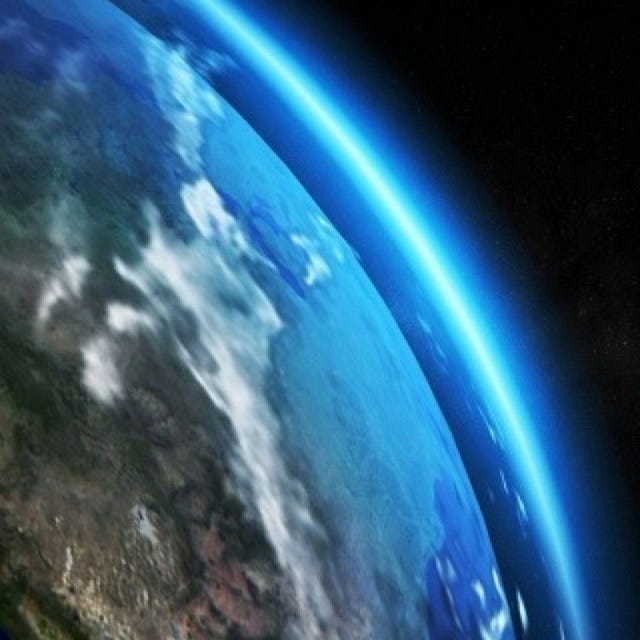
In the upper atmosphere, some of this oxygen was transformed by ultraviolet radiation into ozone. Over time, an ozone layer formed around Earth, acting as a protective shield that blocked much of the Sun’s harmful radiation. This protection made Earth’s surface far more suitable for life. With oxygen available, some organisms evolved the ability to use oxygen for respiration, which allowed them to produce far more energy than before. This extra energy made it possible for life to evolve more complex structures.
For billions of years, life on Earth consisted only of single-celled organisms. Eventually, as environmental conditions changed and Earth cooled, some cells began to cooperate and join together. This marked the beginning of a new geological era, the Proterozoic, and the appearance of more complex biological structures such as stromatolites, layered formations created by microbial communities.
Cooperation among cells led to increasing complexity. In the oceans, the first multicellular animals began to appear, including organisms similar to jellyfish and worms. In these early animals, cells started to specialize. Some cells handled movement, others digestion, and others reproduction. This specialization allowed organisms to become more efficient and more complex.
Life in the oceans continued to diversify dramatically. Eventually, fish with many different shapes and features appeared, marking the arrival of the Devonian period, often called the “Age of Fishes.” While the seas were becoming full of life, plants were beginning to attempt an extraordinary transition: the colonization of land.

Over many generations, some aquatic plants developed roots to anchor themselves in soil and stronger tissues to prevent them from drying out. These adaptations allowed them to survive outside the water and gradually spread across damp land surfaces. These first land plants were bryophytes, organisms similar to modern mosses. Their arrival laid the foundation for the future forests that would later dominate Earth’s landscapes.
Around 375 million years ago, an extraordinary transitional creature appeared: Tiktaalik. This animal represents one of the most important evolutionary steps in the history of life. Tiktaalik was neither fully a fish nor fully a land animal. It had fins that were beginning to function like legs, allowing it to support its body in shallow water or on muddy surfaces. It also possessed primitive lungs in addition to gills, enabling it to breathe air. Tiktaalik symbolizes the great evolutionary transition from aquatic to terrestrial life.
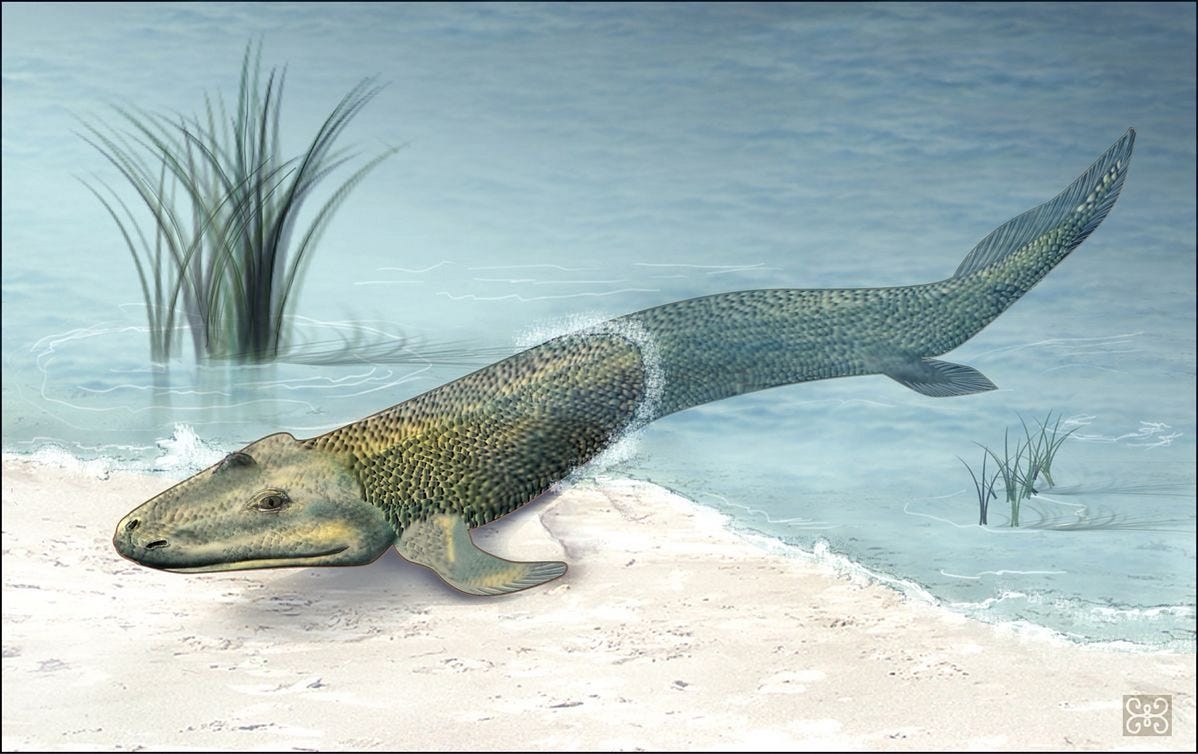
After Tiktaalik, new groups of animals evolved, including amphibians, which could live both in water and on land. Later, reptiles, birds, and mammals would descend from these early land vertebrates.
However, life’s progress was not smooth. Around 360 million years ago, the Devonian period ended with the first major mass extinction in Earth’s history. Large volcanic eruptions released vast quantities of carbon dioxide and sulfur, warming the climate and acidifying the oceans. At the same time, massive blooms of algae consumed oxygen in the water, creating deadly conditions for many marine organisms.
This ecological crisis did not happen suddenly. Instead, it unfolded over about 20 million years in several waves. By the end of the extinction, nearly 75% of species had disappeared. Despite the devastation, some species survived. As environmental conditions gradually improved, these survivors began to repopulate empty ecological niches and diversify once again.
Among the survivors were certain fish capable of breathing air using primitive lungs. These were the lungfish, close relatives of the ancestors of amphibians. Remarkably, lungfish still exist today, making them living representatives of a lineage that is more than 400 million years old.
After the Devonian crisis, more species began to explore life on land. Some fish already possessed strong fins capable of partially supporting their weight. Over time, these fins evolved into jointed limbs, giving rise to the first tetrapods, vertebrates with four limbs. By the beginning of the Carboniferous period, these animals had diversified and established themselves in terrestrial environments, taking advantage of the expanding forests and plant life on land.

For a time, tetrapods dominated the Earth. But another catastrophe awaited life on the planet. Around 252 million years ago, Earth experienced the Permian — Triassic mass extinction, the most severe extinction event in the history of life. Approximately 95% of all species disappeared.
Before this disaster occurred, however, tetrapods had already developed a crucial evolutionary innovation: the hard-shelled egg. Unlike amphibian eggs, which required water, these eggs could survive on land. Reptiles adopted this adaptation and gained a major evolutionary advantage. They became more independent from water and more resilient in harsh environments.
Because of these advantages, many reptiles survived the Permian catastrophe. In the millions of years that followed, some reptile lineages evolved into one of the most famous groups of animals in Earth’s history: the dinosaurs.
The story of life on Earth is therefore a long journey of adaptation, cooperation, crisis, and renewal. From a single microscopic cell in a hostile ancient ocean, life slowly evolved into the extraordinary diversity of organisms that inhabit the planet today.
메타데이터
- post_id
- cbca231a7ffe
- slug
- the-early-history-of-life-on-earth-cbca231a7ffe
- url
- https://medium.com/@ssdtqxnc/the-early-history-of-life-on-earth-cbca231a7ffe
- canonical_url
- https://medium.com/@ssdtqxnc/the-early-history-of-life-on-earth-cbca231a7ffe
- author_url
- https://medium.com/@ssdtqxnc
- status
- ok
- fetched_at
- 2026-07-12 02:20:00