The Frozen Formalism Problem in Physics and Its Solution
Why Equations Freeze and Reality Still Moves
The Frozen Formalism Problem in Physics and Its Solution
Why Equations Freeze and Reality Still Moves
Abstract Physics equations are famously time-symmetric. Newton, Schrödinger, Einstein, even Wheeler–DeWitt: each describes relations that are reversible, frozen, and still. Taken at face value, they map structure but not transition. This is the Frozen Formalism Problem: nothing in the mathematics itself explains why motion occurs at all. Existing fixes — entropy arrows, decoherence, collapse, emergent time — either reinterpret stillness or impose asymmetry by hand. This paper proposes a solution in Dual Kernel Theory. Reality consists of two fundamental domains: K₁ (coherence), which encodes correlations and persistence, and K₀ (erasure), which enacts collapse and irreversibility. Motion arises only from their interplay: K₁ alone would be frozen symmetry, K₀ alone would be annihilation, but together they yield becoming. Consciousness is the lived proof of this ontology: even if illusory, its flow presupposes motion that frozen equations cannot deliver. Dual Kernel Theory reframes motion not as an emergent artifact but as the joint creation of persistence and erasure — the hidden engine of a universe that truly moves.
1. Introduction: The Puzzle of Motion
Motion is the most obvious feature of our world. We see it, feel it, and live inside it. Every thought, every heartbeat, every orbit of the planets is an unfolding sequence. Yet the closer we look at the foundations of physics, the more motion seems to vanish. The fundamental equations of nature — Newton’s laws, Schrödinger’s equation, Maxwell’s equations, Einstein’s field equations — are all symmetric and reversible. They describe patterns that can run forward or backward with equal validity. Taken strictly at face value, they map structure, not transitions. They show what relations hold, but not why anything should happen at all.
This is not a new tension. Philosophers have wrestled with it since antiquity. Zeno’s paradoxes questioned how motion could occur if space and time can be infinitely divided. In more recent non-formal literature, “Dean’s paradox” reprises the same theme: logic appears to freeze motion even though we experience it continuously. In physics, Loschmidt’s paradox highlights the gap between time-symmetric micro-laws and the irreversible arrow of thermodynamics. Each version circles the same riddle: if the equations are symmetric, why is reality not still?
But there is a deeper oversight. The usual framing asks: why does motion have a direction? Our claim is starker: why is there motion at all? Symmetric equations alone describe a frozen universe — a block of relations with no inherent reason for transitions. Yet motion is inescapable: even if consciousness were an illusion, the illusion itself unfolds as a sequence. The fact of becoming, whether real or illusory, remains unexplained in physics.
This paper argues that the oversight can be resolved only by a new ontology. Dual Kernel Theory proposes that the symmetric equations describe K₁, a coherent but frozen scaffold, while motion arises from K₀, an irreducible collapse kernel that forces transitions. Motion is not optional; it is the scar left when K₀ presses on K₁. Without this second kernel, the universe would be still — incapable of sustaining life, mind, or even the illusion of time.
2. Symmetric Equations as Frozen Maps
At the foundation of physics lie equations that are astonishingly powerful in their predictive reach. Yet beneath their elegance lurks a striking omission: none of them intrinsically justify motion. They describe relations, not becoming.
Classical mechanics. Newton’s laws describe how forces, masses, and accelerations are related. Mathematically, they are symmetric: if you replace ttt with −t-t−t, the laws still hold. The equations allow us to map trajectories, but nothing in them compels one state to “update” into the next. The motion we observe is read off the solutions, not generated by the equations themselves.
Electromagnetism. Maxwell’s equations are also time-symmetric. Waves propagate in the math both forward and backward. We usually select retarded solutions (waves spreading outward), but advanced solutions (waves converging inward) are equally valid. The formalism itself is neutral — stillness disguised as symmetry.
Quantum mechanics. Schrödinger’s equation, too, is symmetric and unitary. If a state vector evolves forward in time, it can also be evolved backward with equal validity. The equation is a map of Hilbert space correlations, not a principle of becoming. Decoherence models attempt to explain the appearance of irreversibility, but at root the formalism remains frozen symmetry.
Relativity. Einstein’s field equations describe how matter and energy relate to spacetime curvature. They are not equations of motion but constraint equations — relations between geometry and stress-energy. Motion through spacetime is reconstructed after the fact by tracing world-lines. Taken as a whole, the relativistic “block universe” is static: all events coexist timelessly.
Quantum gravity. The Wheeler–DeWitt equation makes the problem explicit. In its canonical form,

the wavefunction of the universe has no explicit time parameter. It describes a stationary, frozen state. What we call “time” arises only when subsystems are used as clocks relative to others. At the most fundamental level, the universe does not move.
Across these domains, the pattern is the same. The equations are symmetric, reversible, and static when taken literally. They carve out structures in a vast relational landscape, but they do not explain why transitions occur. They describe a frozen map of correlations, not the unfolding dance of reality.
3. Existing Attempts and Their Limits
If the equations are frozen at their core, why does the universe appear alive with motion? Physicists have not ignored this puzzle. Many frameworks attempt to account for motion, but all of them either reinterpret stillness or smuggle in asymmetry by hand.
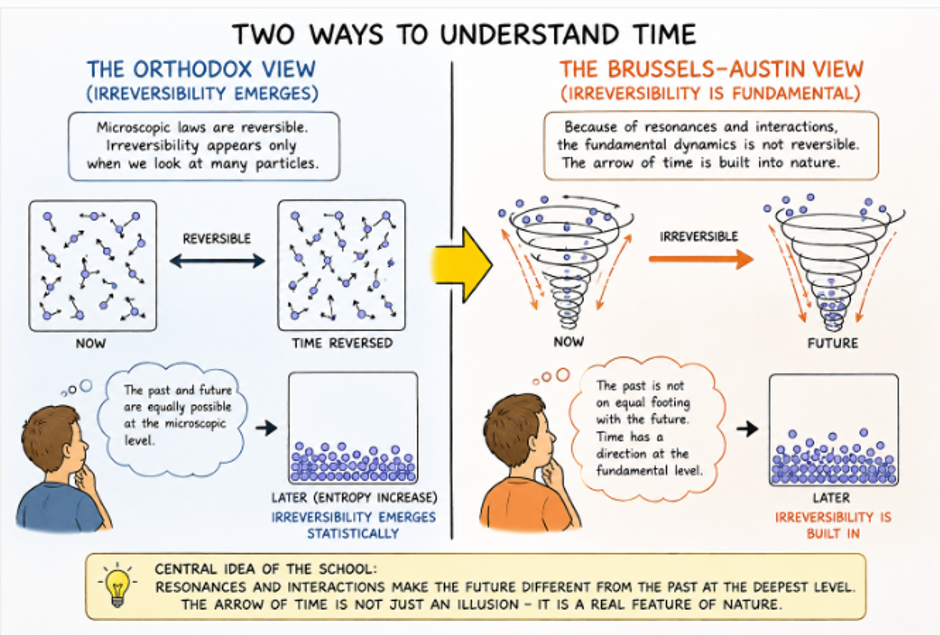
a. Thermodynamics and entropy. The Second Law of Thermodynamics gives us an arrow: entropy increases. But this is not derived from the fundamental laws themselves — it is a statistical assumption about initial conditions. The microscopic equations remain reversible; irreversibility is imposed by averaging over ensembles. Motion is explained as the march toward disorder, but the law itself is not fundamental. It is a layer built atop frozen symmetry.
b. Decoherence in quantum mechanics. In quantum theory, decoherence explains why superpositions appear to collapse into definite outcomes. A system coupled to its environment loses phase coherence, making outcomes effectively classical. Yet decoherence does not create true motion or collapse — it only spreads correlations. The underlying Schrödinger dynamics remains frozen and reversible. Decoherence re-describes stillness; it does not solve the Frozen Formalism Problem.
c. Wavefunction collapse. The Copenhagen interpretation posits that during measurement the wavefunction literally collapses. This injects motion — a sudden, irreversible jump — but only at the cost of leaving the collapse rule outside the math. Collapse is imposed, not derived. It acknowledges the problem but resolves it by fiat.
d. Pilot-wave theories. De Broglie–Bohm theory adds real particle trajectories guided by a pilot wave. This restores motion, but the guiding equation is itself deterministic and time-symmetric. The trajectories are extra scaffolding, not an intrinsic reason why transitions occur.
e. Holographic and emergent time proposals. Modern approaches like AdS/CFT duality or emergent time scenarios in quantum gravity suggest motion arises as an emergent phenomenon from deeper symmetries. But again, the base equations remain static. Emergence is descriptive: it explains how frozen correlations look like motion when reinterpreted, but does not explain why anything moves at all.
Across all these attempts, the pattern repeats:
- Motion is not explained.
- It is either assumed (entropy arrow), added by hand (collapse), or reinterpreted (decoherence, emergence).
What remains unsolved is the core: why transitions occur at all if the equations themselves only describe timeless relations. This is the heart of the Frozen Formalism Problem.
4. Dual Kernel Theory as the Ontology of Motion
The Frozen Formalism Problem shows us that motion is not guaranteed by physics as we currently frame it. Symmetric equations are still equations. They describe structure, not transitions. To explain motion itself, we need an ontology that accounts for why anything changes at all.
Dual Kernel Theory (DKT) offers such an ontology. It begins with two fundamental kernels:
- K₁ (coherence): the domain of structure, traceability, and mutual information. K₁ corresponds to what the equations describe — correlations that can be reversed, predicted, and preserved. It is the frozen scaffold physics is so adept at mapping.
- K₀ (erasure): the domain of collapse, irreversibility, and information loss. K₀ is what the equations leave out. It is the asymmetric press that breaks reversibility, deletes alternatives, and drives systems from one state to another.
In this view, motion arises only at the interface of K₁ and K₀.
- If K₁ were alone, reality would be static: a perfect, reversible symmetry, frozen like the equations themselves.
- If K₀ were alone, reality would collapse instantly: no persistence, no continuity, only erasure.
- Together, they create becoming: K₁ provides coherence that can persist, while K₀ ensures transitions occur by erasing alternatives and forcing updates.
This is why Dual Kernel Theory resolves the paradox that physics has left open. Motion does not emerge from equations; it emerges from ontology. Every step forward in time, every ripple of change, is the trace of K₀’s erasure pressing against K₁’s coherence.
Where existing theories either smuggle motion in or reinterpret frozen structures, DKT grounds motion in the most fundamental way: as the dance between persistence and collapse. The universe moves because it cannot do otherwise. Without K₀, there would be no change; without K₁, there would be no endurance. Motion is their joint creation.
5. K₀ as a Chaitin-like Operator
Physics typically treats decoherence as a statistical effect: the spreading of correlations into the environment that makes superpositions look classical. But in this account, nothing is truly erased. The global wavefunction remains intact, frozen in its symmetry. The appearance of motion is, again, re-description.
Dual Kernel Theory takes a different step. It treats K₀ as a physical ontology: an operator that acts like Chaitin incompressibility in computation. Where Chaitin showed that some numbers are irreducibly uncomputable — resistant to compression into shorter descriptions — K₀ operates as the irreducible eraser in physics. It deletes information in a way that cannot be reversed, compressed, or traced.
This makes decoherence real, not just apparent.
· In standard accounts: decoherence = effective, statistical, no true collapse.
· In the DKT account: decoherence = the manifestation of K₀ actively erasing coherence, collapsing possibilities into a single persistent trace.
By positioning K₀ as a Chaitin-like operator, DKT explains why physics equations alone freeze: they map K₁ coherence but omit K₀ erasure. It also explains why motion is unavoidable: every transition is an act of deletion, a cut made by K₀ in the frozen scaffold of K₁.
6. Consciousness as the Lived Proof
If motion is not derivable from frozen equations, where is our evidence that becoming is real? The answer is simple yet profound: consciousness itself.
Every moment of awareness is saturated with motion — sensations flowing, thoughts arising and fading, memories updating. Even if one adopts the view that consciousness is an illusion, the illusion itself presupposes motion: illusions change, update, and persist across time. A frozen formalism cannot generate even the appearance of flow.
This makes consciousness unique in physics. It is not just a phenomenon within the universe; it is the only direct evidence we have that reality contains more than static, reversible relations. Consciousness is motion made intimate.
In the Dual Kernel view, this is exactly what we should expect.
- K₁ provides the coherence that gives continuity to memory, identity, and perception.
- K₀ ensures that those structures are continuously updated by erasure, collapse, and noise.
- What we call the “stream of consciousness” is the lived manifestation of this interface: persistence and change woven together.
Thus, consciousness is not an optional add-on to physics. It is the proof of principle that motion exists, even when physics equations by themselves would predict only stillness. Consciousness tells us that the Frozen Formalism Problem cannot be the final word. Something more fundamental — like Dual Kernel Theory — is required.
7. Conclusion — Beyond Frozen Physics
From Zeno’s paradoxes to Wheeler’s frozen formalism, the problem of motion has haunted philosophy and physics alike. Our best equations describe elegant symmetries, but left alone, they freeze. They tell us how states relate, not why transitions occur. Motion, as such, is absent.
Existing attempts to resolve this gap — entropy arrows, decoherence, collapse postulates, emergent time — either smuggle motion in or reinterpret static structures as if they were dynamic. None explain why there is becoming at all.
Dual Kernel Theory offers a sharper answer. Motion is not derived from equations but from ontology. K₀ (erasure) and K₁ (coherence) are not optional refinements; they are the twin conditions for a universe that moves:
- K₁ alone would yield a static, reversible symmetry — frozen physics.
- K₀ alone would yield collapse without continuity — annihilation.
- Together, they yield the real universe: coherent enough to endure, but driven forward by irreversibility.
And consciousness is the proof. Even if consciousness were an illusion, the illusion itself presupposes motion. Our most intimate experience testifies to what the equations leave out: the dance between persistence and collapse.
The Frozen Formalism Problem thus becomes the pivot point for a new ontology. Physics describes the scaffolding of coherence, but only by acknowledging erasure as equally fundamental can we explain why the universe does not remain still. Dual Kernel Theory reframes motion not as an accident, not as an emergent trick, but as the very heartbeat of reality.
The question is no longer “Why does the arrow of time point forward?” but something deeper: Why does the universe move at all? Dual Kernel Theory offers an answer: because coherence resists erasure, and erasure presses on coherence. Motion is not optional. It is the joint creation of the two kernels, without which nothing — not galaxies, not life, not the self — could ever come to be.
Appendix: Why Frozen Formalisms Cannot Justify “Seeing” the Past or Future
Some interpretations of physics — such as the block universe picture in relativity or Everett’s Many Worlds Interpretation of quantum mechanics — suggest that the past and future are equally real. In this view, “seeing” one slice at a time is simply how we experience a timeless structure.
But this move does not solve the Frozen Formalism Problem. It assumes what it cannot explain. To “see” already presupposes motion. A self that “travels” a worldline or “samples” one branch after another requires a mechanism of traversal — and symmetric equations provide none.
The issue is deeper than the arrow of time. It is not only that equations cannot explain why time points forward; they cannot explain why there is any flow at all. A frozen formalism describes relations, not transitions. Without an ontology of motion, there is no justification for why one state is followed by another.
Consciousness makes this gap unavoidable. Even if one insists that consciousness is an illusion, the illusion itself unfolds — it flows. That flow is motion, and motion cannot be generated by frozen, reversible equations alone. The experience of becoming is therefore decisive evidence that more is required.
In Dual Kernel Theory, that “more” is K₀: real erasure pressing on K₁ coherence. Without it, no traversal is possible. With it, motion becomes not an illusion but the joint creation of persistence and collapse.
메타데이터
- post_id
- cbe11dfc47cb
- slug
- the-frozen-formalism-problem-in-physics-and-its-solution-cbe11dfc47cb
- url
- https://medium.com/@bill.giannakopoulos/the-frozen-formalism-problem-in-physics-and-its-solution-cbe11dfc47cb
- canonical_url
- https://medium.com/@bill.giannakopoulos/the-frozen-formalism-problem-in-physics-and-its-solution-cbe11dfc47cb
- author_url
- https://medium.com/@bill.giannakopoulos
- status
- ok
- fetched_at
- 2026-06-26 06:47:43