One-Punch Man’s Hero Rankings Don’t Measure Strength — They Measure Visibility
King is a reputation with a man attached. Mumen Rider’s courage has no point value. And the strongest hero alive spent years at the bottom…
One-Punch Man’s Hero Rankings Don’t Measure Strength — They Measure Visibility
King is a reputation with a man attached. Mumen Rider’s courage has no point value. And the strongest hero alive spent years at the bottom of the chart. Here’s our read on the sharpest workplace satire hiding inside a gag manga.
⚠️ Spoiler warning: This piece covers the anime through Season 3 (2015–2025) and the manga through the end of the Monster Association arc. Nothing from the current manga chapters, and nothing that’s still webcomic-only.
Everyone laughs at the same joke in One-Punch Man: Saitama can delete any monster with a single punch, and the world files him at the bottom of C-Class. It’s a great gag. It’s been a great gag since ONE started posting the webcomic for free in 2009, and it’s still the engine of Yusuke Murata’s gorgeous remake, 34 volumes deep in Japan as of this spring.
But treat it as only a gag and you miss what the Hero Association is actually for. The Association isn’t a broken system played for laughs. It’s a working system — it just isn’t measuring what everyone assumes it’s measuring. Watch what actually moves the numbers: not strength, not virtue, not results. Witnesses.
Here’s our read, up front: the hero rankings don’t measure ability. They measure visibility. And once you see that, four of the series’ best characters snap into place as four different ways of breaking the same metric.
A system built on its own blind spot
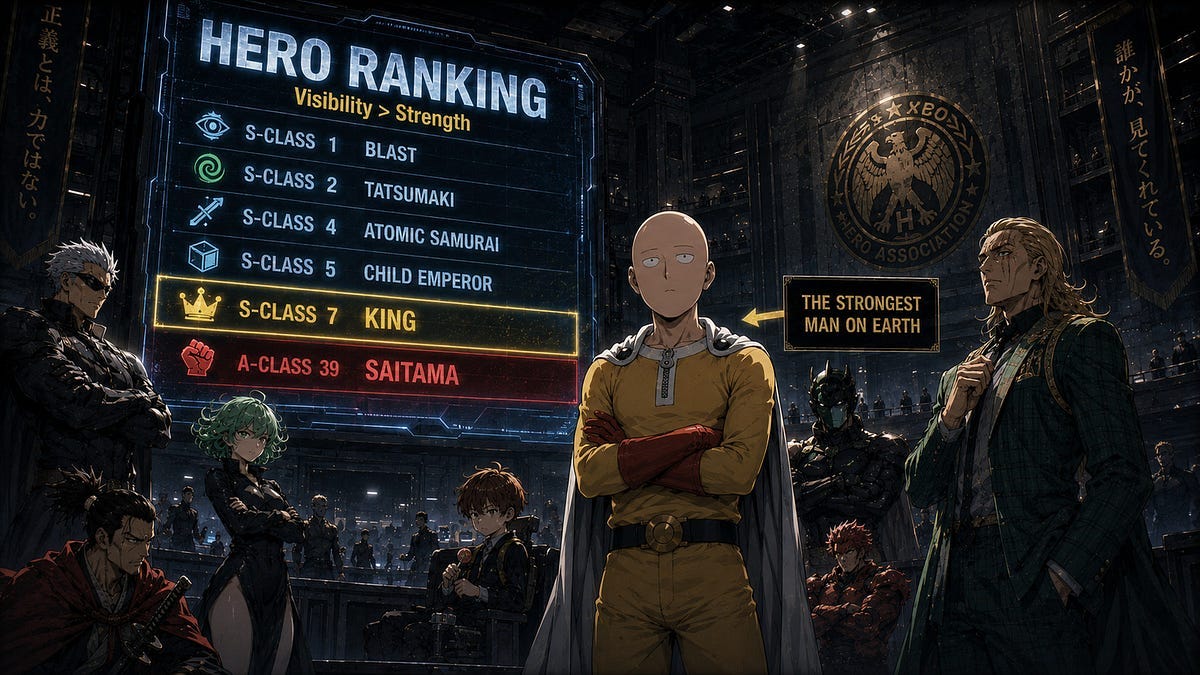
Start with the mechanics. The Hero Association sorts every professional hero into four classes — S, A, B, C — each with a numbered ranking inside it. You climb on results: monsters defeated, civilians saved, public evaluations. On paper, perfectly reasonable. In practice, every one of those inputs requires someone to have seen you do it. A disaster prevented before it starts scores zero. A monster vaporized in an empty street scores zero. The metric doesn’t reward doing good; it rewards being observed doing good.
And the series bakes this blind spot into the Association’s own origin story. Canon: three years before the story begins, a monster called Crablante attacked a child, and a jobless young man in a cheap suit killed it to save him. The child’s grandfather — a tycoon named Agoni — was so shaken that he founded the Hero Association on the spot. That jobless young man was Saitama, before the training, before the baldness, before any registry existed to record what he’d done.
Sit with that for a second. The entire ranking apparatus is a monument to a single heroic act — and it has no record of that act. The founding good deed is invisible to the institution it created. Whether ONE planted that irony deliberately or it simply grew out of the gag, we can’t say. But it’s hard to imagine a cleaner thesis statement.
Then Saitama registers, and the system does exactly what it was built to do. He maxes out every physical test and bombs the written exam, scraping in at C-Class, Rank 388 of 390. From there his career is a parade of unwitnessed miracles: kills with no survivors to report them, kills credited to whoever was standing nearby, kills so fast that bystanders assume the monster self-destructed. The manga does let him climb — canonically he reaches B-Class in a record 22 days, and after the Monster Association war he’s finally promoted to A-Class, Rank 39. That’s the punchline hiding in chapter 172: after saving the world more times than anyone can count, the strongest being alive has earned… a respectable mid-table position.
The Hero Association can measure everything about a hero except whether anyone was watching. Saitama’s entire career falls into that gap.
King: a reputation with a man attached
If Saitama is what the metric can’t see, King is what happens when the metric sees things that never happened.
King debuts in chapter 38 as an S-Class hero — Rank 7 at the time — billed as the strongest man on Earth. Monsters surrender at the sight of him. And he is, canonically, an ordinary 29-year-old otaku with zero combat ability who would rather be home playing dating sims.
The origin is the series’ bleakest joke about record-keeping. Years ago, a monster clawed King’s face; a teenage Saitama destroyed it; and the reports credited the scarred survivor standing in the wreckage. Then it happened again. And again — Vaccine Man’s defeat among them, roughly half a dozen of Saitama’s victories filed under King’s name. The Association never audits any of it. It has no way to verify what happens at a disaster site, so official records are built from incident reports and civilian testimony, and misinformation hardens into rank. King stays S-Class for years for one reason: nobody checks.
Which brings us to the King Engine — the ominous rumble monsters hear when they face him, the sound that has ended fights before they start. It’s his heartbeat. He’s terrified, and the world hears his panic as power. We’d struggle to invent a better image for how reputation works: an involuntary signal, misread at scale, that becomes real force precisely because everyone agrees to read it the same wrong way. King wins fights with pure accumulated belief. Meanwhile the man whose deeds built that belief can’t get promoted, because belief was never attached to him.
Here’s the part we want to be careful with, though, because the series is careful with it. ONE never writes King as a con man. King didn’t fabricate anything — the system fabricated him, one clerical error at a time — and he’s shown suffering under the weight of it, sick with guilt, eventually confessing everything to Saitama of all people. He keeps trying to be worthy of a record he knows is false. Read one way, that’s comedy. Read another, King is the metric’s second victim: Saitama got less credit than he earned, King got more, and the system crushed them both.
Mumen Rider and the number that doesn’t exist
So what does the metric miss entirely? For that, the series gives us its moral center: Mumen Rider, C-Class Rank 1, a man who fights evil by bicycle. (A quick Japan-side note: his name, Mumen Rider — the Viz manga renders it “License-less Rider,” so you’ll see both — is a pun on Kamen Rider, with mumen meaning “unlicensed.” He’s a superhero parody who pedals to emergencies because he has no license to drive.)
His defining scene is the Deep Sea King arc — episode 9 of Season 1, around chapter 27 of the manga, and still the sequence fans of the first season bring up before any fight Saitama wins. The Deep Sea King has torn through every hero in the city, A-Class included. Mumen Rider knows exactly what he is: too weak, canonically, even for B-Class. He charges in anyway. Not because he can win — he says as much, roughly, in the moment: nobody expects him to win, and he’s still not allowed to back down while civilians are behind him. The crowd, which has watched stronger heroes fall, starts chanting his name. In the manga, a bystander puts the theme into words — the gist being that everyone else looked away, and this one man stepped forward.
He’s defeated in a single hit, of course. Saitama arrives, ends the monster with one punch, and then does something that completes the argument: when the crowd starts sneering that the fallen heroes must have been weaklings, Saitama loudly plays the villain of the story — bragging, in effect, that he just swooped in and stole the glory after the others softened the monster up. He deliberately spends his own reputation to protect theirs. In a system that only counts what’s visible, the kindest thing the strongest man can do is manipulate what people think they saw.
Mumen Rider is Rank 1 of C-Class, and that’s the ceiling — the courage to stand in front of certain death has no point value, so the chart literally has no place to put him. The series’ most hero-like hero is unrankable, and our read is that this is precisely the point: the quality that defines heroism is the one thing the Hero Association’s spreadsheet cannot represent.
Genos: the growth that happens off the chart
Genos gives us the fourth failure mode — what chasing the number does to someone genuinely trying.
He enters the series as the prodigy the system loves: a perfect score on the hero exam, placed directly into S-Class at Rank 17, the first newcomer in two years to debut at the top class. And he treats rank exactly the way a metrics-driven institution teaches you to: as a proxy for strength, and strength as a proxy for closing the distance to his teacher. He climbs steadily. The number goes up.
The number also keeps lying to him. S-Class rank doesn’t stop Garo — the Hero Hunter (that’s the Viz spelling; most fans write “Garou”) — from taking him apart, and the Monster Association war reduces his body to parts more than once. Each upgrade makes him stronger on paper; each defeat teaches him the paper wasn’t the thing.
When he asks Saitama how to become stronger, the answer he gets is the franchise’s most famous non-secret: the training regimen. A hundred push-ups, a hundred sit-ups, a hundred squats, a ten-kilometer run — every single day. Fans quote it as a joke, and it is one. But the joke has a floor under it: there is no trick, no shortcut, no dashboard. Just the unglamorous daily thing, done when nobody is watching — which is to say, done in exactly the place the ranking system can’t see.
And quietly, across the series, Genos’s real growth happens there. Not in his rank — in what he thinks strength is for. The obsession with destroying stronger enemies slowly bends toward protecting the people in front of him. No metric registers that shift. It’s the most important change in his character, and it is worth zero points.
Our read: the satire is aimed at us
Let’s be explicit about where canon ends and interpretation begins. Everything above about how the Association works, how King’s record was built, what Mumen Rider did at the Deep Sea King fight — that’s all on the page. What follows is our reading, not anything ONE has stated: One-Punch Man works as a satire of evaluation systems in general — sales targets that can’t see the colleague who quietly holds the team together, follower counts that reward the loudest voice, titles and credentials that keep paying out long after the substance is gone. King is every inflated brand. Mumen Rider is every essential worker whose KPI doesn’t exist. Saitama is every person whose best work happened where no one was measuring.
The series even hands us its own antithesis, in the line every fan knows. Asked who he is, Saitama answers — as the anime’s official English release puts it — “I’m just a guy who’s a hero for fun.” Not for rank, not for the record, not for the crowd. The Japanese fandom has long treasured that line (shumi de hīrō — a hero “as a hobby”), and to us it reads as a complete rejection of the premise that a scoreboard should tell you what you’re worth.
One last Japan-side observation, offered gently because the parallel is ours, not ONE’s: the man who wrote all this has been drawing the original One-Punch Man webcomic for free since 2009, updating whenever he feels like it — sometimes with years between chapters — while the polished, chart-topping Murata version carries the sales and the fame. The author of “a hero for fun” makes his masterpiece as a hobby, off every chart that matters, and lets the visible version take the credit. If the rankings measured what actually matters, we suspect ONE knows exactly where he’d place.
If you like getting the Japan-side context behind big shonen ideas — the puns, the fandom readings, the stuff that doesn’t survive translation — follow Manga Deep Dive. And tell us in the responses: what’s the King Engine in your life — the metric everyone hears as power, that’s really just a pounding heart?
A note on sourcing: The following are canon or public record — ONE’s One-Punch Man webcomic has run since 2009 and still updates sporadically; Yusuke Murata’s remake has run on Shueisha’s Tonari no Young Jump since 2012, with volume 34 released in Japan in April 2026 and English chapters simulpublished by Viz; the anime’s third season aired October–December 2025 with a second cours announced for 2027; the Hero Association was founded by Agoni after a pre-registry Saitama saved his grandson from Crablante; Saitama entered at C-Class Rank 388 and reached A-Class Rank 39 after the Monster Association arc (ch. 172); King debuted at S-Class Rank 7 with a record built on misattributed Saitama victories, and the King Engine is his terrified heartbeat; Mumen Rider (Viz manga: “License-less Rider”) faced the Deep Sea King in the scene described, after which Saitama deliberately took false credit; Genos entered S-Class at Rank 17 via a perfect exam score. The reading offered here — rankings as a measure of visibility rather than strength, King as a satire of reputation economies, Mumen Rider as the unquantifiable, Genos’s growth as off-the-chart, and the parallel to modern metrics culture — is our interpretation, supported by the text but not stated by it. Names follow the official English releases, with variant spellings (Garo/Garou, Mumen Rider/License-less Rider) noted where official usage differs.
Originally published at https://mangadeepdivejp.substack.com on July 28, 2026.
메타데이터
- post_id
- cbe856ee1831
- slug
- one-punch-mans-hero-rankings-don-t-measure-strength-they-measure-visibility-cbe856ee1831
- url
- https://medium.com/@mangadeepdivejp/one-punch-mans-hero-rankings-don-t-measure-strength-they-measure-visibility-cbe856ee1831
- canonical_url
- https://medium.com/@mangadeepdivejp/one-punch-mans-hero-rankings-don-t-measure-strength-they-measure-visibility-cbe856ee1831
- author_url
- https://medium.com/@mangadeepdivejp
- status
- ok
- fetched_at
- 2026-08-12 23:53:48