Didcot Wanderings discoveries the history of the WW2 hangers at Culham
If you have ever travelled between Didcot and Oxford by train you may have noticed several structures next to Culham station being used by…
Didcot Wanderings discoveries the history of the WW2 hangers at Culham
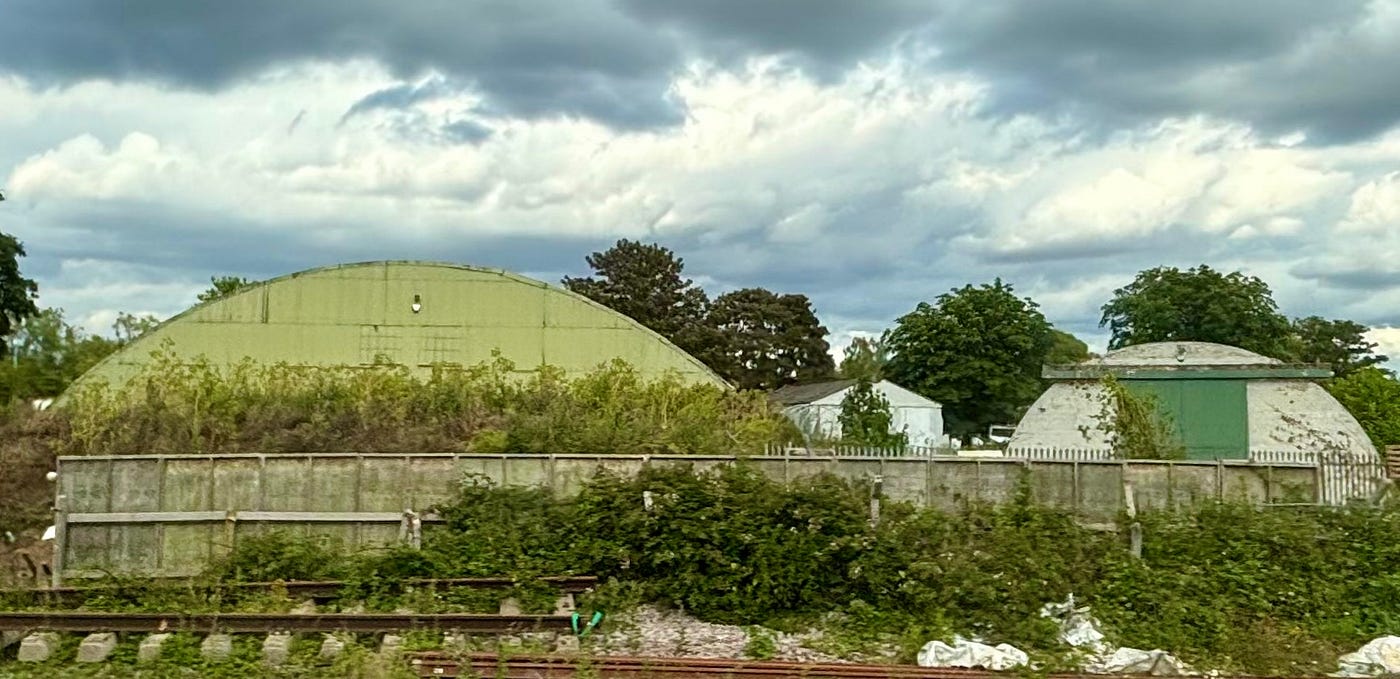

Second World War aircraft hangers at Culham Campus
If you have ever travelled between Didcot and Oxford by train you may have noticed several structures next to Culham station being used by the businesses on Culham Campus that appear to be aircraft hangars, even though today the Culham Campus site is a science park rather than an airfield. This part of Culham Campus, which is known as Culham Site №1, was originally the Royal Naval Air Station Culham, better known as HMS Hornbill, from 1944 to 1953. There were three runways on the site at that time as well a control tower, Nissen huts (which were used for barracks and the mess hall) and, of course, the hangars. After the closure of the airfield, the site was taken over by the UK Atomic Energy Authority (UKAEA) in the mid-1960s and was the home of the Joint European Torus (JET) project from 1983–2023. It continues to lead the way in research into fusion energy.
As a history buff, my interest is in the hangars and their story, in particular, in the years of the Second World War up to its decommission as a Naval Airbase in 1953. The airfield was bordered by the railway to the (west), the Abingdon Road to the south, Nuneham Park to the north and Clifton Hampden to the east. There were five sites, plus two camps (Argus and Pegasus) to the north of the airbase. Culham was geographically in an ideal location, being close to several RAF sites (at Abingdon, Harwell and Benson) and having access to a good rail and road network to easily move people and equipment around, but far enough away from the coast that there was less of a serious threat of being bombed. No 1 site, near the railway station, is the only one of the HMS Hornbill sites that remains today. It was first used to train aircrew from the Royal Naval Volunteer Reserve Air Branch, which was a group of volunteers made up of civilians from a variety of backgrounds who agreed to undergo military training and were prepared to be called up for military service if necessary. The Air Branch was formed in 1938 and was nicknamed the ‘Wavy Navy’ due to the wavy pattern of the gold lace insignia on the officers’ uniforms, rather than the straight pattern of the Royal Navy and Royal Naval Reserve officers, and which had an ‘A’ on it to indicate they were a member of the RNVR Air Branch. By the end of the Second World War there were 8000 air crew in the RNVR which made up a large part of the Fleet Air Arm. The Fleet Air Arm flew aircraft carrying bombs and torpedoes from navy ships with the aim of sinking enemy ships. HMS Hornbill was an important part of the Fleet Air Arm as a dispatch centre where pilots ferried aircraft to the front. During its operating period from 1944 to 1953 various Naval Air Squadrons were billeted there before moving on to other, more urgent, locations. HMS Hornbill was also was a hub where aircraft could be repaired, modified and tested. The hangers were important for housing aircraft while they were being worked on. There were two types of hangar at HMS Hornbill which can still be see from the train today. The large ones with the gable roof are called pentad hangars and are where the larger aircraft would have been housed. Aircraft would have included the Supermarine Seafire (a naval fighter based on the Spitfire) and the Fairey Firefly. The smaller hangars with an arched roof are called blister hangars and would have been used to house smaller aircraft and training equipment. Even though both types of hangar were designed to be transportable so that they could be assembled and dismantled on temporary airfields they have definitely stood the test of time at Culham!
Next time you look out of the window on the train between Didcot and Oxford and see the hangars, think of what life there must have been like during the latter years of the Second World War. Young men in smart uniforms landing aircraft and taking off from the three runways while mechanics in overalls worked on aircraft in the hangars. Today the hangars remain a direct link to that part of history and help to keep it alive.
메타데이터
- post_id
- cbefdf57e12c
- slug
- didcot-wanderings-discoveries-the-history-of-the-ww2-hangers-at-culham-cbefdf57e12c
- url
- https://medium.com/@didcot.wanderings/didcot-wanderings-discoveries-the-history-of-the-ww2-hangers-at-culham-cbefdf57e12c
- canonical_url
- https://medium.com/@didcot.wanderings/didcot-wanderings-discoveries-the-history-of-the-ww2-hangers-at-culham-cbefdf57e12c
- author_url
- https://medium.com/@didcot.wanderings
- status
- ok
- fetched_at
- 2026-08-12 18:35:13