Muhammad Ali Part 6
The Twilight Champion
Muhammad Ali Part 6
The Twilight Champion By Kevin J. W. Driscoll © 2026
By the mid‑1970s, Muhammad Ali had become more than a boxer — he was a living myth, a man who had fought the world and won. But myths, like men, grow old.
The Thrilla in Manila was the beginning of the end, though no one dared say it aloud. The heat was suffocating, the air thick as molten glass. Ali and Joe Frazier met again, not as rivals but as reflections — two warriors who had given everything to the same God of endurance.
Round after round, they punished each other beyond reason. Frazier’s eyes swelled shut; Ali’s legs trembled. Between rounds, Ali whispered to his corner, “This is the closest thing to dying.” Yet he kept going. When Frazier’s trainer finally stopped the fight, Ali didn’t celebrate. He simply slumped on his stool, spent, victorious, and haunted.
He had won, but something inside him had broken.
The years that followed were quieter, though never peaceful. He fought again — too often, too long. The reflexes slowed, the punches lost their poetry. But the crowds still came, drawn not to the spectacle of combat but to the presence of a man who had become a symbol of courage itself.
He traveled the world, shaking hands, speaking of peace, of faith, of unity. The defiant young champion had become a global elder — still proud, still witty, but gentler now. His words carried the weight of experience, not rebellion.
Then came the tremor.
At first, it was small — a hand that wouldn’t stay still, a voice that faltered. Parkinson’s, the doctors said. The disease that steals motion from the man who once danced like lightning.
Ali faced it the way he faced everything: with grace and humor. “I’m still pretty,” he joked, though his body betrayed him. He refused pity. He turned illness into testimony — proof that dignity could survive even when strength could not.
He lit the Olympic torch in Atlanta in 1996, his hand shaking but steady enough to ignite the flame. The crowd wept. It wasn’t nostalgia; it was reverence. The man who had once refused to fight now stood as a symbol of endurance beyond the ring, beyond politics, beyond time.
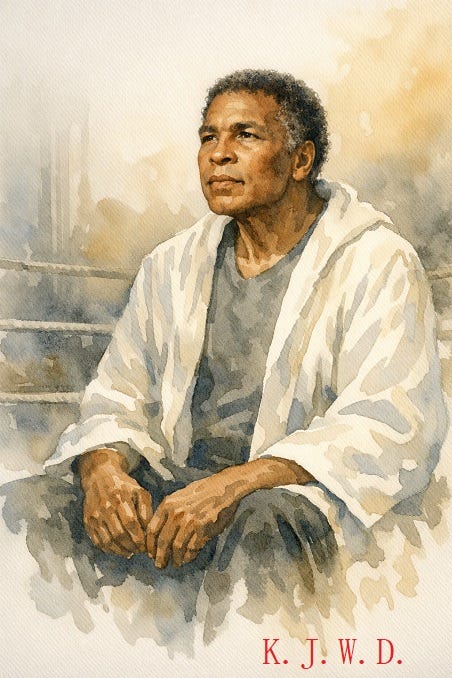
In his later years, he became almost saint‑like — a quiet presence, smiling, listening, his eyes still bright with mischief. He visited schools, mosques, hospitals. He spoke few words, but every gesture carried meaning.
He had spent his youth shouting at the world; now he taught it to listen.
The myth had softened into humanity.
He watched his old fights sometimes, laughing at his own arrogance, admiring his own speed. “I was something, wasn’t I?” he’d say, and it wasn’t vanity — it was wonder.
He had lived a life so large that even memory struggled to contain it.
When he finally passed in 2016, the world didn’t mourn a boxer. It mourned a conscience.
He had been the loudest, the bravest, the most beautiful — and in the end, the most human.
The boy from Louisville who had once shouted “I am the greatest!” had proven it, not through victory, but through compassion.
He had fought for faith, for justice, for identity, for peace — and, ultimately, for grace.
The gloves had fallen, the robe hung silent, but the spirit remained.
Muhammad Ali had transcended the ring, the era, the body.
He had become what he always promised: a man who shook up the world — and then taught it how to stand still.
— 30 —
메타데이터
- post_id
- cbf71b589f02
- slug
- muhammad-ali-part-6-cbf71b589f02
- url
- https://medium.com/@kevinjwd/muhammad-ali-part-6-cbf71b589f02
- canonical_url
- https://medium.com/@kevinjwd/muhammad-ali-part-6-cbf71b589f02
- author_url
- https://medium.com/@kevinjwd
- status
- ok
- fetched_at
- 2026-06-09 15:37:30