Why I Foster Animals: Love, Rescue, Second Chances, and What a Lifetime with Animals Actually Teaches You
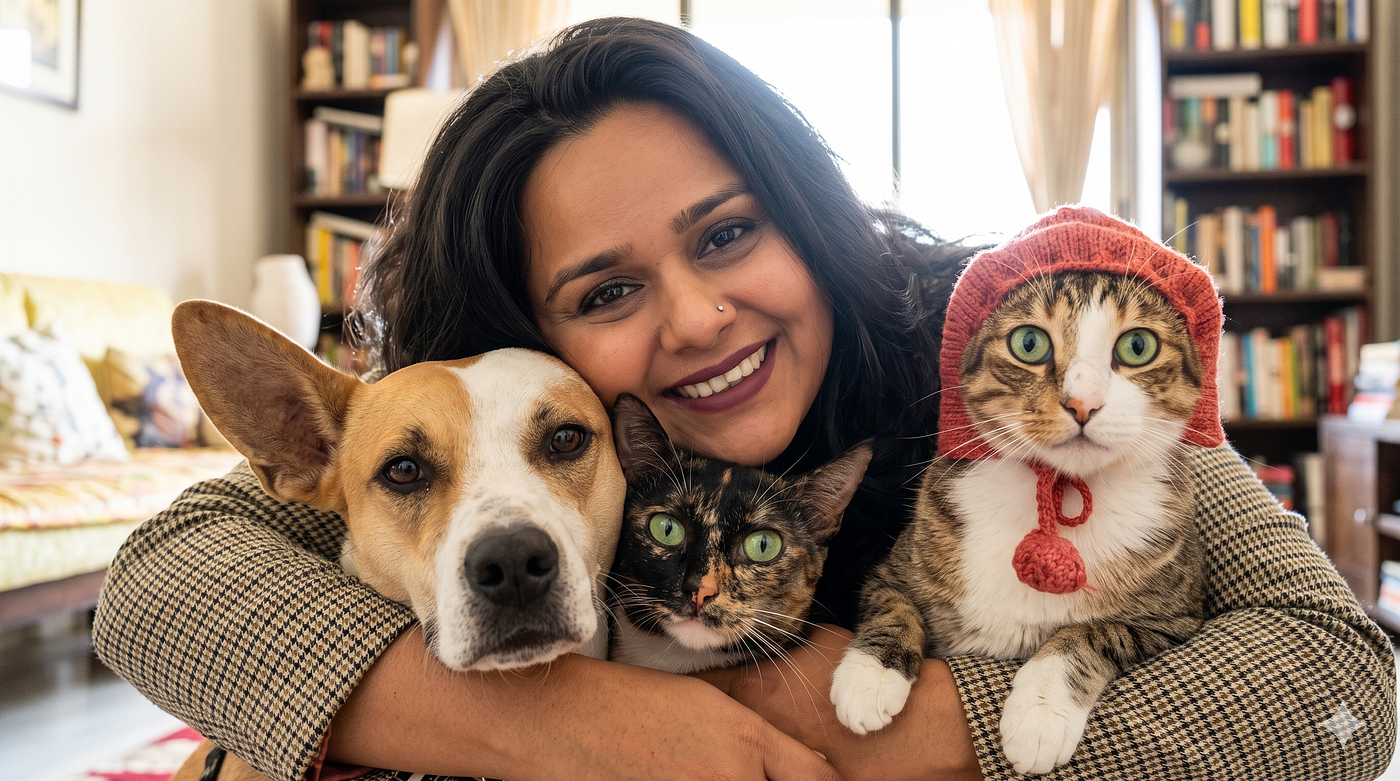
Why I Foster Animals: Love, Rescue, Second Chances, and What a Lifetime with Animals Actually Teaches You
People often ask why someone would foster an animal that is not even their own.
Some find the idea emotionally confusing. Some are curious but hesitant. Some ask why not just adopt instead. Others genuinely cannot understand why anyone would willingly invite uncertainty into their home for an animal that may leave in a few weeks.
This is my attempt to answer those questions honestly.
But I want to say something first: this story is not really about fostering. Fostering is just the most recent chapter.
This is a story about what happens when animals are woven into the fabric of your entire life — from the time you are three years old until right now, in a different country, with a different dog sleeping near your feet. It is a story about what that does to your character. What it teaches you about trust, patience, love, leadership, limits, and joy.
This is my story. It is also everything I know about fostering, because the two are inseparable.
The thread that never broke
I did not grow up in a house full of pets. But animals were woven into the texture of my life from the very beginning — at every age, in a different form, as if the universe kept placing them in front of me until I finally understood what I was supposed to do with that.
When I was three or four years old, I would come home from school and stop at my neighbour’s house every single day. They had a large pet tortoise and a parrot. I would sit with them, watch them, just be near them. I do not know what I thought in those moments. I only know that being near those animals felt quieter, more honest, and less complicated than most things at that age.
When I was five, my dad came home with a rabbit. Not bought, not adopted, not staying. Borrowed for a few hours from someone who was rehoming it. I still remember those few hours with a clarity that makes no logical sense.
Around the same time, the people living near our building kept baby chicks under large jute baskets. I was five, and that seemed completely unreasonable to me. So every time I had the chance, I lifted the baskets and made all the chicks run free. Every single time. I thought I was being helpful.
By 3rd grade, I had started noticing the street dogs in our residential area and near the temple — not playing with them exactly, just existing near them, which is its own kind of relationship.
In 8th grade, my cousin and I got into fish. We would buy fish together, set up tanks, and watch them. There had been an aquarium in our home for years before that — something I associated with coming home, with the blue light and slow movement of it — and in 8th grade I became actively involved rather than just observing.
In 10th grade, my brother had fully befriended every street dog in our society. He played with them for hours. And occasionally, purely to torment me, he would set all of them running behind me. I was not a dog person back then. I mostly just ran.
The year everything shifted
By 2006, when I was in 11th grade, everything shifted into something more intentional.
That year, two star tortoises came to me as rescues. I named them Prixi and Brixy. They would be with me for the next thirteen years. Taking care of them was the first time I was formally, consciously responsible for an animal that needed help — and it settled something in me that has never quite unsettled.
That same year, my neighbour’s dog Angel started coming to our home to play with me. Not a stray, not a foster — just Angel, belonging to someone down the hall, showing up because animals know who will receive them warmly. There is something about being chosen by someone else’s animal that feels particularly honest. They have no obligation to come to you. They just do.
Also that year, I started feeding the street dogs and cats in our society. I had a friend — about twenty years older than me, working in corporate — who had been doing this quietly for years. He would set up water bowls for the street animals in our area without making any announcement about it. He was one of those people who simply does the right thing. I learned from watching him. I learned that care does not need to be dramatic. It just needs to be steady.
My brother joined me. We started buying food together and going out to feed the animals ourselves. It became a practice. A commitment. A way of being in the world.
That is how, in 2010, Mili first came to our house. She had been watching us show up consistently, with food and patience. And one day she came closer. That is exactly how it works with street animals — you cannot call them or fetch them. You simply become someone worth coming to.
Simba’s mother knew
The story of Simba begins with his mother.
She was a street cat who had been living around our building. I had been feeding the street animals in our area for years by this point, and she knew me. Every evening when I came home from the office, she would be waiting. Not for the building watchman. Not for anyone else. Only me. She would climb the stairs with me, sleep outside my door, and leave when the milkman came in the early morning.
Slowly, she started coming inside.
My parents and brother had gone to Delhi for a cousin’s wedding, and only my grandmother was home. My grandmother mentioned one morning, somewhat puzzled, “A cat came out of our house today.” I stayed quiet. I had been taking her in at night, letting her sleep in my room, and she would leave before anyone was up. My grandmother never quite worked out the logistics.
That is how Simba’s mother came to have her kittens in my home. She chose my room. She had already decided I was the safest person she knew.
She gave birth outside — and then a tom cat found the kittens and killed them. All of them except one. That one surviving kitten she brought back inside and sat with in my room, as if she knew exactly what she was doing.
We raised that kitten.
On February 7, 2015, when Simba was just four days old, I took the first photograph of him. He fit in the palm of a hand. I still have that picture.
He became everything. The kind of animal that makes you understand, viscerally, why people use the word family for their pets — because that is exactly what he was. He had polycystic kidneys. When he was six months old, the vet told us to put him down. I could not. We made the decision that Simba would live on his own terms, for as long as he wanted to.
I have a tattoo. His name, paw marks, a heartbeat line. Some losses do not get smaller. They just become part of you.
The first foster who changed everything
Before Simba, in 2013, came the foster who changed the course of my life.
A volunteer brought a dog to my home at 3 in the morning. This dog had been beaten. Her front leg was broken. She had been found on the street and there was nowhere else to bring her in the middle of that night.
Her name was Mishti.
My entire family got up. We cleared a space. We laid her down. And for the days that followed, all of us took care of her together — my parents, my brother, everyone. There was something about the shared nature of that care, the 3 a.m. beginning of it, that made Mishti belong to all of us.
She got adopted by a wonderful family.
What happened afterwards was something I had not anticipated. They kept tagging me on social media. They sent pictures, updates, messages of gratitude. Through their posts, I watched Mishti thrive — fully herself, happy, in a home that had been made for her. That image of the complete arc — rescue, care, family, joy — settled somewhere deep in me and never left.
That is the thing nobody warns you about when you first foster: it does not only change the animal. It changes you.
When animals entered the brand conversation
In 2015, while Simba was still a kitten and I was deep in my career, I got the opportunity to integrate pets into the Tata Hexa launch — one of the largest brand activations I had been part of.
Hexa was an MUV built on the Aria chassis, and we were working directly with Cyrus Mistry’s team during a significant transition year, with a new marketing head coming in post-Auto Expo. We were building a massive family-day experience. The entire Tata Group ecosystem was present — Tanishq, Titan, Tata Consumer, Tata Cliq, Vistara, and more. We had brought in Cougar Motorsport to recreate steep-incline and off-road terrain experiences. We were spending approximately 1 crore INR per center, expecting over 10 lakh footfalls across three days, and booking large concert grounds for the scale of it.
I was already connected to NGO networks in Mumbai, Delhi, Bangalore, and Chennai. And standing in the middle of all of this, I had one very clear thought: why are there no pets here?
It was not just instinct. It was logic. Pets are one of the reasons people buy larger vehicles. In North India especially, people have bigger dogs — the terrain, the lifestyle, the region’s relationship with animals makes it a practical reality. Our ORM study had already shown that some consumers were rejecting the Duster because it did not fit their dogs. And the Tata brand already had a completely authentic relationship with animals. Ratan Tata has always had pets. Street dogs and cats walk freely through Bombay House. The Tata Motors plant had dog kennels on site. This was not a stunt. It was already in the brand’s DNA.
The NGO integration made equal sense. They would get visibility, fundraising support, and reach. The brand would get a genuine lifestyle story. The consumers would see themselves reflected in it. The materials used to set up the stalls would be donated to the NGOs afterwards. A complete win for everyone in the chain.
Getting it done was another matter.
The brand manager kept removing the pet center logo from the main posters and creatives — quietly, every single time. Some people felt street dogs at a premium car launch was inappropriate. The event agency was uncomfortable, as if working on an animal-related activation was somehow not serious work. I got substantial pushback.
But the marketing head supported the idea. My ex-boss from the media agency handled the flex creatives. The social media team built content around it. One person from the event agency helped me shop, design, and set up the center. We pushed through because the right people chose to believe in it.
When the CEO meeting happened, everything shifted. People wrote down NGO phone numbers. They asked how to replicate this at their own corporate events. The Tata team was genuinely appreciated for thinking with social purpose at that scale.
That was the moment I understood something clearly: my animal instinct and my brand instinct were never separate things. They were one and the same. Animals do not belong only in homes and shelters. They belong in culture, in community, in how we think about the lives people actually want to live.
What 2019 held
In 2019, I was in Bangalore for a period that I remember with a very specific texture. Simba was with my parents back home in Mumbai — that was how it worked whenever I moved for work. The animals stayed with the family. The family stayed connected across cities.
My neighbour in Bangalore had a stray cat who they would regularly bring to my house. The kids in the building opposite mine kept cats and would bring them over to visit me. Animals kept finding their way into my life even when I was not looking for them, even in a city I had not grown up in.
But the most extraordinary relationship was with a Labrador who lived on the terrace directly opposite my flat. His terrace was about two feet from my balcony. Every morning when I woke up, even before I got out of bed, he would start barking. He somehow always knew the exact moment I was awake. We would look at each other across that two feet of open Bangalore sky. I would throw treats from my window and they would land on his terrace. He would eat them and look back at me with his full Labrador sincerity. By 7 p.m. he would be taken inside, and I would know the day was ending.
We communicated every single day. We emotionally supported each other. I do not know how else to say it. He was a dog on a terrace and I was a person in a flat across a tiny gap of air, and something real passed between us every morning.
That year, Prixi and Brixy — my star tortoises who had been with me since 2006, through thirteen years of my life — died.
And then Simba died.
He was four years old. He had lived so far past the vet’s original timeline, had lived on his own terms exactly as we had decided, and still — losing him was like losing something structural. Something that had held the shape of home.
After Simba, I was not okay. I went out one day specifically looking for a pet, because that is simply true of who I am. While I was out, a volunteer called. She had just found a one-month-old puppy on the swamp of Lokhandwala backroad in Mumbai and needed help figuring out what to do with him. That dog was Bhola.
Bhola was with me for ten days. He died of dog COVID. He was a baby who had just begun to feel safe. And then he was gone.
There is a grief that comes from losing a small animal you have had for a very short time that does not match its duration. It matches its hope.
Mili came home
During COVID, I was walking to a store near my home when I noticed a cat sitting outside. I said hi to her, the way you do when you see an animal and the impulse to acknowledge them is just automatic.
On my way back, I stopped. I said: “Come. I’ll give you food.”
She meowed. And she followed me home.
She walked straight into my room, sat on my bed, and did not leave. She did not meow again for the next three months. She would not acknowledge my parents. She would not look at anyone else. She followed only me — room to room, floor to floor, like a very quiet and very decided shadow.
And then, slowly, she normalized. She extended herself to the rest of the family. She became a proper household member.
When I came to Canada in 2024, I left Mili with my parents — just as I had left Simba with them when I went to Bangalore. That is simply how our family works. The animals stay with whoever is home. The care continues across distances. Mili is with them in India right now, and she will be coming to Canada with my parents for a visit soon. I cannot wait for that.
Canada changed the shape, not the instinct
In 2024, I moved to Canada.
New country. New culture. New professional landscape. And naturally — because this is who I am — one of the first things I thought about was how to bring animals back into my life. Animals have never been separate from how I engage with a new place. They are part of how I settle, how I build a sense of home, how I operate in the world.
When I first arrived, I was living in residence. No pets per policy. So I waited.
Once I moved into my brother’s house, space opened up. But I had to think carefully about what was possible. I had first signed up to foster cats — my instinct, given my life with Simba and Mili. But we had discovered that my brother had developed allergies to both cats and dogs. He could not breathe around cats at all. He was on medication for both, and dog allergies turned out to be significantly milder for him. Cat fostering was not possible. Dog fostering became the one path forward.
That is how it started here.
What fostering actually is
Before I get into the details, let me explain fostering clearly — because many people do not fully understand what it means, and some have strong feelings about it without the complete picture.
Fostering is temporary care. You are not the owner of the animal. You are the bridge between a difficult past and a permanent future. You are giving a dog a real home environment — to decompress in, to heal in, to learn to trust people in — while the rescue organization finds them the right permanent family.
Animals in foster care have often been surrendered, found on the street, pulled from overcrowded shelters, or rescued from difficult situations. They need a home — not a kennel — to show the world who they actually are. In a kennel, a dog who is genuinely calm and loving can appear shut down or anxious. In a home, that same dog might open up completely within days.
Your job as a foster is to give them that window.
You are not replacing adoption. You are making adoption possible.
Why foster instead of adopt?
This is probably the question I hear most.
If you love animals, why not just adopt?
Different people are in different situations, and fostering allows meaningful contribution without permanent commitment. That is not a lesser thing — it is a different and necessary thing.
Some people travel frequently and cannot guarantee long-term care. Some are in a transitional phase of life — new city, uncertain housing, a career still finding its shape. Some have family members with allergies. Some already have pets and want to test compatibility carefully. Some simply want to give back without promising forever.
And here is an emotional truth that not everyone talks about openly: fostering teaches you things about yourself and about animals that adoption alone might not. Every dog that comes through your home is different. Every one has a different history, different fears, different ways of asking for help. You learn to read body language. You learn patience. You learn that love is not the same as ownership — and that one does not require the other.
There is also the system-level reality: without fosters, rescue organizations would have nowhere to place the animals they pull from streets and overcrowded shelters. Fosters are the backbone of the entire rescue model. Without them, many animals simply would not make it.
What to know before you say yes
The process of fostering is not casual, and it should not be. The screening exists to protect the animals.
After trying a few options that were not the right fit — including one organization that would have had the cat staying in the bathroom for a month, which was simply not right for my home — I found Loved at Last Dog Rescue in Vancouver. A proper website, an active presence, visible people, and a clear process. That gave me confidence.
Their application asked everything relevant: who I lived with, how long I had been there, the pet rules of my building, my work schedule, how many hours I was home each day, my previous experience with animals, and specific behavioral scenarios — what would I do if the dog barked for hours, guarded food, or refused commands? I had to send pictures and videos of my home. Then came a phone interview.
Be completely honest in that process. About your schedule, your home, your allergies, your emotional bandwidth. About your limits. A good rescue is not looking for someone with a perfect setup. They are looking for someone with an honest one. They can match you to the right animal only if they understand your actual situation.
Also ask what support the rescue provides — food, vet approvals, transport, behavioral guidance. Ask what happens if the match is not right and how quickly they can step in. These are not difficult questions. They are the right ones.
For your home: remove anything chewable, dangerous, or precious before the dog arrives. Create a quiet corner that is just theirs. Set realistic expectations for the first 72 hours — many foster dogs go through a decompression period where they barely move, barely eat, and barely look at you. This is not a sign that something is wrong. It is a sign they have been through something. Give them time.
Beauty aka Snowie — my first foster in Canada
After I was cleared, I got a call saying there was an 8-month-old dog from Turkey who needed urgent placement. I had about an hour to decide.
I said yes.
That dog was Beauty, also known as Snowie.
The first two days were rough. She guarded her food so fiercely that if anyone walked near her bowl she would bark, growl, lunge, and hang onto your pants. Then around day two, something shifted. She started eating off my plate. Then she started guarding my food from everyone else and guarding me personally. She was a Maltese terrier mix — small in size, enormous in personality, and possessed of more energy than most dogs twice her size. She could spot another dog in the building opposite ours, stand on her hind legs, and sustain two to three hours of continuous barking without pausing.
She had been through quite a lot before she arrived: rescued, placed with a family whose child had come from Turkey, then kept in a bathroom, then urgently extracted. She also had leftover stitches from a previous neuter that had caused an infection, and we took her to the vet.
What I did not fully anticipate was the laundry situation.
She ate my socks. She ate my underwear. She would drag entire laundry bags across the apartment, break their handles, and look at me as if I was the one behaving unreasonably. If I attempted to take anything back from her, she would come after me. We would run complete loops around the apartment — room to bedroom to living room to my brother’s room to the patio and back again — with Beauty in pursuit, ears flying. My brother and she were essentially two dogs together.
I bathed her in the bathtub and she would go completely limp in my arms and let me wash her slowly. Then she would run out and wet the entire apartment. She loved being dried with the hair dryer and would rub herself against every sofa in the house with enormous satisfaction. In the mornings she would lick my entire face until I woke up and then defend my bed from my brother with full-body determination.
I was simultaneously exhausted and completely in love with this dog.
Then the adopters came. A young couple — the boyfriend, Leo, was from Brazil, had experience with dogs, and had done training. His girlfriend had once had a dog who looked almost exactly like Beauty. She wanted her completely. But when they arrived, Beauty would not let them enter. She barked and growled and stayed pressed against us on the sofa for close to an hour.
Leo did something very smart. He put his hands in his pockets and said that if she wanted to bite him, she could, but he was not going to back off in fear. She tried. He stayed calm. We stepped back and gave them space. When we looked again, Beauty was eating treats from his hand and licking his girlfriend’s face.
She left with them that day.
For weeks after, the house was very quiet. My brother and I both felt it. I slept alone. There was no one to put a blanket on. But then the pictures started coming — her in her new home, thriving. Watching the full arc again, exactly as I had first seen it with Mishti — that was the part that made everything make sense.
Yagger aka Kalus — when fostering becomes a lesson in limits
The next dog came in winter.
Yagger, also known as Kalus, was a 12-year-old Corgi who had been surrendered. The story we were told was that he had lived with a man whose family had eventually started keeping him in a separate room and sedating him because he would not let the wife and children live peacefully.
When he came to us, he was angry, depressed, and deeply shut down. Getting the leash on became a thirty-minute negotiation every time. He bit my brother on the finger badly enough to need stitches. Sometimes he seemed to want to come near us but would then go completely still, as if he remembered that people were not reliably safe. When we went to sleep, he would wander the house alone.
Outside on the leash, he was calmer. Long walks helped. But inside, the emotional weight was constant. It was peak winter. The combination of a depressed, grieving dog, freezing temperatures, and the particular darkness of a Canadian winter made the atmosphere in the house very heavy.
Within two days, we knew this was not the right match.
Getting that acknowledged became its own challenge. There was a volunteer coordinator who seemed determined to keep Yagger with us regardless of what we communicated. The calls would stretch to two, three hours — the same points looping back, mixed with personal disclosures about her own difficult situation that felt like emotional pressure. I would end each call with a headache and hours gone from my day. I was in the middle of my co-op placement, trying to find a job, settling into a new country, and managing a dog who had bitten my brother.
We were connected to a dog behaviourist named David, who had worked with Beauty after she was adopted, so he knew us and knew our intent was genuine. By day two or three, David understood clearly that Yagger needed a trained handler, not a foster home. But the process of getting the dog moved took far longer than it should have.
I want to say this clearly because it matters: the challenge was not only the dog. Some people in animal rescue become so focused on protecting animals that they stop being able to see both sides of a situation. Humans who are fostering are also making real sacrifices — of time, emotional energy, sometimes physical safety — and when those contributions are dismissed or used as leverage, it damages the whole system. I was an immigrant in a new country giving everything I had. I deserved to be treated as a partner, not as a resource.
Eventually the dog was placed elsewhere. But it took days to recover from the experience. And for a while, I stopped fostering entirely.
This is one of the real reasons people drop out of fostering systems — not the animals, but the dynamics around them. When the support breaks down, when a foster feels used rather than valued, they leave. No one talks about this enough.
Estraya aka Stella — how faith comes back
I had decided I was done.
Then one day, heading downtown for a sound healing class, I got a call from a different Loved at Last volunteer. She said there was a beautiful dog who needed a short-term foster.
I told her about Yagger. I told her I had stopped. I mentioned the weight limits I needed. I was honestly looking for reasons to say no.
She said: “If you think the dog is too much, we will take her right away. We’re ten minutes from you.”
That one sentence mattered more than she may have realized.
I asked every hard question I could think of. What trauma did the dog carry? Could she walk on a leash? Would she bite? How much did she bark? How did she react to other dogs? Did she guard food? Did she chew furniture? Every answer was a green flag.
They arrived with Estraya — also called Stella — along with food, a bowl, leashes, a training collar, and a body harness. Estraya was big, muscular, and powerful-looking. Almost like a small mountain. I had not handled a dog this size before.
For the first two days she was completely silent. She would not move, bark, or come toward us. I was worried I had made a mistake. Then I was told: she plays ball.
That was the turning point.
The first time I rolled a ball toward her, something switched on in her face. From that point, slowly and steadily, she opened up. She had the most expressive eyebrows I have ever seen on a dog — every time I spoke to her, her face did full commentary, her brows going up and down as if she came with subtitles. My brother, who had initially joked that if she bit him his whole hand would be gone, started playing with her around the apartment. She began sleeping only with me. She followed me to every room.
She only looks big and muscular. Inside, she has entirely small cat energy.
In the beginning she was chewing her paws — anxiety, I think — so I put bandages on them. Her elbows were very dry with old whiteheads that had built up over the years, and I cleared those out carefully using Vaseline. When she hurt her paws running on stones at the park, I made her small shoes from plastic bags and rubber bands. Some people in the park have yelled at us — about her size, about the DIY shoes, about various things — and she would be sad for about two days and then come back to herself completely.
She loves curd, cheese, chapati, and quinoa. She is almost a vegetarian dog. She has never once barked at another dog. Dogs do whatever they want around her — scratch her, jump on her — and she simply does not react. But when she plays ball, she is pure joy. That is the clearest version of her.
She has been with me for three months now. She has started saying no to things she does not like. Earlier she did everything from fear. Now she expresses herself. I find this deeply satisfying.
Thor and Kari, the volunteers who brought her to me, have been extraordinary. Kari sent goodies back from her travels, including things that felt connected to Indian culture. I sent her wooden trays in return. They take Estraya to the vet with me. They keep thanking me and my brother. Their warmth — the way they treat fostering as a genuine partnership — restored my faith in what this work can feel like when the right people are behind it.
We found a potential adopter for Estraya but they ghosted without filling the form or paying the adoption fee. We did not chase it. It felt, honestly, like the universe was not ready. My parents and Mili are coming to visit, and I want Estraya to meet them. Some things need their own timing.
What animals actually made me
People sometimes frame a love of animals as a personality trait, like a preference or a quirk. It is not. It is a full education.
They taught me to read what is not being said. When you spend years with animals who cannot speak, you develop a different quality of attention. You watch energy levels, appetite, posture, the set of the ears, the weight of someone’s stillness. You learn to register the subtle before it becomes the obvious. In corporate environments, this translates directly: reading a room before you speak, catching tension in a team before it surfaces as conflict, sensing when a client has disconnected before the meeting ends. People call it intuition. What it actually is, is practice accumulated over decades.
They taught me that trust cannot be rushed. You cannot force a rescued animal to trust you. You can only be consistently present, calm, safe, and patient — and wait. Mishti, brought to me at 3 a.m., beaten and frightened. Beauty with her food guarding. Yagger with his grief. Estraya, completely silent for two days before she let herself believe she was somewhere safe. Every single one taught me this again. The professional equivalent is identical: you cannot force a team, a client, or a colleague to trust you. You have to show up consistently, reliably, with integrity — and let time do its part. This is perhaps the most valuable lesson I carry, and it came entirely from animals.
They taught me that care does not require control. You can pour yourself completely into something and still let it go. Fostering makes this visceral in a way that adoption does not. You give everything to a dog for weeks and then watch them walk out the door into someone else’s home. The first time it feels like loss. But gradually you understand that it was always the point — not to keep them, but to prepare them. In leadership, this looks like developing people fully and letting them grow into opportunities beyond what you can offer. In relationships, it looks like loving without suffocating. These are not easy lessons to learn from a book. Animals make you live them.
They taught me to know my limits and honour them. Walking away from the Yagger situation — deciding that my peace and capacity matter, that I could not be endlessly available to a system that was not holding up its end — was one of the more important things I did. In corporate life, this is the skill of knowing when a project, a role, or a dynamic is no longer working and having the clarity to say so. Staying too long in something that is wrong is not loyalty. It is a failure to read reality clearly.
They taught me what it means to give someone a second chance. The full arc of Mishti — broken front leg, 3 a.m. rescue, the whole family on the floor with her, and then watching her thrive in a home that was made for her — formed something in me before I had words for it. The willingness to believe that a being who has been badly treated can still become fully themselves again, given the right conditions, is not only an animal-care principle. It is a human leadership principle. It is how you see potential in people that others have already written off.
And then there is the plain joy of it.
Estraya’s eyebrows doing full commentary while I talked to her. Beauty running loops around the apartment with my underwear while I tried unsuccessfully to catch her. Simba’s mother waiting at the top of the stairs every evening as if to say: finally, you’re home. Mili arriving with one meow and immediately choosing my bed as if she had always lived there, then not meowing again for three months. The Labrador on the Bangalore terrace two feet from my balcony, somehow knowing the exact moment I woke up every morning, starting to bark, waiting for the treats I would throw across that gap of open air.
These are not grand moments. They are small, specific, and quietly hilarious. They are the texture of a life with animals — and that texture changes you. You stop needing everything to be a performance. You start noticing what is actually in front of you. You develop a tolerance for impermanence and a genuine pleasure in the ordinary. In work, in life, in relationships, this makes you a more grounded and more present person.
Animals did not just live in my home. They shaped my nature.
Before you close this tab
If you have read this far, you already have something in you that is inclined toward this.
Maybe you have thought about fostering and talked yourself out of it. Maybe someone you live with is hesitant. Maybe the timing feels wrong. Maybe you are worried about the goodbye at the end.
Here is what I know: the animals who come into foster care do not need perfect homes. They need present ones. They need someone who will show up consistently, be honest about what they can give, ask for help when they need it, and allow the animal to unfold in their own time.
You do not need a big house. You do not need prior experience. You do not need to be certain you will not get attached. You just need to be honest — with the rescue organization, with your household, and with yourself.
And if you are not in a position to foster right now, there are still ways to be part of this: supporting rescues financially, sharing adoption posts, being a short-term dog-sitter for someone who needs help. There are many ways in.
But if the door is open — if the timing is right, if the support is real, if you have some genuine capacity to give — reach out to a rescue organization near you and start the conversation.
The paperwork is manageable. The process is designed to support you. And the first night a foster dog sleeps deeply in your home, fully relaxed, breathing slowly and easily for possibly the first time in a long while — that moment will answer every question you had about whether this was worth it.
It always does.
메타데이터
- post_id
- cc034a2ac705
- slug
- -cc034a2ac705
- url
- https://medium.com/@priyanka.dhelia89/-cc034a2ac705
- canonical_url
- https://medium.com/@priyanka.dhelia89/-cc034a2ac705
- author_url
- https://medium.com/@priyanka.dhelia89
- status
- ok
- fetched_at
- 2026-07-09 16:18:44