Love Is Not a Plot Twist: What The Wedding Date Gets Wrong About Love (and What bell hooks Gets…
On bell hooks, rom‑com longing, and why love as an ethical practice will never hit the algorithm as hard as yearning.
Love Is Not a Plot Twist: What The Wedding Date Gets Wrong About Love (and What bell hooks Gets Right)
On bell hooks, rom‑com longing, and why love as an ethical practice will never hit the algorithm as hard as yearning.
You know that feeling when you rewatch an old rom-com, and suddenly it hits different — not as comfort food, but as a case study in everything you now know about harm, patriarchy, and the lies you once swallowed whole?
For me, The Wedding Date has become exactly that.
On the surface, it’s fizzy and familiar: an anxious woman hires a professional escort to be her date to her sister’s wedding, partly to save face in front of her ex, partly to calm the shame buzzing under her skin. There’s champagne, banter, slow dances. The movie keeps insisting this is a story about second chances and romantic fate.
And I already know, as I write this, that this essay will not land as lovingly or as enthusiastically on the internet as the soft-focus line I once posted — “I think I’d miss you even if we never met.” That one slid down easy. This one has splinters.
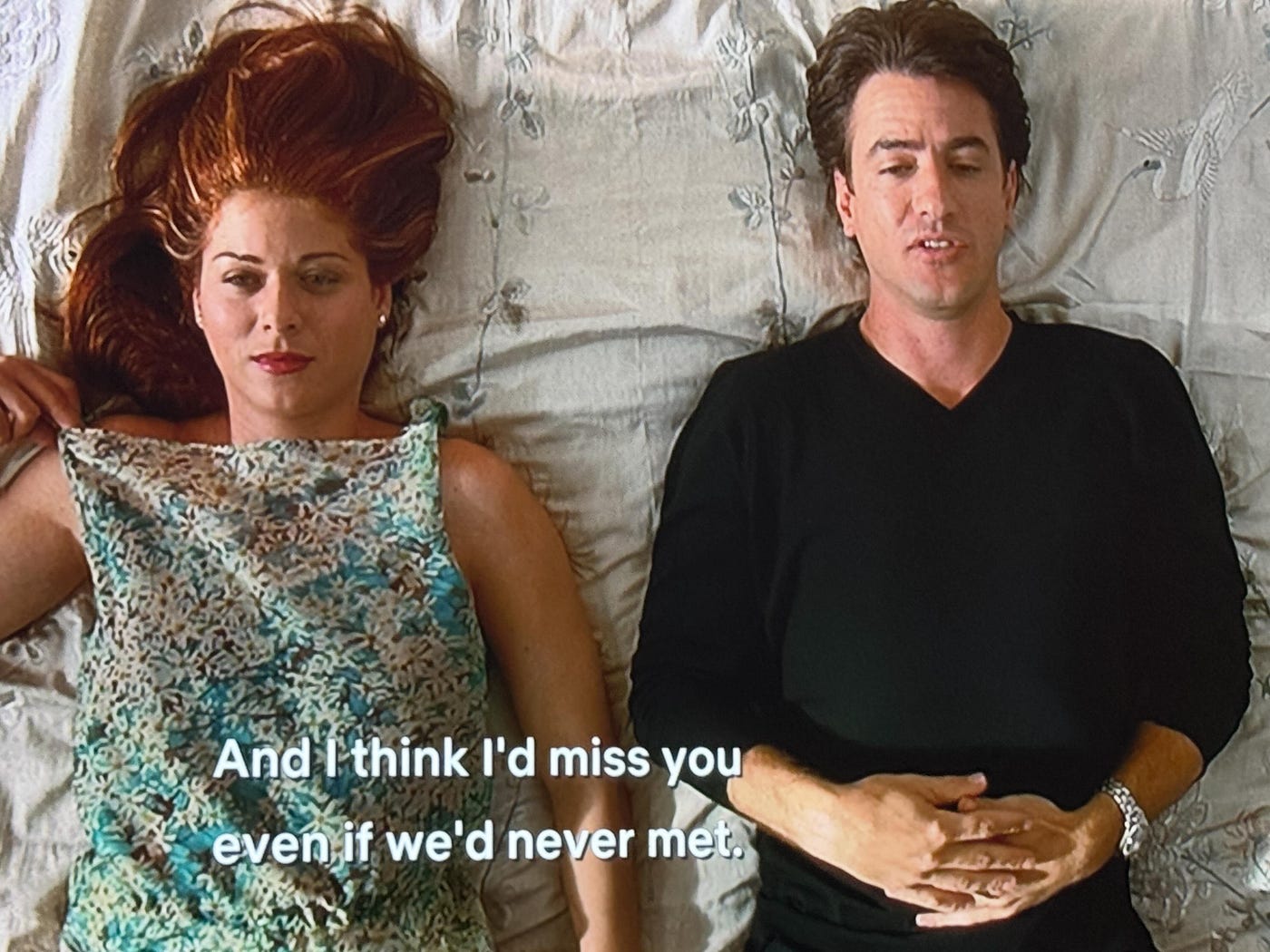
debra messing (zionist) and dermont mulroney in the wedding date, laying back on a bed, he says to her when sharing things about himself “and i think i’d miss you even if we’d never met.”
The rom-com brain and the fantasy of being chosen
I grew up on movies like The Wedding Date the way some people grow up on church. I learned that the holiest moment in a woman’s life is not revelation, not survival, not self-recognition. It’s being chosen.
In The Wedding Date, Debra Messing’s character, Kat, is anxious, self-conscious, and haunted by the man who left her. She hires an escort to play the ideal partner: composed, attentive, impossibly handsome. His job is to convince everyone — family, ex, herself — that she is desirable, lovable, fine.
Our bodies know this script by heart. The story offers that familiar chemical rollercoaster: humiliation, fantasy, tension, release. We get the humiliation of being abandoned, the fantasy of being flawlessly accompanied, the satisfaction of watching a man who once discarded her now have to witness her upgraded. The film offers a controlled environment where shame is always followed by redemption, like a reflex.
But that predictability is precisely the problem. The movie feeds us an old, dangerous logic: if you are wounded and ashamed, the cure is not transformation or community or ethical love — it’s the right man in the right suit saying the right lines at the right time.
No wonder the quote about missing someone you’ve never met goes viral. Yearning asks nothing of us. It doesn’t require we leave, change, or tell the truth. It lets us ache in peace.
What The Wedding Date teaches us to normalize
Strip away the lighting and the soundtrack, and what does the story invite us to accept as normal, even romantic?
A woman’s worth is measured in how convincingly she appears desired. Humiliation is treated as a rite of passage, something a “good sport” of a woman can laugh about later. Betrayal is downgraded to plot device. Kat’s ex cheats on her with her sister, and instead of the story centering the enormity of that betrayal, the narrative keeps orbiting her supposed inadequacy.
The escort is framed as a quirky solution, not a serious question about why she must purchase a façade of safety to be taken seriously as lovable. Family functions as an audience whose gaze must be managed at all costs, rather than a site where truth and accountability might actually be worked out.
We’re trained to treat all of this as mildly chaotic, adorably messy, but ultimately harmless — because it ends with a kiss. The credits roll over unresolved power dynamics and unaddressed harm, and we are encouraged to call it love.
The viral quote lives here: in the fog where harm and longing blur, where what we crave is not clarity but the warm reassurance that someone, someday, will stand close enough to us that the pain will blur out of frame.
bell hooks and the refusal to misname harm
bell hooks interrupts this warm haze by doing something profoundly unromantic: she defines love. Not as chemistry, not as destiny, not as the mood of two people swaying under fairy lights, but as an ethic.
Love, in her terms, is a combination of care, commitment, trust, responsibility, respect, and knowledge. It is an ongoing practice aimed at one another’s spiritual and emotional growth.
Under that definition, The Wedding Date is not a love story. It is a story about shame management. About performance. About a woman trying to outsource her self-worth to a man she paid to stand beside her.
Where, in this film, do we see genuine accountability from the ex who betrayed her? Where do we see sustained repair between sisters, not just shared scenery at a wedding? Where do we see Kat honored as a person who deserves dignity regardless of who is on her arm?
Hooks is ruthless about this: where there is domination, there cannot be love. Domination doesn’t only look like bruises or shouting; it looks like manipulation, deceit, and the expectation that one person absorb all the consequences so another doesn’t have to change.
By that measure, how many of our favorite “love stories” evaporate on contact?
And I know as I say this that it won’t gather the same tender chorus as that one soft line from the movie. It is easier to like a sentence about missing someone you never met than to face the possibility that half the relationships we’ve called “love” might not qualify under an ethic of care.
The sociology under the champagne
Our ideas about love don’t fall from the sky. They’re produced, circulated, monetized. Family, religion, school, film, advertising — all of these institutions have a stake in keeping certain scripts in place.
Patriarchy relies on love stories where women swallow their rage and doubt while men stumble toward growth in time for the proposal. The Wedding Date gives us exactly that: a woman bending herself around everyone else’s comfort, learning to package her hurt into something palatable, even charming.
Capitalism loves a story where emotional safety can be purchased. Hire the man. Buy the dress. Rent the illusion of being fine. The deeper work of building self-worth and community care isn’t just unmarketable; it’s threatening. If we learned that love is something we practice collectively — rather than something we must individually attract and perform for — entire industries would falter.
The family in the film is chaotic, but the chaos never matures into accountability. The cheating is scandalous, not systemic; nobody interrogates the entitlement that made the betrayal feel possible in the first place. The wedding functions as a stage on which everyone must pretend, rather than a moment when truth-telling might actually set anyone free. The little sister gets to be the absolute gremlin who gets the dream.
This is not a glitch in the genre; it’s the genre doing its job. The rom-com form smooths over structural harm with chemistry and charm. It teaches us to be more fluent in longing than in liberation.
Why yearning goes viral and ethics doesn’t
I have proof of this in miniature, sitting right there in my own analytics. A post about a sappy line from The Wedding Date — “I think I’d miss you even if we never met” — circles the globe while I sleep. People tag lovers and almost-lovers, archive it, whisper yes to themselves under their breath.
Posts about the actual skills of love — how to apologize without self-erasing, how to leave what is killing you, how to build relationships that can hold conflict and not collapse — barely break the surface tension of the feed. They sink like stones.
Of course they do. The soft quote lets us stay in fantasy. We can touch the idea of being that cherished without exposing anything ugly in ourselves. We don’t have to admit how we’ve failed others, how we’ve participated in harm, how much we still prefer being adored to being accountable.
Ethical love is not as screenshot-able. It is slower, more demanding, less photogenic.
It asks:
How do you behave when you’re bored, triggered, disappointed? What do you do with your power? Who pays the price for your comfort?
These are not questions you can double-tap and move on from. No wonder they don’t travel as fast. No wonder I can already feel the difference in how this paragraph will land compared to that one romantic line from the film.
From cinematic love to liberatory love
The shift bell hooks invites us into is not merely semantic; it is revolutionary. To treat love as an ethic is to treat it as a site of struggle, a discipline, a daily practice in refusing domination in all its forms.
That kind of love will never be as easy to package as a still from a wedding dance. It doesn’t fit neatly in a caption. It’s messy, iterative, full of missteps and repairs.
It looks like naming abuse as abuse, even when everyone around you prefers the softer label of “complicated love.”
It looks like choosing partners and communities who welcome your wholeness, not just your performance.
It looks like asking not only, “Who do I love?” but “How does my life participate in the liberation or confinement of the people I claim to love?”
This is love as political practice, not just personal consolation. It refuses to be confined to the couple, to the bed, to the wedding venue. It spills outward — to how we organize, how we show up, how we redistribute care and risk and resources.
It will not go viral like a line about suggesting at soulmates and destined lovers. But it might keep someone alive.
Writing for the people who stay
I don’t pretend I’m above the appeal of the soft line; I wrote it. I felt it. There is a part of me that will always be seduced by the idea that someone could miss me without knowing me, that my existence alone is enough to tug on some invisible thread.
But I am also increasingly suspicious of the ways we substitute that fantasy for the harder, less glamorous work of knowing and being known.
So I keep writing pieces like this one, knowing they will not land as sweetly or spread as quickly. Knowing some readers will flinch and click away the moment love stops being dreamy and starts being demanding. Knowing the internet, like the rom-com, is built to reward yearning more than responsibility.
I am writing, now, for the people who don’t click away. The ones who feel a small shame stir when they recognize themselves in both sides: the one who shared the sappy quote and the one who has avoided the mirror of accountability. The ones who are ready, or almost ready, to want something beyond being endlessly almost-chosen.
I write for the part of me that is tired of living in the trailer and never committing to the full, difficult film of my own life.
Maybe this essay will be quietly bookmarked instead of loudly shared. Maybe it will reach fewer eyes than a single romantic sentence from The Wedding Date. But if it reaches the part of you that is hungry for a love you can actually live inside — a love that is ethical, liberatory, unspectacular and real — then the numbers were never the point.
The world can keep swooning over the line about missing someone we’ve never met. I am more interested, now, in the people we have met, the harm we have done, the worlds we could build if we finally decided to love each other on purpose.
메타데이터
- post_id
- cc0436cf1fd3
- slug
- love-is-not-a-plot-twist-what-the-wedding-date-gets-wrong-about-love-and-what-bell-hooks-gets-cc0436cf1fd3
- url
- https://medium.com/@weavingcommunitycurrents/love-is-not-a-plot-twist-what-the-wedding-date-gets-wrong-about-love-and-what-bell-hooks-gets-cc0436cf1fd3
- canonical_url
- https://medium.com/@weavingcommunitycurrents/love-is-not-a-plot-twist-what-the-wedding-date-gets-wrong-about-love-and-what-bell-hooks-gets-cc0436cf1fd3
- author_url
- https://medium.com/@weavingcommunitycurrents
- status
- ok
- fetched_at
- 2026-06-10 12:26:30