Saga Pattern in System Design: Why You Should Learn It
If you build distributed systems, you eventually meet a problem that looks simple on paper and messy in production: one business action…
Blog Thumbnail
Saga Pattern in System Design: Why You Should Learn It
If you build distributed systems, you eventually meet a problem that looks simple on paper and messy in production: one business action touches multiple services, and one step fails after the others have already succeeded. At that point, the system needs more than retries. It needs a way to stay consistent without pretending the world is transactional when it is not.
That is exactly where the Saga Pattern matters.
The Saga Pattern is one of those ideas that sounds abstract until you see it in a real system. Then it becomes practical very quickly. Order placement, payment processing, inventory reservation, booking flows, refunds, onboarding, account provisioning — all of these can break across service boundaries. Saga gives you a structured way to handle that complexity without locking everything inside one giant database transaction.
In modern system design, this is not a niche topic. It is a core one.
What Is the Saga Pattern?
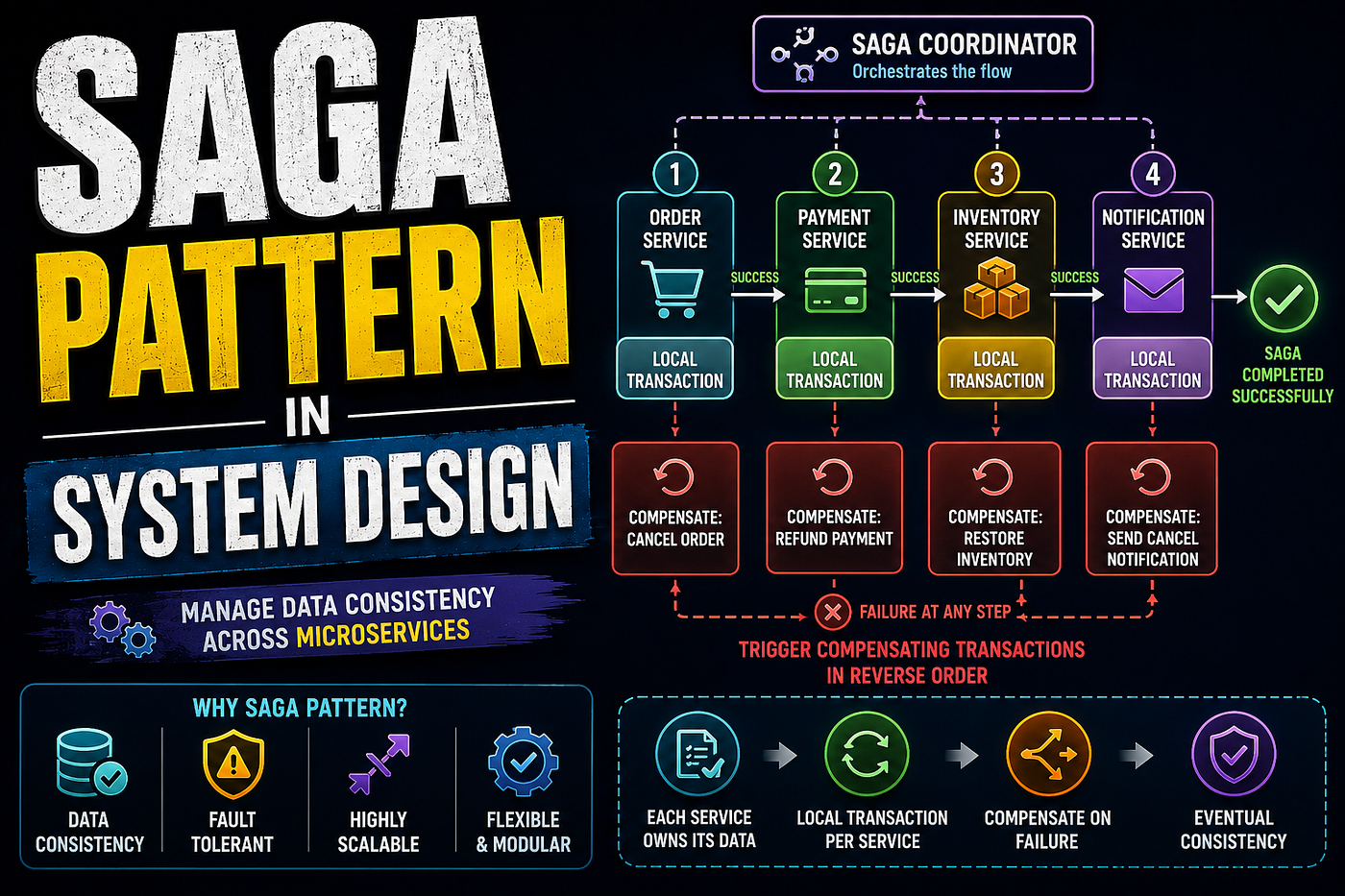
A Saga is a sequence of local transactions. Each step updates only one service or one database. If a step fails, the system runs compensating actions to undo the earlier successful steps.
In simple terms:
- Do one local operation.
- Publish or trigger the next step.
- If something fails later, roll back the earlier work through compensating logic.
That sounds easy. It is not always easy in practice. But it is still much more manageable than forcing distributed ACID transactions across services that were never meant to behave like one database.
Saga is built for eventual consistency. That is the trade-off. You give up immediate global consistency, and in return you gain scalability, service independence, and better fault tolerance.
Why Saga Exists
Traditional distributed transactions are heavy. They can slow systems down, increase coupling, and create operational pain. In microservices, that pain grows fast.
Imagine an e-commerce checkout flow:
- Create an order.
- Reserve inventory.
- Charge payment.
- Arrange shipment.
Now imagine the payment succeeds, but shipment fails. Or inventory was reserved, but payment later gets rejected. A single database transaction across all these services would be fragile, expensive, and unrealistic in many environments.
Saga solves this by breaking the flow into smaller transactions. Each service owns its own data. Each step is committed independently. If the workflow cannot complete, earlier steps are compensated.
This is the real value: not magic consistency, but controlled inconsistency.
How Saga Works
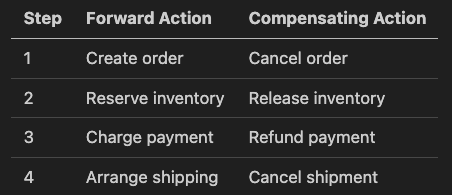
A Saga usually has two kinds of actions:
- Forward actions: the normal business steps.
- Compensating actions: the undo steps if something goes wrong.
For example:
Forward Action | Compensating Action
If step 3 fails, step 2 and step 1 may need compensation. If step 4 fails, steps 3, 2, and 1 may all need to be reversed in the correct order.
That last part matters. Compensation is not always a perfect undo. A refund is not identical to never charging. A canceled shipment may still leave side effects. In real systems, “rollback” often means “make the business state acceptable again,” not “time travel.”
Two Main Saga Styles
Saga is usually implemented in two broad ways.
1. Choreography
In choreography, each service listens for events and reacts independently. There is no central controller. One service does its work, emits an event, and the next service continues the workflow.
Example:
- Order Service creates an order and emits
OrderCreated. - Inventory Service listens to that event and reserves stock.
- Payment Service listens to
InventoryReservedand charges the customer. - Shipping Service listens to
PaymentCompletedand creates shipment.
This style is lightweight and decoupled. There is no central brain. That is also the weakness. Once the flow gets long or branching logic grows complex, event-driven coordination can become hard to trace.
Advantages
- Less coupling
- Good for simpler workflows
- Easy to extend in some cases
Disadvantages
- Harder to understand end-to-end
- Debugging can become painful
- Event storms and hidden dependencies are common
2. Orchestration
In orchestration, a central component controls the workflow. It tells each service what to do and decides what happens next.
Example:
- Saga Orchestrator tells Order Service to create order.
- Then it tells Inventory Service to reserve stock.
- Then it tells Payment Service to charge.
- Then it tells Shipping Service to fulfill.
If one step fails, the orchestrator triggers compensating actions in reverse order.
This style is more explicit. You can see the flow. That matters when business rules are complicated.
Advantages
- Easier to observe and debug
- Clear workflow ownership
- Better for complex transactions
Disadvantages
- More central coordination logic
- Orchestrator can become a dependency
- Needs careful design to avoid becoming a monolith
A Simple Example
Here is a simplified orchestration flow for an order system:
Start Saga
  -> Create Order
  -> Reserve Inventory
  -> Charge Payment
  -> Create Shipment
If failure at any step:
  -> Compensate previous successful steps in reverse order
End Saga
And a more concrete pseudo-code version:
def place_order(order):
    try:
        order_id = order_service.create(order)
        inventory_service.reserve(order.items)
        payment_service.charge(order.customer, order.total)
        shipping_service.create_shipment(order_id)

        return {"status": "success", "order_id": order_id}

    except Exception as e:
        # compensate in reverse order
        try:
            payment_service.refund(order.customer, order.total)
        except:
            pass

        try:
            inventory_service.release(order.items)
        except:
            pass

        try:
            order_service.cancel(order_id)
        except:
            pass

        return {"status": "failed", "reason": str(e)}
This is not production code. It is just the idea in plain sight. In a real system, compensation must be idempotent, retry-safe, and carefully logged.
Where Saga Fits Best
Saga is useful when:
- A business process spans multiple services.
- A single ACID transaction is not practical.
- You can tolerate eventual consistency.
- You need reliable compensation when something fails.
- The workflow is long-running and distributed.
Common examples include:
- E-commerce checkout
- Travel booking
- Loan processing
- Payment and refund workflows
- Account provisioning
- Subscription lifecycle management
If the workflow is short, isolated, and fits in one database, Saga may be unnecessary. Not every problem needs distributed coordination. Sometimes a transaction is just a transaction.
Important Design Rules
Saga looks elegant in diagrams. In production, it needs discipline.
Make compensating actions meaningful
A compensation step should genuinely restore the business state as much as possible. It does not always mean a perfect revert. It means safe recovery.
Keep each local transaction small
Each service should do one thing well. Large local transactions increase failure surfaces and make retries messy.
Design for idempotency
Retries happen. Duplicate messages happen. Networks fail. Every step and every compensation should be safe to execute more than once.
Persist saga state
You need to know which step has completed, which one failed, and what compensation is pending. Without state, recovery becomes guesswork.
Expect partial failures
A service may go down during compensation. A message may be delayed. Another service may already have seen an event. Saga is not a perfect world model. It is a controlled failure model.
Common Pitfalls
Many teams misuse Saga by treating it like a universal rollback mechanism. That is a mistake.
Here are the usual traps:
- Compensation is impossible for some business actions.
- Event ordering is not guaranteed.
- Duplicate events trigger duplicate work.
- One failed compensation leaves the system half-recovered.
- The orchestrator becomes too large and too smart.
Another issue is human expectation. Engineers often assume rollback means “everything disappears.” In distributed systems, that is rarely true. Payments, notifications, external APIs, and side effects all leave traces. Saga handles business consistency, not physical erasure.
That distinction matters.
Saga vs Distributed Transactions
People compare Saga with two-phase commit or other distributed transaction models. The comparison is useful, but the answer is not always “Saga is better.” It depends.
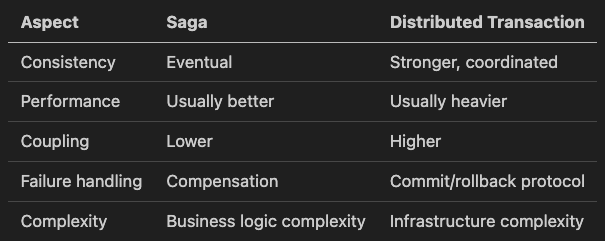
Saga vs Distributed Transactions
Saga shifts complexity from the database layer into application logic. That is the real trade. In many microservice systems, this is still the better choice.
When Not to Use Saga
Saga is not ideal when:
- The process is simple and fits in one database transaction.
- Compensation is not possible or not acceptable.
- Strong immediate consistency is mandatory.
- The business flow is too small to justify the overhead.
For example, updating a user profile in one service does not need Saga. A checkout flow across payment, inventory, and shipping often does.
Use the pattern where it earns its place, not because it sounds advanced.
A Practical Mental Model
A good way to think about Saga is this:
A Saga is not about making distributed systems behave like one database.
It is about designing business workflows that can survive failure without collapsing the whole system.
That is a subtle difference, but an important one. Saga accepts that failure is normal. It does not fight that truth. It organizes around it.
Final Thoughts
The Saga Pattern is one of the most useful tools in system design when your workflow crosses service boundaries. It gives structure to failure, makes distributed processes more manageable, and supports scaling without forcing one giant transaction across the system.
It is not simple. It is not free. It demands careful design, strong observability, and clean compensating logic.
Still, once you understand Saga, many real-world system design problems start looking less mysterious. You stop asking, “How do I make this one transaction?” and start asking, “How do I make this workflow reliable?” That is a better question.
And in distributed systems, better questions usually lead to better designs.
메타데이터
- post_id
- cc07ffaee75a
- slug
- saga-pattern-in-system-design-why-you-should-learn-it-cc07ffaee75a
- url
- https://medium.com/algomart/saga-pattern-in-system-design-why-you-should-learn-it-cc07ffaee75a
- canonical_url
- https://medium.com/algomart/saga-pattern-in-system-design-why-you-should-learn-it-cc07ffaee75a
- author_url
- https://medium.com/@yashjainio
- status
- ok
- fetched_at
- 2026-07-09 06:53:08