The Telegram Ban and the Myth of Expanding State Power Erected by Fearmongerers dressed up as Tech…
Indian tech law journalism may have a problem. It’s the excessive suspicion of any measure undertaken by the Government of India (“GoI”)…
The Telegram Ban and the Myth of Expanding State Power Erected by Fearmongerers dressed up as Tech Law Critics
Indian tech law journalism may have a problem. It’s the excessive suspicion of any measure undertaken by the Government of India (“GoI”) regarding constitutionalization of the cyberspace as some form of ‘concentration of state authority’, as if the very idea of authority and state must be seen as inherently problematic in their coming together.
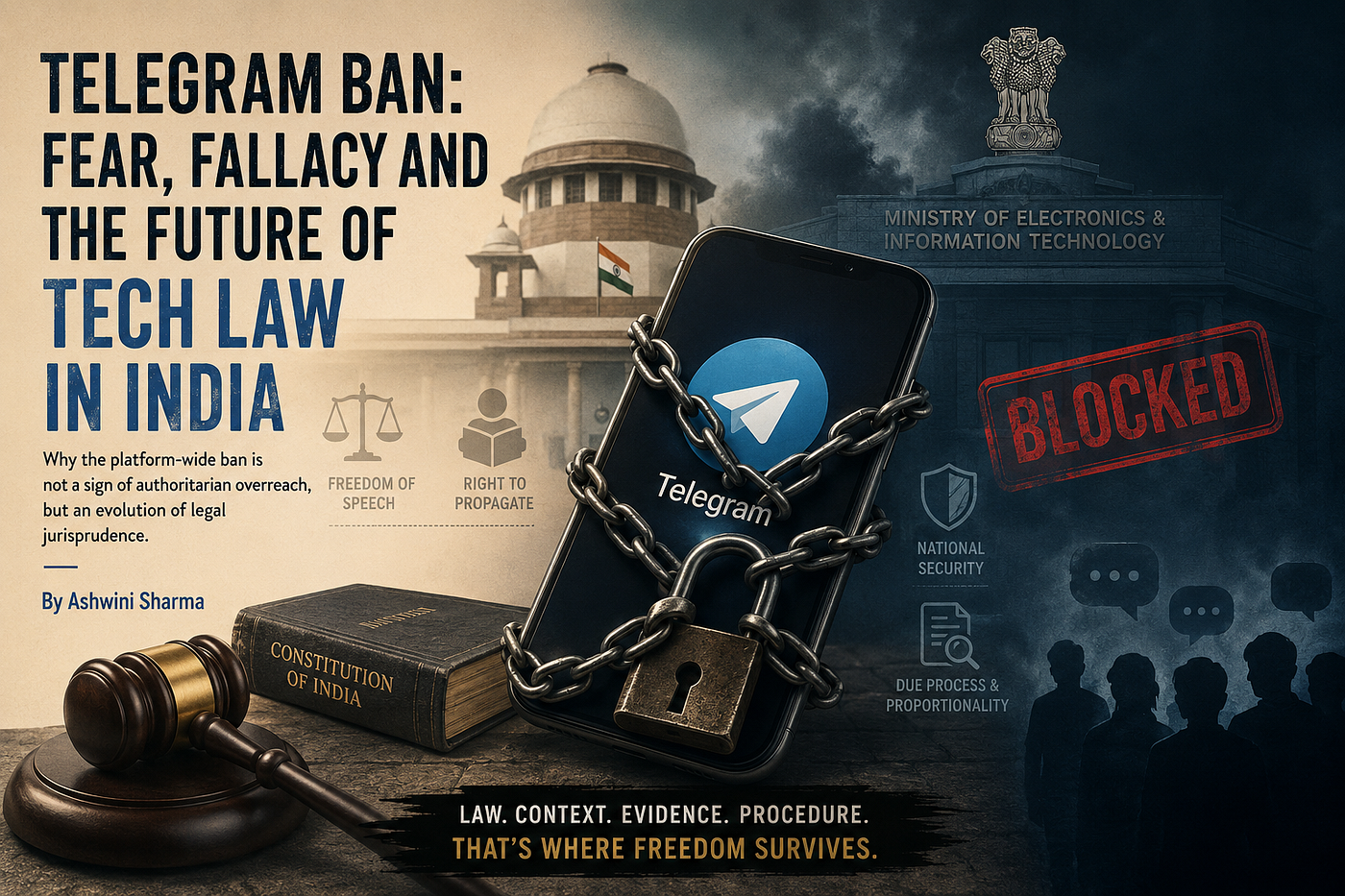
Take the recent example of platform-wide ban of Telegram, pursuant to an order issued by India’s tech ministry, Ministry of Electronics and Information Technology (MeitY) resorting to emergency provisions under Rule 9 of the Information Technology (Procedure and Safeguards for Blocking for Access of Information by Public) Rules, 2009 (“Blocking Rules”).
In what would be a first for Indian tech law jurisprudence, this platform-wide ban should have been seen as advancement of the envelope of tech law jurisprudence in India, but merely because the GoI was able to achieve legal victory over sustaining the platform-wide ban of Telegram, is being interpreted by critics as some kind of ‘concentration of state authority’ using vacuous arguments that do not stand together even with the slightest of scrutinies.
Consequently, fear mongering becomes the next corollary. The Telegram ban is now presented as if platform-wide bans are going to become the new normal. The fear mongerer’s argument would be that a ‘fascist state consolidating its authority’ is going to resort to new measures, means and mechanisms to extend its ability to control, censor, and block any information or content at will — thus imagining the ‘fascist state’ as some kind of a monstrous leviathan just waiting and biding its time to ultimately pounce on the liberties and freedoms of humans that have been achieved with so much struggle and courage. Of course, all these things are never stated but they are alluded to. The underlying fallacy is the ‘slippery slope’ fallacy that tends to flatten all the distinctiveness of elements that go into any particular decision, which has been carefully laid out as well in the blocking order.
A simple question to ask is whether an argument of ‘concentration of state authority’ sustain in the backdrop of the actual legislative intent? The criticism concerning such concentration is advanced on the idea that somehow, and only in the case of ‘Telegram’, the State managed to expand its powers to block — by interpreting the term ‘information’ more broadly than it could have been.
That’s a very artificial construction actually. That’s because the existing legislative framework does not specify any kind of limitation on interpretation of ‘information’ to exclude ‘apps’. Section 2(1)(v) of the Information and Technology Act, 2000 clearly defines information as “data, message, text, images, sound, voice, codes, computer programmes, software and data bases or micro film or computer generated micro fiche”. Thus, the term “information” includes ‘software’ also. An app is a software and capable of being considered as ‘information’ for the purposes of blocking rules.
It’s a straightforward principle of interpreting statutes that the ordinary meaning of the plain text of a legislation has to be given effect to. When the ordinary meaning itself does not exclude ‘software/apps’ from the scope of information, which means the enabling legal framework permits the GoI to achieve platform wide bans also, then the very fact of reporting the Telegram ban as constructed on ‘expansive’ definition is misleading and misinforming.
How can there be an ‘expansion’ of the definition, when the banning measure proceeded on the basis of what’s already part of the existing legislation? Clearly it’d be a rhetorical exercise to call the ban as ‘expansive’ when the GoI only performed what it was always empowered to do. One can question the justification for exercising such a power, not the capacity itself, in the absence of any express limitation mentioned in the rule book.
The other leg of criticism against the Telegram ban rests on the “proportionality doctrine”. The argument goes that the platform-wide ban was not proportional because the interests of the few, i.e., NEET test takers (about 2.2 million), in whose interest the ban was implemented was being privileged over a much larger cross-section of users across industries and social profiles (about 150 million), who would be limited from making legitimate use of the banned platform.
The Delhi HC, in its judgment by Justice Karia, upheld the ban as ‘proportional’ on the view that the ban was only for a temporary and limited duration, i.e., only until the date of the RE-NEET exam, viz., 22nd June, 2026, with the prohibition on text-editing being in place only until 30th June, 2026. Secondly the ban was not being put in place because the GoI had an ideological issue with the platform or that the platform was being used to criticize the GoI and GoI had resorted to a vengeful order — facts that ought to constitute the views of anyone casually resorting to terms such as ‘concentration of state authority’. The ban was considered as narrow enough because it was NEET-event specific.
The GoI’s action on this front was not to outrightly go for the platform ban. That would have been easy, convenient and perhaps suicidal. What helps blunt the theoretical and alarmist arguments of the critics is the fact that the GoI first resorted to the usual and ordinary process of initiating identification of the offending digital sources, notifying the platform’s officers, having a proper meeting with the platform’s officers to understand the scale and nature of misuse of the platform (as reported by National Testing Agency (“NTA”), the nodal office responsible for conducting NEET throughout the country), issuing a list of offending URLs, and having the platform take those down.
The emergency measure ordering platform-wide ban was adopted under Rule 9, not upon the mere first discovery of the issue, but from the escalation and persistence of the identified threat in the immediate run-up to the examination, which were found to be ‘resilient’ in the face of specific takedown orders that were issued earlier.
Further, the real world context of student suicides, public disorder, formation of CJP on the ground protesting NEET leakages posed actual challenges that required GoI’s action to prevent further worsening of the on-ground public order and peace. After all the GoI could not be unmindful of 22 lakh NEET students that tied their aspirations on an exam that occurs once in a year. The ban was adopted keeping in mind that the exam timelines had become ‘critical’ (being only 6 days away from the date of the ban order) and a complete prohibition could only avoid the kind of systemic risk that is associated with a one-time occurring exam tied to the aspirations and hopes of millions of young lives.
Subsequently on 16th June, 2026, the blocking orders were issued after having ensured first that specific takedown requests are sent. This demonstrated that the GoI is not normalizing platform wide bans without first adopting the lesser intrusive measure of issuing specific takedown requests.
The logic for going for the entire platform wide banning was given on the basis that despite repeated takedown measures and engagement, unlawful channels continued to re-emerge through backup channels and bots, thereby rendering narrower measures ineffective. This was made possible due to Telegram’s distinguishable ‘mass-multiplication features’, ‘anonymity’ and ‘date-time editing features’ that were held to make Telegram as ‘structurally incapable’ of preventing misuse.
The date-time editing feature was especially diabolical because it allowed anyone to completely edit a past message in all its contents including any PDF file, text message and even the time of sending that passage. Using such feature any malicious actor could easily update the released exam paper on a message sent earlier, edit any message’s time to a date and time before the date of exam and use it to spread rumours that the question paper had been leaked.
The reason why using the Telegram’s temporary ban to fearmonger as some kind of normalization of platform wide bans on the road to some autocratic dictatorship concentrating state authority is absurd and outrageous is because the GoI clearly explained that it was Telegram’s ‘material distinguishability’ from other intermediary platforms owing to its ‘technical architecture’ including cloud-based infrastructure, large public broadcast channels, automated bot ecosystems, concealment of user identifiers, large-volume file-sharing capabilities, and self-destructing messages, which cumulatively create an ecosystem particularly susceptible to misuse and also structurally incapable to prevent misuse in the face of issuing specific takedown orders.
To call such features, otherwise fit to be considered as a ‘rogue design’ as ‘architectural resilience’ is dressing up the platform’s rogue design as some kind of product robustness. Well, resilience against legal enforcement is not a reputable feature of any product.
It is worth noting that the GoI made it a point to bring out the fact that such distinguishable Telegram’s features were not ‘unlawful’ in as much as they became handy tools for malicious actors to evade law enforcement. Even though Telegram asserted that its content moderation features were effective enough to counter-balance, yet its rapid audience migration features, mirror/reserve channel features, could make it possible for malicious actors to resurface with the entire network fully intact without any marginal costs whatsoever — a factor that became crucial in the run up to the annual (RE) NEET exam date with only a week remaining, a timeline that would make specific takedown requests ineffective in face of the efficiency of ‘resilient architecture’ that enabled such malicious actors to bounce back easily and conveniently.
What further clinched the Delhi HC’s judgment in favour of the GoI was the fact that Telegram’s own founder, Pavel Durov had admitted that they are setting about to correct their date-time editing feature which had caused a lot of ‘backdating scams’. This was used to point out that Telegram’s backdating feature was not architecturally necessary to the entire app and that therefore it was a deliberate product choice. The GoI reasoned that it cannot wait for the date-time editing feature of Telegram to be removed as the exam timeline had become critical and therefore even issuing specific takedown requests are not going to be effective enough to avoid large scale public order challenges concerning rumour-mongering regarding paper leaks through backdating scams, thus making platform wide ban as a necessary and proportional measure.
The usual critics relying on anti-establishmentarian motifs proceed on an auto-pilot mode because they tend to take a view that ‘evasive actors’ could very well be persecuted members of opposition that the ‘autocratic’ and ‘dictatorial’ state is out to apprehend and eliminate. Fair point of view, only that, their argument is always comprehensively theoretical in light of the liberal-constitutional-democratic framework in place and in practice in India.
Yet their theoretical arguments help them become useful idiots for actual fraudsters and criminals who benefit from the shroud of ambiguity created by such anti-establishmentarian theoretical arguments. Do note that here I intend to refer to ‘establishment’ as the constitutionally sanctioned governance framework administering the country.
Such critics would point out the necessity of ensuring takedown of ‘specific information’ and might even say that they do not support any fraudsters or criminals, but at the same time, they would be out with their swords to gash at any initiative of the GoI to creatively approach (within constitutional parameters) persistent problems wrought by the massive scale and potential of communication and messaging platforms — a development that human society is slowly coming around to in adoption and letting it gain power, influence, and agency over their actions, relations, communications and destiny itself. Although from the write-up above, it’s very much clear that this platform wide-ban does not imply that the era of ‘specific takedown’ requests is over, only that, a platform wide ban is a natural corollary if the product design makes it ‘structurally incapable’ to prevent redressal through specific takedowns.
메타데이터
- post_id
- cc0fd8bdb2dc
- slug
- the-telegram-ban-and-the-myth-of-expanding-state-power-erected-by-fearmongerers-dressed-up-as-tech-cc0fd8bdb2dc
- url
- https://medium.com/@ashwinisharma777/the-telegram-ban-and-the-myth-of-expanding-state-power-erected-by-fearmongerers-dressed-up-as-tech-cc0fd8bdb2dc
- canonical_url
- https://medium.com/@ashwinisharma777/the-telegram-ban-and-the-myth-of-expanding-state-power-erected-by-fearmongerers-dressed-up-as-tech-cc0fd8bdb2dc
- author_url
- https://medium.com/@ashwinisharma777
- status
- ok
- fetched_at
- 2026-06-29 01:02:39