Oat Milk vs Camel Milk: What the Nutritional Data Actually Shows
Oat milk became the dominant alternative milk in the United States in under five years. By most measures it won the market: barista…
Oat Milk vs Camel Milk: What the Nutritional Data Actually Shows
Oat milk became the dominant alternative milk in the United States in under five years. By most measures it won the market: barista performance, mainstream availability, recognizable branding, and a sustainability narrative that resonated with a specific consumer demographic. But popularity is not the same as nutritional merit, and the oat milk vs camel milk comparison is one that the mainstream food media has been almost entirely unwilling to have honestly.
What Oat Milk Actually Contains
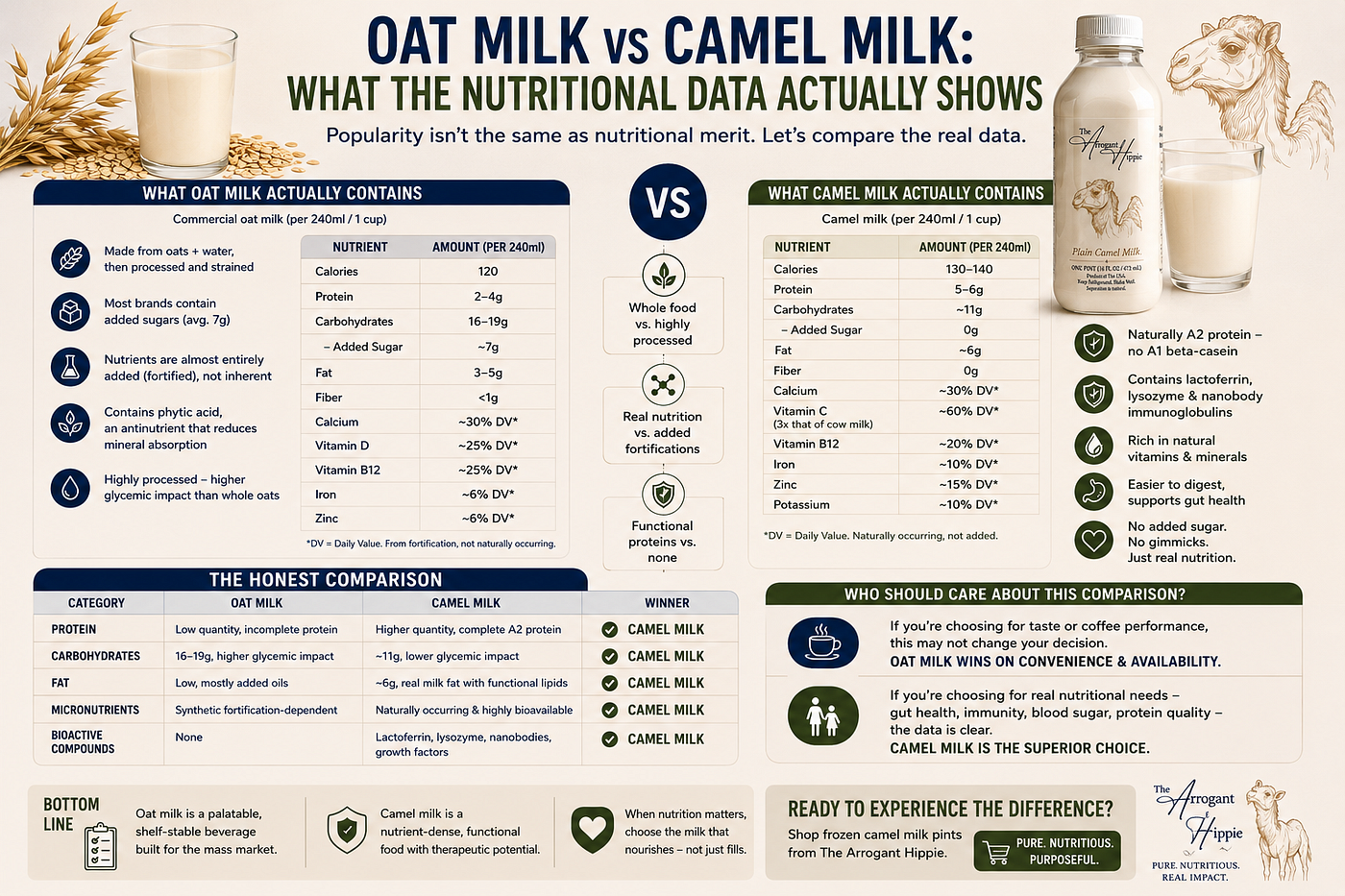
A standard serving of commercial oat milk (240ml) contains approximately 2 to 4 grams of protein, 16 to 19 grams of carbohydrates including 7 grams of added sugar in most brands, minimal fat, and a micronutrient profile that is almost entirely fortification-dependent. The vitamins and minerals on an oat milk nutrition label are not inherent to oats. They are added post-processing to make the label competitive with cow milk. Without fortification, commercial oat milk is essentially a sweet, slightly viscous carbohydrate suspension.
Oat milk also contains phytic acid, an antinutrient that reduces absorption of iron, zinc, and calcium. The processing that converts whole oats into a pourable liquid breaks down the cellular structure that would otherwise moderate blood glucose response, producing a product with a glycemic impact meaningfully higher than the oats it was made from.
What Camel Milk Actually Contains
Camel milk is a whole food with an intact nutritional matrix. A standard 240ml serving contains approximately 5 to 6 grams of protein from bioavailable A2 casein and whey fractions, 6 grams of fat including a favorable short-chain fatty acid profile, 11 grams of carbohydrates with no added sugar, and a micronutrient profile that is inherent rather than fortified. Camel milk is a natural source of vitamin C at levels three times higher than cow milk, vitamin B vitamins, zinc, calcium, potassium, and iron in forms that are highly bioavailable.
Camel milk also contains active bioactive proteins including lactoferrin, lysozyme, and nanobody immunoglobulins that have no equivalent in any plant-based milk. These compounds are not nutrients in the conventional sense. They are functional proteins with documented anti-inflammatory, antimicrobial, and gut-protective properties. No fortification achieves what they do.
The Honest Comparison
Protein: Camel milk wins. Oat milk’s protein is incomplete and present in low quantities. Camel milk provides complete protein from animal sources in forms that do not require fortification to be meaningful.
Carbohydrates: Oat milk has two to three times the carbohydrate load of camel milk and significantly higher glycemic impact. Camel milk is a better option for blood sugar management.
Fat: Both contain modest fat content. Camel milk’s fat profile is more complex and includes functional lipids. Oat milk fat is primarily added oil in most commercial products.
Micronutrients: Oat milk’s label depends on fortification. Camel milk’s label reflects actual food content. For individuals who cannot absorb synthetic fortification effectively, this distinction matters enormously.
Bioactive compounds: Camel milk is in a separate category. Oat milk contains none of the functional proteins that make camel milk nutritionally meaningful beyond its macronutrient profile.
Who Should Care About This Comparison
If you are choosing a milk alternative primarily for taste or coffee performance, this comparison may not change your decision. If you are choosing based on genuine nutritional need, including gut health, immune support, blood sugar management, or protein quality, the data does not support oat milk as a nutritional equivalent to camel milk. It supports oat milk as a palatable, shelf-stable, widely available beverage that has been successfully marketed as a health product.
For the full structural comparison of camel milk against cow milk and why the protein question matters, read camel milk vs cow milk: the honest comparison. To source camel milk, shop camel milk pints here.
메타데이터
- post_id
- cc167b30741f
- slug
- oat-milk-vs-camel-milk-what-the-nutritional-data-actually-shows-cc167b30741f
- url
- https://medium.com/the-alternative-milk-report/oat-milk-vs-camel-milk-what-the-nutritional-data-actually-shows-cc167b30741f
- canonical_url
- https://medium.com/the-alternative-milk-report/oat-milk-vs-camel-milk-what-the-nutritional-data-actually-shows-cc167b30741f
- author_url
- https://medium.com/@aunesty_74363
- status
- ok
- fetched_at
- 2026-06-15 20:49:13