Why QA Teams Need an Agent — TestMu AI (Formerly LambdaTest)
The way software gets tested hasn’t kept pace with the way software gets built.
Why QA Teams Need an Agent — TestMu AI (Formerly LambdaTest)
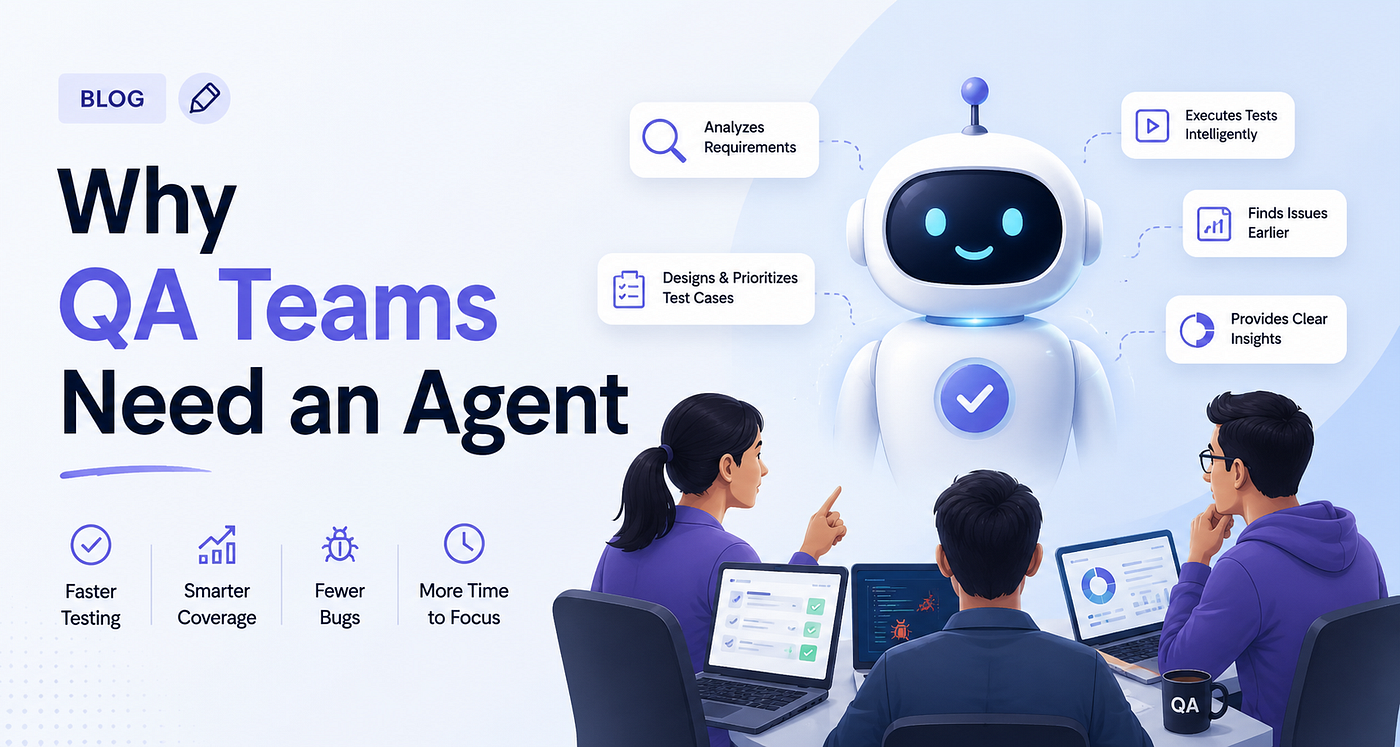
The way software gets tested hasn’t kept pace with the way software gets built.
Developers ship code faster than ever. AI code assistants generate entire features in minutes. Product cycles that used to run quarterly now run weekly. But the quality engineering process underneath it all — authoring test cases, maintaining automation scripts, triaging failures, filing bugs — still runs mostly on human time, at human speed.
That gap is the problem. And it’s getting wider.
TestMu AI (formerly LambdaTest) — the world’s first full-stack Agentic AI Quality Engineering Platform — was built to close it. The answer isn’t another automation framework or a dashboard with better charts. It’s an agent: an AI system that doesn’t just run your tests, but plans, authors, executes, analyzes, and repairs them, with your quality engineers in the loop.
Here’s why that shift matters, and what it actually looks like in practice.
The Testing Bottleneck Is a People Problem
Talk to any QA lead at a fast-moving company and you’ll hear the same frustrations:
- We have more features to cover than we have time to write tests for.
- Our automation suite is brittle — UI changes break dozens of tests at once.
- We spend more time maintaining existing tests than writing new ones.
- Developers ship faster than QA can validate.
- We can’t tell if a test failure is a real bug or a flaky test until someone digs in manually.
These aren’t signs of an incompetent QA team. They’re signs of a QA process that hasn’t scaled with the rest of engineering. The tooling caught up to the problem of running tests at scale. It never caught up to the problem of managing tests at scale.
That’s the gap an agent fills.
What a Testing Agent Actually Does
When most people hear “AI for testing,” they think of a smarter linter, a test generator you prompt once and forget, or a chatbot that answers questions about your test suite. Those are tools. An agent is different.
An agent is a system that:
- Plans what needs to be tested — based on what changed in code, what paths matter, what gaps exist in coverage
- Authors test cases in natural language or code — without requiring an engineer to write every step manually
- Executes tests against your app — across browsers, devices, and environments
- Analyzes results — classifying failures, distinguishing real bugs from flakiness, surfacing root causes
- Repairs tests when they break — detecting selector drift, updating locators, and healing tests automatically
- Learns over time — improving from patterns in your codebase and test history
This is what KaneAI, the core testing agent inside TestMu AI, does. It’s not a code generator that hands work back to a human. It’s an agent that completes loops.
KaneAI: The Testing Agent for Modern QE Teams
KaneAI is the world’s first GenAI-native end-to-end software testing agent. You describe what you want to test — in plain English — and KaneAI authors the test, runs it, and maintains it.
This is what the workflow looks like in practice:
Without KaneAI:
- Developer ships a new feature
- QA engineer reads the ticket, understands the feature
- QA engineer manually writes test steps
- QA engineer implements them in Selenium, Playwright, or Cypress
- Tests run on the grid
- Failures come in — QA engineer manually triages each one
- UI changes break selectors — QA engineer updates the scripts
- Repeat for every new feature, every release, every regression cycle
With KaneAI:
- Developer ships a new feature
- QA engineer describes the test scenario in natural language
- KaneAI authors the test, selects appropriate selectors, and generates runnable test code
- Tests run on TestMu AI’s cloud grid
- KaneAI classifies failures — bug vs. flakiness vs. environment issue
- Auto Healing Agent detects selector drift and updates locators automatically
- Root Cause Analysis Agent provides a clear explanation of every failure, with actionable next steps
The quality engineer’s job shifts from writing and maintaining test code to reviewing what the agent produces and making judgment calls. That’s a meaningful upgrade in how engineering time gets spent.
The Auto Healing Agent: Solving Brittle Tests
Test brittleness is one of the most expensive problems in quality engineering. When a UI change — a new CSS class, a refactored component, a moved button — breaks 50 tests at once, someone has to fix all 50 of them. That’s days of engineering time, not hours.
TestMu AI’s Auto Healing Agent addresses this directly. When a test fails due to a changed selector, the agent detects the drift, identifies the correct element using contextual signals, updates the locator, and retries the test — automatically.
The result: tests that used to require manual intervention after every UI change now heal themselves. Your automation suite stays green without constant maintenance overhead.
Agent-to-Agent Testing: A New Category for AI Applications
The agent model isn’t just for testing traditional web apps. As AI-native products proliferate — chatbots, voicebots, customer service agents, AI assistants — they create a testing problem that manual and scripted testing can’t solve.
You can’t reliably test a conversational AI with a static test script. The responses vary. The context matters. The failure modes are different from a button that either works or doesn’t.
TestMu AI’s Agent-to-Agent Testing solves this. It deploys AI agents to test AI agents — running real conversations at scale, covering edge cases, adversarial inputs, and multi-turn dialogue flows that scripted tests can’t reach. For teams building AI-native products, this is infrastructure they can’t get anywhere else.
Test Intelligence: When the Agent Analyzes Your Whole Suite
Individual test failures are manageable. Patterns across thousands of tests are not — not without help.
TestMu AI’s Test Insights layer gives quality engineering teams AI-native analytics across their entire test suite. The Root Cause Analysis Agent groups related failures, classifies them by error type, and surfaces the highest-priority issues automatically. Instead of combing through thousands of log lines, your team sees a curated list of what’s broken and why.
The Test Insights AI Copilot goes further: it’s a conversational interface that lets engineers ask questions about their test data — “Which tests have been flaky for more than two weeks?”, “What’s our coverage gap on the checkout flow?”, “Which builds have the highest failure rate?” — and get answers without writing a single query.
What QA Teams Get Back
When agents handle test authoring, maintenance, and analysis, quality engineering teams get back something they’ve been losing for years: time to do high-judgment work.
Instead of spending cycles on test maintenance, they’re:
- Designing testing strategies for complex features
- Reviewing and refining what the agent produces
- Making release decisions with better signal
- Collaborating earlier in the development cycle — when their input actually changes how features get built
This is what 18,000+ enterprise customers at TestMu AI — including teams at Microsoft, OpenAI, and NVIDIA — are experiencing with the shift to agentic quality engineering. The volume of test coverage goes up. The manual overhead goes down. The team’s impact on product quality becomes more visible.
The Shift From Automation to Agentic Testing
Automation was the right answer for quality engineering in 2015. Write the script once, run it repeatedly, save the manual effort.
Agentic testing is the right answer now. The agent doesn’t just run scripts — it decides what to test, creates the tests, runs them, fixes them, and explains what failed. The quality engineer is in the loop as a decision-maker, not a script writer.
TestMu AI was built on this premise. It’s not a testing tool that added AI features — it’s an agentic AI platform where the agents are the product and the cloud infrastructure is what makes them scalable.
Getting Started
If your team is running Selenium, Playwright, Cypress, Appium, or any other major framework, you can move to TestMu AI without changing your existing scripts. The platform runs them as-is, immediately giving you access to 3,000+ browser and OS combinations, HyperExecute’s parallel execution speed, and AI-native analytics.
KaneAI and the full agent suite layer on top. You don’t need to rebuild your testing strategy — you augment it with agents.
Start at testmuai.com and run your first test in under 10 minutes.
메타데이터
- post_id
- cc16dc6d94bf
- slug
- why-qa-teams-need-an-agent-testmu-ai-formerly-lambdatest-cc16dc6d94bf
- url
- https://medium.com/@tafarooqsxr/why-qa-teams-need-an-agent-testmu-ai-formerly-lambdatest-cc16dc6d94bf
- canonical_url
- https://medium.com/@tafarooqsxr/why-qa-teams-need-an-agent-testmu-ai-formerly-lambdatest-cc16dc6d94bf
- author_url
- https://medium.com/@tafarooqsxr
- status
- ok
- fetched_at
- 2026-06-09 15:37:30



