Swami Vivekananda’s Only Hope: Overcoming Monet
Artist’s Statement
Swami Vivekananda’s Only Hope: Overcoming Monet
Artist’s Statement

Flyer design by Erika Keck

These paintings track my progression from an exciting — but upon further inspection, rather perverse — state of spiritual escapism to a more grounded and worldly peace.

Photo by Heather Seybolt
It is an illustration of a personal journey, from discovering a secret Truth in the darkness of night, and carrying it through dawn and a hot midday, to a glowing sunset and dusk. The secret Truth found in the dark night, discovered out of an escapist journey away from society, gets integrated with the world through Law and by sunset, is revealed as a true and mature Love.

Photo by Ishani Chokshi
They say to beware the sullen saint, those who run off to the wilderness — or some other escape — to feel the presence of GOD. But there are moments in our lives where we, almost as if by beyond our own control, have to “run out to the desert” so to say — to wash off the muck of the world, all the layers of other people’s drama which has caked over our eyes, and confront the night sky. The void. Feel GOD. Let worldly identifications, struggles, identities, differences lose their power before ONE inexplicable, intoxicating Truth. And with this experience, which is always-new, to rebalance, and come back to society with a clearer head, hopefully with a surer way of being.
“…I feel ashamed to think about my little researches into form and colour while so many people are suffering and dying…” — Claude Monet (1914, during WWI)
But this is impossible for those without respect, and indeed, love for Law. Yes, this prerequisite embrace of the Law comes at a cost — there are certain liberties which one must sacrifice. The question is, is this sacrifice worth it?
Imagine one June night, me sitting alone on the roof of my car, around midnight, at the top of Crater Lake in Oregon. I was in the middle of my solo West coast road trip over the summer, in search of something important to paint.

Dhikr 6.97 & Dhikr 21.32 — Photo by Ishani Chokshi
On this road trip, I was on a Search for Halal Painting. I had adopted Islamic aesthetic laws — namely, its prohibition against iconography, or depicting animate creatures (including animals and people). As a former-portrait painter, I wondered: could adopting such a strict limit on my art-making produce beauty? Was such a sacrifice worth it? I had long been haunted by the so-called “death of painting” and its futility … but through this search for halal painting, could I find what I was looking for: something important to paint?
And on my car rooftop late at night on Crater Lake, with the world blanketed in darkness and the stars shining far above, I encountered the void, the world and its creatures veiled by the night. I felt the quiet presence of GOD on top of everything, on top of all the nothingness of the world. And at last I found something important to paint: this nothingness, an encounter with which led me to feel the universal presence of GOD, the One Truth of the world.
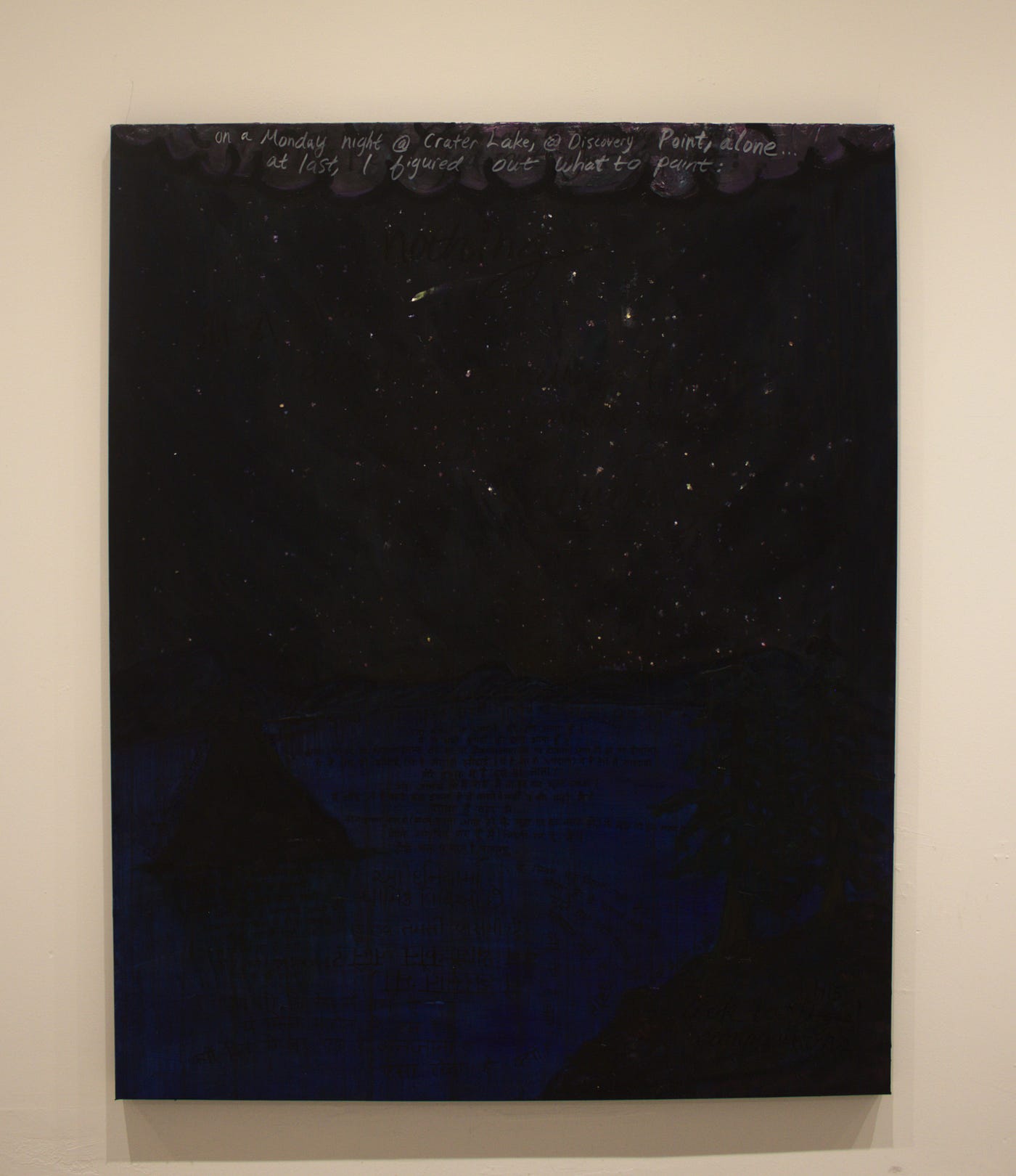
Dhikr 6.97 — Photo by Ishani Chokshi

Dhikr 6.97 — Photo by Heather Seybolt
Such an experiential Truth is present in the Hindu tradition as the philosophy of Nondualism, or Advaitism. This philosophy of Nondualism sees all the creations of the World as expressions of One GOD: a Divine Oneness. In the late 19th century, Swami Vivekananda famously brought this philosophy to the forefront of Hinduism, calling it the Truth of Hinduism which was kept secret by the elite “Pharisees” of the religion: the Brahmins. It finds a parallel in the Islamic concept of tawheed.
Viewing all creations of the world as expressions of this Oneness results in a concept of radical equality: the mosquito is raised to the level of the human, dust to the level of a diamond. It is a philosophical lens which famously leads mystics of all types, Sufi Muslims and Vedanta Hindus alike, to an intoxicating stupor, an almost paralyzing and overwhelming trance of Divine witnessing. And of course it would lead to such a result: with such a worldview, how can you not just gaze in eternal wonder at everything, even the smallest speck of dust?
Everything becomes everything else, everyone becomes everyone else. We all dissolve into one another before the ONE inexplicable, intoxicating Truth. This is most easily-experienced in the night: when worldly creation is asleep, dimmed and darkened, and less distracting. The trouble, however, is bringing this secret Truth to the light. It often leads to madness.
Accordingly, this series of painting picks up where my previous series, *In Search for Halal Painting, left me, taking as starting point its two culminating pieces (the Dhikrs*). Having experienced this Truth of Nondualism, the project becomes: how can I bring this to the light, and to society?

Awaiting a Lotus Before Dawn– Photo by Ishani Chokshi
The trouble with a Nondualist worldview, this consciousness of Oneness, it that without worldly guidance, it is very difficult to come back to society, since it is tempting to believe that everything other than GOD — the rituals of the world, the petty dramas and fights for survival, all differences, labels, the laws and rituals of the world— is untrue and meaningless. The risk is of having a passive and disengaged relationship with the world, rather than an active and empowered one.
Monet depicts the beauty yet conundrums of a Nondualist worldview through his lily pond paintings, in which flowers morph into leaves, leaves into water, water into flowers, and reflections dissolve and reverberate against and between one another. These paintings famously bewildered their viewers into a helpless and speechless stupor. They are worlds where all things lose their individuality and dissolve into a vibrant oneness. Paul Cézanne, another painter, described Monet as “only an eye — but my God, what an eye!” And truly, such a witnessing of the world is mesmerizing.

Claude Monet, Water Lilies 1917 4
But GOD demands that we use more than just our eyes to worship him, and Truth demands that we use more than just our eyes to appreciate It. Society demands the same. We have brains, and other body parts too. Thought, reason, action. To remain “just an eye” is to remain stunted.
Yet, Monet seemed to revel in this stuntedness; he adamantly instructed painters to paint only “what they see” — not what they think they see, not their thoughts. I myself was trained as such: an Impressionist oil painter commanded to paint only “what I see.” Such a painting practice is in a perpetual war against incorporating thinking. Its currency is impression, pure impression: see a color, place that color. Some claim Monet is very thoughtful, but a more honest description of his practice is that he is mindful in a general sense, not thoughtful in any specific or granular way.
This is a shame. Monet’s supposedly “pure” painting practice — which claims to be pure because it obfuscates and confuses forms and thoughts — is now revealed as impure precisely for that same reason; in all reality, we do not experience the world thoughtlessly, and a true impressionism would also depict the thoughts which accompany our experiences of the world. I did not experience Crater Lake without thinking of my own personal dilemmas, or how I would drive back down late at night. To deny the thoughtfulness of my experience would be to betray it.
I‘ve sought to overcome this in my work, by waging Law upon art — upon Monet in particular.

Do Not Ask For Whom the Willow Weeps — Photo by Heather Seybolt
The trouble with a Nondualist worldview is that, without worldly guidance (meaning: a system of law), it is impossible to return to society without becoming destructive. When the dawn comes and the world wakes up, how can I explain to it the experience I had that night at Crater Lake? Two reactions are common: to trap yourself in a room, in terror of the outside world, or to go out barking at everyone that they are unconscious, low-vibrational “sheeple” who need to forget their differences and “wake up” to the One Truth, that we are all One. And then, of course, fall into existential depressions and frustrations when people “fail” to “get” you, because, of course, if everyone simply “got it,” this would solve all the problems in the entire world forever and ever. If everyone just turned off their minds and brains which think such divisive things and stopped using labels (or any thoughts, for that matter) and just witnessed GOD for ever, there would surely be eternal peace.
I myself spent years in the mad state of lawless Nondualism, this agonized state of pseudo-Hindu hippie nonsense. Without a guru, without discipline, I found GOD in the sky and nature and in the drugs and sex and in places and situations I’m lucky to have come out alive from. My escapes were my addictions and debaucheries and all the darkness behind my eyelids where I would hide, shut off from the word, doing my meditations and Hindu chants. Because worldly realities did not make sense to me. I would rather be formless and nothing, before GOD. I sought to live in an eternal state of simply witnessing GOD.
But eventually, GOD himself gets tired of being gaped at so perversely, and one way or another, pushes you back out into the world, saying, “Go! You’re alive for a reason!” GOD demands that we use more than just our eyes to worship Him. We have brains, and other body parts too. Thought, reason, action. I just didn’t know how to use them in a way which would please GOD. I lacked clarity of vision, and I sought to shut my eyes and escape into pure sensualities.
I had been doing a comparative religious study of the “Big Five” religions, juxtposed with a survey of the history of Western legal philosophy, all in a quest to prove Hinduism as the “missing piece” which would solve the problems in the rest. But when I came to study Islam, I began realizing … there is something here. A deep logic.

It Weeps For Thee — Photo by Ishani Chokshi
And then I saw videos of Muslim mothers standing upon firm legs, in the rubble where their children were buried under them; and these mothers raised their arms to the sky and praised and thanked God. And I knew then: here is a people who know how not to escape. I realized that I did not want to continue with the escapisms which had become my lifestyle. I wanted what they had. And after some study, I learned they had and what I lacked was a transcendental and immanent legal tradition (a logic) which held and guided them when nothing else did, when everything else around them fell away.
There is no monastic tradition in Islam — if Muslims seek to escape, they escape only to GOD. Five times a day, often more, Muslims get their daily droughts of the presence of God, and turn right back to engage in the world, further guided by Islamic laws.
All meaning to say, there might be a very good and valid reason why the “Pharisees” of Hinduism — the Brahmins — kept Advaita Oneness a secret amongst their own. Contrary to the “free-love” hippie anti-authority nonsense espoused by modern so-called “We are all God” “everything else is a social construct” spiritualists, the Brahmannical Hindu system was extremely strict, hierarchical, and disciplined. Filled with divine laws. Those who “knew” this “secret” doctrine of Oneness subjected themselves to the absolute authority of a single guru, who laid down extreme restrictions and requirements which would make even most strict Muslims seem liberal. The question is: why did they find this discipline necessary? What was the wisdom in it?

Platonic Glitches at Portland Japanese Garden — Photo by Ishani Chokshi
The risk of adopting a Nondualist worldview without also adopting a code of conduct, or in other words, a legal system — is the risk of having a escapist, passive and disengaged, or even worse, an abusive relationship, with the world, rather than an active, empowered, integrated and productive one.
Without a guru and a guru’s strict disciplines and rituals, the “free-love” hippie pseudo-Hindu nonsense lacks clarity of vision. Everything becomes good and holy to it, even evil; or else, everything becomes evil to it, even the good and holy. Without authoritative guidance, it cannot properly respond to the current context. It cannot even explain its own behavior to others. It is not concerned with laws — only “free love and vibing it out.” It is not concerned with justice — only “peace,” no matter how unjust that peace may be. Everything becomes everything else, everyone becomes everyone else, and all clarity of vision, responsibility communication, and decisiveness fails, dissolved in an overwhelming mental swamp which renders them passive and pathetic, shouting into the void. Hegel’s impotent “Beautiful Soul.”
In other words, this divine worldview — which views all of creation through a lens of divine Love — requires worldly legal support to make and manifest its promised Love: to go from merely viewing to doing. It has a critical need for a legal system by which to act as responsible, loving, understanding and active community members. Without such Law, this worldview will only debilitate, confuse, disorganize and destroy: despite all their hysterical claims to the contrary, its adherents will fail to Love.
The question remains, of course, the same: which Law?
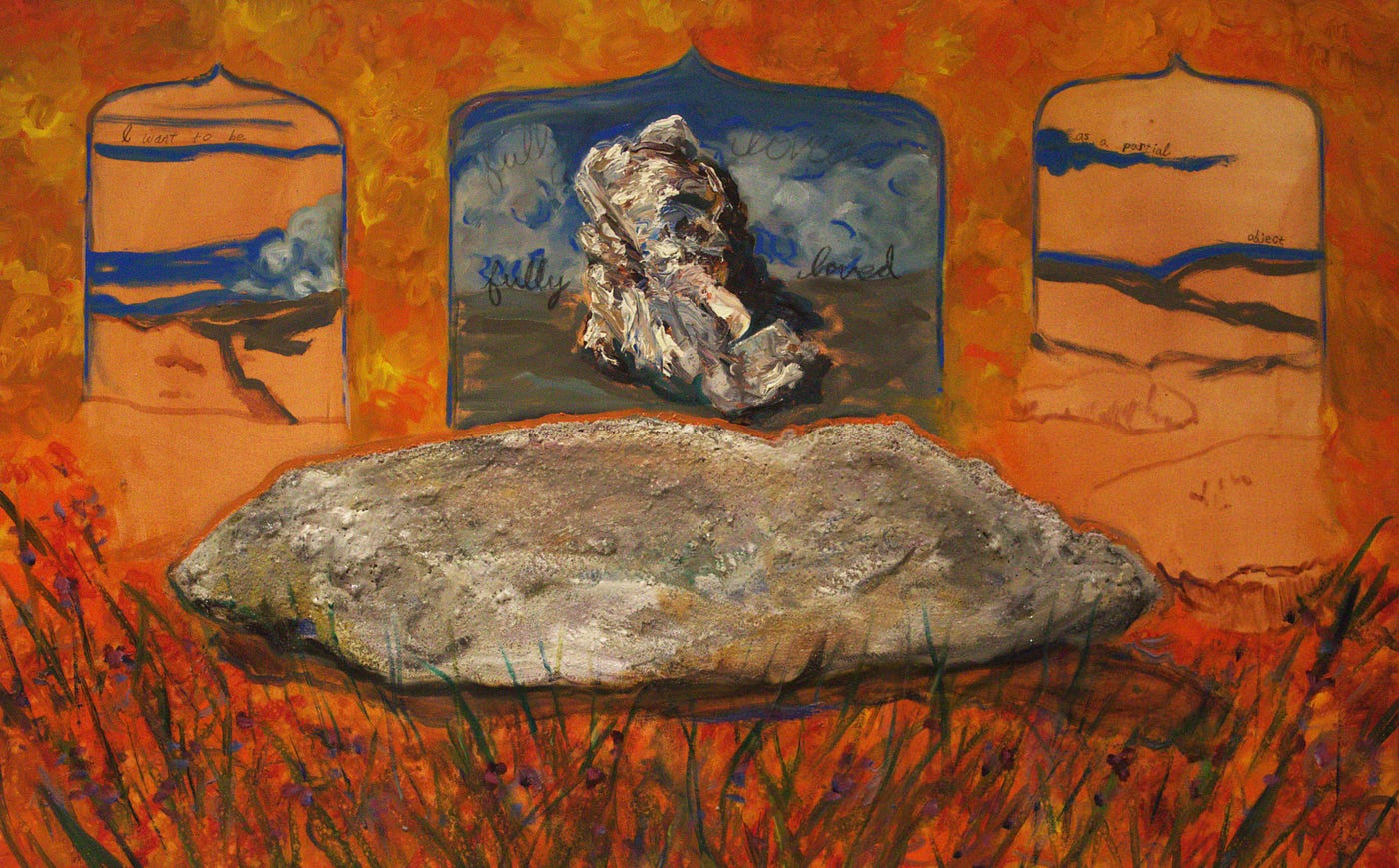
Platonic Glitches at Yosemite — Photo by Ishani Chokshi
Me, with my critical and skeptical mind, saw through every legal system that society pushed upon me. I was in need of Law and discipline, but if you know me, you know I wouldn’t settle for anything less than divine Law and discipline. I’m following no man but the man. This went on for a few years. I was in a search for a sufficient Law. And so, curious at witnessing the Gazan women and wanting to have even a bit of their strength and clarity, and already having realized the logical veracity of Islam through my comparative religious study, I looked into Islam and found a unique marriage between Love and Law.
On the other hand, without a guru, there is not much law to be found in the pure state of pseudo-Hindu Nondualism, except perhaps St. Paul’s “Law of Love,” Christianity’s golden law to “Love thy neighbor as thyself”… but that still doesn’t get you far. How does that love practically look like? Does it deny justice? If your neighbor kills your cat, what would it mean to respond in a way which loves your neighbor? If your neighbor kills someone, or commits genocide — what would loving him look like? Simply to confess and forgive?
St. Paul is a bit clearer when he says “Love thy Neighbor is the fulfillment of the Law,” not as the law itself, not the only law — but as Law’s fulfillment. Such a Law-fulfilling Love emerges only upon the back of Justice and the various more specific, granular laws that be. Jesus, peace be upon him, was much more clear when he said that all the other commandments and laws hinge off of the two greatest commandments: to love God and love your neighbor. This is a more mature, freer Love, one which embraces — rather than rejects — Law, including the more granular laws, while always aiming towards the grand project: Love as the fulfillment of Law. Love as the greatest expression and result of Justice, Justice as the vehicle for Love. But otherwise, Christianity doesn’t have much of a legal tradition. It is more known and celebrated for abandoning the Jewish laws; freedom from Law, not through Law. Indeed, the entire history of Western legal philosophy from St. Aquinas through Hegel is comprised of retroactive (yet, always incomplete) attempts at supplementing Christianity with a legal foundation — or otherwise, after Hegel, abandoning religion altogether in pursuit of pure secularism which brought us to the horrors of Carl Schmitt. We are realizing now, in our post-postmodern, neo-conservative era, what Martin Heidegger realized: that “only a God can save us.”
Islam resurrects the legal system within the Abrahamic tradition while also retaining the divine Love — the “good news” of Christianity. In Islam, there is a bothness of Law and Love. I have moved to explore this bothness in my painting practice, seeking to aesthetically depict this balanced beauty. I wanted to find a different way of ethical being other than hippie pseudo-Advaitism, and painting has been my space to explore this way of being.
Could embracing the strict Islamic laws of image-making help me out of my painting conundrum and give me something important to paint? Could it allow me to overcome Monet? From this, could I also learn lessons on how to integrate with the world and live a meaningful life?

Platonic Glitches at Klamath Falls — Photo by Ishani Chokshi
Because the true spiritual project is to learn how to live in this world and society; not to renounce or spiritually bypass it, but to work with and through it all. Not to shelter in the night, but to work in the daylight. And to do this, thoughts — in all their specificity and granularity — are required; you cannot wander around the streets blinded by the glorious light of GOD, or trying to blind others with it, imploring them to forget their differences or grievances — you need a much more sober and nuanced clarity, to see the nuances of the world and navigate through it, rather than bumble through like a bull in a china shop, or a Pollyanna in Auschwitz.
And so, as I did in my previous painting series, I incorporated my thoughts — and with it, meaning — back into the realm of pure painting. Seeking to be more than “just an eye!”, this series of work embraces Islamic aesthetic laws to explore solutions to the paralyzing problems that Monet and postmodernism has left us with. It seeks to incorporate the whole mind-body-spirit, rather than simply rushing into one body part, Monet’s eye, for example, and neglecting the rest; because ultimately, we do not experience the world as Monet claims: we do not abandon the brain and use “only our eye.” I did not witness Crater Lake without also thinking about GOD and the world and my own personal struggles — and so, Monet’s “pure painting practice” is incomplete and even perverse and dangerously misleading. It pulls you into a war in your mind, rather than pushing you out and into the world, grounded and balanced, and upon sure footing. Still mesmerized at creation, but with a more Platonic — rather than purely passionate — Love.
This requires clarity of thinking, and clarity of thinking requires a legal system by which to navigate community and the world. It is this clarity which I sought to discover and depict in this series of painting, which wages Law upon art — upon Monet in particular.

Awaiting a Lotus After Sunset — Photo by Heather Seybolt
In these paintings, I sought to establish a “purer” painting practice by reincorporating what Monet got rid of: thoughts and forms. To respect these additional aspects of creation, I incorporated Islamic frames from which to view the world and also adopted the Islamic practice of incorporating script into artworks … but I did it (mostly) in English, and using my own (inshallah, halal) thoughts and ideas. You can see these thought-formations in the charcoal writings and drawings over the first layer of landscape painting.

Detail of Dhikr 6.97, depicting Sufi lyrics from the movie “Veer Zara”— Photo by Heather Seybolt

Detail of Dhikr 6.97 — Photo by Heather Seybolt
Mucky, imperfect blobs of lilies — which is how Monet left his lilies — are elevated from partial, incomplete lotuses, through a gesture towards a “perfect” lotus, traced in a charcoal outline.
Such a legally-perfect lotus exists only in this realm of ideas, depicted by my charcoal tracings and writings. No actual lotus, in painting or real life, will ever look like such a lawful, perfect lotus — but the aspiration, the attempt to become so perfect, and more importantly: the gap between the actual lotus and the perfect outlined form, is where all that is valuable of humanity lies.
The glitch between the two realms, the real’s traumatic confrontation with the ideal, the failure of reality to conform to legal ideals, is where the Love of the Spirit comes flowing in. Love rushes into this gap, holds the deformed lily through its terror, its insecurities, its fears of abandonment, and it is a very maternal and paternal love, a divine love that holds you where and how you are while also directing you towards an ideal. Such is the beautiful struggle and purpose of life, without which people fall into depressions and escapisms. This struggle itself is a gift from GOD — it is where goodness and all the rest of the beautiful and unique wonders of humanity come in and blossom, all the things which are virtuous and good, all of it: mercy, love, generosity, faith, justice, reason, humility, loyalty, self-overcoming, transformation, action and bravery … all of it, born from this existential struggle.

Detail of Platonic Glitches at Klamath Falls — Photo by Heather Seybolt

Photo by Heather Seybolt

Detail of Platonic Glitches at Portland Japanese Garden — Photo by Heather Seybolt
Many may still question why I, a queer man, would ever appreciate Islam. And the answer, I hope, is now clear, and simple. It is because it is beautiful, absolutely (in the full Hegelian sense) beautiful, to view the world and myself through an Islamic lens, and it is utterly beautiful to be a Muslim, even — especially — a bad one.
I am one of these queer deformed lotuses, and in these paintings, I’ve sought to portray the beauty of these existential struggles. In embracing an Islamic principles, my painting practice found a balance between Law and Love, brain and body, eye and mind. I did not have to rid my thoughts or my passions. Adopting Islamic practices has allowed me to squarely and soberly witness and wonder at the beauty of the world, and record my experience with it, including my thoughts — which always pull me towards some other realm. It has led to the conclusion that “The/This path to heaven is cold,” meaning — the passions, disciplined, brought to heel (rather than indulged in and worshipped), the passions used as fuel to ascend to the transcendental plane of thought and to contemplate the greatest idea of all ideas: GOD. “I became cool, free,” as the Buddhist bhukkunis of the Therīgāthā say.
In Islam, I found a bothness of Law and Love and sought to depict it through these paintings. I took on Islamic arches as a frame from which to witness the world and its undulating creations — and I found it quite beautiful, to witness the world and myself from an Islamic lens, and inscribe it all onto the plane of the canvas.
Guided by one ideal (impossible?) goal: a clarifying, not confusing Oneness, these paintings hopefully leave us with precious partial objects aiming towards transcendental outlines. It’s Platonic glitches all the way down … gaps waiting to be filled with your Love.

Detail of Platonic Glitches at Yosemite — Photo by Ishani Chokshi

Detail of Platonic Glitches at Yosemite — Photo by Heather Seybolt

Detail of Platonic Glitches at Yosemite — Photo by Heather Seybolt

Detail of Platonic Glitches at Yosemite — Photo by Heather Seybolt
So, ultimately, I abandoned portraiture — was the sacrifice worth it? I think so; it forced me to discover a whole new type of beauty, an absolute beauty, a way to balance the mind with the body, the brain with the eye, which is the project of life and immortality itself, which provides a stability and empowerment far better than the drunken stupor of Monet’s lily ponds. I’ve learned lots from this painting practice, and it has brought me balance and purpose and direction.
Islam provides granular laws and — most revolutionarily — applies them equally, regardless of caste. It provides many of such laws, a strict yet flexible, universal yet tailored legal support by which to engage in this world — and I didn’t need to subject myself to any guru, except GOD himself.
It is these laws that I took as guide to make these paintings. These paintings present body and mind, brain and eye, reason and passion, working together. They place the sensuous in a transcendental yet immanent Islamic frame.

Photo by Heather Seybolt
These paintings have waged Law upon Monet, upon postmodernity itself.
Such an overcoming, I think, was also Swami Vivekananda’s Only Hope: to overcome Monet. He identified in Advaita Hinduism the problem I just explicated. In a brilliantly paradoxical way, a rigid and unjust, unequal and unfree system of caste was built upon this Nondualist philosophy of radical equality. And this, because the Nondualist could simply say to an anti-caste activist, “In truth, in the eyes of GOD and divinity, all castes are equal, the king is the same as the toilet cleaner — it is you, you simpleton who is demanding practical, worldly equality! How lowly you must be, to not see you, and everyone else, are already equal!” What a cynical and perverse use of this philosophy! Swami Vivekananda identifies it, when he wrote, that “practical Advaitism, which looks upon and behaves to all mankind as one’s own soul, was never developed among the Hindus universally. On the other hand, my experience is that if ever any religion approached to this equality in an appreciable manner, it is Islam and Islam alone. Therefore I am firmly persuaded that without the help of practical Islam, theories of Vedantism, however fine and wonderful they may be, are entirely valueless to the vast mass of mankind.”

Detail of Dhikr 21.32 — Photo by Heather Seybolt
In its stead, Swami Vivekananda, who was a staunch Hindu nationalist and PM Modi’s hero, who habitually condemned Muslims and even Islam itself for the massacres of Hindus, destruction of temples and forced conversions … Swami Vivekananda nonetheless (and this speaks to his uniquely elevated and creative wisdom) envisioned a peculiar nationalism. He wrote, “… a junction of the two great systems, Hinduism and Islam — Vedanta brain and Islam body — is the only hope. I see in my mind’s eye the future perfect India rising out of this chaos and strife, glorious and invincible, with Vedanta brain and Islam body.”

Photo by Heather Seybolt
In embracing Hindu Love and Islamic Law, I have attempted to embody such a hope, Swami Vivekananda’s Only Hope, and in this series of paintings, I hope to have expressed it to you all.
Because it is easy — and oh so tempting — to wrongly conclude that in the face of Divine Oneness, all worldly things are meaningless. The truth, in fact, is not that everything is meaningless, but simply that meaning itself is revealed as just another aspect of creation, which pales in comparison to the Creator: to That which grants meaning. We still have to respect worldly differences, thoughts, and meaning, as we have to respect all creation, including Law. It is immoral — and even anti-Advaitist — to do otherwise.
It this “secret Truth” of Nondualism which I, by embracing Law, carried back with me from Crater Lake and into this art gallery, and it is this experience which I hope these paintings leave you with.

Photo by Heather Seybolt
메타데이터
- post_id
- cc1703f77ef8
- slug
- swami-vivekanandas-only-hope-overcoming-monet-cc1703f77ef8
- url
- https://medium.com/@ishanichoks/swami-vivekanandas-only-hope-overcoming-monet-cc1703f77ef8
- canonical_url
- https://medium.com/@ishanichoks/swami-vivekanandas-only-hope-overcoming-monet-cc1703f77ef8
- author_url
- https://medium.com/@ishanichoks
- status
- ok
- fetched_at
- 2026-06-26 03:39:16




