The D.E.E.P. Model: Turning AI Research into a Controllable Process — Part-02
A lot of people watch a Deep Research demo and come away with the same first reaction:
The D.E.E.P. Model: Turning AI Research into a Controllable Process — Part-02
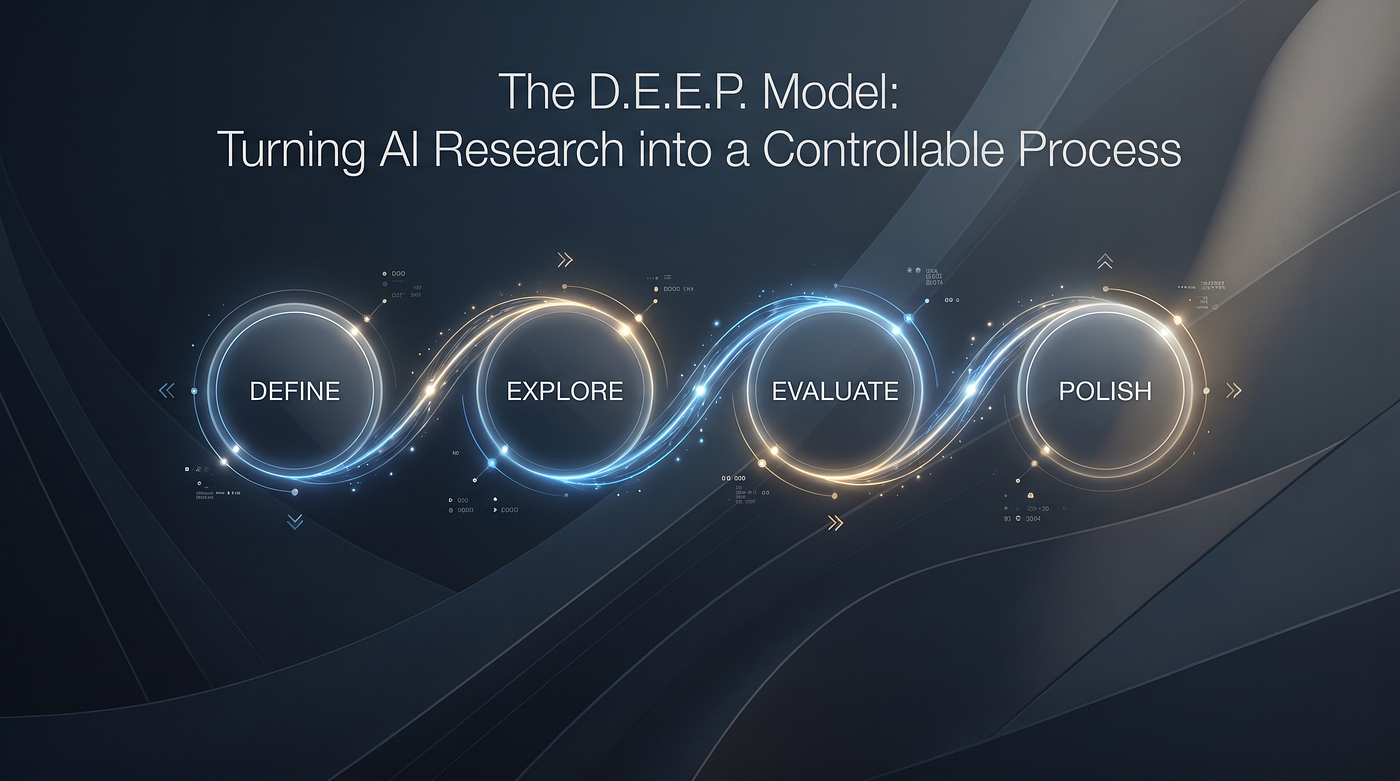
02-deep-workflow-cover
A lot of people watch a Deep Research demo and come away with the same first reaction:
“This tool is incredibly strong.”
But after using it a few times, a second reaction often shows up:
“Then why do my research outputs still feel vague?”
That is normal.
Because the gap between “this tool is powerful” and “I can reliably produce high-quality research” is not a stronger model.
It is a controllable process.
That is why I compress the method into a simple four-step model:
D.E.E.P.
- D = Define
- E = Explore
- E = Evaluate
- P = Polish
Think of it as the minimum viable loop. Not the most elaborate. But enough to push you from research-by-instinct into a real working method.

deep-research-deep-model-framework-en
01 Why do so many AI research outputs look complete but fail to support decisions?
Because they only finish collection, not research.
Collection asks: Did we gather enough material?
Research asks: What does the material actually mean? Can it support judgment? Where might it be misleading us?
Many AI research workflows still look like this:
Think of a question → Open Deep Research → Wait for the report → Reuse the parts that look goodThe problem is not that this is slow. The problem is that it is uncontrolled.
You did not set the boundaries. You did not design the routes. You did not validate key assumptions. You did not compress information into insight through questioning.
The result may look like a report.
But it does not necessarily function like decision support.
That is what D.E.E.P. is for.
02 Define: ask the right question before you ask for the answer
Most failed research does not fail because people cannot find answers.
It fails because they started with the wrong question.
Ask this:
“Does our new product have market opportunity?”
Of course the AI can answer.
It will give you market size, trends, competition, opportunities, and risks. It will sound plausible. But the question is too large and too vague. It invites polished nonsense.
Real Define work does at least four things.
Break the big question into researchable sub-questions

02-inline-define-board
Do not stop at “Is there opportunity?” Keep breaking it down:
- Do target users have a concrete pain point?
- How do they solve it today?
- Why are current solutions unsatisfying?
- Which variable actually determines willingness to buy or convert?
- Is our edge really about product, channel, cost, or delivery?
The moment you decompose the question, the research improves.
Set clear boundaries
If the boundaries are fuzzy, the research will sprawl.
At minimum, define:
- which market,
- what time range,
- what product or use case,
- and what decision this research is supposed to support.
If you are evaluating whether a BeePop.ai capability is worth investing in, you should not vaguely research “the AIGC content tools market.” You should specify:
- who the comparison set is,
- whether Lovart, Gamma.app, and LinkFox solve the same user problem,
- and whether the goal is product direction or go-to-market judgment.
Make the AI show its thinking route first
One of the most practical moves in the entire workflow is this:
Before you begin the research, tell me your thinking, framing, and research structure so we can find the golden thread together.
This is enormously valuable.
You see where the model is about to go before it spends the effort.
If the structure is already crooked, you can correct it early.
Start from a hypothesis, not from empty curiosity
A more mature method is not to dump a blank question on the model, but to begin with a tentative hypothesis:
- I suspect the real issue is not traffic but fulfillment stability.
- I suspect these users care less about feature breadth than about result speed.
- I suspect the apparent moat of this competitor is not product quality but channel power.
Now the model is not just gathering material. It is helping you validate or overturn a working theory.
Minimum usable prompt example
A version closer to how I actually used it is this:
I want to research [TOPIC].
Before you begin, tell me your ideas / framing / research structure so we can find the golden thread together.
Please help me through the D.E.E.P. process:
- Define: break down the problem, fill in boundaries, surface key hypotheses;
- Explore: propose several different research paths;
- Evaluate: identify the main risk points that require validation;
- Polish: show me how to turn the result into a decision recommendation.
Use English or local-language search terms if helpful, but write the output in Chinese.
03 Explore: do not search more — design better routes
Many people still understand Explore as “search a few more keywords.”
That is nowhere near enough.
Real Explore means building a search and route strategy that improves your hit rate.
Start with light research, then escalate
My normal pattern is not to open the heaviest mode immediately.
I usually start with a light round first.
For example:
- let GPT-5.4 or GPT-5.5 sketch the problem frame,
- use Perplexity to see which sources and angles already dominate,
- or ask a freeform question to see where the model naturally wants to go.
The point of light research is not a final answer. It is to:
- expose the most promising sub-questions,
- calibrate keywords,
- surface possible routes,
- and reveal blind spots early.
Run multiple routes in parallel
The same question can produce dramatically different results depending on how you package it.
That is why I do not trust a single route.
I try different versions:
- open-ended framing,
- structured framing,
- business perspective,
- user perspective.
With platform research — for example Shopee, eBay, and eMAG — you can explicitly split the inquiry:
- Which platform fits based on rule structure and traffic dynamics?
- Which fits based on fulfillment, selection, and competitive density?
- Which fits based on long-term repeat purchase and content-led growth?
Use cross-language and non-standard search
The most valuable information is often not in Chinese.
So whenever the topic involves overseas platforms, users, or products, explicitly request:
Search in English or the local language, but summarize in Chinese.
Also, do not only search for the “standard answer.”
Look for:
- user complaints,
- community threads,
- hiring pages,
- investor materials,
- conference talks,
- and edge-case evidence.
A surprising amount of truth does not live on page one.

deep-research-guide-02-advantages-comparison
04 Evaluate: do not just stack information — start judging it
If Define sets direction and Explore sets route quality, Evaluate determines whether the whole exercise has any soul.
At this stage you are no longer merely collecting information. You are starting to form judgment.
Use a two-way movement
I like to explain it this way:
- bottom-up pattern extraction
- top-down hypothesis validation
If you only do the first, you drown in material.
If you only do the second, you become trapped inside your own prior assumptions.
The real work is in moving back and forth between them.
Cross-check the claims that matter most
Not every sentence deserves the same level of scrutiny.
The ones that do are usually:
- critical data,
- trend judgments,
- cause-and-effect explanations,
- competitor comparisons,
- and the suspiciously elegant conclusion.
Ask:
- What exactly is the evidence?
- Are there counterexamples?
- Is there an independent source?
- Is the data being quoted in the right context?
- Is correlation being mistaken for causation?
Watch the cognitive traps
The most dangerous problem in research is not lack of information.
It is bad information, half-true information, or information that flatters what you already want to believe.
So Evaluate should always watch for:
- confirmation bias,
- survivorship bias,
- anchoring,
- authority bias,
- narrative fallacy,
- overgeneralization,
- false causality.
If a conclusion feels especially satisfying, that is often a sign you should check it harder.

deep-research-guide-04-evaluate-pyramid
05 Polish: turn “what I learned” into “what it means”
Many people think the work ends when the report is complete.
In practice, that is where the real work begins.
Polish is not mainly about polishing wording. It is about compressing information into decision support.
Alternate between fast and slow
Not every thread deserves immediate deep drilling.
A better rhythm is usually:
- fast, broad, shallow first,
- then slower, narrower, deeper work,
- then opening a new branch only when the evidence says it is worth it.
Translate findings into action
Real insight is not “I now know a lot.”
It is:
- What does this imply for our decision?
- Which hypothesis was confirmed?
- Which one collapsed?
- What should we do next?
- What should we stop doing now?
Keep a research log
If you do this work often, keep a research log:
- What you asked,
- which framings worked,
- which turns later proved wrong,
- which judgments reality confirmed,
- which prompt shapes work for which task.
That is how AI research skill becomes a compounding asset instead of a repeated reset.
06 A minimum practical example: running D.E.E.P. for BeePop.ai and cross-border platform research
Imagine two kinds of research:
- competitor research around BeePop.ai / lovart / linkfox ,
- and platform-entry judgment among Shopee, eBay, and eMAG.
A D.E.E.P. run might look like this:
Define
- What decision is this serving?
- Product direction?
- Growth strategy?
- Platform pilot priority?
Explore
- One route for product capability and user job-to-be-done
- One route for traffic, fulfillment, and competition density
- One route for user reviews, forums, and real complaints
Evaluate
- Does the user truly care about this feature?
- Is the competitor advantage real or just demo polish?
- Is the platform opportunity a durable edge or a temporary mirage?
Polish
- Which direction deserves a pilot?
- Which assumption deserves a cheap validation step?
- Which noisy opportunity should be ignored for now?
Minimum usable prompt example
If you want to run a first pass with D.E.E.P., a practical prompt closer to my real workflow looks like this:
I want to research [TOPIC].
Before you begin, tell me your ideas / framing / research structure so we can find the golden thread together.
Please help me through the D.E.E.P. process:
1. Define: break down the question, set boundaries, surface key hypotheses;
2. Explore: give me several different research paths;
3. Evaluate: identify the risks that most need validation;
4. Polish: show me how to translate the result into a decision recommendation.
Use English or local-language search terms where useful, but write the output in Chinese.
deep-research-guide-05-training-workflow
Conclusion: process is not a cage — it is how insight becomes repeatable
People sometimes hear “model” or “process” and worry that it will make thinking rigid.
I see it the other way around.
Process is not a cage. It is how you stop relying purely on luck.
D.E.E.P. does not exist to restrict thought.
It exists to help compress scattered intuition, vague judgment, and occasional inspiration into a reusable, verifiable process that can actually move decisions.
So if you ask me what Deep Research really changed, I would say this:
It did not suddenly make everyone smarter.
It forced us to admit that high-quality research has never been a tool problem. It is a process problem, a judgment problem, and a question of whether you are willing to keep pushing.
메타데이터
- post_id
- cc186a0a69f5
- slug
- the-d-e-e-p-model-turning-ai-research-into-a-controllable-process-part-02-cc186a0a69f5
- url
- https://medium.com/@Seamoon.Beepop/the-d-e-e-p-model-turning-ai-research-into-a-controllable-process-part-02-cc186a0a69f5
- canonical_url
- https://medium.com/@Seamoon.Beepop/the-d-e-e-p-model-turning-ai-research-into-a-controllable-process-part-02-cc186a0a69f5
- author_url
- https://medium.com/@Seamoon.Beepop
- status
- ok
- fetched_at
- 2026-06-09 15:37:30





