Dwight Boyer: The Man Who Spoke for “the Little Feller”
Beyond the Numbers: Dwight Boyer and the Work of Caring for History
Dwight Boyer: The Man Who Spoke for “the Little Feller”
Collage for Flower in the River Podcast, Dwight Boyer: The Man Who Spoke for “the Little Feller”
Beyond the Numbers: Dwight Boyer and the Work of Caring for History
Promo video link: Dwight Boyer: The Man Who Spoke for “the Little Feller”
Podcast link: Dwight Boyer: The Man Who Spoke for “the Little Feller”
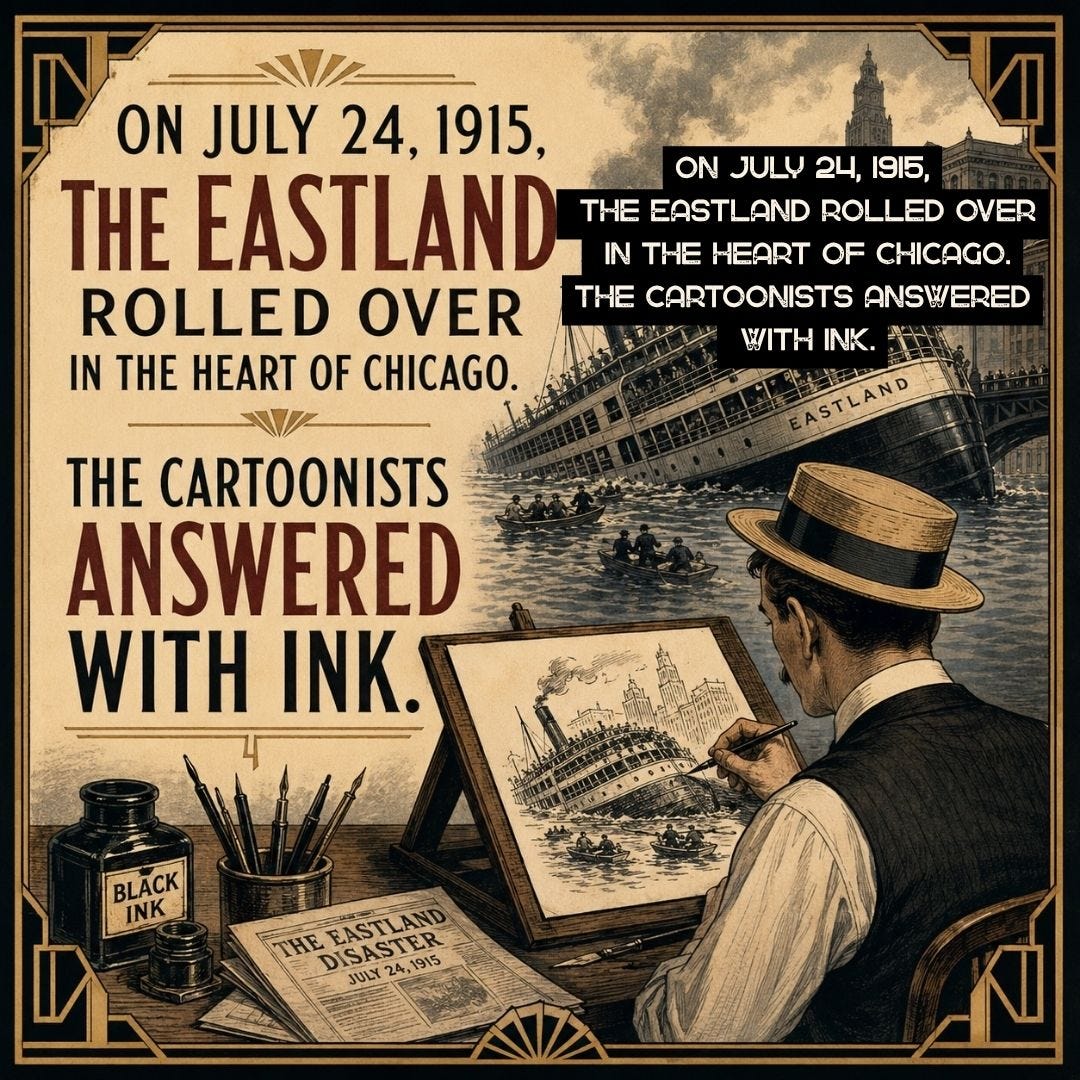
The Eastland disaster of 1915 conceals a story far richer and more gripping than recent retellings reveal. Its true depth comes alive as we follow the meticulous records left in its wake. The guiding principle is clear: let the evidence speak for itself.
It also urges us to revive the voices of those who endured the Eastland disaster: poets and journalists who distilled the city’s raw grief, searing anger, and desperate search for answers in the aftermath.
One of the best guides to this evidence is maritime journalist and Great Lakes historian Dwight Boyer. Before George Hilton wrote E astland: Legacy of the Titanic, Boyer had already published a detailed account of the Eastland in True Tales of the Great Lakes. He used primary sources, courtroom records, and interviews to create a report that reads like a story but stays true to the facts. Boyer stands out for his strong commitment to accuracy, his patience with small details, and his effort to remember the victims as people, not just numbers. For anyone studying the Eastland disaster, Chicago history, or maritime history, Boyer’s approach shows how to do careful research without losing sight of the human impact.
Boyer’s chapter revolves around “the little feller,” once just Victim 396, a child left unclaimed for days in the makeshift morgue at the Second Regiment Armory. Only when his playmates spoke up, and his grandmother arrived with the unworn extra pair of knickers from his new suit, did Willie Novotny regain his name. The story’s power lies not only in its heartbreak but in what it reveals: language barriers, families lost in an instant, agonizing delays in identification, and the city’s mounting demand for accountability amid the chaos.
Today’s marketing-driven retellings often begin with numbers, overlooking the fact that each one stands for a human life. Boyer reminds us that our work does not end with tallying the dead and closing the book. History is never truly finished. Every claim deserves verification, every source must be traced, and every name should be handled with care. Responsible stewardship of history welcomes questions, corrections, and even criticism, inviting family members, researchers, historians, and genealogists into the process. Engaging with the past is a living commitment to research and documentation, ensuring that every person touched by the Eastland disaster and its aftermath is restored to the historical record.
In this episode, I mention the wider circle of Eastland disaster writers who have been profiled in recent episodes, including Carl Sandburg, Agnes Lee, Edith Wyatt, and Olive Carruthers. I also introduce Michael Schumacher’s Along Lake Michigan: Shipwreck Stories of Life and Loss (2025). Schumacher’s key contribution is restraint: he explains why passenger counts and casualty totals were difficult to verify, noting how children were counted inconsistently and how survivors moved through hospitals without clean paperwork. Together, Boyer and Schumacher model responsible historical research, the kind that questions easy numbers, cites sources, and keeps faith with the people behind the records.
This approach lifts us beyond the repetition of familiar claims and guides us toward a richer, more thoroughly documented understanding of the people, records, and events that shaped the Eastland story.
Resources:
- Michael Schumacher, Along Lake Michigan: Shipwreck Stories of Life and Loss (Minneapolis: University of Minnesota Press, 2025).
- Dwight Boyer, “Who Speaks for the Little Feller?” in True Tales of the Great Lakes (Michigan: Thunder Bay Press, 1971), 27.
- Natalie Zett, “Who Speaks for Dwight Boyer? The Storyteller Who Remembered Them All,” Flower in the River, episode 126, August 7, 2025
- Natalie Zett, Dwight Boyer: Forgotten Chronicler of the Eastland Disaster,” Flower in the River, episode 125, July 31, 2025.
Originally published at https://www.flowerintheriver.com on July 10, 2026.
메타데이터
- post_id
- cc22d73cbf02
- slug
- dwight-boyer-the-man-who-spoke-for-the-little-feller-cc22d73cbf02
- url
- https://medium.com/@zett_51423/dwight-boyer-the-man-who-spoke-for-the-little-feller-cc22d73cbf02
- canonical_url
- https://medium.com/@zett_51423/dwight-boyer-the-man-who-spoke-for-the-little-feller-cc22d73cbf02
- author_url
- https://medium.com/@zett_51423
- status
- ok
- fetched_at
- 2026-07-23 05:18:06