Will Someone Please Tell me What’s Going on in Bharat?
“Will someone tell me what’s going on here?”
Will Someone please tell Me What’s going on in Bharat?
Every American movie usually features this dialogue at least once - “Will someone tell me what the hell is going on here?”
To non-Americans, this is emblematic of the average American’s ignorance of what’s happening in the real world.
Regime change and replacing democratic rulers by more authoritarian ones is the stock in trade of US foreign policy, despite the US’s much touted democratic credentials. If the natives react violently, the usual American response is to send in the cavalry. Today that’s B-52 and B-1 bombers, to apply large quantities of high explosive liberally to the affected parts.
Unfortunately we in India cannot use this sovereign American remedy for all ills.
A Road Trip East — West and North — South
I drove frequently across India when in service. Nowadays I drive regularly between Bangalore, where we stay, to my wife’s tharawad (family house) near Kochi and further south to my own house in Thiruvananthapuram, earlier Trivandrum.
Two years ago I drove from Guwahati to Shillong and then all the way East-West along the Himalayan foothills to a place in the hills North of Dehra Dun. Last year we drove from Delhi to Kargil via Pathankot and returned via Amritsar. This year my daughter and I drove from N of Dehra Dun (yes, that same place) to Pune via Jaipur and Mhow. These were all trips she had planned with her husband. He’s in the Army. However every time, he was called away at the last moment for some national emergency. So I packed my bags and flew over to join as co-driver.
In the first journey from the North-East of India to North-West of the Doon Valley, we drove along the foothills practically all the way. The route travelled from Assam to Meghalaya back through Assam, West Bengal, Bihar, Uttar Pradesh, Uttarkhand and Himachal Pradesh.
It was very scenic especially up in Meghalaya and then as we made our way down through West Bengal through Cooch Behar and Siliguri. Thereafter it was the plains and the Gangetic belt until we hit the hills once again past Dehra Dun. A distance of about 2300 km and we were still in the same country. We would have had to travel another thousand to hit the Western border. Made me feel very good for some reason. Call it patriotism, if you will, for want of a better word.
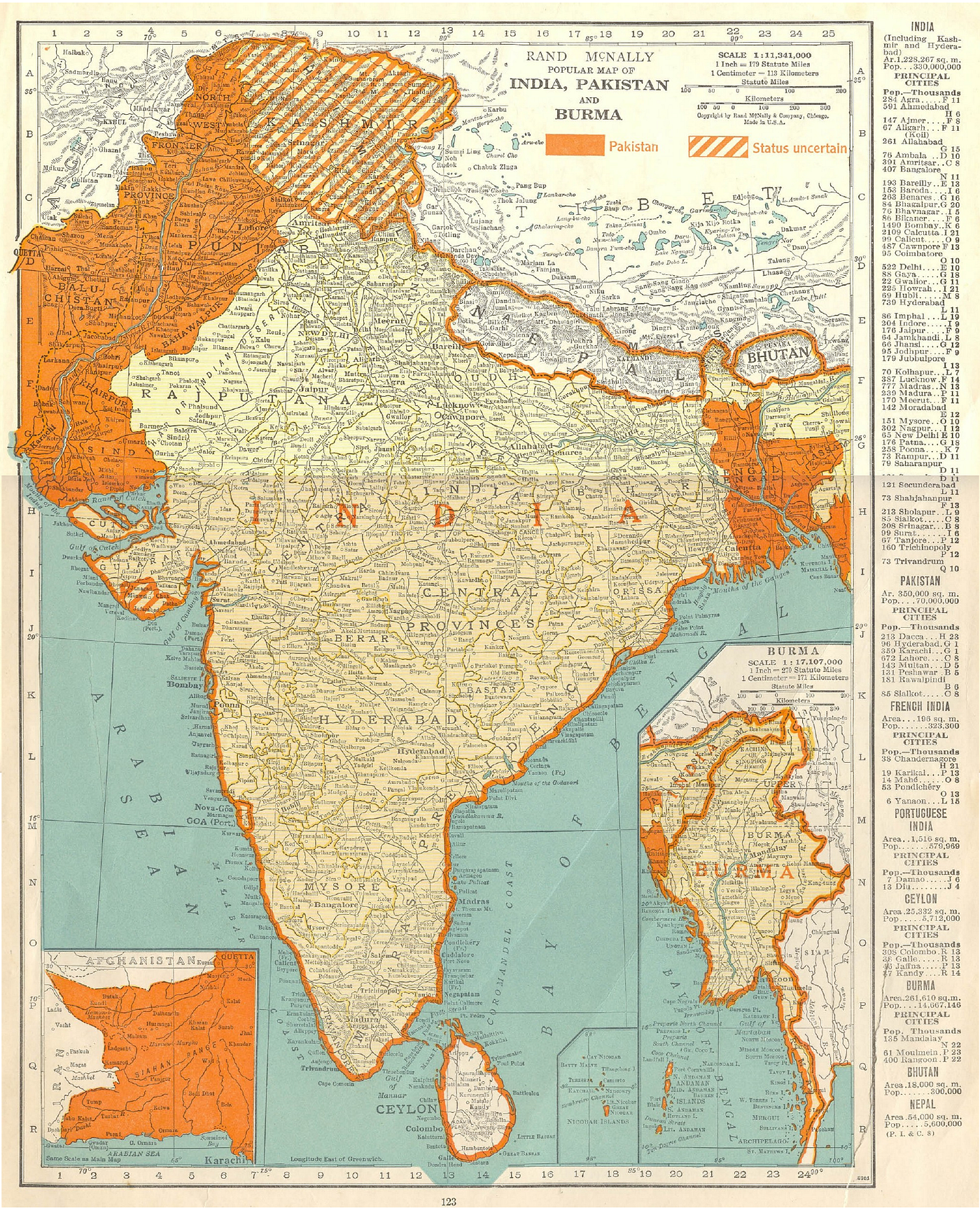
An outline of India as it was in 1947 by Rand-McNally
If we had not been partitioned in 1947, that border would have been two thousand km further west from Dehra Dun and the neighbour in question would have been Iran or Afghanistan. I often thought about that when doing ORP (Operational Readiness Platform) duties flying fighters in the Air Force, ready to take off within two minutes in case of a Pakistani intrusion. Foolish as it seems now, we trained all the time for war with Pakistan, not China.
Let me tell you what I saw.
Strange Travellers
All along the foothills, actually all along the route on the national highway, I saw newish settlements of people who looked as if they had come from somewhere else. Somehow different. They looked quite comfortable where they were, going about their business. What business? Selling fruit and vegetables, minding small grocery shops and so on. Not millionaires by any stretch of the imagination, but present in no small numbers. Who are these people? Not native to the region clearly, but from somewhere else. Who were they? God knows or perhaps Allah knows. Yes that’s right. All Muslim, the usual mosques with the mandatory domes and spindly minarets adorning the countryside. In fact on one occasion we had to slow down to avoid an eighty year old about to prostrate himself on the highway.
And this was not just in one place. It was practically all along the route. New settlements, not really pucca, but in the process of becoming permanent. The usual heaps of garbage and black burkha-garbed women going about their business, numbers of children playing around.
And later when we drove into the northern hills where there are plenty of sensitive defence installations, they were there too, herding flocks of sheep, cows and goats, more of them encamped in some field nearby. On inquiry we found out that that particular group were Bakarwals from Kashmir. I didn’t know that they wandered so far afield.
A History Lesson — Before Partition and After
So what is happening? To understand that we have to go into a bit of history.
The first official call for Pakistan was first made in 1930 by Mohammed Iqbal the poet (1877–1938), in his presidential address to the Muslim League in Lahore in 1930. This became official after the League’s 1940 Lahore session. However the Two Nation Theory which occasioned the birth of Pakistan was first propounded by Sir Syed Ahmed Khan (1817–1898), founder of the Anglo-Islamic College in Aligarh (now AMU) who is often wrongly proclaimed to be a modernist. Some ascribe its vague beginnings to Ahmed Sirhindi (1564–1624), a divine who claimed descent from the Punjabi saint Baba Farid (1173–1266). Sirhindi opposed Akbar’s pragmatic policy of religious pluralism, calling it anti-Islamic. In essence, he was a Salafi before Salafism was invented. Later Shah Waliullah (1703–1762) articulated the Islamic identity crisis due to the collapse of Muslim power post-Aurangzeb. Similar Muslim grievances were also voiced by Syed Ahmed Barelvi (1786–1831), another extremist, killed in Balakot in 1831 by the Sikhs under Maharaja Ranjit Singh.
According to the Muslim idea of India, Muslims had ruled the entire subcontinent ever since Mohammed bin Qasim conquered Sind in AD 711. Many Muslims called him the first Pakistani since they dated the creation of Pakistan to that event. Basically they thought of themselves as the ‘natural’ rulers of the subcontinent with the Mandate of Heaven.
A democratic India would mean that the more numerous Hindus would rule. Since Muslims thought only along religious lines, they assumed everyone else too did so, democracy or no democracy. A Muslim would therefore have to live under a Hindu ruler — a kaffir. This was unacceptable to the Muslim elite. Where the Muslim elite led, the Muslim under-class followed.
Mohammed Ali Jinnah expected to get the whole of the Punjab and Bengal for his Pakistan. Bengal then included today’s Bihar, Bengal (including what is now Bangladesh), parts of Odisha and Assam (today’s Assam plus all the other north-eastern states). A not inconsiderable piece of real estate, with Kashmir as bonus. How the considerable Hindu and Sikh populations who lived in these provinces were to be dealt with, was not clear to Jinnah — no deep thinker himself.
However what Jinnah got was just West Punjab, fertile though it was, and the city of Lahore with it. And the North-West Frontier Province or what is roughly Khyber Pakhtunwa today. And across the country on the other side, East Bengal and the Sylhet district of Assam. Jinnah got his Christmas present on 17 Aug 1947. Not exactly overjoyed, he gave vent to the now-famous phrase ‘a moth-eaten Pakistan’.
The Integration of the Native States — Junagadh, Hyderabad and Kashmir
Both Bengal and the Punjab were part of the British Raj, directly ruled by the British. But there remained some 560 odd native states in the rest of India. So when Sardar Patel and VP Menon went about the tricky business of coaxing reluctant maharajas and nawabs to become part of India, Jinnah’s emissaries were there too, to try and persuade them to join Pakistan. At the end, the holdouts were Kashmir, Hyderabad, Junagadh and briefly Travancore. Goa was annexed later in 1960.
With two wings two thousand kilometres apart, Jinnah had a huge logistics and administration problem. Meanwhile, he set about wooing the Nawab of Junagadh and the Nizam of Hyderabad to join Pakistan. Both were Muslim rulers of majority Hindu states, unlike Kashmir which was a Muslim majority state bordering Pakistan that had a Hindu ruler. Jinnah thought that Kashmir was bound to join Pakistan anyway. He decided to concentrate on Junagadh and Hyderabad, to which Pakistan had no physical connection. He was quite confident about his ability to persuade them to join Pakistan.
The Standstill Agreement which the native states had to sign in case they did not accede immediately to either state laid down that all agreements and administrative arrangements existing between the Crown and the States should continue ‘until new arrangements in this behalf’ were made.”
Junagadh never signed the Standstill Agreement with India, choosing to do so with Pakistan in July 1947 itself and actually acceded to Pakistan on 15 Aug 1947. The Indian government came to know about this fact only through newspaper reports on 17 Aug 1947, two days later. On 09 Oct 1947 after much parleying between India, Pakistan and Junagadh, the Indian Army entered Junagadh and took over the state with little resistance.
Hyderabad was the largest princely state in South India, with a Muslim prince ruling a Hindu majority, exactly the reverse of Junagadh. The Nizam too had hoped to remain independent, but realised soon that this would be difficult and entered into communication with Pakistan where Jinnah promised him great autonomy. In order to hold off Indian pressure he signed a Standstill Agreement on 29 Nov 1947 while he opened negotiations with Portugal for port facilities in Goa and placed orders for arms to be delivered to the state army and the Razakars. These last were an irregular force headed by an Muslim extremist called Kasim Rizvi.
The Razakars had already started terrorising Hindus in Hyderabad state, carrying out many atrocities as the state forces, practically entirely Muslim, looked passively on. With violence against Hindus increasing and refugees making their way to neighbouring provinces, the Govt of India sent the Indian army into Hyderabad state on 13 Sep. The operation took just three days. The army suffered only light casualties but the Razakars suffered almost 800 killed. On 17 Sep the Hyderabad army surrendered and on 18 Sep 1947, the Indian army entered the Nizam’s capital Hyderabad.
The Kashmir Conundrum
In the case of Kashmir, the Maharaja signed a Standstill agreement with Pakistan on 12 Aug 1947. India refused to sign one, asking the state to send its representatives to Delhi for further discussions, but there was no response. The Maharaja dithered while some of his retired Muslim soldiers started non-cooperation movements. On 22 Oct 1947, Pakistan launched Op Gulmarg, mobilising a mixed force of army regulars in mufti and tribals from the NWFP. They captured Muzaffarabad, then Uri and advanced along the Jhelum towards Baramulla, preparatory to entering Srinagar. These elements proceeded to unleash loot and rapine on the hapless population. Fired by religious zeal, serving Muslim soldiers of the state army also revolted, in many cases massacring their unsuspecting Dogra and Gurkha fellow soldiers.
Belatedly, the Maharaja saw reason and indicated that he was ready to sign the Instrument of Accession. However for some reason, PM Jawaharlal Nehru kept delaying the signing of the instrument. Many ascribe this to his strong desire to force the unwilling Maharaja to appoint Sheikh Abdullah as the Prime Minister of the state. The situation continued to unravel with urgent calls from the Maharaja for Indian intervention, which was not possible without accession. This part is shrouded in mystery, with all the principal actors now dead and gone. This delay allowed the raiders to capture more territory, including the province of Gilgit-Baltistan, where the infamous Lt Brown declared its accession to Pakistan.
Sardar Patel though earlier reconciled to Kashmir joining Pakistan, was persuaded to change his mind by his deputy VP Menon’s advice. Indian troops moved into Srinagar on 26 Oct 1947, following the Maharaja’s signing of the Instrument of Accession earlier that day. The raiders’ delay in capturing Srinagar airport allowed the Indian army to airlift its troops in. That rapidly turned the tables allowing the recapture of several areas. But an importunate appeal to the UN by Nehru on 01 Jan 1948 gave the old colonisers and their friends the opportunity they desired to brew trouble. Nehru bears much of the blame for this, thanks to his misplaced belief in the white man’s fair mindedness and impartiality.
Pakistan’s Logistics Problem
Now reconciled to a Pakistan with two wings separated by one thousand miles of India, Jinnah decided to request India for a corridor connecting Pakistan’s two halves. Earlier when it seemed that Hyderabad would be part of Pakistan, he had modified this corridor to include a southern link to that state. East and West Pakistan and then Hyderabad would be connected by this umbilical cord to each other. How he thought this could be made workable is not clear, but it depended very much on the mercy of the Indian state and could be cut at any time.
Lately I have seen some YouTube interviews in which a Pakistani reminiscences that the original map of Pakistan included not only what is now Pakistan but also East Punjab (India’s Punjab), Haryana upto Delhi, all the PEPSU hill states (present day Himachal Pradesh), Jammu, Kashmir, Ladakh and the entire foothill region west to east all the way to what is now Bangladesh. This would imply that Pakistan would extend unbroken across the entire northern part of this subcontinent. You learn something new every day. I had not seen this earlier in all my reading.
Choudhry Rahmat Ali’s Pakistan
The name Pakistan was coined by Choudhry Rahmat Ali, a Punjabi Muslim, while he was still a student in England in 1933. Pakistan stood for Punjab, the NWFP (Afghania), Kashmir, Sind and Balochistan. The map below shows what Rahmat Ali thought India should look like after the British had left.
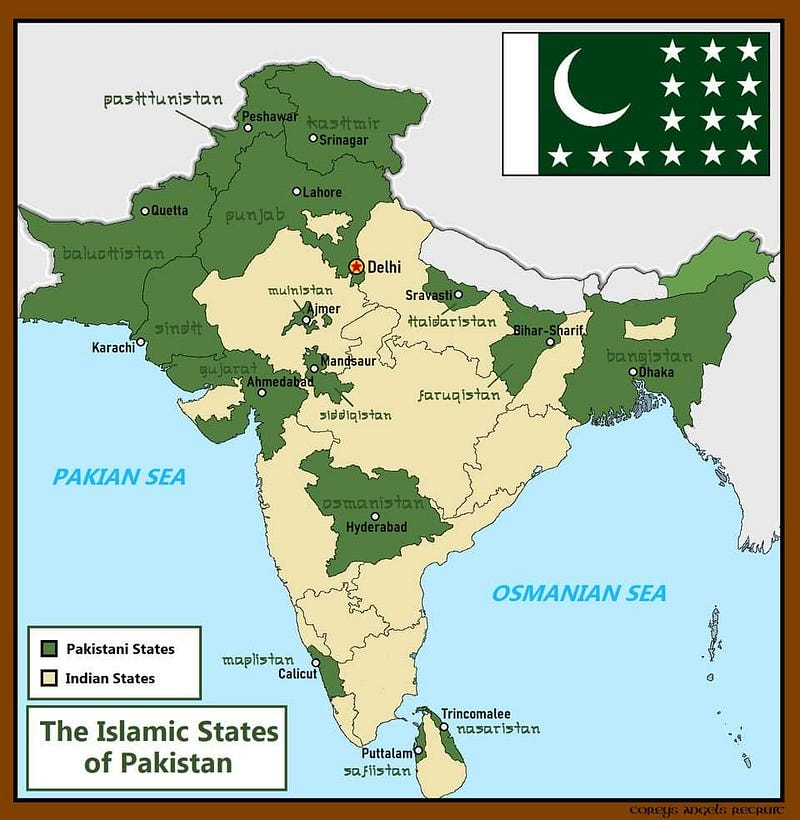
Choudhry Rahmat Ali’s Vision of India Balkanised
He envisioned an India with many Muslim majority statelets (shown in green) scattered throughout its territory. Of course he did not call it India. It is quite obvious that he did not foresee any territorial federal unit in charge of the whole. There would be different territories, the most powerful of which would be Muslim, and a few Hindu ruled statelets.
Punjab would include Delhi too. There were to be Muslim enclaves in Malabar (Maplistan) in what is now Kerala and even in Sri Lanka (Safistan and Nasaristan) at its northern end closest to India. Gujarat too would be part of Pakistan, not to mention Siddiqstan, Haidaristan and Faruqistan. Bengal and Assam together constituted Bangistan.
Rahmat Ali also renamed the Indian Ocean as the Osmanian Sea, the Arabian Ocean as the Pakian Sea and the Bay of Bengal as the Bangian Sea.
Rahmat Ali blamed Jinnah for accepting a much smaller Pakistan than his own maps had depicted, calling him Quisling-e-Azam. In 1948, he was expelled from Pakistan, dying in poverty in England in 1951.
Demographic Changes in India
A 2003 book by AP Joshi, MD Srinivas and JK Bajaj titled ‘The Religious Demography of India’ highlights demographic changes district-wise based on the Indian Census reports from 1881, when the census was first conducted by the British, until 2001. The book received instant condemnation from leftist and Islamist circles.
JK Bajaj has also posted a detailed updated video on YouTube, which now includes all the census data till 2011, post which year the census has not been conducted. See it here (https://www.youtube.com/watch?v=FiRi-W4uM8g). The 2021 census was postponed due to the Covid pandemic.
Ignoring data that stares you in the face is an article of faith for most Muslim apologists. So data is interpreted to show that Muslims birth rates, historically higher that that for any other religious group, are declining steeply and might even fall below that of Indic populations, while in actual fact Muslim births far outnumber Hindu as a percentage of population. Leftist ‘experts’ claimed that Hindus were making a needless fuss about population growth rates which was not borne out by the ‘facts’. They had nothing to worry about. This has been endlessly repeated with minor variations.
In Kerala for example, Hindus number around 55 per cent, while Muslims number 27 per cent vide the 2011 census. So the Muslim population is about half that of the Hindus. In the year 2021, Muslims accounted for 40 percent of all child births while Hindus accounted for 43 per cent of all childbirths.
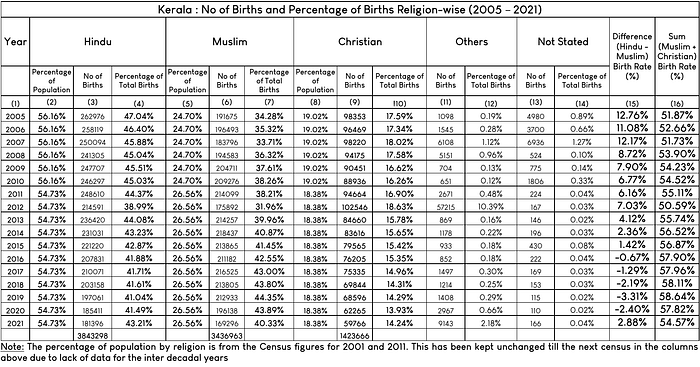
However it turns out that 2021 was actually an aberration, since that year 12100 more Hindu babies were born than Muslim. Actually, in every year after 2015, more Muslim babies than Hindu have been born in Kerala. In the years between 2016 and 2021 (both included) Kerala has seen the births of 11,84,928 Hindu babies and 12,19,879 Muslim babies. So in a space of six years a Muslim population which is less than half the Hindu population, has produced about 35000 more babies. That’s pretty good going by any standard. And remember that in Kerala the Muslim population is much more prosperous and the women more highly educated than in any other Indian state, both factors conducive to the wider acceptance of family planning and smaller families.
The term BIMARU was coined as a pejorative acronym for Bihar, Madhya Pradesh (MP), Rajasthan and Uttar Pradesh (UP) due to their low socio-economic indicators. The states of Chattisgarh, Jharkhand and Uttarkhand were later formed from MP, Bihar and UP respectively. In all these states, the birth rates of the Hindu and Muslim populations are far higher than in Kerala. So Kerala is an outlier as far as socio-economic indicators are concerned.
India’s Muslim Problem
India’s Muslim population is about 200 million or about 14.2 percent of the population, though some estimates put it at 250 million.
Most Muslims exist at the lower end of the socio-economic scale. They have low education, low incomes and poor prospects. This is not unlike many in the lower castes among the Hindus. Most Muslims live in urban areas in densely populated ghettos composed almost exclusively of Muslims. Education means going to the madarsa or madrasa, where they get a smattering of letters while memorising the Quran. Most do not learn Arabic, so the book is merely memorised. For meaning, they are dependent on the maulvi, to whose supposed knowledge they defer.
Unlike the Muslims, Hindus have always had great respect for secular education. The idea that one’s lot can be bettered by education prompted the majority to opt for higher education and to strive for government and private sector jobs. This pattern fell into place soon after the first Anglo-Indian colleges were opened by the British in the 19th century. Hindus soon started filling up all the lower posts in the East India Company’s offices in the administration. Muslims refused to opt for a secular education and continued to patronise their madrasas. They soon saw with dismay that Hindus were occupying most positions in the lower hierarchy and as British attitudes liberalised, they started moving up into positions of greater authority.
Unfortunately Muslims have been let down by their religiously oriented collective leadership. They have failed to go in for modern education and are content with madrasa education. This is not to gainsay the fact that Muslims own many small businesses in the cities — vegetable, fruit, flower, meat, automobile and mobile repair shops, businesses which in fact they dominate. However the vast majority continue to languish in poverty.
Since many Muslims are deeply religious and attend mosque services regularly, they are therefore deeply influenced by what is preached by the supposedly more worldly-wise maulvis who harangue them there every Friday. One cannot afford to ignore the fact that many communal riots have been engendered by what is said in the mosques of a Friday.
The Nupur Sharma case in June 2022 and the killing of Kanhaiya Lal in Udaipur a few days later for supporting her, one of many associated with that case, spring to mind. Nupur Sharma’s crime was quoting some facts from the Islamic holy book without disparaging the prophet Mohammed. Even this it seems is not acceptable to Muslims. Hence manufactured outrage and many murders.
The BJP did not cover itself with glory. It immediately expelled her from the party.
One glaring fact which is often not mentioned is that those who participate in communal riots and are the major casualties thereof, are overwhelmingly from the lower end of the social spectrum. Their upper class co-religionists provide the fuel and leadership for these riots, while maintaining a safe and deniable distance from the death and destruction they so assiduously fan.
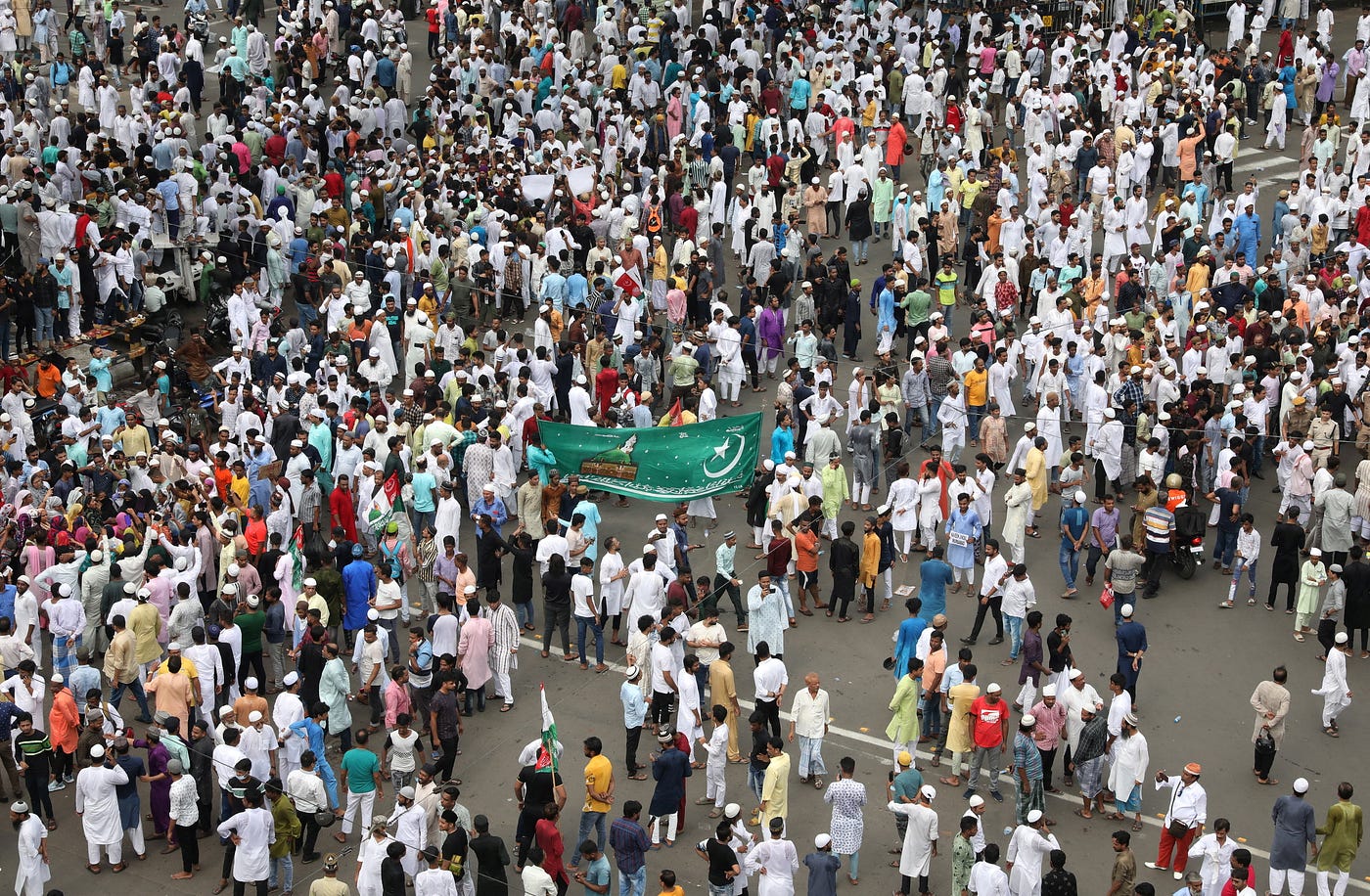
Muslim protesters demanding the arrest of Nupur Sharma for her remarks on Islam
Most Muslims are illiterate in Arabic and have merely committed their holy book to memory, without understanding its contents beyond the most basic. Because of their willingness to listen to and to obey religious dictates, and their blind adherence to a faith whose book they have not even read, they are easily led. The cry of ‘Islam is in Danger’, ‘Naara-e-Taqbeer’ and the consequent shouts of ‘Allah-u-Akbar’ are now familiar throughout the world not less in Europe than in Asia, Africa and Arabia. These are all that is necessary to rouse the faithful to action, which usually includes violence of appalling variety.
The desire for living in a state governed by Sharia law is often expressed even in Europe by the large numbers of Muslim immigrants who claim to have fled oppression in their own native lands. They apparently wish to replicate in these countries the failed systems they fled. The hold of Islam on its adherents cannot be understated. Understanding this is crucial for any state which counts followers of other religions among its citizens, to survive.
I have to add a disclaimer. There are many Muslims who are patriotic Indians. They are modern, well-educated and have small families, quite contrary to the usual impression most Hindus have of Muslims. However these are few in number, in relation to the large mass of backward Muslims. They are a small minority and speaking up against the bigots might cost them dearly. Hence they prefer to keep quiet. One cannot blame them. So what I have said above does not apply to them.
There are also an increasing number of ex-Muslims — Muslims who felt alienated at what is preached and practiced in the name of Islam. They are against the violent promotion of mediaeval practices and customs. Hitherto they had no platform. With the availability of social platforms, many of them have come out of the closet and now openly speak against Islamic practices, especially the lack of tolerance both within the community and against those of other faiths. Some of them have huge following. There are reports of large numbers of Muslims who have ceased to believe, but pretend to do so because of a fear of upsetting family and for socio-economic reasons.
The East-West Corridor
Dr JK Bajaj’s YouTube presentation follows the demographic changes in what is now India (as distinct from what is now Pakistan) district-wise from 1881 till 2011. There are several significant changes. Kashmir is now practically Hindu-free since 1990, when the Pandits were driven out after a concerted campaign of violence which included rape and brutal killings. Even a BJP central government has been unable to resettle them there.
However his analysis shows significant changes in religious demography in all the border states of the subcontinent. Practically all districts along the northern border with Nepal and China and in the East with Bangladesh show a significant increase in Muslim population. In some places in Bihar and West Bengal there is a sizeable Muslim majority. In the districts on the border with Bangladesh which is surrounded by India on three sides, Muslims form the majority. This Muslim majority is most significant in the ‘Chicken-Neck’, the narrow 26 km wide strip of land connecting the Northeast to the rest of India. In this area Muslims form 70 per cent of the population. They are mostly illegal immigrants from Bangladesh.
What is striking is that all along the northern boundary there is now an unbroken chain of Muslim majority districts connecting Bangladesh to Pakistan. So effectively after Jinnah’s death, our inattention to cross-border and internal migration has created the corridor Jinnah dreamed of between Pakistan and erstwhile East Pakistan, now Bangladesh.
Any area in which Muslims settle has the usual Muslim architecture of dominance - masjids, madrassas, mazhars, dargahs and areas exclusively Muslim. Therefore prospectively any Muslim immigrant from Bangladesh or Rohingya from Myanmar can at his first port of call in India, obtain all the papers necessary to identify himself/herself as a bonafide Indian and travel all the way to Pakistan and back. We know that there are agencies which provide genuine looking Aadhaar cards and voter-IDs to all these immigrants. La voila, they can vote in our elections and do.
The Spread of Illegal Immigrants Countrywide
In fact Rohingya and Bangladeshi illegal immigrants can now be found even in Kerala in the far south. It is estimated that by 2030 they will form fully one-sixth of the population in that state. Such immigration has been encouraged by both the Congress-led UDF and the Marxist-led LDF for vote-bank politics, though perhaps a shade more by the Marxists. Whatever be the reason, the fact is that the Kerala landscape has been irrevocably changed. If you take a walk at 6 am in the morning, the language that you are most likely to hear will be Bengali.
In fact the TV preacher Zakir Naik has exhorted Muslims in the North of India to move to the South of India where Muslims are more politically powerful and prosperous. He currently lives and broadcasts from Malaysia, having fled there from India after a non-bailable NIA warrant was issued against him for money laundering and propagating Islamic violence.
I use Kerala as an example merely to cite the reach of illegal immigration by Bangladeshis and Rohingyas. Malayalis now know enough to spot the difference between these two varieties of illegal immigrants. Another factor which has to be kept in mind is that this illegal immigration has been faciltated and encouraged by Kerala’s large Muslim population.
Kerala’s Muslims
Islam came to Kerala soon after the advent of Mohammed in the seventh century with the Arab merchants from Yemen who traded in pepper and other goods.
Kerala has been trading with the West and Arabia since well before the birth of Jesus. But in the seventh century, it just so happened that these same Arabs had now become Muslim. India’s first mosque was built at Kodungaloor (Cranganore) near Kochi. The Chera ruler donated a site or perhaps materiel meant for a temple, to the Arab merchants. Islamic lore claims that this ruler or possibly another, converted to Islam and died in Mecca. These rulers bore the hereditary title Cheraman Perumal (not a name) and hence this mosque became the Cheraman Mosque.
Kerala’s Muslims are now among the most prosperous and well-educated in the sub-continent. The Gulf boom which started in the seventies has benefited them tremendously. They number several billionaires among them. Their wealth originated in trade and business in the Gulf. This gives them great influence in politics in Kerala.
The fact that Muslims are a cohesive vote-bank also ensures that in every ministry whether led by the Congress or the CPI(M), Muslims control several of the most important ministries. Like at the Centre in the Nehru and Indira years, the Education Minister in Kerala is usually a Muslim. This has resulted in a mushrooming of Muslim institutions of higher education — higher schools, medical and engineering colleges and nursing schools. The reservation policy for Muslims pioneered by the Communists and continued by the Congress, has resulted in Muslims occupying a wide variety of positions in government and the judiciary.
Why I particularly mention Kerala’s Muslims will become clearer as we proceed.
Gandhi takes over the Congress
Mohandas Karamchand Gandhi returned to India from South Africa in 1915, having made his reputation by taking on the discriminatory system there, which segregated people on the basis of race / skin colour. Educated as a barrister in London, Gandhi found this overt discrimination shocking and fought against it. He however did not make common cause with the native Africans, but fought to put Indians on a level with the whites. Be that as it may, he returned to India in 1915 to great acclaim and joined the Indian National Congress.
The Congress at this time was dominated by the trio of Lala Lajpat Rai, Lokmanya Bal Gangadhar Tilak and Bipin Chandra Pal, collectively known as Lal-Bal-Pal.
The British government had enacted a series of repressive measures in order to ensure that support for the imperial war effort in WWI was not jeopardised by the struggle for Home Rule. Vague promises that Indian support for the war in Europe would be rewarded by some measure of autonomy or Home Rule like in Australia and Canada were also made.
Shortly after the war the Montague Chelmsford Reforms recommended limited self-government for India. But in 1919, the British passed the Rowlatt Act which mandated imprisonment without trial for sedition and continued the repressive measures of the war years.
Since his return Gandhi had been at a loose end. He had taken part in some minor anti-British farmer protests in Gujarat and Bihar. He now seized this opportunity to announce a satyagraha against the Act. This received massive support especially in the Punjab. Reports of the arrest of Indian leaders resulted thereafter in violent riots with foreigners being attacked.
All this came to a head on 13 Apr 1919, when more than 400 unarmed Indians who had gathered to protest the Act at a park in Amritsar were killed by an army detachment headed by Brig Reginald Edward Harry Dyer. He claimed in exoneration that an armed insurrection would surely have broken out had he had failed to act. Martial law was proclaimed throughout the Punjab and Indians were humiliated in public for breaking the curfew.
To the British, with memories of the Great Mutiny of 1857, Dyer seemed a hero. He was feted and a large public purse presented. An enquiry exonerated him. All this caused immense outrage in India.
The Khilafat agitation broke out shortly thereafter.
The Abolition of the Caliphate
Turkey joined WWI on the side of the Central Powers - the Austro-Hungarian Hapsburg Empire and Germany, against the Allied Powers — Great Britain, France and Russia. After the defeat of the Central Powers, the Allies (Britain, France, Italy and Greece) occupied Turkey. The Allies aimed to divide the Ottoman Empire amongst themselves, in effect an erasure of Turkey from the map. This was the culmination of plans laid as far back as 1915. The legal fiction of a Mandate from the League of Nations to administer these territories was the excuse.
One of the tools the Allies (Great Britain and France) used was the ‘principle of self-determination for ethnic and religious groups under the Ottoman Empire, which the British hypocritically refused to apply to India.
When Turkey was defeated in WWI, Mehmed VI had just taken over after the death of his brother Mehmed V. In 1920, he signed the Treaty of Sevres. This would have ceded large parts of what remained of the Empire to France, the UK, Italy and Greece, leaving just a tiny rump Turkish state which he would rule. This was unacceptable to patriotic Turks led by Mustapha Kemal Ataturk. The War of Independence broke out and was ended by Turkish victory with the Treaty of Lausanne confirming Turkey’s current borders in 1922.
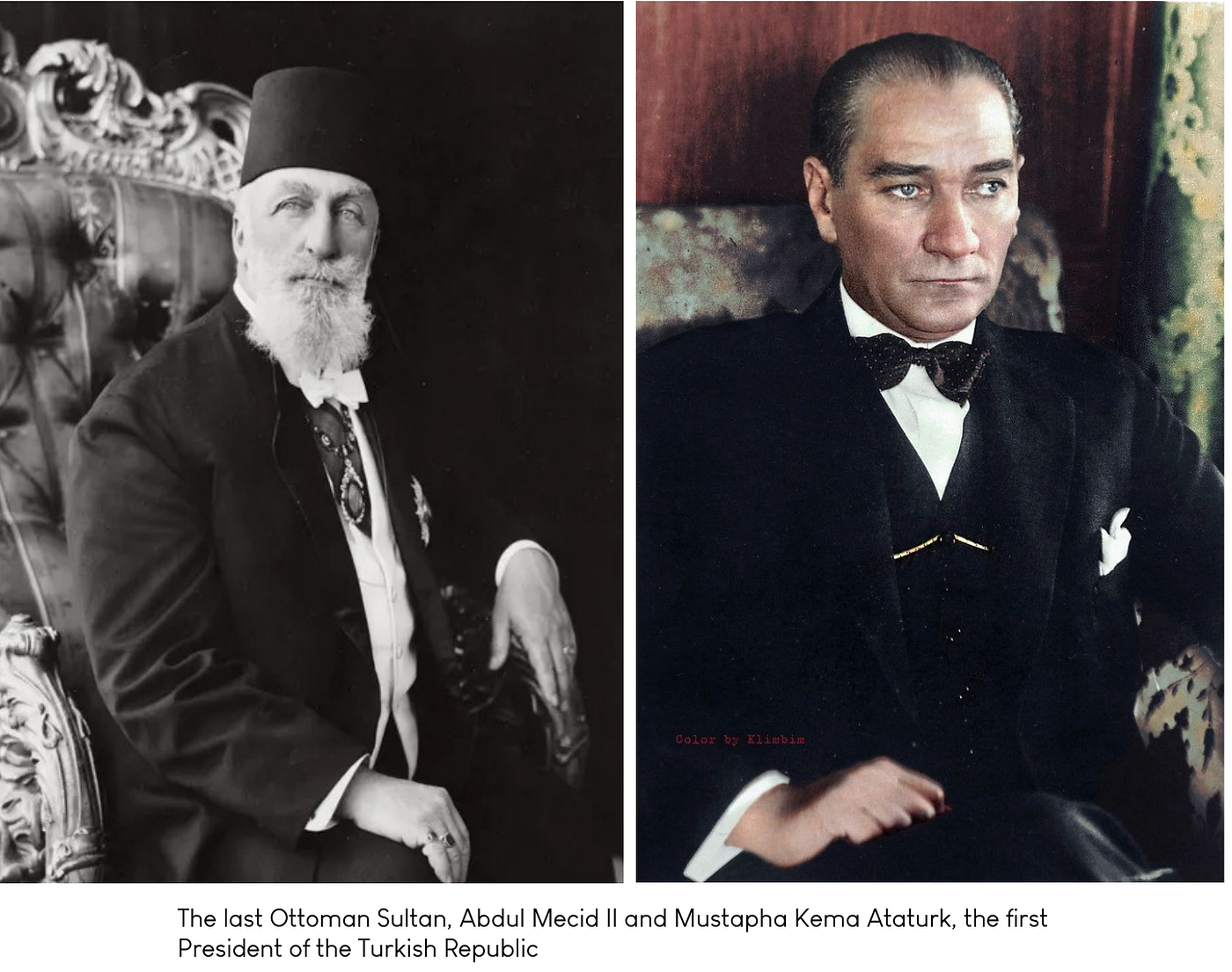
The Sultanate was then abolished and Mehmed VI sent into exile. In 1924, Abdul Mecid II was elected Caliph by the Turkish National Assembly, but six months later the Caliphate was abolished, Abdul Mecid II going into exile.
Indian Muslims became upset when Mehmed VI was removed from power and the monarchy abolished, with Turkey becoming a republic. At this stage the Caliphate was still in existence. The casting aside of the Caliph upset the Muslims of India more than it did the Turks. It was these circumstances that gave rise to the Khilafat movement headed by the Ali brothers.
Ataturk’s next moves must have appalled Indian Muslims even more. Traditional dresses like the burkha and hijab were banned. Women were required to dress in Western fashion. The fez was abolished. Men had to go bare-headed or wear hats. The Turkish language script was changed from Arabic to Roman. Education for women was decreed. All these measures were strictly enforced.
Gandhi saw the Khilafat Movement as an opportunity to solidify Hindu-Muslim relations. So he urged Hindus to show common cause with the Muslims and participate in this retrogressive agitation to restore the Caliphate, which modernist Turks themselves had rejected in favour of a secular state. It was a colossal blunder and injected communalism into Indian politics, the effect of which still looms large. It proved that he did not at all understand the Indian Muslim mindset and its desire for a universal Muslim state governed by sharia.
The Moplahs
The Muslims of Malabar in North Kerala are known as Moplahs. The term Moplah is a corruption of Mappilai or son-in-law. Many of the Arab merchants were from Yemen and had been coming to Kerala for trade since well before the birth of Christ. Some of them married local women who were Hindu or Jain. Most people do not know that at the time South India was also a stronghold of both Buddhism and Jainism (Incidentally Gp Capt Abhinandan Varthaman whose MiG-21 was shot down the day after Balakot is a Tamil Jain). These Arabs were known as Mappilai or son-in-law. This term later came to be adopted for their descendants and other Muslims in North Kerala.
The Moplah massacre is not, as the name might suggest a massacre of the Moplahs. Instead it refers to a series of massacres perpetrated by the Moplahs on Hindus living in Malabar during the Khilafat agitation. Simply put, it was a jihad.
The Khilafat Movement
The Khilafat Movement was first championed by the Ali Brothers, Mohammed and Shaukat, both English educated but conservative Muslims. Gandhi saw an opportunity to promote Hindu Muslim unity and quickly jumped in. The movement was even labelled a jihad. In fact Gandhi became its leader and the first Hindu ever to lead a jihad.
One of the first moves by the committee directing the movement was to present a petition to the British govt demanding the restoration of the Caliphate. There was little the British could do. They had already been defeated and had withdrawn from Turkey. The decision was purely that of the Turkish governing council led by Ataturk, who wished to push Turkey into a modern future.
In Kerala, the movement caught on spectacularly in Malabar. However from being one in which Hindus and Muslims led by the Congress fought together for a common though Islamic religious goal, it soon metamorphosed into a jihad. A caliph (Variyam Kunju Haji) was nominated and then massacres of Hindus started, some in the most gruesome ways including sawing in two, beheadings, rapes of girls and married women, and of course that last staple of jihad — the forced conversion and circumcision of those willing, and the murder of those who chose not to convert.
Gandhi down played the violence in his usual fashion, urging Hindus to submit meekly to beheadings and so on, justifying such behaviour as essential to the Muslim’s practice of their religion. This was of a piece with his advice later to the Jews of Hitler’s Europe in the forties to submit to genocide. One is sometimes tempted to call his sanity into question.
The British eventually had to send in the British Army to end the violence. Several of the ring leaders were executed and the rest imprisoned, some being transported to the Andamans.
Post independence, in an ecstasy of secular votebank politics, the Congress elevated these jihadis to freedom fighters, awarding them tamrapatras and freedom fighter pensions. In their turn, the Communists continued this appeasement policy. The jihadis now became Communist peasant martyrs fighting oppressive upper-caste Nair and Namboodiri landlords in an agrarian revolt. Neither the Congress nor the communists cared to explain why freedom fighters or peasants fighting upper-caste landlords needed to rape and kill those belonging to another religion or call this movement a jihad. No one was asking anyway.
Today the municipal headquarters in Tirur, the main town in Malappuram is named after Variyam Kunju Haji, the ‘caliph’ and chief of the rebellion. For many Muslims, he is a martyr par-excellence.
Why is Kerala important?
As I said earlier, Kerala has India’s most prosperous and educated Muslims. They now constitute about 35 per cent of the population (an estimate since no census has been conducted since 2011). They run businesses and are small scale entrepreneurs. They control the fruit, flower and vegetable businesses, run grocery stores and have a stranglehold on the fresh meat business. However there is also another side to this.
Kerala hosts India’s most radical Muslims. Starting with the Moplah rebellion, Kerala has been the home of many political parties aiming to create a sharia-run Muslim state, initially in Kerala and later throughout the subcontinent. Separatist parties like the National Democratic Front (NDF), the Popular Democratic Party, (PDP), the Popular Front of India (PFI) and the Social Democratic Party of India (SDPI) all aim for the same goal — first a Muslim dominated sharia-run Kerala state and later an Islamic India. NIA agents investigating the PFI after its ban in 2023. have unearthed documents detailing a strategy to convert India to an Islamic state by 2047.
The majority of Muslims eligible voted for Pakistan in the 1946 elections, as did the majority of Malayali Muslims. Some even left for Pakistan in the first flush of enthusiasm at the creation of an Islamic state there, only to return in old age, most with false documentation and a few legitimately on compassionate grounds.
When al Qaeda and ISIS gained prominence following the bombing of the Twin Towers in New York in 2001 and the US invasions of Afghanistan and Iraq later, Malayali Muslims were enthused. Many left their jobs in the Persian Gulf states to join both al Qaeda and ISIS, though only a few made their mark, partly I suspect because of Arab contempt for these converted Indians. That did not stop them however. Some Malayalis planned to go to Afghanistan and landed up in Kashmir, where five died fighting the Indian Army. One Malayali Muslim doctor blew himself up in a Kabul gurdwara killing twenty-five worshippers.
‘Love jihad’ is today an infamous term. Islamists and left sympathisers pretend it does not exist. However there is sufficient evidence of Muslim youths seducing Hindu and Christian girls as part of a wider plan to spread Islam, and converting them in order to serve anti-national ends. Some of these girls chose to go to Syria and Afghanistan. Some languish in jails there today. Most are unrepentant jihadis.
That is not all. Drug and gold smuggling are rampant in Kerala with its four international airports at Thiruvananathapuram, Kochi, Kozhikode and Kannur. and a fifth just across the border in Mangalore in Karnataka. The proceeds of this criminal activity are used to fund jihad.
No one seems to have asked why you need international airports every hundred kms along the southern coastline from Thiruvananthapuram to Mangalore.
Girls are also recruited through love jihad for the drug trade. Earlier police searching for drugs usually let vehicles with a couple inside through, assuming that they were a family. However an examination of many vehicles has revealed that the girls are used to lull the police into this belief. Most of these girls are Hindu and Christian victims of love jihad. This points to deep fissures in the family system in Kerala.
Kerala also provides the intellectual capital for most jihadi activities in India. This was particularly evident during the anti CAA agitation in 2019 and 2020. A large number of Malayali Muslims proceeded to UP, MP and Assam to provide legal aid and advice to ensure that Muslims who were illegal immigrants, had their legal papers in order. Hindus similarly affected were left to their own devices by an uncaring Hindu population.
Those with good memories might remember one so-called journalist named Siddique Kappan. The newspaper he claimed to be a reporter of had shut shop a few years before. He was on his way to Hathras to stir up trouble along with a few jihadi colleagues when he was nabbed. Several SIMs were seized along with evidence of his belonging to the Popular Front of India (PFI).
The Role of the Halal Industry
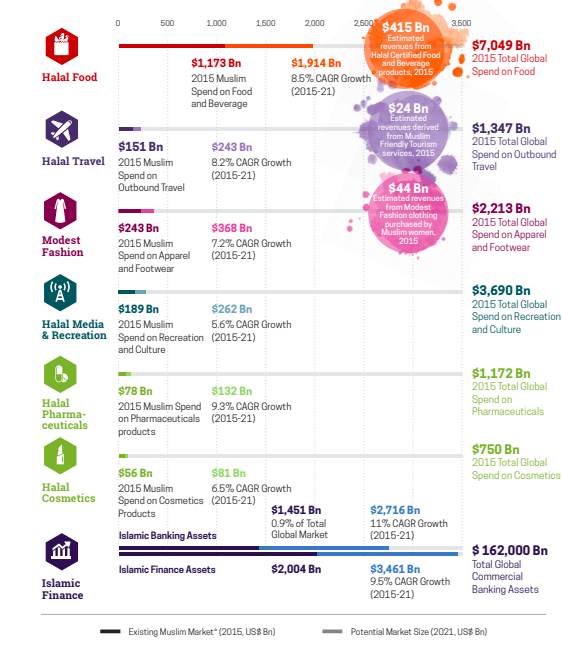
From https://www.mlcmedia.net/global-halal-top-trends-marketers/
Halal is the Muslim ritual slaughter of animals for food, which is derived from Jewish kosher dietary practices. However, even innocuous items of grocery like lentils (dal), milk powder and spices are now halal marked. There is a huge industry geared to certifying products as halal ostensibly to ensure that Muslims do not consume products that are taboo.
This industry does not produce anything, but merely labels products as halal.
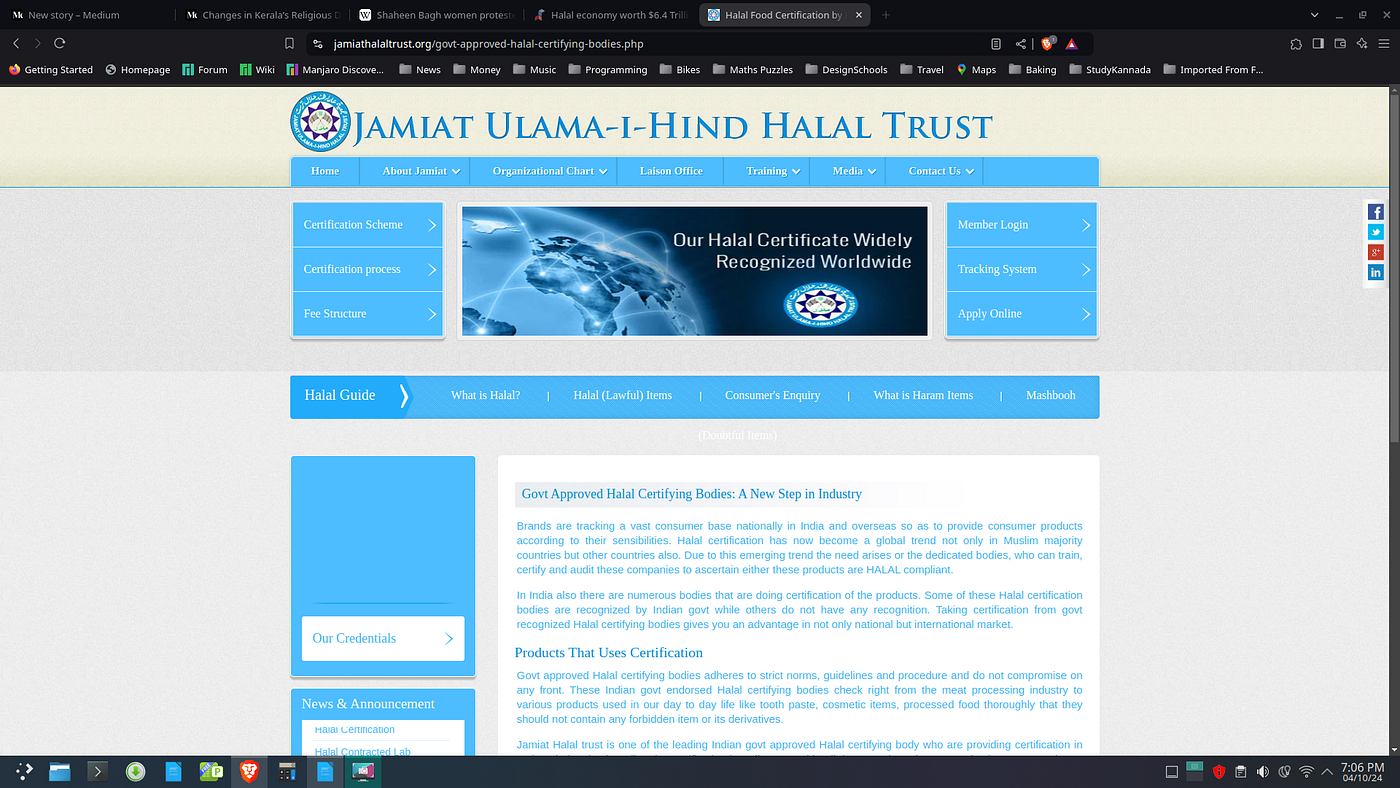
One of the Halal Certification agencies — the Jamiat Ulama-i-Hind Halal Trust. There are many more.
There are agencies which provide product manufacturers with halal certification of their products for a fee. This requires an inspection of the premises, the product manufacturing process to ensure it does not offend Muslim sensitivities and lastly an examination of the payroll. This is to check that the number of Muslims employed in that establishment is above a certain threshold. I am not clear what that is, but have been told it is at least twenty per cent and possibly higher. This certificate has to be renewed every year on the payment of a fee. Thus there is a regular source of income running into several trillions of US dollars available to finance Muslim causes.
Household products of all types in Indian grocery stores now routinely sport the halal certified symbol. Most of these products are produced by Hindu manufacturers. Halal is now apparently acceptable and secular.
Studies have indicated that as of 2023, the halal food industry is worth 2.6 trillion USD. However there are other studies claiming that it is already well in excess of six trillion USD, not a number to be sneezed at. An increasing Muslim population means that this can be expected to increase substantially in the years ahead.
The Northeast and Myanmar
The Northeast presents a different picture. Apart from Hindu majority Assam, the other states now have a Christian majority. Even Manipur has a wafer-thin Christian majority after having once been a mainly Hindu kingdom. Until independence, Christian missionary activity was restricted to the Nagas and the Mizos. Post-1947 however, rampant missionary activity condoned by a passive Union government has seen widespread conversion even in Buddhist Arunachal Pradesh. As a result the Christian population has mushroomed in all the states in the Northeast. Significantly in the years after independence, Hindu organisations like the RSS and Hindu Mahasabha were not permitted to carry out proselytisation in these areas while Christian missionaries had a free run. It is only now that they have made a small beginning. But they are working against the tide.
Why is a Christian majority in the Northeast alarming? Myanmar borders India in the East. Continued military rule and their hardline Buddhist ideology has alienated many of the tribes in the Myanmarese areas bordering India where there are significant Christian populations. Many of these have tribal associations with groups in India like the Kukis, Nagas and Mizos. Indeed the Kukis and the Mizos now claim that they are all Chin and have affiliations with those in Chin state.
Our border with Myanmar, like that with Bangladesh is exceedingly porous. Myanmar being considered friendly, there was hardly any policing of the border. This has given rise to rampant cross-border activity like gun-running and now drug cultivation on a huge scale. The recent trouble in Manipur, which still continues, has been linked to the destruction by the state government of drug cultivation in the hills of Manipur. These are areas inhabited by the Kukis. This caused violent protests and ethnic clashes. However these were spun as inter-religious clashes between the largely Hindu Meitei and the Christian Kukis and gained unwanted international attention. This narrative has still not been scotched.
There have been leaders in the Western press about the lack of religious freedom in India as exemplified by the attacks on the Muslim and Christian communities. Little known is the fact that the Meitei now include Christian and Muslim converts. Therefore the characterisation of the Meitei-Kuki clashes as a Hindu-Christian conflict misses the bus by a wide margin. Perhaps this is intentional, to deflect attention away from the real reason — rampant drug peddling and consumption.
The Siliguri Corridor (The Chicken Neck)
The narrow chicken neck connecting mainland India to the Northeastern states is another area of concern. Erstwhile East Pakistan (now Bangladesh) is surrounded by India on three sides, west, east and north. This narrow passage is only 22 km wide in the northeast where Nepal and Bangladesh form its northern and southern borders. In the north and northeast, the chicken neck is bounded by Bhutan to the north and again as before by Bangladesh to the south. The chicken neck therefore is a kind of tunnel 150 km long which is oriented initially roughly north-south and further eastwards oriented northwest-southeast.
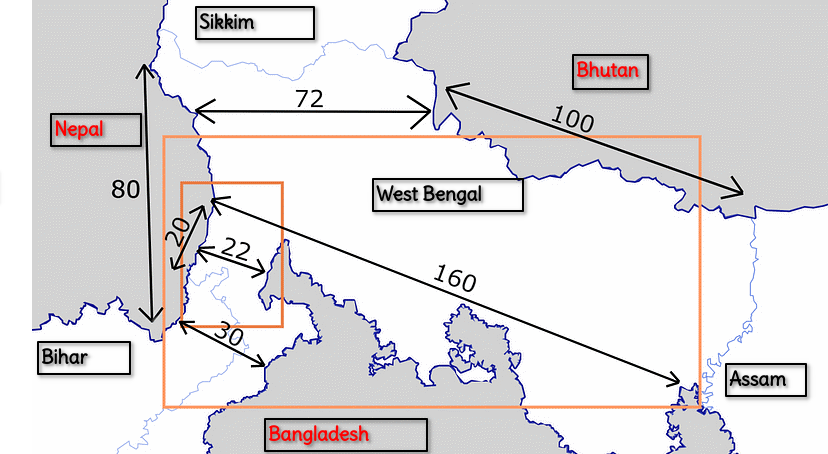
The Siliguri Corridor
The demography in the districts in West Bengal surrounding Bangladesh has changed significantly in the last two decades thanks to porous borders, rampant arms smuggling and people trafficking into India and cattle smuggling into Bangladesh. All this would not occur without official patronage. The Border Security Force (BSF) and the Union Home Ministry must bear a large part of the blame for turning a blind eye to these incursions which have major long-term implications for the future of this country. One reason is of course corruption, India’s national sport.
All parties which ruled West Bengal have been guilty of turning a blind eye to this illegal immigration for the sake of sectarian vote bank politics, but the major share of the blame must go to the CPI(M) and the TMC, which have indulged in the competitive importation of Bangladeshis and now Rohingya in order to boost their election prospects.
Doklam — China, Bhutan and India
What is the significance of the chicken neck? Most people have heard of Doklam, but with only a vague idea of where that is. They might know for example that there was a standoff there between the Indian army and the Chinese in 2017 and that we worsted them then. So where is Doklam? It is in Bhutan, with which we have a treaty promising to assist them in case of external aggression. China now claims Doklam.
The Doklam incident was triggered when China started extending a road which earlier terminated close to the Bhutanese border. This road was now extended into what both Bhutan and India agreed was Bhutanese territory. China disagreed. It said this was not Doklam, but Donglang, which had been Chinese since before the Big Bang.
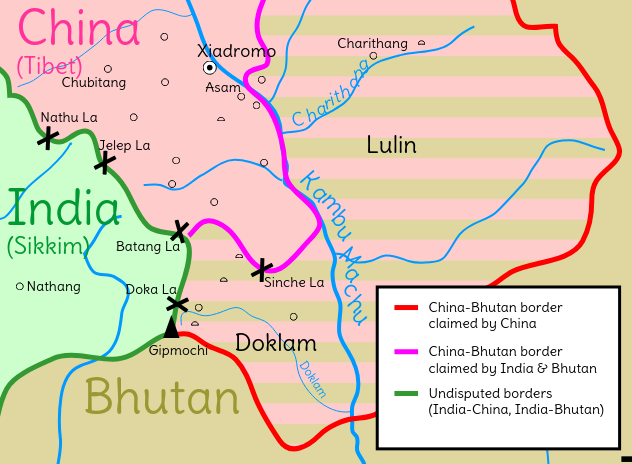
Doklam
The Chinese claim was based on an agreement between Britain and China in 1890. This had agreed that the boundary between Tibet and Sikkim would begin at a certain point on the Bhutanese border called Mt Gipmochi. However the Bhutanese were not party to the treaty and apparently were never consulted. Surprisingly, this is one agreement with the British that China accepts, while it does not accept other treaties which define the India-Tibet border.
The confrontation lasted a couple of months at the end of which there was an agreement that both sides would withdraw to new positions. So that was that and we forced the Chinese to pull back. So we won, right? No!
Shortly after that, the Chinese came back in strength, made permanent structures and a road which is set five to six km from where the engagement took place in 2017. This makes it more difficult for India to challenge without much stronger force activation.Today for all purposes Doklam is Chinese. The Bhutanese seem to have come to some agreement with China, the substance of which I am not aware of. Basically we can surmise that Bhutan, the much weaker state, caved in to Chinese demands.
The long and short of it is that by squatting in Doklam, China is now within striking distance of the Siliguri Corridor, the official name for the Chicken’s Neck. That is not exactly good news for us.
“The new road, 5–6 kilometers to the east and deeper in the Doklam region, would not be amenable to the type of blockade India placed last year. It would require a full-fledged Indian military operation to disrupt the road construction, something that is obviously a fraught prospect, not only because Indian forces can only legitimately intervene there at the invitation of Bhutan. There is nothing to indicate that such an invitation would be forthcoming.” — Manoj Joshi in ORF Journal, “After Doklam, military postures continue to escalate in India China”.
The problem does not stop at the Chicken-Neck, but continues further eastwards. Illegal immigration is rampant in every Indian district bordering Bangladesh and has been going on for decades. Surprising as it may now seem, in 1950, just three years after Partition, Muslim East Pakistanis were encouraged to settle in Assam courtesy of the Liaquat-Nehru Pact and the argument that fertile land in Assam was lying untilled because of the lack of farmers. So Muslims from East Pakistan were imported and allotted plots while Hindu Assamese remained landless and neglected. The politicians who ruled Assam have a lot to answer for. The results of these policies are obvious. Today Hindu Assamese are a minority in the state they once dominated.
So what are we looking at? Large parts of India and most of the border territories are already dominated by Muslims. The cohesive nature of the Muslim majority when it faces outwards, irrespective of any internal differences, should be apparent to any neutral observer. These are papered over in the face of a non-Muslim other. Experience tells us that Muslims do not have to reach fifty per cent of the population to start exerting their dominance. A figure as low as thirty per cent should be adequate. Why such a low figure?
(1) Essentially because of their ability to mobilise people quickly through mosques and madrasas and now shops along important roads, get them into the street, threaten violence and generally cause mayhem.
(2) Through friendly media the ability to paint any violence as due to Islamophobia and thus get instant attention in the already left-leaning domestic and international press.
(3) Since they vote en-bloc, while Hindus are divided by caste and political considerations, their vote will be decisive and most in demand. This vote will be delivered by religious leaders to whichever party promises them the most.
The CAA — anti-Muslim?
Some people might recollect a ‘student’ by the name of Sharjeel Imam who became rather notorious during the anti-CAA agitation in New Delhi in 2019. He is believed to have strategised the long sit-in at Shaheen Bagh.
The 2019 Citizenship Amendment Act was intended to fast-track the citizenship of persecuted non-Muslims from the Muslim majority nations of Afghanistan, Pakistan and Bangladesh. It pointedly left out Muslims. The reason is obvious. These are Islamic states. Islam is the state religion. More importantly, there is active discrimination against the minorities.
In these countries, the major minorities like Hindu, Sikh and Christian continue to be subject to various atrocities, rapes, the kidnapping of minor children, their forced conversion and marriage to elderly Muslim males, illegal eviction from properties etc. The police stand passively by or even assist in the commission of these crimes while the judicial system sides with the perpetrator. Such active discrimination has resulted in the steady decline of the minority population.
The CAA was intended to help such victims of state-sponsored discrimination secure fast-track citizenship by shortening the usual waiting period. This does not however mean that Muslims from these countries are denied citizenship. They have to apply under the Citizenship Act, which means a longer waiting period.
Once the bill was passed, chaos erupted as leftists and Muslims made common cause claiming discrimination against Muslims. Shias and Ahmediyas too are persecuted in Pakistan, they argued. Why were they not covered by the bill?
People familiar with the history of the freedom movement know that the Ahmediya and Shia communities were frontrunners in demanding the Partition of India and the creation of a Muslim state. They did not wish to live in a Hindu majority India. Jinnah was a Shia. Sir Zafrullah Khan, Pakistan’s first foreign minister, was an Ahmediya lawyer of repute. It was he who prepared the note regarding the partition of India into two states on the basis of which the Muslim League passed the 1940 Lahore resolution demanding Pakistan. Zafrullah Khan also represented the Muslim League before the Radcliffe Boundary Commission. He had also advised the Nawab of Junagadh to join Pakistan and provided legal assistance to the Nizam in his confrontation with Sardar Patel.
That Pakistan chose to persecute these communities for sectarian reasons is an internal Islamic issue regarding purity of belief, Shia-Sunni tensions and the claim that Mohammed is the last prophet sent by Allah, which the Ahmediyas dispute. There is no reason for India to privilege Pakistani Shias and Ahmediyas for citizenship via the CAA bill and let them into a country they are taught from childhood to hate.
Sharjeel Imam and the Chicken Neck
So what did Sharjeel Imam do? During the CAA agitation, Sharjeel Imam in a lengthy speech told the large crowd that Muslims were now the majority in the Chicken Neck or Siliguri Corridor and that they could effectively cut off Assam from the mainland. He also said, “Let us see how their army enters Assam” or words to that effect. This is incendiary, anti-national hate speech and clearly secessionist in nature. Imam had a reputation for inflammatory speeches. This time he went too far. A number of cases were registered against him and he was soon in custody. Though he has secured bail in a number of the cases against him, he is still in jail on other charges.
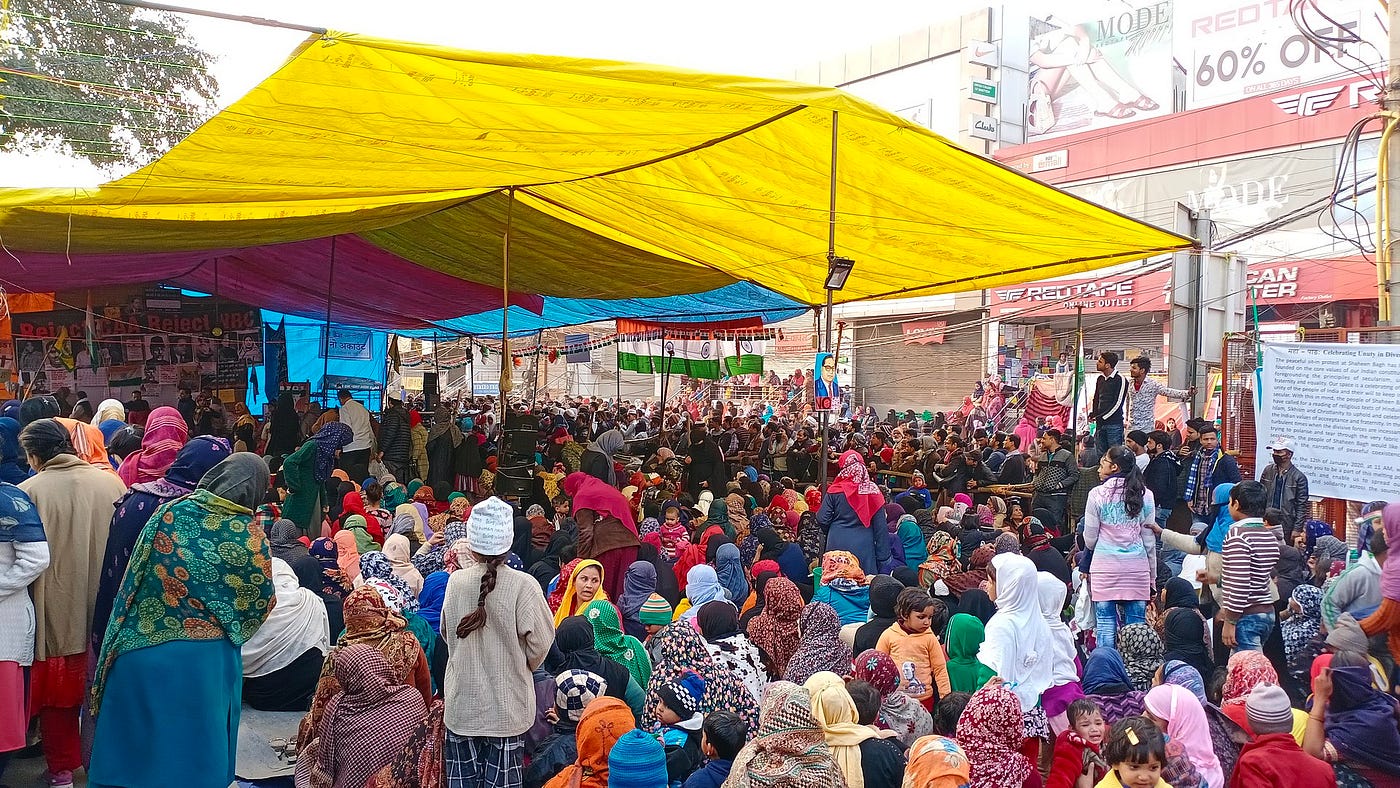
Anti CAA Protests: Crowd at Shaheen Bagh blocking the road
It is clear that blocking the Siliguri Corridor is very much an option for anti-national forces. The fact that Muslims, many of them Bangladeshi pseudo-citizens of India and openly hostile to the idea of India, are in a majority in this vital corridor is a matter of grave concern. However until strong measures are taken, a National Identity document created and the National Register of Citizens updated, the problem of hostile immigration will continue to be a major threat. This will affect our defence posture and will need to be taken into consideration in the eventuality of any operations in this area and eastwards.
Matters have been complicated further by the recent ousting from power of Sheikh Hasina, the relatively pro-Indian PM of Bangladesh. She has been replaced by a grouping of religious groups including the extremist Jamait-e-Islami which is avowedly anti-India. There are indications that several of these groups are planning to send members to India in order to carry out terror attacks here. A complaisant state govt in W Bengal which is sympathetic to Muslim extremism helps. This will make it tough for the army in W Bengal.
There is also a threat of China coordinating attacks in the Chicken Neck area , Doklam and further east in Arunachal Pradesh, with these Muslim extremist elements from Bangladesh. An attempt to block access to the Chicken Neck could render army logistics operations in the Northeast very difficult. This is exactly what Sharjeel Imam suggested.
The Lok Sabha Elections since 1999
The BJP has now won three successive general elections. This time around, it had a reduced majority of 240 seats in contrast to the 282 it secured in 2014 and the 303 seats it won five years later. It was therefore forced to cobble up a coalition.
I have been looking at the majorities, winning candidates secured in 1999 and in 2024. Summing up the total victory margins in 1999, we find that the candidates who won, got a total of 1.27 crore votes more. In 1999, the voting percentage was 60 in an electorate of 61.95 crores. In 2024, the candidates who won secured 1.66 crores more votes. The voting percentage was 66 in an electorate of 97.77 crores.
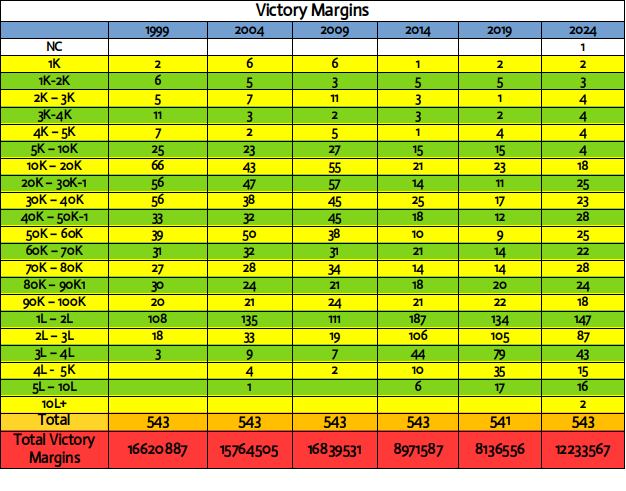
What do these total victory margins mean? This is by no means a professional analysis, but one I thought might reveal something.
Between 1999 and 2024 the electorate swelled from 61.95 cr to 97.77 cr, a factor of some 58 percent. The voting percentage in 2024 dropped by some 3.5 percent from 2019, when Modi secured 303 seats. So the drop in percentage is perhaps indicative of disenchantment with Modi or perhaps not.
The winners in 2024 secured 1.22 cr more votes. Out of an electorate of 97.77 cr, 1.22 cr meant the difference between victory and defeat. That is to say that about 1.2 percent of the electorate determined the final result. This is excessively simplistic of course.
In 2024, the BJP won 240 seats, the next largest party, 99 seats. The difference in voting percentages was 36.9 to 21.4, the BJP getting 15.5 percent more votes. However in 2019 with just 0.8 percent more votes, the BJP secured 303 seats compared to 240 in 2024. Of course the opposition performed better in 2024. The Congress vote share went up by 1.7 percent and it secured 99 seats compared to 44 in 2019.
What we learn is that a margin of 0.9 to 1.2 cr votes can swing an entire general election.
However what I find interesting for this piece is the number of marginal seats. I have arbitrarily taken a winning margin of 10000 votes as marginal. In 2024 there were 21 seats where the victory margin was less than 10000 votes.
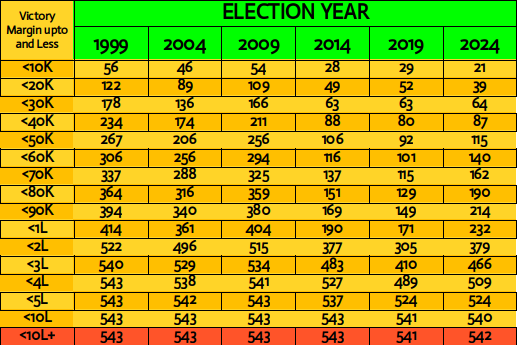
Victory Margins
Marginal Seats and a Surplus Population
So what do you need to win these seats?
Imagine that you have a pool of people who are willing to be moved to a different place for love or money. This is where your surplus population comes in.
You explain to them that you are trying to ensure that the right people win the elections next time around. Are they willing to help? Of course sir, they say with the usual Arabic expostulations that they have heard — Alhamdulillah, Bismillah and so on.
How many people do you need to move?
If in a certain constituency, last time around the winner defeated his opponent (who is your man) in a two-way contest by a margin of 10000 votes, then if you can shift slightly more than half the voters to your side, you will win. However, it is possible that the other side has a very strong ideology or loyalty factor, so their voters are not likely to switch sides. In that case you need to bring in extra voters to tilt the margin your way. In this case you will need to move about the same number of voters as the victory margin. In order to ensure that you do indeed win, you also need to split the votes on the other side. This you do by setting up dummy candidates (for a fee of course) from the same caste, creed or ideology. Your people will vote en-bloc, while the others split their votes. You will win by a margin even greater than the victory margin last time around.
Sounds simple doesn’t it? This is the formula for victory in marginal constituencies. What is a marginal constituency? One where the victory margin is such that it can be tilted by a suitable transfer of votes from within the constituency or by bringing in voters from outside.
Of course if one can move 50,000 people instead of 10,000, one can change the voting pattern in more places.
So here’s where I use my surplus population.
Take the table below. This is an excerpt of the 2024 general election results and relates to the two candidates who won by the highest victory margins and the two who won by the narrowest of margins. Fortuitously, the two highest victory margin candidates belong to the Congress and the BJP. Their victory margins are stupendous. Rakibul Hussain of the Congress won by a margin of over 10.12 lakh votes (a margin of 41.3%) in Dhubri in Assam, while Shankar Lalwani of the BJP won by a margin of 11.75 lakh votes (75.2%) in Indore in MP.

It would seem obvious that this is overkill. All each candidate required was one vote more than the next highest polling candidate. But that would have required planning of high precision. So let that pass.
The lowest victory margin in 2024 was the 48 votes by which Dattaram Waikar of the Shiv Sena defeated his nearest opponent. Despite the razor-thin margin of his victory, Waikar’s victory by 48 votes in Mumbai (NW) is as valid as Hussain’s or Lalwani’s. As also is Adv Adoor Prakash’s victory by 684 votes in Attingal, Kerala.
So many of the voters in both Hussain’s and Lalwani’s case might as well have stayed home, considering the massive margin of victory in either case. There were enough and more people to vote in their candidate by a huge margin. Let us say that there were about five lakh voters too many.
Imagine a scenario where you could transfer these extra voters of yours to another place where they could do more good. If these people were only making a marginal living where they were, you could promise them El Dorado somewhere else and tell them, “If you go where I tell you to and if I (or our man) win there, I’ll do such and such for you. It’ll be a great life out there, not like here.” and so on.
Now you help these people to move to another parliamentary constituency, which your candidate lost by a few votes. Taking the same 2024 general election, let us say, you move a few of these voters to Karimganj, also in Assam, where the BJP candidate Kripanath Mallah won by 18360 votes. If you transferred 20000 people there you could swing the vote and win the seat. And so on and so forth.
Implementing a Nation-wide Population Transfer
Now imagine that this scheme is being implemented on a nation-wide scale by someone who has analysed the previous election results and realises that a transfer of a portion of the extra voters in one seat to another where your party’s candidates are losing, could swing the election your way. You would need plenty of money and a willing populace motivated by some ideology.
It is clear that the motivation is available in spades. The ideology is clear — Islam. Islam has long sold the dream of a Ghazwa-e-Hind to the faithful. This is nothing less than a reconquista, the recapture of the crown jewel of India. The reconquista was the name the Spanish gave to the reconquest of Spain and Portugal from the Moors in the 15th century. India was not only the Crown Jewel of the British Empire. It was the Crown Jewel of Islam too. It provided employment to millions in the Islamic arc from Turkey to Central Asia. It’s loss is still keenly felt. Hence Ghazwa-e-Hind.
A Place to Live and a Job
I have said that you would require a great deal of money to finance the transfer of people nation-wide.
I wish to modify that statement. There is a lot of government owned land in India, land owned by the Railways, the Forests, the Defence departments. These are inadequately looked after. You could settle migrants on these lands, often in plain sight and no one would ask a question. Once you build religious structures there, say a mosque, mazhar, dargah or madrasa, then no one will dare to evict you. Our secular governments will not dare to lay a finger on them for fear of getting a bad press. There would be immediate shouts of secularism in danger, Islamophobia, poor Muslims targeted by the RSS-BJP combine and so on. No one wants to hit the headlines.
So what do the news headlines tell you when attempts are made to evict people from govt property? We are told about the Rajinder Sachar Commission which, without carrying out any scientific survey, culled some data from questionable sources and then unilaterally declared that Muslims were an even more deprived section than the Dalits.
So at little expense you could move these people and settle them on government land in forests, in cities,in rural areas, along the railway lines.
Public property is no one’s property. No one cares.
We have seen this attitude in agitations where public property like buses and train coaches are routinely burnt. Half-hearted attempts are made to prosecute those involved. However they soon secure bail from an over-liberal judiciary and move on. The idea that these buses and railways are our property has not percolated down. We will then spend some more money to procure new buses and railway coaches, which will again be fair game the next time around.
So you can settle your people on public or even private land somewhere trusting in strength of numbers to quell protests. In a few years a recently built mosque will be declared to be hundreds of years old and some leftist historian will produce ‘proof’ of it having been used by Mohammed Tughluq in the 14th century and so on.
How can you find these people you have transferred to a new place, a way to make a living?
I would suggest you look around your locality. Any new vendor selling vegetables and fruits lately, pushing his handcart around? Yes, you will probably see a few, quite a lot in fact. Where did all these people come from?
Like most Indian cities, Bangalore too has no pavements. Where they exist, they look like one of Salvador Dali's paintings of melting watches. You could easily twist an ankle or fracture a leg on these marvels of civil engineering. So you walk on the road. Among the fundamental rights you have as an Indian citizen, the right to walk on the road is one.
In some places the municipality has woken up and is making new pavements. However in no time at all, this pavement is encroached upon by the said vegetable vendor with his handcart. He soon upgrades to metal kiosk, then commences to pile his wares on the road in front and thus stake his claim to property.
Where did he get that cart and the vegetables and fruits? I mentioned earlier that in the South, this trade has passed into Muslim hands. So any new arrival is initially provided with a handcart and vegetables and fruits at concessional rates. He is then told where to go in the city. He finds an empty patch of road or pavement. He establishes his right to that place. Very soon he expands that territory. In case of dispute he can call on his co-religionists at the local mosque. A show of strength will soon cool down any opposition to this encroachment. The municipal officials who turn up are soon mollified in the time honoured Indian manner.
Our friend has now become a bonafide Indian citizen. There is no citizenship document anyway. His claim is as good as yours or mine. And soon he gets his brother, uncle, father and so on. Yes, they will vote in the next election.
Have I answered your question about the right to livelihood?
Any article examining encroachment on government property by a certain section cannot end without mentioning another egregious addition to the laws of India — the Waqf Acts.
The Waqf Acts
The Waqf Act impacts Indians like nothing else the Congress has done.
In 1913, the British introduced the first Waqf act in order to clarify the status of Muslim property donated for religious purposes. It was also to distinguish between Shia and Sunni property, ownership of graveyards being the bone of contention. Since then the scope of the Waqf Act has been expanded tremendously by various Congress governments.
What the Congress has done with the waqf acts since independence beggars belief. The clauses in the 1954 act passed just after independence, directly mirror what was passed by parliament in 1995. The 1954 act was the nucleus of the 1995 act, which vastly expanded the scope of the provisions therein. You may recall that evacuee property in India, which should legitimately have been transferred to the Hindu and Sikh refugees who fled Pakistan was converted to waqf and therefore became untouchable thanks to a complaisant and partisan administration.
What is surprising is that other parties chose to keep quiet about this act and its implications. We were unaware that the Waqf Board was busy all this while adding large chunks of India to its holdings. It now emerges that it is the third largest land-holder in India after the defence and the railways. That this should have happened in a country which is supposed to have become, in the last ten years a ‘Hindu rashtra’ (according to all secularists and the Western press) is a big surprise.
The Waqf Board was created under the Waqf Acts to administer and account for waqf property. The act and its clauses effectively empower the Waqf Board to declare any property as waqf, merely because it feels so. The onus is on the current proprietor to prove otherwise. He cannot go to court; he can only appeal to the Waqf Board, which is judge, jury and executioner. The Waqf Board does not have to produce documents in evidence. You have to. Remember that you only have a month to answer.
The Act also requires the district administration (the district collector) to assist the Waqf Board in any further proceedings like evicting the current occupant and so on.
Incidentally the latest iteration of the Waqf Act by the Manmohan Singh govt in 2013 passed the burden for all actions by the Waqf authorities like a survey of properties, salary payments for waqf functionaries, advertisements, legal costs etc. to the tax payer, i.e. you and I. This means the govt will pay all the waqf bills. Thank you very much!
If one is not satisfied with the Waqf Board’s decision, one can appeal to the Waqf Tribunal. But the Waqf Tribunal is composed solely of Muslims and is the final authority in case of any dispute about waqf property. You cannot appeal to any court.
The idea that the mullahs empowered by the Waqf act can just paste a notice on your door giving you a month to vacate your own house, is outrageous.
The Modi government has tabled a bill proposing to amend the Waqf Act and its more egregious clauses. This has now been referred to an all party committee — the Joint Parliamentary Committee or JPC. The JPC has invited responses from the public through emails.
It has now emerged that Muslims have been told to express support for leaving the Waqf Act untouched, by using a QR code which automatically generates emails in support of their position. The huge number of unlettered Muslims and their willingness to listen to the dictates of their manipulative leaders is quite evident. However there has also been a mass upsurge by Hindus in support of amendments to the bill. Many have actually called for the repeal or total abrogation of the Waqf Act.
All this has given the issue a salience similar only to the Ram Janmabhoomi movement. Hindu reaction is picking up steam and the pot can be kept boiling till the next election.
In fact the scope of the Waqf Act does not extend only to Hindu property. In Kerala, churches too have been claimed as waqf land. No property is safe in this insane bid to maximise Islamic land holdings and pave the way, I assume, to the creation of a Muslim ruled nation here.
No Congressman has come out in public against the Waqf Act and its repercussions for the future of this country. I have yet to see a justification by any writer on the need for this pernicious and anti-national legislation, which leaves no room for appeal to a court, and any citizen at the mercy of a cabal of Muslims.
The idea that a country which was partitioned on the basis of religion in 1947, with a new nation created for Muslims, can now be further divided without the consent of its non-Muslim inhabitants, is alarming to most Indians except the most obdurate so-called secularists.
Below is what a Supreme Court judge said when the Waqf Act was challenged in 2022:-
“Waqf act challenged: Religion should not be brought in while questioning a law”
By Abraham Thomas, New Delhi, Sep 20, 2022
The Supreme Court on Monday expressed “shock” and “pain” over arguments made in a petition challenging the constitutional validity of the Waqf Act for allegedly being discriminatory and noted that religion should not be brought in while questioning a law.
Stating that the law is regulatory in nature, the apex court observed that if the Waqf Act is struck down, it will only benefit the encroachers. The petition objected to certain provisions of the Waqf Act that allow only Muslims to be members of Waqf Boards.
The Waqf Act regulates Islamic religious and charity properties; the Waqf Board administers them.
“I feel pained that you can put your challenge down to religion,” said a bench headed by Justice KM Joseph. “We should go beyond that and certainly not bring religion as a ground to strike down the law.”
The Waqf acts are clearly based on Islamic practices. They aim to further Islamic motives and it is quite clear that the aim is nothing less than a stealthy takeover of land based on dubious documents and practices, making use of the secularism which was surreptitiously introduced into the Constitution. Secularism, it seems, applies only to the majority Hindus and no one else in this country.
So why was Justice KM Joseph surprised when a bill so obviously motivated by a certain religion is challenged on those very grounds? Methinks the learned judge protests too much.
The State of Hindu Temples
When one reads the various waqf acts and their regard for waqf property and the irredeemable nature of a waqf bequest (Once waqf, always waqf) and contrasts that with the alienation of the property of Hindu temples — encroached, given away, sold or otherwise lost to the community — one gets the idea that everything seems to be working according to some plan.
Hindus do not control their temples. These are controlled by government and its representatives through the Devaswom Boards and various committees. There is no consultation with Hindu devotees, the majority faith in this country. The govt selects whom it will, when it will, does what it wills. Hindus have no say whatsoever in the Devaswom Boards, temple management committees and so on. Any temple not currently run by government can be taken over merely by govt notification. Usually it is only rich temples which are thus taken over.
The solicitousness for Muslim waqf property and the blatant disregard for Hindus and their rights strikes one forcibly.
The Money Trail
The rent from waqf property and halal certification combined with gold smuggling and drug running contribute to various activities by no means in the national interest. In all of these activities, Muslims are pre-eminent. A casual look at the names of those involved in drug and gold smuggling will reveal a disproportionate number of Muslim names. This is not unique to India. The percentage of Muslims in jail in India, the US and Europe far outstrips their percentage in the population in all these nations. There must be a reason why Muslims are so prone to violating the law. Perhaps there are other forces at work. All this has been going on in plain sight for decades.
Why have I written this?
My curiosity was piqued by the number of Muslims I saw on the roadside in my journeys. Why were they so ready to upstick and move to new places so far away from where they lived? I have tried to find a reasonable and logical answer, given what I know of the Islamic world view from observation and reading. Hence this piece.
Conclusion
This is what I think is happening in India. People are being moved around all over India in order to influence future elections and change the shape of the polity. As I have shown, you do not need to be a majority though that would certainly help. You can achieve your ends with smaller numbers provided you operate as a cohesive group towards a common goal.
The people I saw in my journey looked like they did not belong where they were, ekeing out a living in some fashion for a goal they have been told will eventually secure them heaven on earth and also guarantee them heaven in the afterlife. What a future that would be!
I hope someone in government is analysing all this and taking steps to scotch any such moves in the bud.
This is just my take on what I have seen. I could be wrong. I hope I am. But something tells me I am right.
Let us see.
메타데이터
- post_id
- cc25f0bcb4e2
- slug
- will-someone-please-tell-me-whats-going-on-in-bharat-cc25f0bcb4e2
- url
- https://medium.com/@rameshsukumaran/will-someone-please-tell-me-whats-going-on-in-bharat-cc25f0bcb4e2
- canonical_url
- https://medium.com/@rameshsukumaran/will-someone-please-tell-me-whats-going-on-in-bharat-cc25f0bcb4e2
- author_url
- https://medium.com/@rameshsukumaran
- status
- ok
- fetched_at
- 2026-08-03 19:22:05