Automated Software Testing Tools ROI for SaaS Companies: What Actually Works
You are running a SaaS company. Someone on your engineering team says you need automated software testing tools. They say it will save…
Automated Software Testing Tools ROI for SaaS Companies: What Actually Works
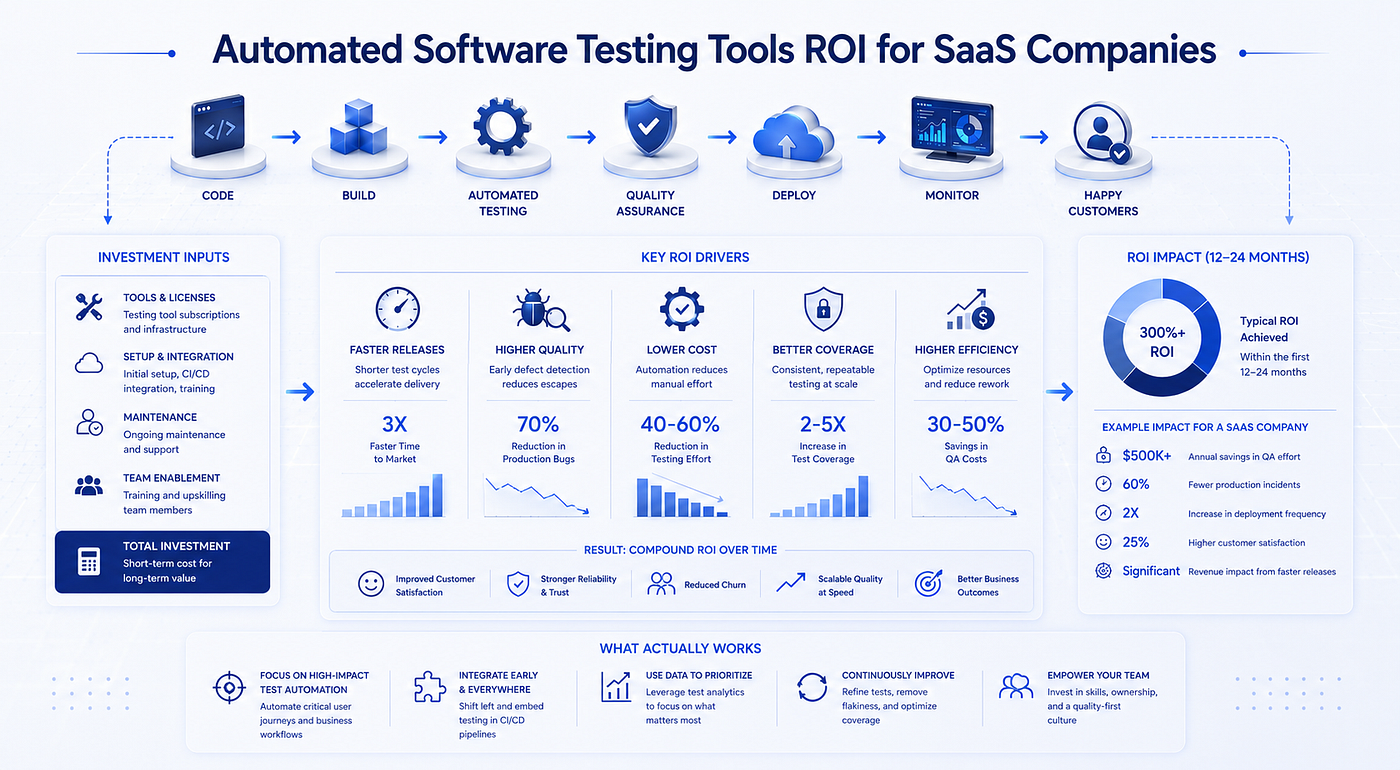
You are running a SaaS company. Someone on your engineering team says you need automated software testing tools. They say it will save money. They say it will increase velocity. They say it is an industry standard.
So you evaluate tools. You look at pricing. You budget for implementation. You allocate engineering time to setup. Then six months later, you are asking yourself if any of this was worth it.
This is the conversation most SaaS leaders have with their engineering teams. The conversation about ROI. Did the investment in automated software testing tools actually pay off?
The answer is complicated. Sometimes yes. Sometimes no. Often something in between. Understanding when automated software testing tools deliver ROI and when they do not is critical for SaaS companies. Your margins are thin. Your runway is finite. Every investment matters.
What SaaS Companies Actually Expect
Before understanding ROI, it is important to understand expectations. What do SaaS leaders think automated software testing tools will deliver?
- Faster development. The promise is simple. Automated testing catches bugs before they reach production. Developers spend less time debugging. Teams ship faster.
- Fewer production issues. The logic is sound. More testing before production means fewer problems in production. Fewer problems in production means less firefighting. Less firefighting means more time for new features.
- Lower support costs. If fewer bugs reach production, support gets fewer tickets. Fewer support tickets mean lower customer support costs.
- Move faster than competitors. If you catch bugs faster and ship faster, you win the market game.
These expectations are reasonable. They are also optimistic.
The Reality of Implementation
- The first challenge is implementation. Automated software testing tools require setup. They require training. They require infrastructure.
- Setup time is not trivial. A SaaS team with ten developers might spend two weeks on tooling setup. Two weeks is 400 hours of engineering time. At average SaaS engineering salaries, that is roughly 40,000 dollars.
- But setup is the easy part. The hard part is adoption. Engineers need to learn how to use the tools. They need to learn to write tests in the new format. They need to learn to integrate tests into their workflow.
- Adoption creates a productivity dip. In the first month, developers are slower. They are learning. They are writing tests alongside their regular work. Shipping slows down initially.
This is important because it means ROI does not start immediately. There is an upfront cost in time and productivity. This cost must be recouped.
The Real ROI Factors
True ROI from **automated software testing tools** depends on specific factors. Understanding these factors is crucial for making the right decision.
- First, bug density matters. If your product has few bugs that reach production, automated testing delivers less value. If your product has many bugs reaching production, automated testing delivers more value. The starting point determines the potential ROI.
- Second, developer velocity matters. If your development process is already optimized and fast, automated testing adds less incremental value. If your development process is slow and contains lots of rework, automated testing delivers more value. Where you start determines the ROI potential.
- Third, support cost structure matters. If your support team is oversized, automated testing reduces some support load but the total benefit might be small. If your support team is lean and overworked, automated testing that reduces support tickets has higher financial impact. Cost structure changes the ROI equation.
- Fourth, production incident severity matters. If your production incidents are minor inconveniences, the cost of them is low. If your production incidents cause customer churn or data loss, the cost of them is high. Automated testing that prevents incidents delivers ROI based on the cost of incidents it prevents.
- Fifth, team skill level matters. A team of junior developers benefits more from automated testing because it catches more of their mistakes. A team of senior developers benefits less because they catch more mistakes themselves. The team matters to the equation.
These factors do not appear in tool vendor presentations. But they determine whether automated testing tools actually deliver ROI.
Financial Impact Analysis
Let us walk through a realistic ROI calculation for a SaaS company. Assume a SaaS company with twenty developers, fifty thousand dollar average salary, ten production incidents per year.
- Implementation cost: Setup time (two weeks across team, spread across two months), training time (one week per developer), infrastructure costs (approximately five thousand dollars per year). Total first-year implementation: approximately sixty-five thousand dollars.
- Maintenance cost: Maintaining test infrastructure, updating tests, managing test data. Approximately one full-time developer equivalent per twenty developers, or one developer. Cost: fifty thousand dollars per year ongoing.
- Bug prevention benefit: Assume automated testing prevents thirty percent of bugs from reaching production. Current production incidents are ten per year. Automated testing prevents three incidents per year. Cost per incident (lost productivity, support time, customer impact): approximately five thousand dollars per incident. Annual benefit from prevented incidents: fifteen thousand dollars.
- Development velocity improvement: If automated testing reduces rework and debugging, it might improve velocity by five percent. At fifty thousand per developer per year, that is two thousand five hundred dollars per developer per year. For twenty developers: fifty thousand dollars per year.
Year one ROI: Seventy-five thousand dollars benefit minus sixty-five thousand dollars cost equals ten thousand dollars profit. This assumes a full year of benefit, which is optimistic. In reality, first year might break even or slightly positive.
Year two ROI: Seventy-five thousand dollars benefit minus fifty thousand dollars cost equals twenty-five thousand dollars profit. Now the investment is recovering.
Year three and beyond: Same calculation. ROI compounds.
This is a realistic scenario. The ROI is modest but real.
When ROI Actually Appears
Timing matters. Most SaaS companies do not see ROI in the first year. The implementation cost and learning curve eat the initial benefits.
ROI typically appears in year two. By then, the team is proficient with the tools. Setup costs are sunk. Infrastructure is in place. Benefits are flowing while costs stabilize.
For some companies, ROI appears faster. Companies with very high production incident rates or very high developer churn see ROI sooner because the benefit is larger relative to cost.
For other companies, ROI appears later or not at all. Companies in hyperscale mode with unlimited budgets might not care about ROI. Companies with low incident rates might not benefit enough to justify cost.
The Real Cost of Not Doing It
There is also the cost of not implementing automated software testing tools. For growing SaaS companies, this cost can be substantial.
As your team grows, the cost of manual testing increases. With five developers, one person can test manually. With twenty developers, manual testing becomes a bottleneck. With fifty developers, manual testing is completely impractical.
If you do not implement automated testing, you eventually hit a scaling wall. You cannot grow the team past a certain size without shipping slower or shipping with more bugs.
This scaling wall costs money. It costs in lost feature velocity. It costs in customer churn from bugs. It costs in the ability to compete.
For this reason, automated software testing tools are not really optional for growing SaaS companies. You need them eventually. The question is when to implement them.
Patterns That Actually Work
SaaS companies with successful automated testing tool implementations share certain patterns.
- They implement tools when they hit specific pain points, not before. When bug rates become unmanageable. When releases become risky. When the team cannot scale further. This means they are implementing to solve a real problem, not to follow best practices. Implementation feels urgent. Adoption is faster.
- They start with high-value, specific testing. Not comprehensive testing. Not testing everything. Testing the features that break most often. Testing the features that cost the most when they break. ROI appears faster when you are testing what matters.
- They treat testing as infrastructure, not as overhead. One key difference is infrastructure ownership. The most successful teams I have seen do not ask developers to maintain testing infrastructure on top of their regular work. Instead, they designate someone or a small team to own it. Testing infrastructure becomes a real product. Developers use it. The infrastructure team maintains it. This separation makes a huge difference in adoption and quality. What separates real ROI from wasted investment is measurement. Successful teams actually keep records. Before implementing automated testing, they document production incidents. They track how long debugging takes. They count support tickets. Then, after implementation, they do the same. Six months later, they compare. Did incident frequency drop? Did debugging get faster? Did support tickets decrease? The data tells them whether the investment worked. Without this tracking, they are just guessing.
Testing Strategy That Validates Reality
One approach that significantly improves ROI for automated software testing tools is grounding testing in actual system behavior rather than predicted behavior. This means recording what your system actually does and validating that behavior remains consistent.
Why does this improve ROI? Because you are testing what actually matters in production, not what you predict might matter. The testing effort is focused on actual system behavior, reducing wasted testing effort on scenarios that never happen.
Tools that capture actual transactions work well for this. When a real user hits an API endpoint, the system records what happens. Later, you use that recording as your validation baseline. New versions of your code must produce the same behavior. Modern tools like **Keploy** do this for API testing. It records actual API behavior and validates that behavior remains consistent. This approach keeps testing focused on what matters in production, not what looks good in theory.
When automated software testing tools are focused on actual observed behavior rather than comprehensive prediction, ROI improves. The testing is more efficient and catches more real problems.
Decision Framework for SaaS Leaders
Should you implement automated software testing tools? Consider these questions:
- Are production incidents affecting customer experience or churn? If yes, automated testing to prevent incidents has high ROI. If no, ROI is lower.
- Is your team growing and hitting velocity scaling limits? If yes, automated testing to enable scaling has high ROI. If no, scaling is not yet a constraint.
- Do you have high developer turnover? If yes, automated testing reduces the cost of onboarding and prevents knowledge loss. High ROI. If no, this benefit is lower.
- Is your product complex with high interconnection between features? If yes, regression testing has high value. If no, testing is simpler.
- Is your current support cost load high? If yes, automated testing that reduces support tickets has financial impact. If no, impact is lower.
- Is your development timeline long with extended debugging cycles? If yes, automated testing that speeds feedback has high value. If no, you already have fast feedback.
If you answered yes to three or more questions, automated software testing tools likely deliver ROI. If you answered yes to one or two, ROI is modest. If you answered no to all, ROI is questionable.
Conclusion
Automated software testing tools deliver ROI for SaaS companies. But the ROI is not automatic. It depends on your current situation, how well you implement, and whether you have the right infrastructure. ROI typically appears in year two after implementation. Setup and adoption costs eat year one. But over three to five years, the ROI compounds and becomes substantial.
For growing SaaS companies, automated software testing tools are not an optional nice-to-have. They are eventually necessary. The question is timing. Implementing too early wastes money. Implementing too late costs velocity and scalability.
Make the decision based on your specific situation. Implement when you have specific pain points. Start with high-value testing. Treat it as infrastructure. Measure results. Done well, automated software testing tools improve velocity, reduce bugs, and enable scaling. They pay for themselves. That is real ROI.
Before you go
- Please take a moment to like the post and follow the writer!
- Did you know that over 400,000 developers share what they’re building, learning, and discovering across our platforms every month? Learn how you can contribute here
메타데이터
- post_id
- cc273e1482d1
- slug
- automated-software-testing-tools-roi-for-saas-companies-what-actually-works-cc273e1482d1
- url
- https://javascript.plainenglish.io/automated-software-testing-tools-roi-for-saas-companies-what-actually-works-cc273e1482d1
- canonical_url
- https://javascript.plainenglish.io/automated-software-testing-tools-roi-for-saas-companies-what-actually-works-cc273e1482d1
- author_url
- https://medium.com/@sancharini.panda
- status
- ok
- fetched_at
- 2026-07-14 22:02:17