Psychological Safety vs. Artificial Harmony- The Leader’s Guide to Constructive Dissent
Nethra Hannadige
Psychological Safety vs. Artificial Harmony- The Leader’s Guide to Constructive Dissent
Nethra Hannadige
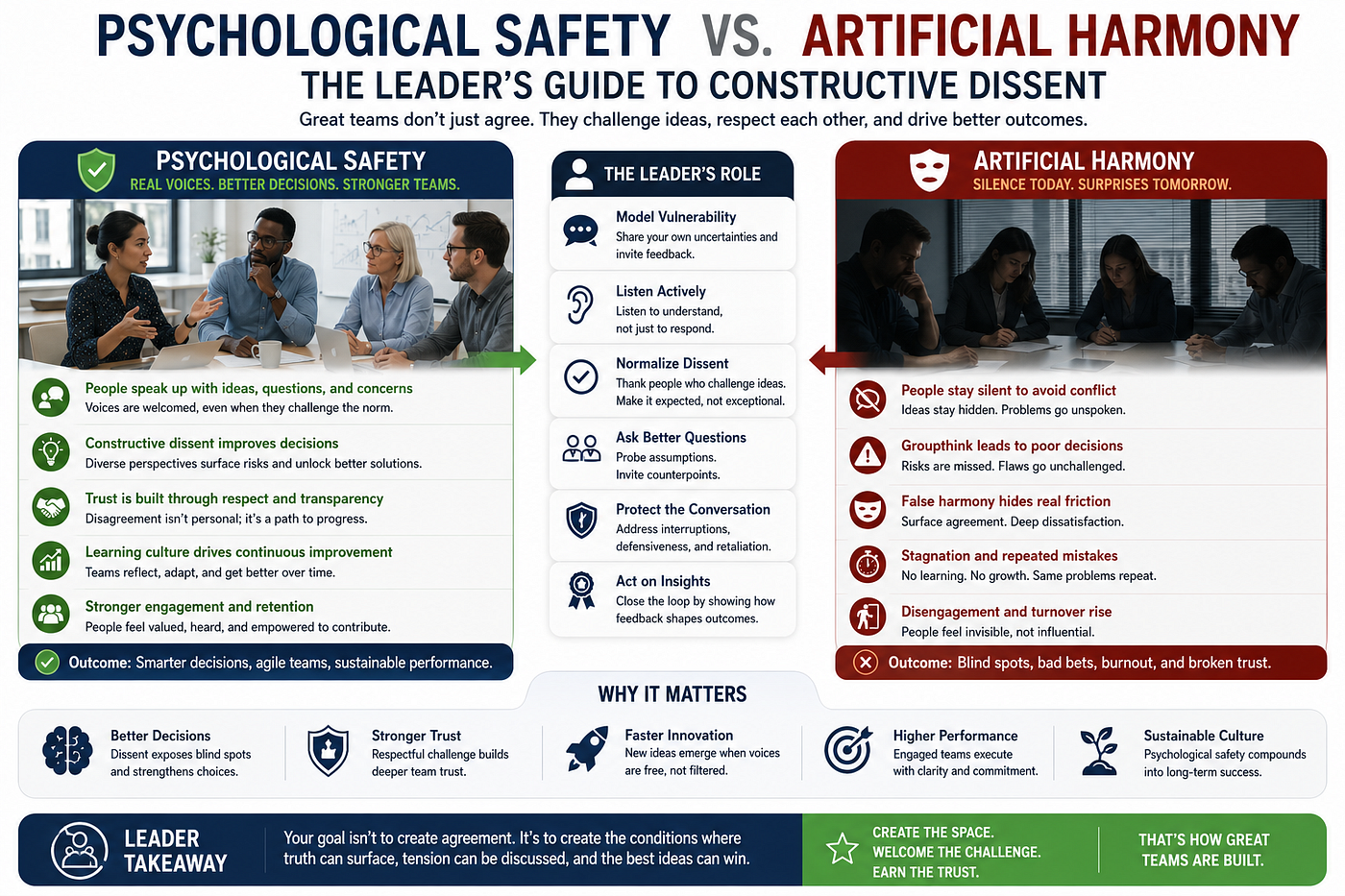
Walk into almost any modern corporate boardroom, and you will find an atmosphere of polite consensus. Nods accompany every executive proposal, smiles are exchanged, and overt conflict is systematically avoided. On paper, this looks like a cohesive team. In reality, it is often a dangerous organizational defense mechanism known as Artificial Harmony.
Many leaders confuse the absence of conflict with the presence of alignment. They build cultures where keeping the peace is prioritized over finding the truth.
However, true Psychological Safety the foundational driver of high-performing teams popularized by Harvard Business School professor Amy Edmondson is not about being nice. It is not about lowering performance standards, nor is it about emotional comfort.
Psychological safety is the structural capacity of a system to tolerate interpersonal risk. It is the architectural foundation that allows for Constructive Dissent.
1. The High Price of Polite Silence: The Amygdala Hijack
To understand why teams default to artificial harmony, we must examine our evolutionary biology. The human brain is hardwired to prioritize social belonging over intellectual accuracy. In our ancestral past, exclusion from the tribe meant literal death.
When an employee sits in a meeting and spots a critical flaw in a leader’s business strategy, a subconscious calculation occurs. If the organizational culture prioritizes absolute agreement, speaking up feels like a threat to social survival.
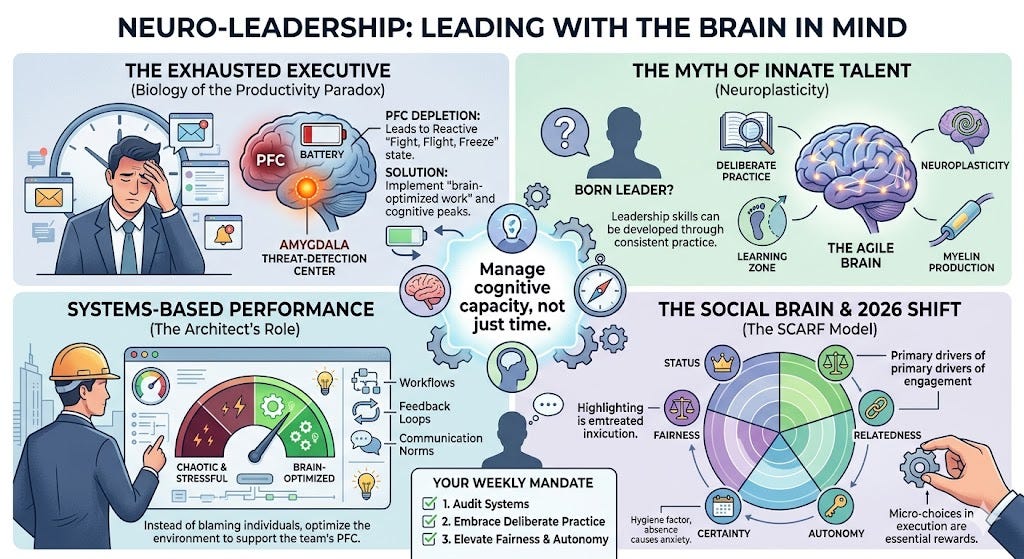
The Amygdala registers this social risk of looking foolish, disruptive, or disagreeable in exactly the same way it registers a physical threat.
[Flaw Spotted in Strategy] ──> Low Psychological Safety ──> Amygdala Registers Social Threat ──> Self-Preservation (Silence)
                                                                                                        │
[Flaw Spotted in Strategy] ──> High Psychological Safety ──> Prefrontal Cortex Process ──> Radical Candor (Constructive Dissent)
The result? The employee chooses self-preservation over institutional improvement. They stay silent, the flawed strategy proceeds, and the organization pays the price. Artificial harmony is nothing more than fear wrapped in politeness.
2. Deconstructing the Spectrum: Safety vs. Comfort
To manage human performance effectively, leaders must distinguish between the comfort zone, the anxiety zone, and the high-performance zone. Artificial harmony traps a team in the comfort zone, where superficial pleasantries mask systemic operational vulnerabilities.
When psychological safety is high, the fear of failure is decoupled from the act of experimentation. Dissent is decoupled from disrespect. Teams can engage in fierce intellectual friction without creating interpersonal friction.
3. Structural Architecture for Constructive Dissent
How do you transition a corporate culture from transactional politeness to relentless intellectual honesty? It requires a deliberate shift in choice architecture and communication protocols:
- Destigmatize the “Red Team” Approach: Borrow a strategy from military intelligence and tech security. For every critical decision, assign a specific individual or sub-team to act as the “Red Team.” Their explicit job description for that hour is to find holes, uncover cognitive biases, and stress-test the proposal. This removes the social stigma of dissent because critiquing becomes an assigned role, not a personal critique.
- Frame Work as a Learning Horizon: Shift the vocabulary from execution targets to experimental feedback loops. Instead of asking, “Are we sure this will work perfectly?” ask, “What is the biggest assumption we are making here that could be wrong?”
- Audit Your Rejection Metrics: Pay close attention to what happens when someone shares an unpopular perspective. If the dissenter is met with rolled eyes, defensive interruptions, or subsequent exclusion, your psychological safety score is effectively zero, regardless of what your corporate value statement claims.
4. Systemic Implementation for Leadership Teams
To dismantle artificial harmony within your executive or cross-functional teams immediately, implement these three practices:
- De-escalate Your Authority: As a leader, you naturally command a massive cognitive footprint in the room. If you speak first, you anchor the entire conversation, and your team will subconsciously shift their views to match yours. Speak last. Ask questions that extract alternative viewpoints before you reveal your position.
- Reward the Dissenter Publicly: When someone challenges your premise, resist the urge to defend. Instead, reward the behavior: “Thank you for pointing out that operational bottleneck, Nimesh. If you hadn’t raised it, we would have run into that blindspot next quarter.” This signals to the rest of the room that dissent is a currency for promotion, not a liability.
- Normalize “Clean” Conflict: Teach your teams how to separate the idea from the identity. Use language frameworks that target the process, not the person: “I disagree with the data model used for this projection,” rather than, “Your projections are unrealistic.”
The Ultimate Executive Currency
In 2026, an organization’s survival depends on its speed of learning. If your corporate ecosystem filters out bad news, warning signs, and divergent opinions for the sake of preserving a polite corporate surface, you are steering into a strategic iceberg with a blindfold on.
True leadership means leaving behind the safe harbor of artificial harmony. By intentionally designing an environment of deep psychological safety, you unlock the collective intelligence of your organization — transforming constructive dissent into your ultimate competitive edge.
Let’s Connect & Grow Together
If you found this exploration of organizational psychology, leadership dynamics, and cognitive safety valuable, let’s connect:
- 🌐 Explore my Work: Head over to my Professional Portfolio to view my corporate training frameworks, soft skills research, and past academic insights.
- 🔗 Professional Networking: Let’s connect on LinkedIn to share ideas on human behavior, industrial-organizational psychology, and leadership metrics.
- 📧 Stay Informed: Subscribe to my LinkedIn Newsletter, Mindset & Management Insights, for weekly strategies focused on optimizing human bandwidth and behavioral performance.
Does your current organization cultivate true psychological safety, or is it operating under the illusion of artificial harmony? How do leaders around you react to constructive dissent? Share your experiences in the comments below!
References
- Edmondson, A. C. (1999). Psychological safety and learning behavior in work teams. Administrative Science Quarterly, 44(2), 350–383.
- Edmondson, A. C. (2018). The Fearless Organization: Creating Psychological Safety in the Workplace for Learning, Innovation, and Growth. John Wiley & Sons.
- Lencioni, P. (2002). The Five Dysfunctions of a Team: A Leadership Fable. Jossey-Bass.
- Scott, K. (2017). Radical Candor: Be a Kick-Ass Boss Without Losing Your Humanity. St. Martin’s Press.
메타데이터
- post_id
- cc2e0f40b9d4
- slug
- psychological-safety-vs-artificial-harmony-the-leaders-guide-to-constructive-dissent-cc2e0f40b9d4
- url
- https://medium.com/@nethrahannadige/psychological-safety-vs-artificial-harmony-the-leaders-guide-to-constructive-dissent-cc2e0f40b9d4
- canonical_url
- https://medium.com/@nethrahannadige/psychological-safety-vs-artificial-harmony-the-leaders-guide-to-constructive-dissent-cc2e0f40b9d4
- author_url
- https://medium.com/@nethrahannadige
- status
- ok
- fetched_at
- 2026-07-16 08:45:14