The Loving Distortion: How Gauguin and Disney Turned Admiration into Cultural Fantasy
Paul Gauguin and Disney’s The Three Caballeros look, at first, like strange things to compare. One belongs to the history of modern…
The Loving Distortion: How Gauguin and Disney Turned Admiration into Cultural Fantasy
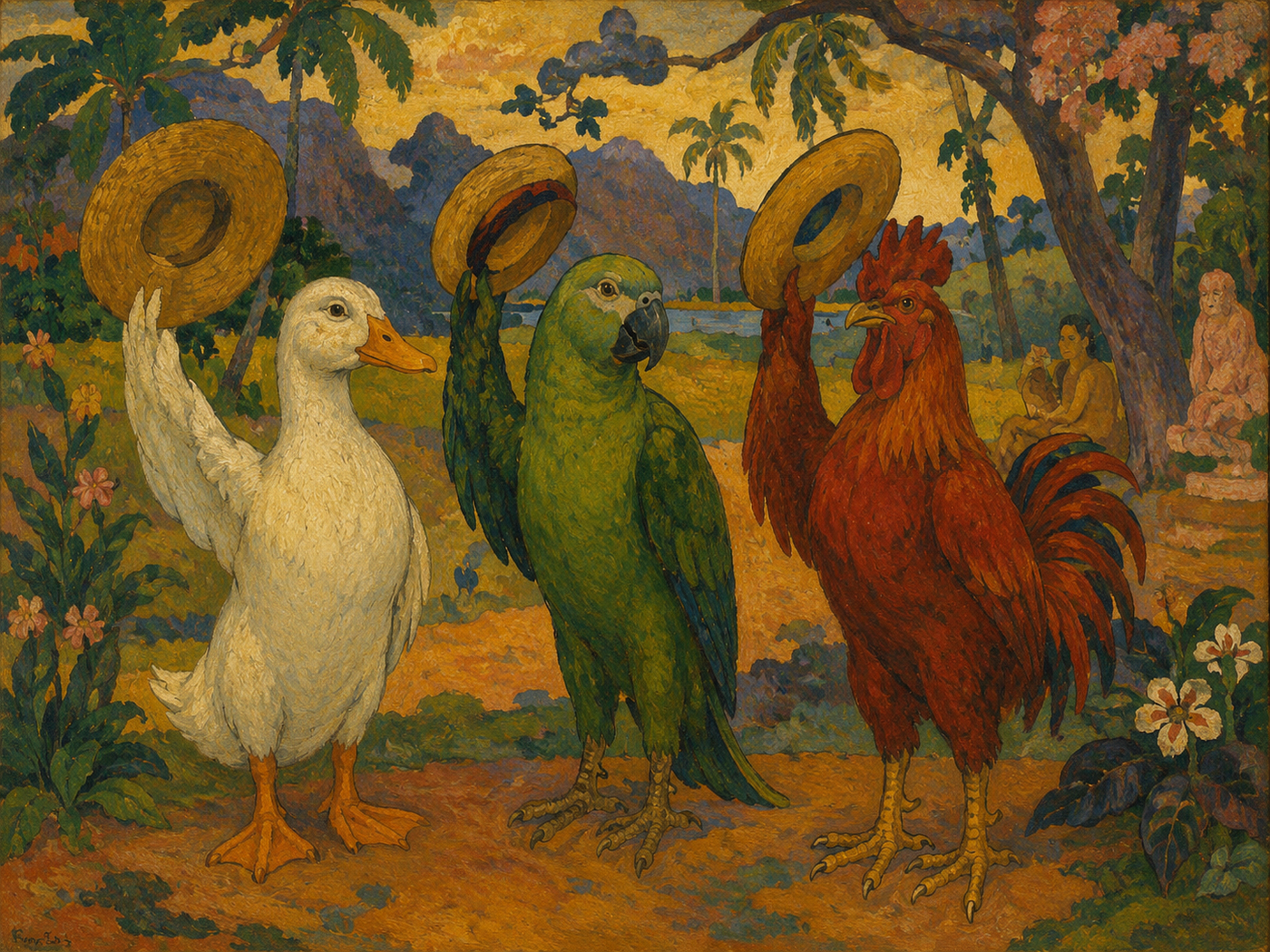
The domination is not in the insult. It is in the framing.
Paul Gauguin and Disney’s The Three Caballeros look, at first, like strange things to compare. One belongs to the history of modern painting: a French artist in the South Pacific, making strange, vivid, symbol-heavy images of Tahitian women, tropical landscapes, religious visions, and imagined Indigenous worlds. The other belongs to mid-century American mass entertainment: Donald Duck, José Carioca, Panchito Pistoles, music, live-action dancers, animated birds, slapstick, travel fantasy, and U.S. wartime cultural diplomacy.
But they are connected by a deeper pattern. Both are examples of an outsider looking at another culture, feeling real attraction toward it, and then turning that attraction into an image that serves the outsider’s needs.
The Gauguin story begins with escape. Gauguin was not simply looking for a place to paint. He was looking for a place that would save him from Europe. He wanted distance from bourgeois life, from academic art, from industrial modernity, from the ordinary. Tahiti became, in his mind, a possible answer: a place where life might be more direct, more sensual, more spiritual, more ancient, more honest.
The problem was that the Tahiti he wanted was already partly a fantasy before he arrived. Tahiti was not an untouched Eden waiting outside history. It had already been deeply affected by European contact, missionary Christianity, disease, commerce, and French colonial power. Gauguin arrived wanting to encounter an Indigenous world that he imagined as more authentic than Europe, but what he found was a colonized society, already entangled with the modern forces he claimed to be fleeing.
So he did what artists often do, but in a morally loaded way: he invented. He painted not simply what was there, but what he needed to be there. His Tahiti became a symbolic landscape where Indigenous women could stand for mystery, erotic innocence, spiritual depth, and a lost human origin. He was not always lying in any simple sense. He was often expressing something he truly felt: longing, disgust with Europe, hunger for beauty, fascination with different forms of life. But sincerity did not make the image truthful. His feeling became a filter, and the filter became the world.
That is why Gauguin is so disturbing. The exploitation is not separate from the beauty. The paintings are powerful partly because his longing was real. But the people he painted were not just raw material for his longing. They had their own lives, histories, languages, social worlds, and forms of meaning. Gauguin’s art often turns them into symbols inside his personal mythology. He loved what he imagined they represented. That is not the same as knowing them.
Disney’s The Three Caballeros comes from a very different world, but the mechanism is similar. The film was released during World War II, after the United States had become intensely interested in strengthening ties with Latin America. The Good Neighbor Policy was meant to replace older, more openly interventionist attitudes with friendship, mutual respect, and hemispheric cooperation. But it was also strategic. U.S. officials were worried about Axis influence in Latin America, and they understood film as a way to shape feeling at mass scale.
Disney became useful because Disney could make politics feel apolitical. Donald Duck did not look like an agent of diplomacy. He looked harmless. He could travel through Latin America, receive gifts, dance, flirt, misunderstand things, get corrected, and make friendship seem natural. The movie does not lecture the viewer about geopolitical alignment. It turns alignment into rhythm, color, charm, and laughter.
This is why The Three Caballeros is more complicated than a crude propaganda film. It contains real artistry. It includes Latin American performers, music, dance, and visual invention. It is not simply sneering at Latin America. In fact, part of its purpose was to move away from older Hollywood stereotypes of Latin Americans as bandits, clowns, and villains. The film wants to be affectionate. It wants Latin America to appear attractive, lively, modern enough to be admired, and different enough to be exciting.
But again, affection is not innocence. The film’s Latin America is organized around what an American cultural machine needed Latin America to be: colorful, musical, friendly, sensual, welcoming, and compatible with U.S. leadership. Difference is celebrated, but only after it has been made safe. The region becomes a party Donald Duck can attend. Its people become hosts, guides, singers, dancers, romantic surfaces, and symbols of hemispheric harmony.
This is the parallel with Gauguin. Both Gauguin and Disney transform another culture into a mirror for outsider desire.
Gauguin’s desire is personal and existential. He wants Tahiti to rescue him from Europe. Disney’s desire is corporate and geopolitical. It wants Latin America to become emotionally available to the United States. Gauguin wants spiritual renewal. Disney wants friendly hemispheric feeling. Gauguin paints the fantasy of the primitive. Disney animates the fantasy of the neighbor.
In both cases, the outsider gaze says: I admire you, but I need you to appear in a form I can use.
This is the heart of the concept: cultural fantasy is often built from admiration, not hatred. That is what makes it seductive. If Gauguin had simply despised Tahiti, his paintings would not matter in the same way. If Disney had simply insulted Latin America, The Three Caballeros would be easier to dismiss. The more interesting danger is the loving distortion. The outsider says, “I see beauty in you,” but what he often means is, “I see a version of you that solves a problem for me.”
For Gauguin, Tahiti solved the problem of European exhaustion. For Disney and the U.S. government, Latin America solved the problem of wartime alliance and American image-making. In both cases, the culture being represented is not allowed to remain fully itself. It becomes medicine for the outsider.
The sharper version is that Disney may be more structurally troubling than Gauguin, even if Gauguin’s personal conduct was more morally ugly.
Gauguin was one man, working through the myth of the solitary artist. His distortions were intimate, erotic, and colonial. They happened inside a world of unequal power, but his tools were canvases, writings, relationships, and the European art market.
Disney’s case is different. Disney had machinery. It had studios, distribution systems, government contracts, diplomats, research trips, commercial incentives, and a mass audience. Its fantasy did not hang on a gallery wall for collectors and critics. It moved through theaters, posters, music, merchandise, publicity, and eventually memory. It could make a geopolitical arrangement feel like a dance number.
That is why the Disney example is not merely “Gauguin, but cuter.” It is the modernization of the same impulse. Gauguin represents the romantic colonial gaze: the European artist who goes abroad to find the primitive truth he thinks Europe has lost. Disney represents the friendly imperial gaze: the American entertainment system that turns neighboring cultures into lovable partners inside a U.S.-centered story.
The friendly version can be more effective because it does not feel violent. It does not say, “We dominate you.” It says, “We love your music.” It says, “We brought your colors to the screen.” It says, “Look, Donald Duck is dancing with you.” The domination is not in the insult. It is in the framing. The culture is invited in, but only as a character in someone else’s production.
This does not mean the people represented had no agency. Latin American musicians and performers contributed to these films. Audiences in Latin America were not passive fools. Some enjoyed the films. Some may have seen opportunity, recognition, or pleasure in them. That matters. A critical reading should not erase the fact that cultural exchange is never only one-way manipulation.
But power determines which version travels farthest. A Brazilian, Mexican, or Tahitian person could interpret their own culture in a thousand ways. Gauguin and Disney had the platforms that made their versions globally durable.
So the comparison is not that Gauguin and Disney are identical. They are not. Gauguin’s work is private, feverish, erotic, and spiritually self-justifying. Disney’s is public, polished, diplomatic, commercial, and state-adjacent. But both show how beauty can carry power. Both show how admiration can become possession. Both show how an outsider can mistake emotional intensity for understanding.
The final point is uncomfortable: cultural exploitation often arrives smiling. It does not always look like mockery. Sometimes it looks like fascination. Sometimes it looks like tribute. Sometimes it looks like a masterpiece. Sometimes it looks like a cartoon bird with a song.
That is why the question should not be only, “Did they love the culture?” They probably did, in some sense. But. What did their love require the culture to become?
메타데이터
- post_id
- cc2ea03ab948
- slug
- the-loving-distortion-how-gauguin-and-disney-turned-admiration-into-cultural-fantasy-cc2ea03ab948
- url
- https://medium.com/@fe.stepka/the-loving-distortion-how-gauguin-and-disney-turned-admiration-into-cultural-fantasy-cc2ea03ab948
- canonical_url
- https://medium.com/@fe.stepka/the-loving-distortion-how-gauguin-and-disney-turned-admiration-into-cultural-fantasy-cc2ea03ab948
- author_url
- https://medium.com/@fe.stepka
- status
- ok
- fetched_at
- 2026-06-17 08:20:12