Uncertainty: Navigating Global Chaos with a 5,000-Year-Old Map
The Illusion of Predictability
Uncertainty: Navigating Global Chaos with a 5,000-Year-Old Map
The Illusion of Predictability
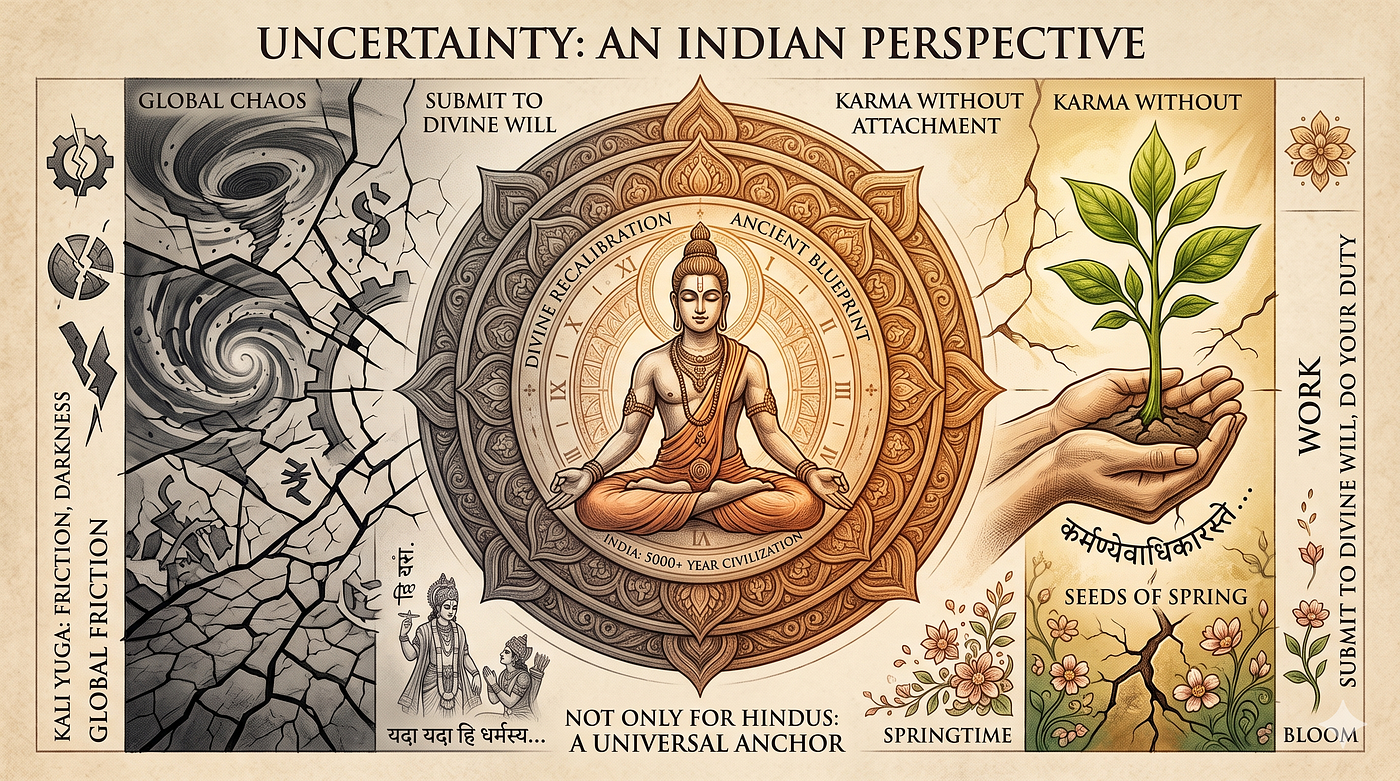
We are living in an era of deep and pervasive friction. Look at the headlines on any given morning right now. Global supply chains are choked at critical bottlenecks. The geopolitical order is fracturing into multipolar rivalries. We are attempting a massive energy transition while old wars over fossil fuels flare up again. Currencies are being weaponized, religious fault lines are widening and this exertion of supremacy by some is leading to wars. It feels as if every pillar of the modern world is trembling at once. It is easy to feel overwhelmed by this level of uncertainty. For the last few decades, a large part of the world operated under the illusion of permanence. We believed history had settled into a predictable rhythm. But history never settles.
The Echoes of Kurukshetra
To understand how to navigate this chaos, We take a look through the lens of India’s civilizational memory — the Mahabharata. Mahabharata, Bharatvarsha’s (India’s) itihasa (/ɪ.tɪ.ˈhɑː.sə/, history), is not merely a story, lore or mythology as many incorrectly refer to it as. It is a profound psychological and historical map of a society navigating total systemic collapse. The world of the Mahabharata was also a world in transition. It was the twilight of one epoch and the violent dawn of another. Every institution of statecraft, family loyalty, and morality was fracturing. In the Hindu worldview, time is not a straight line moving toward a utopian end. Time is cyclical. The universe breathes in and out. Periods of extreme harmony are inevitably followed by periods of decay. When friction and chaos peak, we experience the rise of adharma (unrighteousness or cosmic wrongs if you will). This is a state of profound imbalance where righteous action is eclipsed by greed, conflict, and delusion. Right now, the global turbulence we see is a sharp spike in adharma. But Hindu philosophy offers a powerful anchor in exactly these moments. It promises that the universe is fundamentally self-correcting.
The Promise of Recalibration
When the crisis reaches its zenith on the battlefield of Kurukshetra, the great warrior Arjuna is paralyzed by uncertainty. He drops his weapons unable to see a clear path forward through the devastation. It is here that Krishna delivers a timeless truth about cosmic balance:
”यदा यदा हि धर्मस्य ग्लानिर्भवति भारत । अभ्युत्थानमधर्मस्य तदात्मानं सृजाम्यहम् ॥”
“Whenever there is a decline in righteousness, O Arjuna, and an increase in unrighteousness, then I manifest myself.”
This is not just a theological promise of a divine savior taking a physical avatar. It is a profound philosophical statement about the nature of existence. When the world tilts too far into chaos, the forces of preservation and balance will inevitably rise to meet it. The universe corrects its own course. The avatar is the ultimate recalibration of a system that has lost its center.
Action Without Attachment
So how do we live through the storm while we wait for this balance? The answer lies in another teaching from that very same battlefield. When you are faced with a fracturing global order, you cannot control the outcome. You cannot individually fix currency wars or geopolitical realignments. You can only control your own alignment and your immediate duty.
”कर्मण्येवाधिकारस्ते मा फलेषु कदाचन ।”
“You have a right to perform your prescribed duty, but you are not entitled to the fruits of action.”
This is the ultimate survival guide for an uncertain age. It demands that we focus intensely on doing the right work in our own lives, our communities, and our nations without being paralyzed by anxiety over the macro results. We focus on the action. We let the universe manage the cosmic scales.
The Arrow versus the Wheel
Most of the modern world operates on a Western, linear concept of time. In this framework, time is an arrow shot from a bow. It has a definitive beginning and it travels in a straight line toward a definitive end. This view is deeply embedded in the cultural DNA of the West. It creates an inherent expectation of perpetual progress. We assume tomorrow must be better, wealthier, and more enlightened than today. Because of this linear expectation, a modern crisis feels like a catastrophic failure of the timeline. When we face global pandemics, systemic economic collapse, or the threat of world war, the linear mindset triggers existential dread. It feels as if the arrow has been knocked off course. It feels like the end of the world.
The Seasons of Eternity
The Hindu concept of Samay (Time) is fundamentally different. Time is not an arrow. It is a wheel. The universe does not progress toward a final utopia or a final apocalypse. It breathes. It moves through vast, repeating cycles known as the Yugas. There are four Yugas in a complete cycle. They begin with the Sat Yuga, an age of truth and perfect harmony, and slowly degrade through the Treta and Dvapar Yugas. Finally, the wheel turns to the Kali Yuga. This is the age of darkness, friction, spiritual amnesia, and institutional collapse. According to Hindu cosmology, it is the age we are living in right now. When you view history through the lens of the Yugas, your interpretation of modern crises shifts entirely. Geopolitical chaos, ecological devastation, and societal breakdown are no longer shocking anomalies. They are the expected weather of the current season.
The Liberation of Winter
This shift in perspective is incredibly liberating. If you believe the world is supposed to be constantly improving, the current state of affairs is paralyzing. You feel a frantic, crushing responsibility to fix the timeline. But you do not try to stop winter from being winter. You accept the cold and you build a fire. Understanding the Kali Yuga removes the unbearable burden of having to save the entire world. The world is doing exactly what it is supposed to do at this stage in the cosmic cycle. It is breaking down so that it can eventually be reborn. The wheel will eventually complete its turn, and the Satya Yuga will return. The universe handles its own macro level recalibration. This does not mean we surrender to apathy. It means our focus narrows in a healthy, manageable way. Instead of drowning in anxiety over a collapsing global order, we turn our attention to what is immediately in front of us. Our only job during the Kali Yuga is to protect our own inner light. We focus entirely on upholding our personal dharma, tending to our families, and doing right by our immediate communities. We survive the winter by preserving the seeds of truth for the spring that will inevitably follow.
An Open Unpatented Inheritance
This civilizational memory is not a closed inheritance meant only for those born into the Hindu faith. It is a universal compass offered to the world. For anyone seeking a deeper spiritual anchor, for anyone trying to understand how the great turning wheels of time shape the individual soul, the philosophies of Hinduism provide a profound roadmap. The core of this teaching is a beautiful paradox. We are asked to submit to the divine will and accept that the macro cycles of the universe are entirely beyond our control. Yet, in the exact same breath, we are to relentlessly perform our Karm. We surrender the outcome, but we never surrender the effort. We must do the daily, quiet work of bringing light to our own lives and our communities, striving constantly to take the world to a better place.
The Seeds of Spring
The world is undeniably going through a profound and painful transition. The geopolitical tectonic plates are shifting beneath our feet, and the resulting noise is deafening. We are watching systems we thought were permanent begin to buckle under the weight of war, economic strain, and ideological friction. But when we look through the lens of a civilization that has survived for five millennia, that deafening noise begins to fade into a familiar rhythm. We see clearly that this is not the end of the human story. It is merely a difficult, necessary chapter in a much older book. The answer to our current global uncertainty is not to build higher walls or to paralyze ourselves with existential fear. The answer is to understand exactly where we stand in the turning of the wheel. It is to embrace the cyclical nature of time, to root ourselves deeply in our immediate personal dharma, and to walk forward with the quiet, unshakable confidence of a culture that has survived a thousand winters before. The Kali Yuga is here, and the storm is raging outside. But if we simply do the work in front of us, we will find that we are already holding the seeds of spring.
메타데이터
- post_id
- cc48a9c1bc2c
- slug
- uncertainty-navigating-global-chaos-with-a-5-000-year-old-map-cc48a9c1bc2c
- url
- https://medium.com/@ramit.bhattacharjee/uncertainty-navigating-global-chaos-with-a-5-000-year-old-map-cc48a9c1bc2c
- canonical_url
- https://medium.com/@ramit.bhattacharjee/uncertainty-navigating-global-chaos-with-a-5-000-year-old-map-cc48a9c1bc2c
- author_url
- https://medium.com/@ramit.bhattacharjee
- status
- ok
- fetched_at
- 2026-07-09 13:32:43