Learning Notes: Basics of Linear Algebra for Data Analysts
Today I am covering the topic of three key concepts: scalars, vectors, and matrices, and exploring their significance in data analysis.
Learning Notes: Basics of Linear Algebra for Data Analysts
Today I am covering the topic of three key concepts: scalars, vectors, and matrices, and exploring their significance in data analysis.

Image by macrovector on Freepik
Key Concepts in Linear Algebra
1. Scalars
All numbers are referred to as scalars, in linear algebra. It is a single numerical value. It represents a quantity with magnitude but no direction.
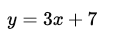
(3 and 7 are Scalars)
2. Vectors
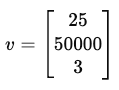
A vector is the simplest linear algebraic object. It is an ordered list of numbers that can represent a point in space, a direction, or multiple attributes of an object. Vectors have both magnitude and direction and are widely used in machine learning and statistics. It can have one column and many rows or one row and many columns . It’s more common to think of a vector as appearing in Matrices. For example, a data analyst working with customer records might represent a single customer’s data as a vector:
3. Matrix
A matrix is a collection of numbers ordered in rows and columns (Rows and columns are the two dimensions of the matrix). It is a fundamental structure in linear algebra used for representing datasets, transformations, and systems of equations. A data table with multiple observations and features can be represented as a matrix. (Matrixes can only hold numbers, symbols or expressions.)
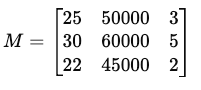
To summarise the 3 key concepts: Matrices have 2 dimensions, Vectors have 1 dimension and Scalars have no dimension.
Why Data Analysts Use Linear Algebra
Data Analysts use linear algebra because it provides the mathematical foundation for many analytical techniques, including:
- Data Transformation: Scaling, rotating, or normalising data to improve model performance.
- Dimensionality Reduction: Techniques like Principal Component Analysis (PCA) help reduce complex datasets to simpler forms while preserving essential information.
- Regression Analysis: Linear regression models use matrix operations to compute the best-fitting line for predictive analysis.
- Machine Learning Algorithms: Many algorithms, including neural networks and clustering methods, rely heavily on linear algebra concepts.
Since I am new to the world of linear algebra, I can practice working with these structures alongside learning NumPy and Pandas.
메타데이터
- post_id
- cc57f0d38d4e
- slug
- learning-notes-basics-of-linear-algebra-for-data-analysts-cc57f0d38d4e
- url
- https://medium.com/@jennycoreholt/learning-notes-basics-of-linear-algebra-for-data-analysts-cc57f0d38d4e
- canonical_url
- https://medium.com/@jennycoreholt/learning-notes-basics-of-linear-algebra-for-data-analysts-cc57f0d38d4e
- author_url
- https://medium.com/@jennycoreholt
- status
- ok
- fetched_at
- 2026-06-25 07:00:49