Kawasaki’s Robot Horse Is a Concept But the Problem It’s Solving Is Very Real
Let’s be honest about what Kawasaki’s Corleo is right now.
Kawasaki’s Robot Horse Is a Concept But the Problem It’s Solving Is Very Real
Let’s be honest about what Kawasaki’s Corleo is right now.
The video that got 1.2 billion social media impressions is CGI. The physical model on display at Osaka Expo 2025 could stand and pose, but not walk. There is no working prototype. The first functional version isn’t expected until Expo 2030 in Riyadh. Commercial launch is targeted for 2035 — nearly a decade away.
So why is this worth writing about?
Because the problem Corleo is designed to solve is completely real. And the fact that a company like Kawasaki Heavy Industries — with serious engineering credentials in both robotics and motorcycles — has established a dedicated development team reporting directly to the CEO tells you that they believe it’s solvable.
Sometimes a concept is just a concept. And sometimes a concept is the clearest articulation of where an entire field of technology needs to go. Corleo, despite its current CGI status, is much closer to the second.
The Problem With Wheels
Off-road mobility has a fundamental constraint that’s easy to overlook because we’ve built so much infrastructure around avoiding it: wheels require relatively flat, prepared surfaces to work well.
ATVs and four-wheelers handle rough terrain better than road vehicles. But they still struggle with steep inclines, loose rubble, narrow mountain paths, and stairs. They need tracks or specialized tyres for soft ground. They get stuck. They tip. And the more extreme the terrain, the more specialized — and expensive — the vehicle needs to be.
Legged locomotion doesn’t have these constraints in the same way. Animals have been navigating rough terrain for hundreds of millions of years using legs, and the engineering advantages are significant. Independent limb control means each foot can find its own stable placement. The body can stay level while the legs adapt to uneven ground. Steps, rocks, and loose terrain that would stop a wheeled vehicle are simply navigated around.
The challenge is that building a mechanical system that replicates this is extraordinarily hard — and making it powerful enough to carry a human rider while running on clean energy harder still.
This is the specific problem Corleo is trying to solve.
What Kawasaki Is Actually Building
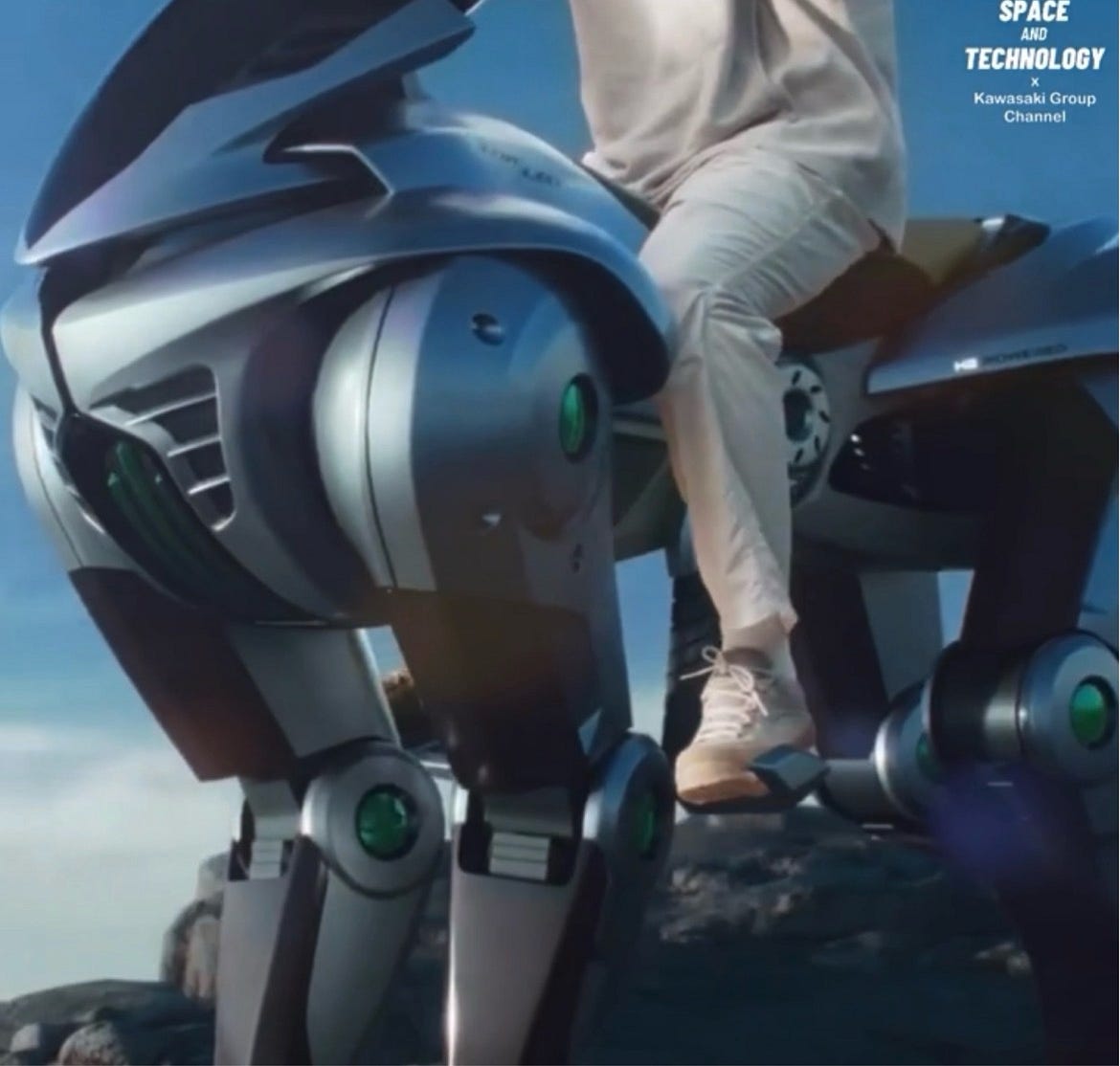
Corleo is a four-legged personal mobility vehicle designed for off-road terrain — mountains, rocky paths, rubble fields, and environments where conventional vehicles can’t operate. It’s designed to carry a rider, controlled through body weight shifting rather than a conventional steering mechanism, in the same way you’d guide a real horse.
The powertrain is unusual and worth understanding properly. Corleo doesn’t use a battery in the conventional EV sense. Instead, it uses a 150cc hydrogen combustion engine as a generator — burning hydrogen to produce electricity, which then powers independent drive units inside each of the four legs. This approach gives it the range and endurance advantages of hydrogen over battery electric, while still being electrically driven at the point of movement.
The rear leg unit operates on an independent swing arm — borrowed directly from Kawasaki’s motorcycle engineering — allowing it to absorb shock independently from the front legs. This keeps the rider level when traversing uneven ground. At night, the system projects navigation markers onto the terrain ahead, showing the path the robot is planning to take.
An onboard AI suite continuously monitors the rider’s weight distribution and adjusts leg movement in real time to maintain balance and stability. The rider doesn’t program the path — they guide the direction through body language, and the robot figures out how to execute it safely.
This is, in concept, a genuinely elegant approach to human-robot physical collaboration. The human provides intent. The machine handles execution.
Why This Is Harder Than It Looks
The gap between what Corleo promises in CGI and what an actual working prototype will need to deliver is significant, and it’s worth being clear about what the hard problems actually are.
Balance and locomotion at human-carrying scale is the central challenge. Boston Dynamics’ quadruped robots — the most capable legged systems currently deployed commercially — weigh around 32kg and carry payloads of 14kg. Corleo needs to carry one or two human riders, which changes the physics of balance and control substantially. Every control system designed for a lightweight robot needs to be rethought for something operating at this scale.
Hydrogen storage and safety in a mobile, off-road vehicle is a non-trivial engineering problem. The fuel is stored in rear-mounted cartridges. Managing hydrogen safely in a vehicle that will be tumbling over rocks and potentially falling over requires careful engineering of the containment system, pressure management, and leak detection.
Real-time terrain adaptation is perhaps the most computationally demanding requirement. The AI needs to perceive the terrain ahead, plan footfall placements, execute those placements, and continuously adjust for the rider’s weight shifts — all in real time, in unstructured environments that no simulation fully prepares you for.
These are solvable problems. But they’re not easy ones. The 2030 prototype target and 2035 commercial launch are ambitious, and Kawasaki has been careful not to overclaim what the current state of development actually looks like.
Why It Matters Anyway
Here’s the argument for taking Corleo seriously despite its current concept status.
Kawasaki isn’t a startup with a CGI video and a pitch deck. They are a major industrial conglomerate with decades of expertise in both robotics and high-performance mechanical engineering. Their motorcycle division understands dynamic balance and rider feedback systems. Their robotics division builds industrial robots. The engineering foundations for Corleo exist in-house in a way that they don’t at most companies talking about quadruped mobility.
The fact that they’ve established a dedicated development team — the Safe Adventure Business Development Team — reporting directly to CEO Yasuhiko Hashimoto is a meaningful signal. This is organizational commitment, not just a concept exercise. The 1.2 billion social media impressions the Osaka Expo display generated probably helped accelerate that commitment, but the technical roadmap appears to be genuine.
The timeline also tells you something. Originally positioned as a 2050 concept, Kawasaki has pulled the commercial launch forward to 2035 and the first working prototype to 2030. That’s either wildly optimistic or a sign that their internal engineering assessment gives them more confidence than the original timeline suggested.
Corleo also exists at an interesting intersection of trends that are all moving in the same direction simultaneously. Legged robotics is advancing rapidly — Boston Dynamics, Unitree, Spot-type quadrupeds, and humanoid bipeds are all pushing the state of the art forward in ways that directly benefit Corleo’s development. Hydrogen as a clean energy carrier for mobile applications is receiving serious investment across the automotive and heavy industries sectors. AI-driven real-time control systems are becoming dramatically more capable.
Corleo is trying to combine all three of these into a single product. That’s either a recipe for a project that’s impossibly complex — or a vision that arrives at exactly the right moment because all the underlying technologies have matured enough to make it feasible.
The Data Dimension
There’s a dimension of Corleo’s development that hasn’t been discussed much publicly but is worth raising: the role of real-world physical data in training the AI systems that will make it work.
The AI suite that keeps Corleo balanced, adapts to terrain, and responds to rider weight shifts is a learned system — not a scripted one. That means it needs training data. And the most valuable training data for a system like this isn’t simulation data alone. It’s real-world data of legged systems navigating real terrain, of humans riding and weight-shifting on unstable surfaces, of the edge cases and failure modes that no simulator generates from scratch.
Kawasaki has actually made an interesting move here: they’ve announced plans to develop a Corleo riding simulator by 2027, and to deploy the motion data, 3D models, and control data generated during Corleo’s development to the gaming and e-sports industries. This is smart — it creates a revenue stream from the development process itself, while also generating a large volume of interaction data from users of the simulator.
But simulator data has limits. At some point, developing a system that works reliably in the physical world requires physical world data. This is the same challenge facing humanoid robotics broadly — and it’s one of the most important unsolved problems in the field.
At FileMarket AI, we think about this from the data collection side. The quadruped and humanoid robots being developed today — including systems like Corleo — will ultimately be trained on and evaluated against real-world physical data. The quality and diversity of that data is one of the key determinants of how well these systems perform when they leave the lab.
The robot might be the most visible part of the story. The data that teaches it to move is the invisible infrastructure underneath.
What to Watch For
The clearest signal that Corleo is progressing from concept to reality will be the 2027 riding simulator. If Kawasaki delivers that on schedule and it generates meaningful interaction data and public engagement, it suggests the engineering program is on track.
The 2030 Expo 2030 Riyadh target is the bigger test. A working prototype capable of carrying riders over genuine off-road terrain — not CGI, not a static display — would be one of the most significant demonstrations in the history of personal mobility robotics.
And if that happens, 2035 starts to look less like a distant ambition and more like a credible commercial timeline.
Corleo is a concept. But it’s a concept built by serious engineers, backed by a serious company, addressing a real problem that nobody has solved yet. That’s a different thing from a concept that exists only to generate impressions.
Watch this space.
Image credit: Kawasaki Heavy Industries, shared via Space and Technology on LinkedIn.
Learn more about Kawasaki Corleo: https://global.kawasaki.com
Learn more about FileMarket AI Data Labs: https://filemarket.ai


메타데이터
- post_id
- cc5bf293df50
- slug
- kawasakis-robot-horse-is-a-concept-but-the-problem-it-s-solving-is-very-real-cc5bf293df50
- url
- https://medium.com/@filemarketai/kawasakis-robot-horse-is-a-concept-but-the-problem-it-s-solving-is-very-real-cc5bf293df50
- canonical_url
- https://medium.com/@filemarketai/kawasakis-robot-horse-is-a-concept-but-the-problem-it-s-solving-is-very-real-cc5bf293df50
- author_url
- https://medium.com/@filemarketai
- status
- ok
- fetched_at
- 2026-07-20 12:41:23