They Are Driving Me Mad!
A rude awakening to the driving philosophy on Port Harcourt roads
They Are Driving Me Mad!
A rude awakening to the driving philosophy on Port Harcourt roads
Let me tell you about the precise moment I understood that Port Harcourt had a completely different relationship with traffic than anywhere I had ever lived, even Lagos!
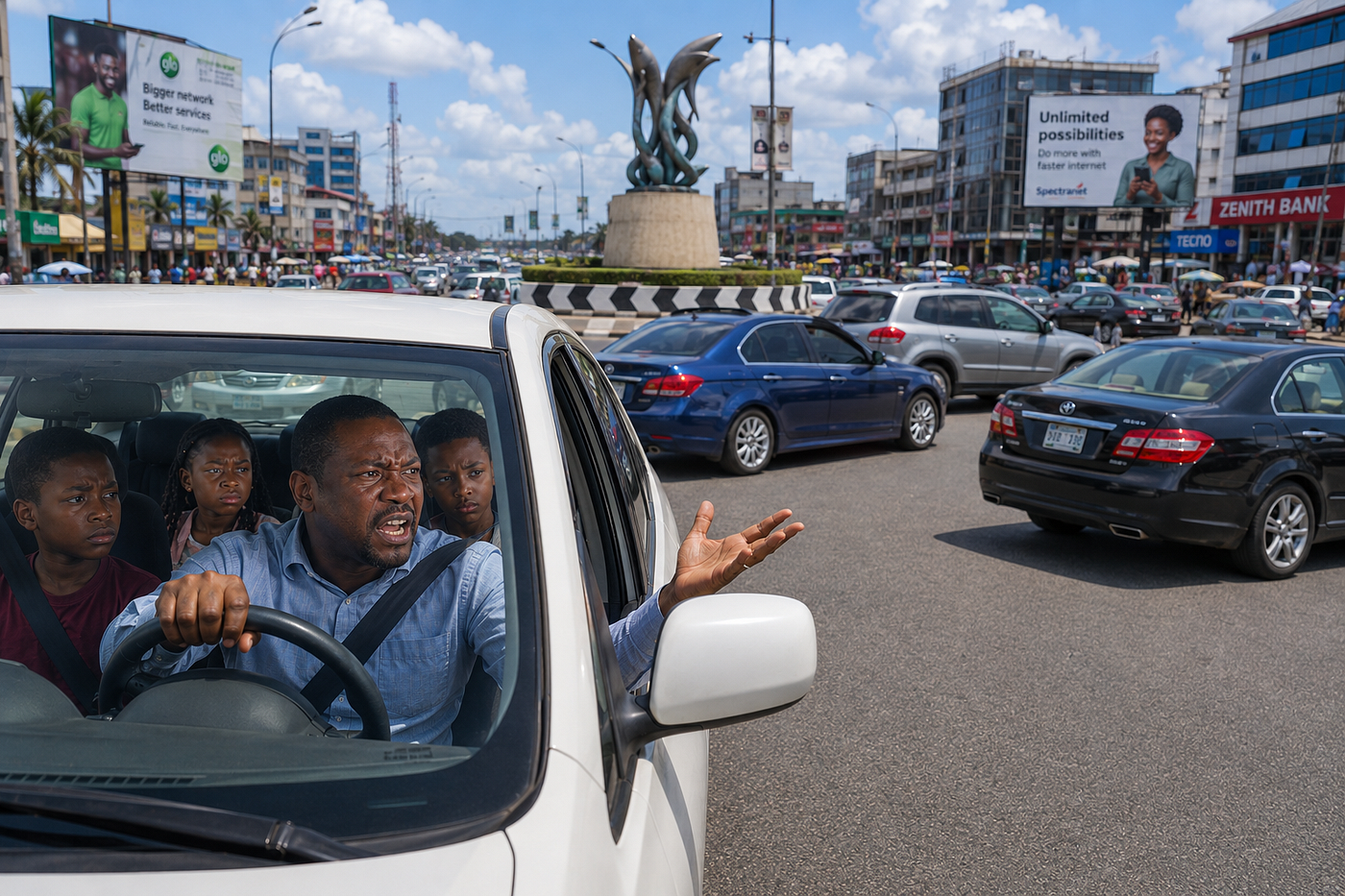
It was a Tuesday morning, and I was doing normal school runs. I had been in the city for less than three weeks at this time. I was driving along Aba road, on the service lane just by Kilimanjaro at GRA Junction. That famous spot where the restaurant sits like a landmark that Port Harcourt people use to give directions to everything within a five-kilometre radius, and I was feeling relatively good about myself and my kids, having said our declaration confessing that our actions will give glory to God on this day. Then, the temptation came!
Just as I commenced indicating that I wanted to navigate into Tombia Street, I saw them. School children. A group of maybe eight or nine of them, hovering at the edge of the road in their uniforms, waiting to use the zebra crossing. You know, the zebra crossing! Those black and white stripes painted on the road that exist specifically so that human beings can cross from one side to the other without becoming a statistic.
I stopped and beckoned to them to proceed.
I want you to understand the full moral weight of what I did in that moment. I stopped my car at a zebra crossing. For children. I was, by any reasonable global standard, doing exactly what every driver everywhere is supposed to do. I was being, in the technical sense, a correct human being.
The driver behind me did not share this assessment.
The horn started approximately 0.4 seconds after my car came to a complete halt. Not a polite horn. Not the gentle, inquisitive beep of a driver who wonders if perhaps you have seen something on the road that they have not. No. This was a horn deployed with intent. A horn that carried within it the full existential frustration of a man who believed, with every fibre of his being, that I had personally wronged him. That I had reached into his morning and stolen something irreplaceable from it. The horn said: what is wrong with you? What is the matter? Why have you stopped on a road that is meant for moving? Are you sick? Do you need help? Are you, in fact, in your right mind?
I did not move.
More horns joined. Because in Port Harcourt, one horn is a suggestion. Two horns is a conversation. Three horns is a movement.
I sat there and watched all nine children cross safely to the other side. It took perhaps twenty-five seconds. I watched them go, one by one, backpacks bouncing, completely unaware that behind them a man in a white Toyota Prius was being treated as a public nuisance for letting them live.
When the last small foot reached the pavement, I looked in my rearview mirror. The driver behind me, a gentleman in a burgundy Toyota Camry, the car of choice of Port Harcourt’s middle class and its most enthusiastic road philosophers, looked at me with an expression I can only describe as deeply aggrieved. Not angry, but aggrieved, the way a man looks when he has been let down by an institution he trusted.
I smiled at him, resisting the temptation to do something else. I smiled. He did not smile back. I was satisfied, but at what I couldn’t say. More from experiencing his anger than from being a good citizen of the Republic, because for most of the time, they are the ones always driving me mad.
Welcome to Port Harcourt, I told myself. You are going to need a different nervous system here.
I lived in Bonny Island for a while. If you have never been to Bonny, I understand that it might sound like a place I have invented for narrative convenience. I have not. It is a real island that is now connected to the mainland by a road, and for most of my memory, one of the more civilised driving experiences in Rivers State. People on Bonny drove like they had somewhere to be, yes, but they also drove like they understood that other people also had somewhere to be. There was, if not courtesy, at least a mutual acknowledgement that roads are shared infrastructure and not personal property, and there are rules that govern that mutual knowledge.
Port Harcourt has a different philosophy entirely. Port Harcourt’s philosophy appears to be this: the road belongs to whoever is on it most aggressively and unfriendly at any given moment.
It is not written down anywhere. There is no official document. But it is understood, it is practised, and it is enforced with great consistency by every category of road user in this city, from the Keke buses of Mile 1 to the SUVs of Peter Odili Road, from the keke napeps of Diobu to the Uber drivers of Old GRA who have apparently decided that their passenger rating is not worth adjusting their behaviours for.
I have lived here nine months now. I have learned things.
On the matter of roundabouts.

https://tirf.ca/blog/roundabouts/
I want to talk about roundabouts specifically because they represent, for me, the clearest window into how Port Harcourt interprets the concept of rules.
A roundabout, for those who remember their highway code is a junction where traffic flows in one direction around a central island, and vehicles already on the roundabout have priority over those entering. This is not a suggestion. This is the rule. It exists in every country that uses roundabouts, including Nigeria, including Rivers State, including, specifically, the Elekahia/Trans Amadi roundabout, the Amadi-Ama roundabout, the Slaughter/Okuru roundabout, and every other circular piece of road infrastructure in this metropolis.
None of this information is relevant to a significant portion of Port Harcourt’s drivers.
The first time I approached the Amadi-Ama roundabout from Peter Odili road, I did what sane people do. I slowed, I checked that traffic on the roundabout was clear, and I prepared to give way. The car beside me, a keke bus, I should mention, with at least six passengers and the energy of a vehicle that has nothing left to lose, simply did not stop. It entered the roundabout with the confidence of a vehicle that has never once encountered the concept of accident. Three other cars followed it immediately, like disciples who had seen a miracle and were not going to miss the next one.
I sat and watched this and tried to locate within myself an appropriate emotional response.
The thing is, if just one person cheats the roundabout, it is a nuisance. But in Port Harcourt, enough people do it that the cheating becomes the system. The people following the rule become the anomaly. You sit there, correctly positioned, correctly waiting, and you are treated as if you are the problem. Cars flow around you. Drivers look at you with mild pity, the way city people look at someone who has just asked for directions to a place that no longer exists.
On road signs and their optional nature.
There is a road sign on one of the roads off NTA road. I have seen it with my own eyes that says NO ENTRY. It is clear. It is large. It is painted in the international red-and-white colour scheme, which means the same thing in Lagos, London, and Lima. It means: do not enter here. This is a restricted direction.
In Port Harcourt, this sign appears to mean: entry is not recommended but is permitted if you are in a hurry, if the road looks clear, if you have already turned your steering wheel in that direction, or if your vehicle has the letters “BUS” or “TRICYCLE” anywhere on its body.
The one-way system in parts of this city exists in a state I can only describe as theoretical. Theoretically, D-Line has roads that run in specific directions. Theoretically, the routes in and out of Old GRA have a logic to them. In practice, these are flexible arrangements, renegotiated in real time by whoever needs to go somewhere faster than the official route allows (except the one at Old GRA, where there are Police men always stationed, waiting for prey). I have watched buses reverse up one-way streets with the calm professionalism of men who have done this every day for years and see nothing unusual about it. I have watched motorcycles come at me head-on with expressions of absolute serenity, as if I am the one going the wrong way and they are simply choosing not to make an issue of it.
Port Harcourt needs RISTMA (Rivers State Traffic Management Agency)! Their own version of LASTMA in Lagos. More drivers would have been sent for psychiatric evaluation here than in Lagos!
On the particular character of Port Harcourt’s traffic psychology.
Driving in this city is not merely a physical act. It is a psychological one. It requires the management of something that I am going to call aggressive proximity. The Port Harcourt driver’s belief that if there is a gap between your car and the car in front of you, that gap is not your safety buffer. It is an invitation. It is empty space that belongs to whoever notices it first.
I learned this at the Elekahia Junction by the Stadium. I had left a gap of approximately two car lengths between myself and the vehicle ahead. In the time it took me to complete one full breath, a Toyota Corolla, and a keke napep had filled that space with the efficiency of water finding its level. I didn’t see any of them indicate. I’m not sure if indicating is something that happens in Port Harcourt outside of dealership showrooms.
The indicator light, in this city, appears to be a feature that comes with the car but is considered, like the spare tyre manual or the service history booklet, largely decorative. Drivers do not indicate before they change lanes. They change lanes and then, occasionally, as a kind of retrospective courtesy, they might flick the indicator on briefly afterwards, as if to say: “yes, I just did that, you already know. But I am telling you formally”.
The horn, uhmmmmm! The horn is used extensively, creatively, and across a remarkable range of emotional registers. I must confess that this is a Nigerian thing, and I am one. There is the warning horn: I am here, acknowledge me. There is the impatient horn: you have been stationary for three seconds, and I find this unacceptable. There is the philosophical horn, deployed at a traffic light that has been red for what the driver considers too long, as if the horn will negotiate with the signal. There is the greeting horn, the goodbye horn, and the horn that is simply a kind of existential statement of presence. I am here. I am moving. Watch out!
Back to Kilimanjaro. Back to the children.
I think about that Tuesday morning more than is probably healthy.
Because here is the thing that bothers me, that I cannot shake off my mind, that sits with me every time I drive past that zebra crossing: those school children waited for someone to stop. They stood at the edge of the road and waited, with the mindset of children who have learned that patience is necessary here, because nobody was going to stop automatically. They waited until I stopped. And when I stopped, and the cars behind me began to make noise, not one of those children looked surprised. They just crossed quickly, heads down, because they knew that the window might close.
Children should not have to know that. They should be able to step onto a zebra crossing with the confidence that the painted road means something. That it will be honoured.
I stayed. I know that one stopped car is not a traffic culture. I know that my stubbornness on that Tuesday morning did not reform a single thing about how Port Harcourt drives. The gentleman in the burgundy Camry went on with his day, no doubt cut in front of three more people and was home in time for lunch, entirely untroubled.
But the children made it across. All nine of them. Backpacks and all.
I am nine months into this city, and I confess that Port Harcourt has begun to colonise my driving — this has been my fear. I catch myself filling gaps I would not previously have filled. I found myself sounding my horn last week at a driver who had been stationary for what I calculated was too long. Last week, I got into the roundabout by Hypercity at Peter Odili road without yielding to traffic on the left.
The city is getting into me. I can feel it.
But I have made myself one promise. Every morning that I drive down that stretch along Aba road by GRA Junction, in front of Kilimanjaro, if there are children at that zebra crossing, I would stop. Horns and all.
They can hoot till the city sleeps.
I am not moving until those children are safely across the road. This is my promise!
And thank you for reading this article. Please share your thoughts on this, and don’t forget to clap. Thank you very much!
메타데이터
- post_id
- cc6e7e7a78ab
- slug
- they-are-driving-me-mad-cc6e7e7a78ab
- url
- https://medium.com/@excelukpohor/they-are-driving-me-mad-cc6e7e7a78ab
- canonical_url
- https://medium.com/@excelukpohor/they-are-driving-me-mad-cc6e7e7a78ab
- author_url
- https://medium.com/@excelukpohor
- status
- ok
- fetched_at
- 2026-06-24 23:31:39